
The G-1f sign is a crucial road marker indicating the left side of the road as you approach a railway crossing. Featuring a single stripe sloping towards the road, it signifies that the crossing is only a short distance away, typically a few dozen meters. This sign serves as a final heads-up, especially on wider roads, ensuring drivers are aware and prepared to stop or yield to any approaching trains as dictated by the St. Andrew's Cross.
This G-1f marker post on the left provides a crucial final visual cue, indicating the immediate proximity of a railway crossing and demanding careful attention from drivers for effective theory test revision.
The G-1f sign is the last marker post on the left side, featuring a single stripe sloping toward the roadway. It indicates that the railway crossing is just a few dozen meters ahead. On wide roads or motorways with rail crossings (rare but possible in specific industrial contexts), this sign ensures that drivers in the fast lane have a final, clear warning to stop or yield as required by the St. Andrew's Cross ahead.
The final distance marker placed on the left side of the road before the crossing.
Get clear, practical answers to the most common questions about the G-1f - One-Stripe Marker Post (Left Side) road sign. Learn how the sign works, what rules it represents, and how it affects real driving situations. This FAQ strengthens your understanding and supports accurate decision making for the Polish driving theory exam in Poland.
The G-1f sign is a marker post placed on the left side of the road, indicating you are very close to a railway crossing. It's the final marker before the crossing itself and has a single stripe sloping towards the road, acting as a last visual cue to prepare for the crossing.
Upon seeing the G-1f sign, you should be extremely vigilant as the railway crossing is just ahead. Reduce your speed, scan the tracks for any approaching trains, and be prepared to stop at the crossing line (P-12) or the St. Andrew's Cross if signals indicate a train is coming or if it's unsafe to cross.
A common trap is not giving enough importance to this final warning. Learners might think they have more time or distance, or focus only on the sign itself rather than the entire crossing area ahead. Remember, it signifies immediate proximity to danger.
Yes, while not a prohibition sign itself, the context of approaching a railway crossing, especially with the G-1f sign visible, strongly implies that overtaking is extremely dangerous and effectively prohibited. You must prioritize safety and awareness of the tracks over any vehicle movement ahead.
The G-1f sign is specifically the final marker post on the left side, closest to the crossing. Other markers like G-1c might be placed at greater distances. They all serve to warn of an upcoming railway crossing, but G-1f denotes you are just 'moments away'.
A clear reference image of the G-1f - One-Stripe Marker Post (Left Side) road sign used in Poland.

The G-1f - One-Stripe Marker Post (Left Side) road sign may also be known by these alternative names or terms.
The G-1f - One-Stripe Marker Post (Left Side) road sign is part of the Additional Railway Crossing Signs (G) category, which groups together signs with similar rules and functions.
Reviewing adjacent or visually similar road signs, like this G-1f marker, aids in sign recognition and reduces confusion, which is crucial for theory test revision. Mastering traffic sign comparison strengthens your understanding of Polish road rules for exam preparation.

Prepare for tram signals ahead with the AT-1 warning sign.

Understand the AT-2 Tram-Activated Signal: Know when trams are coming!
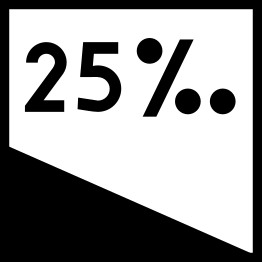
Understand the AT-3 Dangerous Tram Descent warning sign for trams.
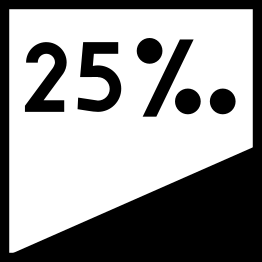
Warning: Steep Tram Ascent Ahead (AT-4)

Understand the AT-5 sign: Tram Collision Movement Warning for Turning Trams
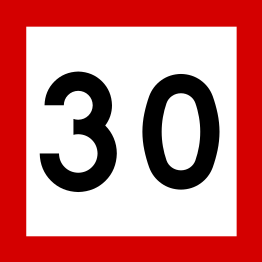
What the BT-1 Tram Speed Limit sign means and how to obey it.

BT-2: Tram Speed Limit Restriction Ends Here

BT-3 Tram Switch Lock: Don't Enter Until Clear!
Deepen your understanding of specific road signs by reviewing official Polish traffic rules and associated real-world driving scenarios. These expert-led resources help you bridge the gap between visual recognition and practical exam application.
Clear windows are not just about personal comfort; they are a fundamental requirement for road safety and a focus area for your theoretical knowledge. You will learn how to effectively use your vehicle's climate control and ventilation systems to manage cabin moisture, ensuring you are prepared for challenging weather scenarios. Understanding these procedures helps you maintain proper visibility and stay compliant with Polish road safety standards during your journey.
For any student preparing for the Polish driving theory exam, recognizing the risks posed by aggressive behaviors like speeding and driving under the influence is essential. This guide highlights the impact of these dangers on road safety while reinforcing the legal standards and defensive attitudes that examiners look for in candidates. You will learn why awareness of other road users is just as vital as following official traffic signs and regulations.
Don't Be a Road Block: Master Minimum Speeds and Smooth Traffic Flow for Your Polish Exam!
Master Your Rights and Obligations During a Polish Roadside Inspection
The A-30 'Exclamation Mark' sign is a general warning. It is almost always accompanied by a descriptive plate (T-series) that explains the specific nature of the danger, such as 'Blind exit,' 'Narrow bridge,' or 'Accident blackspot.' Historically, this sign used a vertical bar instead of an exclamation mark. It tells the driver that something unusual and potentially dangerous is ahead.
The G-4 sign is identical to the G-3 but features an additional partial cross (a 'V' shape) underneath. This indicates that the crossing has multiple tracks. This is a critical warning because drivers often wait for one train to pass and then immediately pull out, only to be hit by a second train traveling in the opposite direction on the adjacent track. It marks the safety boundary for the entire multi-track zone.
After reviewing the full list of Polish road signs, explore specific sign categories for in-depth understanding. Challenge your knowledge with practice questions focused on sign recognition and interpretation to solidify your preparation for the driving theory exam.
Browse All Polish Road Signs