
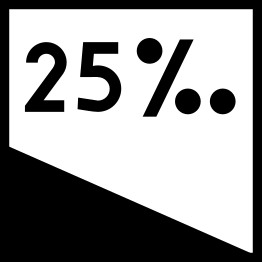
The AT-3 road sign is a warning sign specifically for tram drivers, alerting them to a steep downhill section of tram tracks. The exact gradient, indicated as a percentage on the sign itself, signifies a potential difficulty in braking due to the heavy nature of trams and the physics of steel wheels on rails. Drivers must be prepared to use auxiliary braking systems and reduce speed significantly to ensure safe passage.
The AT-3 sign warns tram drivers of steep downhill tracks, indicating where braking becomes significantly more challenging for heavy trams. Understanding this road sign meaning is vital for all drivers to anticipate potential tram behavior, maintain safe distances, and improve your Polish theory test revision for complex urban scenarios involving public transport.
The AT-3 sign warns of a significant podłużny (longitudinal) slope on the tram tracks. The exact percentage of the incline is written on the sign. Because trams are extremely heavy and rely on steel-on-steel friction, stopping on a steep descent requires much longer distances and carries a higher risk of skidding or 'sanding' the tracks. It tells the driver to use auxiliary braking systems if necessary.
Warns tram drivers of a steep downhill track where braking may be more difficult.
Get clear, practical answers to the most common questions about the AT-3 - Dangerous Tram Descent road sign. Learn how the sign works, what rules it represents, and how it affects real driving situations. This FAQ strengthens your understanding and supports accurate decision making for the Polish driving theory exam in Poland.
The AT-3 sign warns tram drivers about a steep downhill section on the tram tracks. It indicates that braking will be more difficult due to the gradient, requiring increased caution and potentially the use of special braking systems.
Trams are very heavy vehicles, and their braking relies on the friction between steel wheels and steel rails. On a steep downhill slope, momentum increases significantly, and maintaining traction while braking becomes challenging, especially if the tracks are wet or have debris like leaves.
Upon seeing the AT-3 sign, the driver should immediately reduce speed to a safe level before entering the descent, ensuring they have maximum control. They should also be prepared to use their auxiliary braking systems, such as the magnetic rail brake or sander, if necessary, and avoid following other trams too closely.
While the AT-3 sign is specific to tram operations, theory exams for car drivers (Category B) might include questions about general principles of descending steep gradients safely. Understanding that momentum increases downhill and requires early, controlled braking is a universal safe driving concept tested.
Yes, the percentage shown on the AT-3 sign indicates the steepness of the downhill track. A higher percentage means a steeper slope and a greater need for caution, lower speed, and readiness to use more powerful braking methods to maintain control.
A clear reference image of the AT-3 - Dangerous Tram Descent road sign used in Poland.
The AT-3 - Dangerous Tram Descent road sign may also be known by these alternative names or terms.
The AT-3 - Dangerous Tram Descent road sign is part of the Additional Railway Crossing Signs (G) category, which groups together signs with similar rules and functions.
Comparing signs like the AT-3 Dangerous Tram Descent with others in the railway category aids recognition and reduces theory test errors. Effective traffic sign comparison is key for accurate recall and confident exam preparation.

Prepare for tram signals ahead with the AT-1 warning sign.

Understand the AT-2 Tram-Activated Signal: Know when trams are coming!
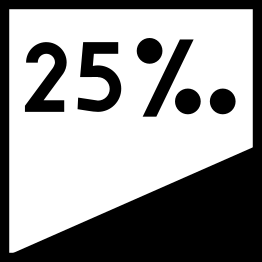
Warning: Steep Tram Ascent Ahead (AT-4)

Understand the AT-5 sign: Tram Collision Movement Warning for Turning Trams
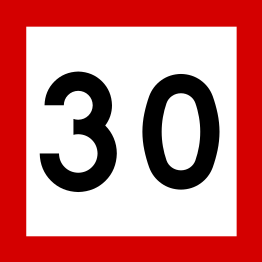
What the BT-1 Tram Speed Limit sign means and how to obey it.

BT-2: Tram Speed Limit Restriction Ends Here

BT-3 Tram Switch Lock: Don't Enter Until Clear!

Stop and manually check the tram switch with the BT-4 sign.
Deepen your understanding of specific road signs by reviewing official Polish traffic rules and associated real-world driving scenarios. These expert-led resources help you bridge the gap between visual recognition and practical exam application.
Master Polish Crossing Markings for a Safer Drive and Exam Success.
Don't Be a Road Block: Master Minimum Speeds and Smooth Traffic Flow for Your Polish Exam!
Learning how to interact with law enforcement is a crucial part of your driver training in Poland, as it helps you understand the legal procedures governing roadside controls. This guide clarifies how officers identify themselves, what behaviors are expected of you as a driver, and how traffic enforcement impacts your penalty points and record. Mastery of these rules ensures you remain compliant with the law and prepared for any roadside situation you may encounter.
Identifying the nature of fluid leaks under your car is a core competency for any responsible driver and a key topic in the Polish driving theory curriculum. This guide teaches you how to use simple physical markers—such as color, smell, and location—to assess potential vehicle malfunctions. Mastering these basic maintenance checks helps you prevent engine failure and ensures you are better prepared for the technical questions on your driving exam.
The A-22 sign is used for descents of at least 10% in mountains or 7% elsewhere. Going down a steep hill can cause your brakes to overheat and fail if used constantly. The sign often includes a T-9 plate showing the actual percentage of the slope. Drivers should shift to a lower gear to let the engine's compression help control the speed, preserving the brakes for emergencies.
The P-10 marking consists of thick white parallel stripes (zebra pattern). In Poland, drivers are required to yield to pedestrians who are already on the crossing AND to those who are clearly entering it. Drivers must approach at a speed that allows them to stop safely. Overtaking on or immediately before a pedestrian crossing is strictly prohibited and carries very heavy fines and penalty points.
After reviewing the full list of Polish road signs, explore specific sign categories for in-depth understanding. Challenge your knowledge with practice questions focused on sign recognition and interpretation to solidify your preparation for the driving theory exam.
Browse All Polish Road Signs