
The R-1a sign marks the precise start or termination point of a designated local cycling route. While similar to the general bicycle trail sign, this specific marker is crucial for cyclists confirming their trailhead or signalling the end of their dedicated path. Drivers should be aware of this sign as it may indicate areas where cyclists are present or about to enter/exit a route, especially near parking areas or transport hubs.
The R-1a sign, indicating a bicycle trail's start or end, is vital for safe interaction between drivers and cyclists on Polish roads. Understanding this specific road sign meaning ensures correct navigation, helps prevent confusion near cycling paths, and is a key topic for effective driving theory test revision.
The R-1a sign is used to define the boundaries of a cycling trail. It features the same bicycle symbol and color code as the R-1, but is used at the very first or very last point of the route. This is helpful for cyclists who are starting their journey and need to confirm they are at the correct trailhead, or for those ending their ride and looking for nearby transport.
Indicates the beginning or the termination point of a local cycling route.
Get clear, practical answers to the most common questions about the R-1a - Start or End of Bicycle Trail road sign. Learn how the sign works, what rules it represents, and how it affects real driving situations. This FAQ strengthens your understanding and supports accurate decision making for the Polish driving theory exam in Poland.
The R-1a sign signifies either the beginning or the end of a local cycling trail. It helps cyclists identify their starting point or the conclusion of their dedicated path.
Drivers should be aware that the R-1a sign indicates a transition point for cyclists. Be prepared for cyclists to start or finish their journey, potentially entering or exiting the road from a trail. This is especially important near parking lots or stations where trails might end abruptly at public roads.
Yes, it's important not to assume the trail continues indefinitely past the 'End' point. Drivers must never ignore the transition to public roads when a dedicated trail finishes. Additionally, avoid stopping right at the sign in large groups as it can obstruct others.
A common trap is confusing the R-1a sign with signs indicating a general bicycle lane or path. Remember, R-1a specifically denotes the absolute start or end of a defined route. Learners might also be tested on understanding that the trail's end often means a direct merge with vehicular traffic, requiring caution.
The R-1a sign is often placed at points where a cycling route begins or concludes, which can be near amenities like parking lots, train stations, or recreational areas. It helps cyclists orient themselves and ensures a clear transition between the trail and regular road use.
A clear reference image of the R-1a - Start or End of Bicycle Trail road sign used in Poland.
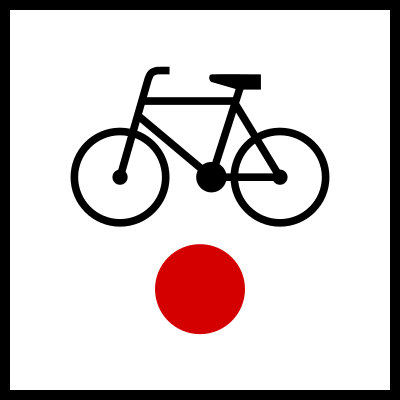
The R-1a - Start or End of Bicycle Trail road sign may also be known by these alternative names or terms.
The R-1a - Start or End of Bicycle Trail road sign is part of the Additional Railway Crossing Signs (G) category, which groups together signs with similar rules and functions.
Comparing similar road signs aids recognition and reduces errors, crucial for your theory test revision. Use this traffic sign comparison to build confidence and improve sign recognition for the Polish driving licence exam.

Prepare for tram signals ahead with the AT-1 warning sign.

Understand the AT-2 Tram-Activated Signal: Know when trams are coming!
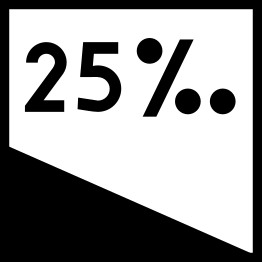
Understand the AT-3 Dangerous Tram Descent warning sign for trams.
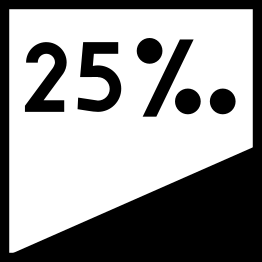
Warning: Steep Tram Ascent Ahead (AT-4)

Understand the AT-5 sign: Tram Collision Movement Warning for Turning Trams
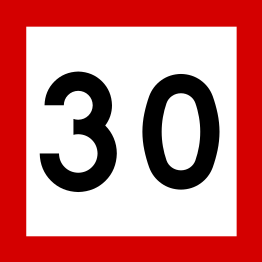
What the BT-1 Tram Speed Limit sign means and how to obey it.

BT-2: Tram Speed Limit Restriction Ends Here

BT-3 Tram Switch Lock: Don't Enter Until Clear!
Deepen your understanding of specific road signs by reviewing official Polish traffic rules and associated real-world driving scenarios. These expert-led resources help you bridge the gap between visual recognition and practical exam application.
Learning how to interact with law enforcement is a crucial part of your driver training in Poland, as it helps you understand the legal procedures governing roadside controls. This guide clarifies how officers identify themselves, what behaviors are expected of you as a driver, and how traffic enforcement impacts your penalty points and record. Mastery of these rules ensures you remain compliant with the law and prepared for any roadside situation you may encounter.
Navigating the rules regarding bike paths and road usage is a critical aspect of Polish traffic law. This guide clarifies when a cyclist is obligated to use a designated path marked by a C-13 sign and identifies the rare situations where road use is legally permitted. By mastering these regulations, you will better understand road safety, priority rules, and how to anticipate the actions of cyclists to pass your Polish driving theory exam with confidence.
Master Polish Crossing Markings for a Safer Drive and Exam Success.
Navigate Tram Intersections Like a Pro: Essential for Your Polish Driving Exam.
The D-6b sign combines the functions of the D-6 and D-6a signs. It is used in locations where a sidewalk and a bicycle path run parallel and cross the road at the same point. The sign displays both the pedestrian and the bicycle silhouettes within the white triangle on a blue background. Drivers are obligated to treat this crossing with extreme care, yielding to both people on foot and those on bikes. The same rules regarding overtaking and parking apply here as with standard crossings.
The D-16 sign marks a stop specifically for trolleybuses. It is visually similar to the bus stop sign but features a trolleybus silhouette (with its distinctive poles for overhead wires). These stops are found in cities with trolleybus networks (like Gdynia, Lublin, or Tychy). The same rules apply here as at bus stops: drivers must not park near the sign and should be ready to yield to the trolleybus when it maneuvers back into traffic.
After reviewing the full list of Polish road signs, explore specific sign categories for in-depth understanding. Challenge your knowledge with practice questions focused on sign recognition and interpretation to solidify your preparation for the driving theory exam.
Browse All Polish Road Signs