
This lesson focuses on mastering the observational skills required for safe riding, specifically balancing mirror usage with critical shoulder checks. It is a vital part of your preparation for the Swiss Category A and A1 motorcycle theory exam, bridging the gap between passive observation and active risk management.
Lesson content overview
Effective mirror positioning and consistent observation are fundamental skills for safe motorcycle riding. In the context of the Swiss Motorcycle Licence Theory Course for Categories A and A1, this lesson emphasizes that mirrors are vital tools, but they must always be complemented by physical shoulder and head checks to ensure comprehensive situational awareness. This integrated approach is essential for identifying hazards, making secure lane changes, overtaking, and executing other maneuvers in diverse traffic conditions.
Maintaining constant awareness of your surroundings is paramount for motorcyclists. Unlike car drivers, motorcyclists have a smaller profile and are less visible, making a proactive observation strategy indispensable. Mirrors provide a continuous, though limited, view of what is happening behind and to the sides of your motorcycle. This early detection capability allows you to anticipate potential hazards and react in a timely manner.
However, vehicle geometry and the fixed nature of mirrors mean they cannot capture every angle. These unobservable areas are known as blind spots, and failing to check them is a leading cause of collisions during maneuvers. Therefore, combining mirror checks with direct physical observation (shoulder and head checks) is not just a best practice—it is a mandatory requirement under Swiss traffic law, specifically Art. 3 of the Swiss Road Traffic Act, which dictates that riders must observe traffic before any maneuver. This principle of complementary checks ensures that you have a complete picture of your immediate environment before committing to any action, significantly reducing accident risk.
Motorcycles are equipped with specific types of mirrors, each designed to provide different fields of view. Understanding their individual functions is key to using them effectively.
Side mirrors are typically mounted on the handlebars and are crucial for observing traffic in the lanes adjacent to your motorcycle, as well as parts of the rearward view. They allow you to monitor vehicles approaching from the left and right sides, which is especially important during multi-lane driving, lane changes, and when preparing to turn. Swiss vehicle equipment regulations mandate the installation of at least one side mirror on each side for motorcycles capable of speeds exceeding 45 km/h.
While less common on motorcycles than cars, a central rearview mirror (if present) provides a direct view of the traffic immediately behind you. This mirror is primarily used to track vehicles directly following your motorcycle, helping you maintain safe following distances and be aware of rapidly approaching vehicles. For motorcyclists, the function of a central rearview mirror is often partially covered by well-adjusted side mirrors and the rider's direct observation skills.
Always use both side mirrors and, if applicable, a central rearview mirror in combination to build a holistic understanding of the traffic around you. Relying on only one mirror can lead to significant blind spots.
Correct mirror positioning is the foundation of effective observation. Mirrors must be adjusted to provide the widest possible field of view with minimal head movement. The adjustment process should be precise and tailored to your individual riding posture and equipment.
For side mirrors, the ideal angle allows you to see the adjacent lane and a small sliver of your own motorcycle or arm at the very edge of the mirror. A common guideline suggests setting side mirrors at about a 15–30 degree outward angle from your direct line of sight. This configuration helps to reduce the size of your blind spots by extending your peripheral vision. When adjusted correctly, you should be able to glance into your side mirrors with only a slight movement of your eyes or a small head turn, not requiring a full swivel of your neck.
If your motorcycle is equipped with a central rearview mirror, it should be adjusted to provide a clear view directly behind you, centered on the lane you are occupying. A slight downward tilt may be necessary to compensate for your riding posture and ensure you see the road surface and traffic directly behind, rather than just the sky.
Mirror settings are highly personal. Your height, arm length, seating position, and even the type of helmet you wear can affect your line of sight. Therefore, mirrors must be adjusted each time you mount the motorcycle, especially if you change riding gear (e.g., a bulkier jacket or a different helmet) or if another rider has used your motorcycle. The adjustment should always be made while sitting in your normal riding posture.
Mirrors should always be adjusted before you start riding. Never attempt to adjust mirrors while moving, as this can distract you from the road ahead and compromise your control.
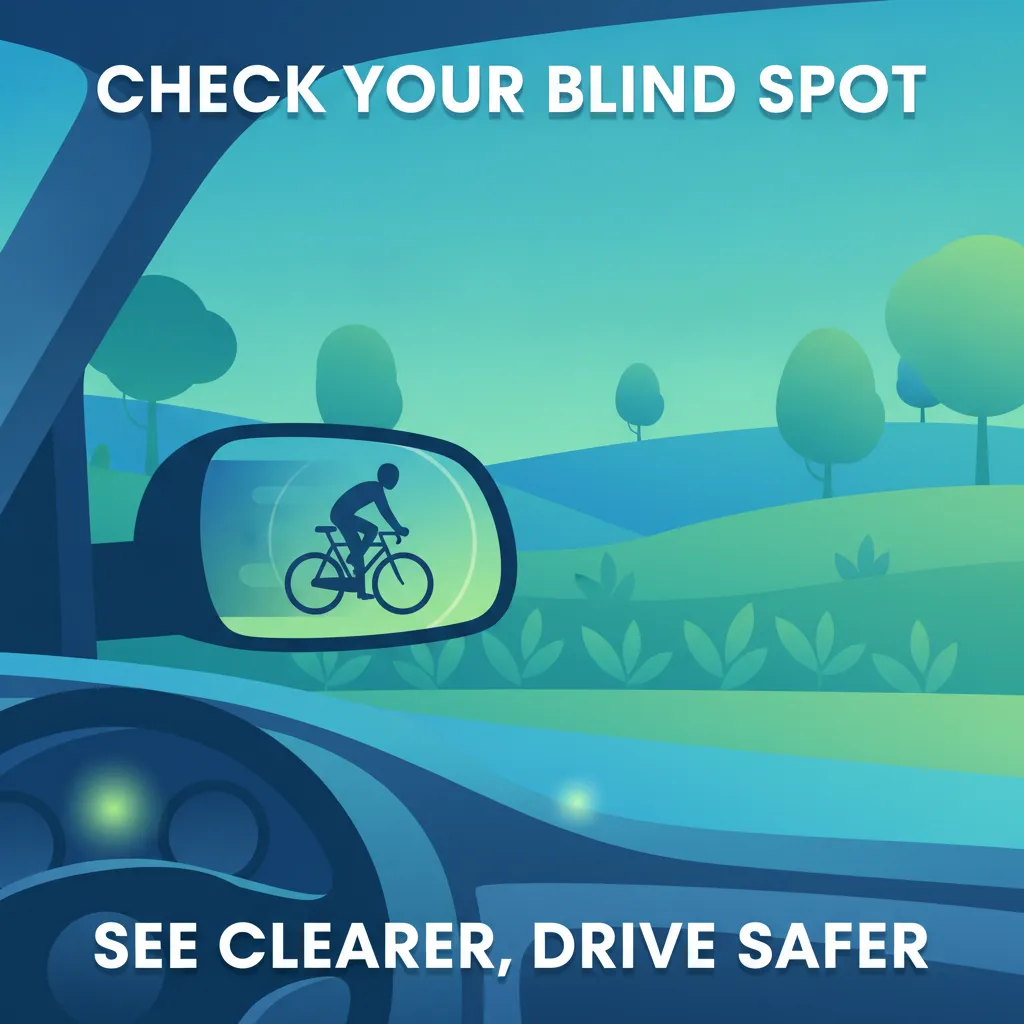
Even with perfectly adjusted mirrors, there will always be areas around your motorcycle that remain invisible. These are known as blind spots, and understanding their location and how to compensate for them is critical for preventing collisions.
An area around a vehicle that cannot be seen by the driver using mirrors alone, requiring a direct physical check (shoulder or head turn) to observe.
Because mirrors alone cannot provide a complete picture, physical shoulder and head checks are indispensable. These direct visual checks allow you to briefly turn your head and look over your shoulder into the blind spot area before performing any maneuver.
A quick, deliberate turn of the head and shoulders to visually scan the blind spot areas not visible in mirrors, typically performed just before a lane change or turn.
A proper shoulder check is:
For example, before merging left, you would glance into your left side mirror, then perform a quick glance over your left shoulder to check the blind spot, and then return your gaze to the road ahead. This sequence ensures that you detect any hidden vehicles, cyclists, or pedestrians before initiating your maneuver.
To ensure consistent safety, motorcyclists must develop and practice a systematic observation routine. This routine integrates mirror checks with physical head and shoulder checks, making observation a continuous and habitual part of riding.
Before executing any maneuver that involves changing your position on the road—such as changing lanes, turning, merging, or even adjusting your lane position—a structured observation sequence is critical. This sequence helps confirm that your intended path is clear and safe.
Check Rearview Mirror (if applicable): Assess the traffic directly behind you, especially for fast-approaching vehicles.
Check Side Mirrors: Scan the mirror corresponding to the direction of your intended maneuver (e.g., left mirror for a left lane change). Look for vehicles in adjacent lanes.
Perform Shoulder Check: Execute a quick, decisive turn of your head and shoulder in the direction of your maneuver to scan the blind spot. Confirm that the area is clear.
Re-check Mirrors/Front: Briefly re-check your mirrors and the road ahead to ensure conditions haven't changed in the short time you looked away.
Signal and Execute: Once you have confirmed the path is clear, activate your indicator signal and smoothly execute the maneuver.
This routine, often remembered as "Mirrors → Shoulder Check → Mirrors," should become second nature. It ensures that you account for all potential hazards before committing to a change in direction or lane.
Observation is not just for maneuvers; it's a continuous process while riding in traffic. You should regularly scan your mirrors—every 5-8 seconds or so—to maintain a dynamic awareness of your surroundings. This continuous scanning helps you:
Continuous scanning is particularly important in urban environments, where traffic is denser and interactions are more frequent, and on motorways, where speeds are higher and traffic flows quickly.
Swiss traffic law places specific obligations on motorcyclists regarding mirrors and observation. Adhering to these regulations is not only a legal necessity but also a fundamental aspect of safe riding.
Regulation: All motorcycles (with a top speed exceeding 45 km/h) must be equipped with at least one side mirror on each side. Practical Meaning: This ensures riders have a mandated minimum level of rearward and lateral visibility. Non-compliance can lead to fines and unsafe riding conditions. Correct Application: Ensure your motorcycle has two functional, correctly sized side mirrors. Incorrect Application: Operating with a missing or damaged mirror that provides insufficient view.
Regulation: Before changing lanes, merging, or turning, riders must observe the traffic using mirrors and shoulder checks. Practical Meaning: This law explicitly acknowledges the limitations of mirrors and the necessity of direct visual checks to cover blind spots, aiming to prevent collisions. Correct Application: Always perform the "Mirrors → Shoulder Check → Mirrors" routine before any significant change in road position. Incorrect Application: Changing lanes solely based on mirror information without confirming the blind spot is clear. This is a common violation with serious safety implications.
Regulation: Mirrors must be clean, unobstructed, and correctly adjusted at the start of each journey, and maintained as such during the ride. Practical Meaning: Clear mirrors provide accurate information. Obscured or misaligned mirrors can lead to misjudgments of distance and speed, increasing collision risk. Correct Application: Regularly clean your mirrors, especially before riding in adverse weather. Readjust them as needed. Incorrect Application: Riding with dirty, fogged, or broken mirrors, which severely compromises situational awareness.
Effective observation adapts to the changing conditions of the road, weather, and traffic. Riders must be prepared to modify their techniques to maintain optimal situational awareness.
The principles of effective mirror positioning and observation are rooted in fundamental aspects of human perception, physics, and rider psychology.
Mastery of mirror positioning and observation is a core competency that underpins almost all advanced riding skills. It forms a crucial foundational habit for safe motorcycle operation in any environment, contributing directly to your ability to plan maneuvers, maintain safe distances, and react effectively to unforeseen circumstances.
This lesson teaches the essential skill of combining mirror observation with physical head and shoulder checks to eliminate blind spots, which is mandatory under Swiss law. Correct mirror positioning should be personalized to your riding posture, with side mirrors set at roughly 15-30 degrees outward to maximize rearward visibility. The systematic pre-maneuver routine—Mirrors, Shoulder Check, Mirrors—must become second nature before executing any lane change, turn, or merge. Swiss regulations (Art. 3 SVG, Art. 9 & 13 VTS) explicitly require both mirror use and direct observation, and riders must adapt their scanning frequency to road type, weather, and traffic density to maintain consistent situational awareness.
A short set of high-value points that capture the most important learning from this lesson.
Mirrors alone are insufficient; shoulder and head checks are mandatory to cover blind spots before any maneuver
Mirror adjustment is personal and must be recalibrated each time you mount the bike, especially when changing gear or adding luggage
The pre-maneuver observation sequence follows a "Mirrors → Shoulder Check → Mirrors" routine before lane changes or turns
Swiss Road Traffic Act Art. 3 legally requires observation of traffic using both mirrors and direct checks before any maneuver
Continuous mirror scanning every 5-8 seconds maintains dynamic situational awareness throughout the ride
Explore all units and lessons included in this driving theory course.
Swiss Vehicle Ordinance Art. 9 mandates at least one side mirror on each side for motorcycles exceeding 45 km/h
A proper shoulder check must be quick (under one second), thorough enough to confirm no hazard, and integrated into a fluid observation routine
Mirror angle guidelines suggest setting side mirrors at about 15-30 degrees outward to maximize the field of view with minimal head movement
Adverse weather (rain, fog) and night riding require increased frequency of both mirror wipes and shoulder checks
When carrying a passenger or luggage, always readjust mirrors as your riding posture changes the visible field
Relying solely on mirror information before a lane change without performing a physical shoulder check into the blind spot
Attempting to adjust mirrors while the motorcycle is in motion, which compromises control and attention
Using only one mirror instead of both side mirrors combined, creating significant blind spots
Failing to recheck mirrors after a shoulder check, missing vehicles that may have closed the gap during the head turn
Neglecting to adjust mirrors after a different rider has used the motorcycle or after changing riding gear
Lesson content overview
A short set of high-value points that capture the most important learning from this lesson.
Mirrors alone are insufficient; shoulder and head checks are mandatory to cover blind spots before any maneuver
Mirror adjustment is personal and must be recalibrated each time you mount the bike, especially when changing gear or adding luggage
The pre-maneuver observation sequence follows a "Mirrors → Shoulder Check → Mirrors" routine before lane changes or turns
Swiss Road Traffic Act Art. 3 legally requires observation of traffic using both mirrors and direct checks before any maneuver
Continuous mirror scanning every 5-8 seconds maintains dynamic situational awareness throughout the ride
Explore all units and lessons included in this driving theory course.
Swiss Vehicle Ordinance Art. 9 mandates at least one side mirror on each side for motorcycles exceeding 45 km/h
A proper shoulder check must be quick (under one second), thorough enough to confirm no hazard, and integrated into a fluid observation routine
Mirror angle guidelines suggest setting side mirrors at about 15-30 degrees outward to maximize the field of view with minimal head movement
Adverse weather (rain, fog) and night riding require increased frequency of both mirror wipes and shoulder checks
When carrying a passenger or luggage, always readjust mirrors as your riding posture changes the visible field
Relying solely on mirror information before a lane change without performing a physical shoulder check into the blind spot
Attempting to adjust mirrors while the motorcycle is in motion, which compromises control and attention
Using only one mirror instead of both side mirrors combined, creating significant blind spots
Failing to recheck mirrors after a shoulder check, missing vehicles that may have closed the gap during the head turn
Neglecting to adjust mirrors after a different rider has used the motorcycle or after changing riding gear
Explore search topics learners often look for when studying Mirror Positioning and Effective Use for Observation. These topics reflect common questions about road rules, driving situations, safety guidance, and lesson level theory preparation for learners in Switzerland.
Browse additional driving theory lessons that cover connected traffic rules, road signs, and common driving situations related to this topic. Improve your understanding of how different rules interact across everyday traffic scenarios.
Learn advanced techniques for comprehensive motorcycle observation in Switzerland, integrating mirror use with effective shoulder checks. Understand how to manage blind spots and maintain situational awareness in complex traffic for your A and A1 license theory.

This lesson focuses on mitigating the risk of collisions at intersections, particularly from vehicles turning across the rider's path. It teaches defensive strategies such as positioning for visibility, anticipating driver actions, and using head checks to be aware of surrounding traffic. Managing your own and others' blind spots is presented as a crucial survival skill.

This lesson covers the systematic use of rearview and side mirrors, combined with head checks, to maintain full awareness of surrounding traffic. It emphasizes frequent observation to detect vehicles in blind spots, especially during lane changes and turns. The content also details the proper timing for head checks and the role of scanning techniques in preventing collisions.

This lesson outlines the principles of safe overtaking, emphasizing the importance of accurate judgment of speed and distance. It covers the necessary steps: checking mirrors, signaling, checking blind spots, executing the maneuver smoothly, and returning to the lane safely. The content is tailored to different road environments, from urban streets to rural roads.

This lesson explains strategic lane positioning to enhance visibility and safety in traffic. It covers how to choose a lane position that helps you see and be seen by other drivers, avoiding their blind spots. The content emphasizes maintaining a space cushion around the motorcycle to allow for reaction time and potential escape routes.

This lesson provides guidance on safely negotiating intersections and roundabouts on a motorcycle. It details the correct procedures for approach, lane selection, and yielding according to Swiss traffic regulations. Emphasis is placed on heightened awareness of other vehicles, cyclists, and pedestrians in these complex traffic environments.

This lesson focuses on techniques and equipment designed to increase a motorcyclist's visibility to others. It explains the strategic use of reflective materials, high-visibility clothing, and the mandatory use of daytime running lights. Understanding how to enhance conspicuity is a critical component of proactive self-protection on the road.

This lesson explores the complexities of riding in busy urban areas with a mix of traffic types. It covers strategies for safely navigating alongside buses, trams, cyclists, and pedestrians. Key topics include respecting designated lanes, anticipating the movements of vulnerable road users, and maintaining heightened situational awareness.

This lesson teaches the principles of active observation, a crucial skill for rider safety. It covers how to develop a scanning routine that includes checking mirrors, blind spots via shoulder checks, and looking far ahead down the road. These techniques allow a rider to identify potential conflicts early and create more time to react safely.

This lesson explores the typical features of rural and alpine roads, such as narrow lanes, sharp bends, and significant elevation changes. It discusses the need for heightened awareness due to limited sight distances and the potential for unexpected hazards like wildlife or agricultural vehicles. Riders will learn to adapt their speed and positioning for these challenging conditions.
This lesson outlines the specific rules and skills required for riding on high-speed Swiss motorways. It covers the correct procedures for entering and exiting, merging with traffic, maintaining appropriate speed, and conducting safe overtaking maneuvers. Emphasis is placed on using mirrors and signals effectively to integrate safely into the flow of traffic.
Master the art of setting your motorcycle mirrors correctly and developing a systematic observation routine for Swiss traffic. Learn how to integrate mirror checks with shoulder turns to ensure safety before every maneuver.
This lesson covers the systematic use of rearview and side mirrors, combined with head checks, to maintain full awareness of surrounding traffic. It emphasizes frequent observation to detect vehicles in blind spots, especially during lane changes and turns. The content also details the proper timing for head checks and the role of scanning techniques in preventing collisions.
This lesson teaches the principles of active observation, a crucial skill for rider safety. It covers how to develop a scanning routine that includes checking mirrors, blind spots via shoulder checks, and looking far ahead down the road. These techniques allow a rider to identify potential conflicts early and create more time to react safely.

A lorry is equipped with multiple mirrors (up to six) to cover different fields of view. This lesson explains the function of each type: the main mirrors, wide-angle mirrors, and close-proximity (kerb and front) mirrors. It stresses the importance of adjusting them properly before every journey and developing a routine of constantly scanning all mirrors to maintain situational awareness.

Buses and coaches have significant blind spots to the front, sides, and rear. This lesson maps out these 'no-zones' and teaches a continuous and active scanning process using all available mirrors and direct vision. The goal is to minimize the time any other road user spends undetected in a blind spot.

This lesson covers the routine maintenance of essential safety components, including lights, mirrors, and the drive chain. Learners will understand how to check light functionality, ensure mirrors are correctly aligned for maximum visibility, and properly inspect, clean, and lubricate the chain. Regular maintenance of these parts is crucial for safe and reliable motorcycle operation.
This lesson focuses on mitigating the risk of collisions at intersections, particularly from vehicles turning across the rider's path. It teaches defensive strategies such as positioning for visibility, anticipating driver actions, and using head checks to be aware of surrounding traffic. Managing your own and others' blind spots is presented as a crucial survival skill.

This lesson explains the strategic importance of road positioning. It details how to select a lane position that makes you most visible to drivers ahead and behind, and helps you avoid the blind spots of larger vehicles. Proper positioning also allows for an escape route and a better line of sight through turns.

This lesson introduces a methodical pre-ride inspection routine to verify that a motorcycle is in safe working order. It outlines a step-by-step process for checking tyres, brakes, lights, controls, and fluid levels. Following this comprehensive safety protocol helps identify potential issues before they become hazards on the road.
This lesson outlines the principles of safe overtaking, emphasizing the importance of accurate judgment of speed and distance. It covers the necessary steps: checking mirrors, signaling, checking blind spots, executing the maneuver smoothly, and returning to the lane safely. The content is tailored to different road environments, from urban streets to rural roads.
This lesson explains strategic lane positioning to enhance visibility and safety in traffic. It covers how to choose a lane position that helps you see and be seen by other drivers, avoiding their blind spots. The content emphasizes maintaining a space cushion around the motorcycle to allow for reaction time and potential escape routes.
Find clear answers to common questions learners have about Mirror Positioning and Effective Use for Observation. Learn how the lesson is structured, which driving theory objectives it supports, and how it fits into the overall learning path of units and curriculum progression in Switzerland. These explanations help you understand key concepts, lesson flow, and exam focused study goals.
Even perfectly adjusted mirrors have significant blind spots where vehicles can remain hidden. On a motorcycle, your body and the bike's structure also obstruct views, making physical shoulder checks essential to confirm it is safe to change lanes.
You should check your mirrors frequently, especially before braking, turning, changing lanes, or when road conditions change. Constant situational awareness is a key requirement for both the theory exam and real-world riding.
No, a single glance is rarely enough. You must use the 'Mirror-Signal-Maneuver' routine, which includes a mirror check followed by a shoulder check to cover the blind spot before you begin your maneuver.
Yes, the test often features images of traffic situations where you must identify the safest action, which frequently involves checking mirrors and blind spots before acting. Understanding these principles is crucial for scoring well.
Pinpoint specific Swiss traffic rules, road signs, or driving situations you need to master. Use the practice search to start a focused revision session now and build confidence for your official driving theory exam.