
This lesson explores the physics of motorcycle stopping distances, covering the critical link between your speed and reaction times. You will learn how to maintain safe following distances in diverse Swiss road environments, a core requirement for both A and A1 category riders. These concepts build upon your knowledge of motorcycle controls and prepare you for safe navigation in subsequent traffic units.

Lesson content overview
Understanding how your speed influences the total distance required to bring your motorcycle to a complete stop is fundamental for every rider. This lesson delves into the critical relationship between speed management and stopping distance, equipping you with the knowledge to make safe and informed decisions on Swiss roads. Mastery of these principles is not just about adhering to legal limits; it is about proactive risk management and ensuring your safety, and that of others, in dynamic traffic environments.
Total stopping distance is the absolute span a motorcycle covers from the moment a rider perceives a hazard until the vehicle comes to a complete halt. It is a composite measure, crucial for calculating safe following distances and executing emergency braking effectively. This distance is divided into two primary segments: reaction distance and braking distance.
Reaction distance is the distance your motorcycle travels during the time it takes for you, the rider, to perceive a hazard, process the information, decide to act, and finally initiate the braking process. This human factor is often overlooked but contributes significantly to the total stopping distance, especially at higher speeds.
The interval between perceiving a hazard and initiating a braking response. For an attentive, sober rider, this is typically around 1.5 seconds.
During this reaction time, the motorcycle continues moving at its initial speed. This means that a longer reaction time or a higher speed directly translates to a greater reaction distance. For instance, at 50 km/h, a 1.5-second reaction time results in a reaction distance of approximately 21 metres. Double your speed to 100 km/h, and that reaction distance extends to about 42 metres. This linear relationship with speed underscores why even minor increases in velocity demand greater vigilance and foresight.
Braking distance is the physical distance required for the motorcycle to decelerate from the moment the brakes are applied until it comes to a complete stop. Unlike reaction distance, which increases linearly with speed, braking distance increases quadratically. This means that if you double your speed, your braking distance will approximately quadruple. This disproportionate increase is a critical concept to grasp for safe riding.
The distance required to decelerate the motorcycle from the point of brake application to a complete stop, influenced by speed, deceleration rate, and road conditions.
Several factors profoundly influence braking distance, including the motorcycle's speed, its mass, the effectiveness of its brakes, and critically, the friction between the tyres and the road surface. Understanding these elements is key to predicting how far your motorcycle will travel during a braking manoeuvre.
The science of motion dictates the effort and distance required to stop a moving motorcycle. Two core physical principles are at play: kinetic energy and the rate of deceleration, which is heavily influenced by braking force and the coefficient of friction.
Every moving object possesses kinetic energy – the energy of motion. This energy is not merely proportional to speed; it is proportional to the square of the speed (½ mv², where 'm' is mass and 'v' is velocity). This exponential relationship is the primary reason braking distance increases so dramatically with speed.
For example, doubling your speed from 50 km/h to 100 km/h does not merely double your kinetic energy; it quadruples it. To dissipate this fourfold increase in energy, your motorcycle requires approximately four times the braking distance under otherwise identical conditions. This physical reality means that small speed increases can have a huge impact on your ability to stop safely.
When you apply your brakes, you are generating a braking force that converts the motorcycle's kinetic energy into heat through friction. The greater the braking force that can be effectively applied to the road, the faster the motorcycle can decelerate, and thus, the shorter the braking distance.
The deceleration rate (a) describes how quickly your speed reduces, typically measured in metres per second squared (m/s²). It is directly influenced by the braking force and limited by the grip of your tyres on the road. Higher deceleration rates mean shorter braking distances. However, there's a limit to how much deceleration can be achieved before the tyres lose grip, leading to a skid or loss of control. Optimal braking involves applying maximum braking force without exceeding the available grip.
The coefficient of friction (μ) is a critical, dimensionless value that quantifies the amount of grip available between your motorcycle's tyres and the road surface. It's the ratio of the maximum frictional force that can be generated to the force pressing the tyre onto the road. A higher coefficient of friction means more grip, allowing for greater braking force and shorter stopping distances.
A dimensionless number representing the ratio of frictional force to normal force between tire and road, indicating the level of grip.
The coefficient of friction is not constant. It varies significantly with:
Understanding μ is vital because it sets the absolute limit for how quickly you can stop. Riders must constantly assess road conditions and adjust their speed to match the available friction, ensuring that their maximum braking capability remains within safe limits.
While physics governs the motorcycle's capabilities, human factors are equally crucial in determining safe speed and stopping distance. Rider perception, decision-making, and physical response all contribute to the overall reaction time and, consequently, the reaction distance.
As noted, an average, attentive, and sober rider typically has a reaction time of about 1.5 seconds. However, this is an ideal figure. Many elements can lengthen your reaction time:
A longer reaction time directly translates to a longer reaction distance, adding to your total stopping distance without any change in your braking ability. This highlights the importance of staying alert, well-rested, and focused on the road ahead.
Always assume your reaction time might be longer than the average 1.5 seconds, especially if you are feeling tired, distracted, or in complex traffic situations. This conservative approach encourages lower speeds and greater safety margins.
Beyond speed and rider factors, numerous external conditions demand a proactive adjustment of your speed to maintain a safe stopping distance.
Weather significantly impacts both the coefficient of friction and rider visibility, necessitating substantial speed adjustments.
Never assume your braking performance is similar in wet or icy conditions compared to dry roads. The reduction in friction is profound and requires a significant corresponding reduction in speed.
The weight carried by your motorcycle – including a passenger, luggage, or fuel – directly impacts its momentum and handling characteristics.
Riders must account for these changes, especially when riding with a passenger or carrying heavy luggage, by reducing their speed and allowing for increased stopping distances. This is particularly crucial on downhill sections, where gravity adds to the momentum.
The type and layout of the road also influence safe speed choice and stopping distance.
In Switzerland, speed management is not just a safety recommendation; it is strictly regulated by the Road Traffic Regulations (SVG). Riders are legally obligated to manage their speed according to the conditions.
Swiss law establishes maximum speed limits for different road types, which serve as a baseline for safe riding.
It is critical to remember that these are maximum limits. They do not imply that it is always safe to travel at that speed. Conditions often require a lower speed.
Swiss road traffic law mandates a "duty of care" for all drivers, including motorcyclists. This principle means you must control your vehicle such that you can stop safely within the visible distance ahead. This legal obligation supersedes posted speed limits when conditions are poor.
The "duty of care" (Vorsichtsprinzip) requires riders to always maintain a speed and control that allows them to react and stop safely within their line of sight, regardless of the general speed limit.
The legal obligation to maintain a safe following distance is directly tied to total stopping distance. The standard guideline in Switzerland, under normal dry conditions, is the two-second rule. This means you should maintain a gap of at least two seconds between your motorcycle and the vehicle ahead.
A method of calculating a safe following distance: choose a fixed point, and when the vehicle ahead passes it, count 'one thousand one, one thousand two'. Your vehicle should not reach that point before you finish counting.
This time-based measurement automatically adjusts for speed; a two-second gap is a longer physical distance at higher speeds. However, this gap must be increased under adverse conditions:
Effective speed management is a continuous process of assessing conditions and adjusting your speed.
Continuously scan the road ahead, to the sides, and behind.
Anticipate Hazards: Look far ahead to identify potential hazards like intersections, pedestrian crossings, or sudden changes in traffic flow. Reduce speed before reaching them.
Brake Before Corners: Slow down and complete your braking before entering a corner. This allows you to maintain throttle through the bend, which helps stabilize the motorcycle and preserve traction.
Account for Weather: Always reduce speed significantly in rain, fog, snow, or ice. Increase your following distance to compensate for reduced friction and visibility.
Consider Your Load: If carrying a passenger or heavy luggage, understand that your stopping distance will increase. Adjust your speed downwards, especially on descents.
Match Speed to Sight Distance: Never ride faster than your ability to stop within the distance you can clearly see ahead. This is fundamental to the duty of care.
Many accidents involving motorcycles are directly or indirectly linked to inappropriate speed management.
Speed management is arguably one of the most critical skills for a motorcycle rider. It's a dynamic skill that requires continuous assessment, understanding of physics, and adherence to legal and ethical responsibilities. By internalizing the principles of total stopping distance, kinetic energy, reaction time, and the coefficient of friction, and by proactively adjusting your speed for all conditions, you will significantly enhance your safety and confidence on Swiss roads. Always remember that the "safe speed" is not necessarily the posted speed limit, but the speed that allows you to stop safely, under full control, within the distance you can see ahead.
Speed management is critical for motorcycle safety because stopping distance has two components—reaction distance (linear with speed) and braking distance (quadratic with speed due to kinetic energy). At 50 km/h, a 1.5-second reaction time alone covers about 21 metres, while braking distance depends on tyre grip quantified by the coefficient of friction, which can halve on wet roads and drop to near-zero on ice. Swiss law requires riders to maintain speeds allowing them to stop within visible distance under the duty of care principle, and the two-second following distance rule must be extended to three seconds in wet conditions and four seconds in icy or low-visibility conditions. Proactive speed adjustment based on road surface, weather, traffic density, and load is essential for safe motorcycle operation on Swiss roads.
A short set of high-value points that capture the most important learning from this lesson.
Braking distance increases quadratically with speed because kinetic energy is proportional to the square of velocity (½mv²), meaning doubling your speed quadruples the energy to dissipate.
Total stopping distance consists of reaction distance (linear with speed) plus braking distance (increases with the square of speed), both of which must be accounted for.
The coefficient of friction (μ) varies dramatically by road condition: dry asphalt offers μ ≈ 0.8–0.9 while icy surfaces drop to μ ≈ 0.1–0.3, drastically reducing braking capability.
Swiss road traffic law mandates the duty of care (Vorsichtsprinzip), requiring you to maintain a speed allowing you to stop safely within your visible sight distance regardless of posted limits.
The two-second rule provides a time-based minimum following distance that automatically scales with speed and must be extended in adverse conditions.
Explore all units and lessons included in this driving theory course.
Reaction time averages 1.5 seconds for an attentive rider; at 50 km/h this alone covers approximately 21 metres before brakes are even applied.
In wet conditions, friction can halve, increasing braking distance by a factor of two; icy conditions require speed reductions of 40% or more to maintain control.
Swiss speed limits are baselines: 50 km/h in built-up areas, 80 km/h on rural roads, 120 km/h on motorways—conditions may demand significantly lower speeds.
Brake before corners, not during them; braking mid-corner compromises traction and stability, especially on wet or gravel-covered surfaces.
Load affects stopping distance through increased kinetic energy and altered weight transfer; carrying passengers or luggage requires lower speeds and greater following distances.
Tailgating and maintaining insufficient following distance, leaving no room to react and brake when the vehicle ahead stops suddenly.
Treating posted speed limits as safe speeds in adverse weather, failing to adjust for reduced friction on wet or icy roads.
Entering curves too fast and attempting to brake mid-corner, which risks exceeding tyre grip limits and causing loss of control.
Riding with a passenger or heavy luggage without reducing speed, not accounting for increased momentum and altered weight distribution during braking.
Allowing reaction time to increase through distraction, fatigue, or overconfidence, without compensating through increased following distance.
Lesson content overview
A short set of high-value points that capture the most important learning from this lesson.
Braking distance increases quadratically with speed because kinetic energy is proportional to the square of velocity (½mv²), meaning doubling your speed quadruples the energy to dissipate.
Total stopping distance consists of reaction distance (linear with speed) plus braking distance (increases with the square of speed), both of which must be accounted for.
The coefficient of friction (μ) varies dramatically by road condition: dry asphalt offers μ ≈ 0.8–0.9 while icy surfaces drop to μ ≈ 0.1–0.3, drastically reducing braking capability.
Swiss road traffic law mandates the duty of care (Vorsichtsprinzip), requiring you to maintain a speed allowing you to stop safely within your visible sight distance regardless of posted limits.
The two-second rule provides a time-based minimum following distance that automatically scales with speed and must be extended in adverse conditions.
Explore all units and lessons included in this driving theory course.
Reaction time averages 1.5 seconds for an attentive rider; at 50 km/h this alone covers approximately 21 metres before brakes are even applied.
In wet conditions, friction can halve, increasing braking distance by a factor of two; icy conditions require speed reductions of 40% or more to maintain control.
Swiss speed limits are baselines: 50 km/h in built-up areas, 80 km/h on rural roads, 120 km/h on motorways—conditions may demand significantly lower speeds.
Brake before corners, not during them; braking mid-corner compromises traction and stability, especially on wet or gravel-covered surfaces.
Load affects stopping distance through increased kinetic energy and altered weight transfer; carrying passengers or luggage requires lower speeds and greater following distances.
Tailgating and maintaining insufficient following distance, leaving no room to react and brake when the vehicle ahead stops suddenly.
Treating posted speed limits as safe speeds in adverse weather, failing to adjust for reduced friction on wet or icy roads.
Entering curves too fast and attempting to brake mid-corner, which risks exceeding tyre grip limits and causing loss of control.
Riding with a passenger or heavy luggage without reducing speed, not accounting for increased momentum and altered weight distribution during braking.
Allowing reaction time to increase through distraction, fatigue, or overconfidence, without compensating through increased following distance.
Explore search topics learners often look for when studying Speed Management and Its Influence on Stopping Distance. These topics reflect common questions about road rules, driving situations, safety guidance, and lesson level theory preparation for learners in Switzerland.
Browse additional driving theory lessons that cover connected traffic rules, road signs, and common driving situations related to this topic. Improve your understanding of how different rules interact across everyday traffic scenarios.
Learn how rain, snow, fog, and wind affect your motorcycle's grip and visibility. This lesson explains essential speed adjustments and safety buffers required for navigating challenging weather in Switzerland, crucial for safe motorcycle theory.

This lesson details how adverse weather conditions like rain, fog, and snow affect motorcycle safety. It explains how wet surfaces reduce tyre grip, requiring smoother control inputs and longer braking distances. Strategies for managing reduced visibility in fog and the extreme hazards of riding on snow and ice are also covered.

This lesson provides essential strategies for riding in adverse weather like rain and fog. It explains how to increase following distances, reduce speed, and use lights effectively to enhance visibility. The content also addresses the loss of traction on wet roads and the importance of smooth control inputs for braking, accelerating, and steering.
This lesson focuses on adapting braking techniques for low-traction surfaces like wet or icy roads. It explains the need for gentle, progressive brake application to prevent wheel lock-up and maintain control. Learners will understand how to scan the road ahead for potential hazards and adjust their braking strategy accordingly.
This lesson examines the impact of weather and visibility on driving safety and speed selection. It covers how fog, rain, snow, and darkness affect visibility and reaction times, providing guidelines on adjusting speed. It also includes strategies for improving visibility, such as proper headlamp use, to ensure you can adapt to varying weather conditions.

This lesson teaches riders how to identify and manage different road surfaces that can affect tyre traction. It covers the challenges posed by wet pavement, loose gravel, cobblestones, and slippery tram rails. Learners will understand how to adjust their inputs for throttle, brakes, and steering to maintain grip and control in these conditions.

This lesson examines the impact of various weather conditions on driving safety. It explains how to adjust speed in low visibility and the risks of aquaplaning in heavy rain. The content also covers using snow chains in snowy conditions, handling icy surfaces, and dealing with strong winds, particularly on bridges and open roads.
Wet or icy roads drastically reduce tyre grip and can double or triple braking distances. This lesson stresses the importance of significantly reducing overall speed and increasing following distances in such conditions. It advises on using brakes with extreme care to avoid skidding and explains how the vehicle's retarder should be used with caution as it can cause the drive wheels to lock up on slippery surfaces.
Weather has a profound impact on vehicle handling and visibility. This lesson teaches you how to reduce speed, increase following distances, and use controls smoothly to maintain traction in poor conditions. It also covers the legal requirements and practical application of snow chains in winter.

This lesson explores the necessary preparations and adjustments for riding throughout the year. It discusses the specific challenges of winter riding, such as cold temperatures and icy roads, and summer riding, like overheating and sun glare. The content emphasizes proactive planning, including checking weather forecasts and selecting appropriate seasonal gear.

This lesson focuses on identifying and managing specific road surface hazards that can compromise traction. It provides techniques for safely crossing slippery tram rails and painted markings, navigating uneven cobblestones, and maintaining control on loose gravel. The core skill is learning to scan the road ahead and adjust riding style proactively.
Explore the critical link between your line of sight, speed, and the legal duty of care in Switzerland. This lesson details how to ensure your speed is always appropriate for your visibility and surroundings to avoid accidents.
This lesson focuses on techniques and equipment designed to increase a motorcyclist's visibility to others. It explains the strategic use of reflective materials, high-visibility clothing, and the mandatory use of daytime running lights. Understanding how to enhance conspicuity is a critical component of proactive self-protection on the road.

This lesson explains strategic lane positioning to enhance visibility and safety in traffic. It covers how to choose a lane position that helps you see and be seen by other drivers, avoiding their blind spots. The content emphasizes maintaining a space cushion around the motorcycle to allow for reaction time and potential escape routes.
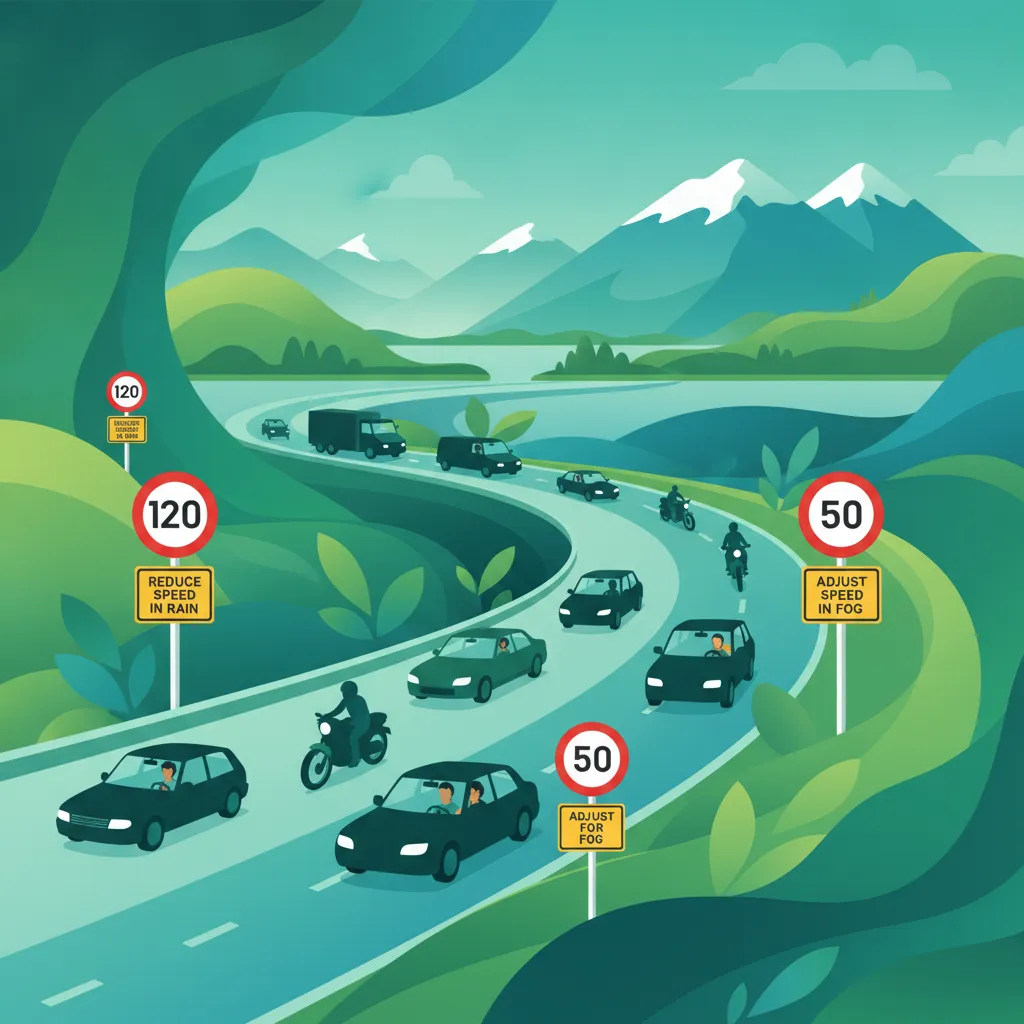
This lesson details the different speed limits applicable in urban, rural, and motorway environments across Switzerland. It explains speed limit signs, temporary restrictions, and how to adapt speed safely based on visibility and road conditions. Understanding these principles helps you comply with legal limits while ensuring an appropriate speed for the circumstances.
This lesson outlines the specific rules and skills required for riding on high-speed Swiss motorways. It covers the correct procedures for entering and exiting, merging with traffic, maintaining appropriate speed, and conducting safe overtaking maneuvers. Emphasis is placed on using mirrors and signals effectively to integrate safely into the flow of traffic.

This lesson outlines the principles of safe overtaking, emphasizing the importance of accurate judgment of speed and distance. It covers the necessary steps: checking mirrors, signaling, checking blind spots, executing the maneuver smoothly, and returning to the lane safely. The content is tailored to different road environments, from urban streets to rural roads.

This lesson explains the strategic importance of road positioning. It details how to select a lane position that makes you most visible to drivers ahead and behind, and helps you avoid the blind spots of larger vehicles. Proper positioning also allows for an escape route and a better line of sight through turns.
This lesson teaches the importance of maintaining a safe following distance to allow adequate time to react and stop. It explains methods like the 'two-second rule' for gauging a safe gap in ideal conditions. The content emphasizes increasing this distance in adverse weather or poor visibility to ensure a sufficient safety margin.

This lesson focuses on the concept of conspicuity, or how easily a rider can be seen by others. It explains the legal requirements for vehicle lights and reflectors in Switzerland and the benefits of wearing bright or reflective clothing. Learners will understand how to maximize their visibility during the day, at night, and in poor weather conditions.
This lesson details the maximum legal speed limits applicable to Category M vehicles in Switzerland. It explains how to identify speed limits through signage and differentiates between built-up areas, rural roads, and motorways where permitted. The content stresses that the legal limit is a maximum, and riders must always adapt their speed to traffic, weather, and road conditions.

This lesson teaches riders how to establish and maintain a safe following distance from the vehicle ahead. It introduces the 'two-second rule' as a simple and effective method for gauging a safe gap in ideal conditions. The content also explains why this distance must be increased in wet weather, at night, or when visibility is poor.
Find clear answers to common questions learners have about Speed Management and Its Influence on Stopping Distance. Learn how the lesson is structured, which driving theory objectives it supports, and how it fits into the overall learning path of units and curriculum progression in Switzerland. These explanations help you understand key concepts, lesson flow, and exam focused study goals.
Total stopping distance is the sum of the distance traveled while you perceive a hazard and decide to brake, plus the distance covered while the brakes are active. Even with fast reflexes, the bike travels significant ground before slowing begins, which is a common topic in the Swiss theory exam.
Stopping distance increases exponentially, not linearly, with speed. If you double your speed, your braking distance roughly quadruples, making speed control your most effective tool for hazard avoidance on a motorcycle.
Swiss guidelines typically emphasize the two-second rule as a minimum distance, which must be increased significantly in poor weather, on slippery surfaces, or when riding in mountainous terrain.
Not necessarily. While motorcycles may be lighter, they rely on only two contact patches. If braking technique is poor or the rider is unprepared, a car with ABS might stop in a shorter distance than an improperly managed motorcycle.
Pinpoint specific Swiss traffic rules, road signs, or driving situations you need to master. Use the practice search to start a focused revision session now and build confidence for your official driving theory exam.