
This lesson explores the vital link between environmental visibility and safe speed selection on Swiss roads. You will learn how to adapt your driving to challenging weather conditions like fog, heavy rain, or darkness to ensure you meet Category B standards. Understanding these adjustments is essential for both your theory exam and your future practical driving safety.
Lesson content overview
Driving safely requires constant adaptation to changing conditions. This lesson, part of the Comprehensive Swiss Driving Theory Course for Category B License, explores how varying visibility and adverse weather directly influence driving safety and demand specific speed adjustments. Understanding these dynamics is crucial for maintaining control, reacting to hazards, and preventing collisions on Swiss roads. We will cover the impact of fog, rain, snow, and darkness on your ability to see and react, providing essential guidance on how to adjust your speed and effectively use your vehicle's lighting systems to enhance safety.
Safe driving in challenging conditions is built upon several fundamental principles that extend beyond mere adherence to posted speed limits. These principles guide drivers in making informed decisions to protect themselves and other road users.
The most critical principle for safe driving is to adjust your speed so that you can always bring your vehicle to a complete stop within the distance you can clearly see. This is known as the Principle of Visibility Matching. Its purpose is to prevent collisions, especially those caused by unexpected hazards appearing beyond your line of sight. This means you must continuously assess the visual range ahead and reduce your speed whenever visibility diminishes, whether due to a curve, a hill crest, or adverse weather.
Proper use of your vehicle's lighting system is vital for both seeing and being seen. The Principle of Light Control dictates that you must use appropriate headlamp settings (dipped beam, high beam, fog lights) to optimize your visibility without dazzling or causing glare for other road users. Correct headlamp usage is not merely a courtesy; it is a mandatory safety measure under specific weather and lighting conditions as prescribed by Swiss traffic law.
Maintaining an adequate distance from the vehicle in front – the Principle of Safe Following Gap – becomes even more critical in reduced visibility. This distance, usually measured in seconds, must be extended to account for longer reaction times and increased braking distances in challenging conditions. A sufficient following gap provides the necessary time and space to react safely if the leading vehicle brakes unexpectedly, significantly reducing the risk of rear-end collisions.
While legal speed limits provide a maximum threshold, the Principle of Condition-Adjusted Speed emphasizes that your actual driving speed must be selected based on prevailing conditions. This includes current weather, road type, traffic density, and your vehicle's load and capabilities. Often, this will mean driving significantly below the statutory speed limit to ensure safety, even if no explicit temporary speed reduction signs are present.
Numerous factors can impact a driver's visibility and overall road safety. Understanding these elements is the first step towards mitigating risks.
Visibility Range refers to the maximum distance at which you can clearly identify road markings, signs, and other road users under current conditions. This range is dynamic and can change instantly. For instance, daylight visibility might extend for hundreds of metres, while dense fog could reduce it to less than 50 metres. Your safe stopping distance must always be less than or equal to this visible range. Swiss regulations mandate specific headlamp usage when visibility drops below certain thresholds, such as 150 metres. Ignoring this can lead to dangerous situations, like driving at a daytime speed limit during dense fog.
Different atmospheric phenomena affect road surface traction and visibility in unique ways, demanding distinct adjustments from drivers.
Fog and mist consist of tiny water droplets suspended in the air, which scatter light and severely reduce visibility. In dense fog, visibility can drop to below 30 metres. This significantly increases reaction times and stopping distances. Drivers must switch to dipped beams and, if visibility is severely reduced (below 100 metres), activate fog lights. High beams in fog are counterproductive as they reflect off the fog, creating glare and worsening visibility.
Rain, whether light drizzle or heavy downpour, reduces visibility and makes road surfaces slippery. Water on the road decreases tire grip, increasing braking distances significantly – sometimes by as much as 40% on wet pavement compared to dry. Heavy rain can also lead to aquaplaning, where tires lose contact with the road surface due to a layer of water, causing a complete loss of steering and braking control. Drivers should reduce speed, increase following distances, and use dipped beams. Fog lights may be beneficial in very heavy rain if visibility drops below 100 metres.
Snowfall dramatically reduces visibility and makes roads extremely slippery, reducing traction to a fraction of that on dry roads. Ice, especially black ice (a thin, transparent layer of ice), is even more perilous as it is often invisible. Driving on snow or ice requires extreme caution: significantly reduce speed, increase following distances, and use gentle inputs for steering, braking, and acceleration. Winter tires are mandatory in snowy or icy conditions in many areas and are strongly recommended throughout winter in Switzerland. High beams should be avoided in snowfall as they reflect off the flakes, impairing vision.
Driving at night inherently reduces visibility, even in clear weather. Depth perception and the ability to detect hazards are diminished. The contrast between lighted and unlighted areas can also strain the eyes. Proper use of dipped beams and high beams is crucial, along with a greater awareness of potential unlit obstacles or vulnerable road users. Glare from oncoming headlights can temporarily blind drivers, necessitating a quick switch to dipped beams.
Bright sunlight, especially at sunrise or sunset, can cause severe glare, temporarily blinding drivers. Reflections off wet roads, snow, or other vehicles can exacerbate this. Drivers should use sun visors, wear sunglasses, and slow down. Maintaining a clean windscreen is also vital, as dirt can scatter sunlight and worsen glare.
Your vehicle's lighting systems are your primary tools for managing visibility. Knowing when and how to use each type of light is essential for safety and compliance with Swiss traffic laws.
The Dipped Beam (also known as low beam) is the standard headlamp setting for normal night driving. It provides sufficient illumination ahead without causing significant glare for oncoming traffic or vehicles in front. It must also be used during the day whenever visibility is reduced to below 150 metres due to fog, heavy rain, snow, or mist, and in tunnels.
High Beam headlights offer long-range illumination and should be used on unlit roads at night when there is no oncoming traffic and you are not following another vehicle closely. While they significantly enhance your field of view, they cause intense glare. Swiss law mandates that high beams must be dimmed to dipped beam when an oncoming vehicle is within 150 metres or when following another vehicle within 200 metres. Using high beams in fog or heavy rain is counterproductive, as the light reflects off atmospheric particles and severely impairs your own vision.
Fog Lights are specifically designed to cut through dense fog, mist, or heavy precipitation. Positioned low on the vehicle, they cast a wide, low-angle beam that illuminates the road surface without causing significant backscatter or glare. In Switzerland, fog lights may only be used when visibility is reduced to less than 100 metres due to fog, mist, or snow. They are not to be used in clear conditions, as they can unnecessarily dazzle other drivers.
Always remember the 100-metre rule for fog lights in Switzerland: only activate them when visibility drops below 100 metres.
Daytime Running Lights (DRL) are designed to make your vehicle more visible to other road users during daylight hours. They are not intended to illuminate the road for the driver. While beneficial, they are generally not bright enough for use in low visibility conditions like fog or heavy rain, where dipped beams are legally required. Some vehicles automatically switch to dipped beam when external light levels drop, but drivers should not rely solely on these systems and must manually activate dipped beams when visibility is poor.
Beyond merely observing traffic laws, drivers must actively manage their speed and spacing to suit the dynamic road environment.
Safe Speed Selection involves choosing a driving speed that allows you to react safely and stop within the visible distance. Factors like visibility range, road type, traffic density, vehicle load, and your vehicle's braking capability all play a role. On a wet road, for instance, your safe speed will be considerably lower than on a dry road, regardless of the posted speed limit. Always assume that conditions might worsen suddenly and adjust your speed proactively.
The Stopping Distance is the total distance your vehicle travels from the moment you perceive a hazard until it comes to a complete stop. It comprises three components:
Understanding these components is vital. On wet or icy roads, braking distance increases dramatically. Therefore, in adverse conditions, your speed must be significantly reduced to ensure your total stopping distance does not exceed your visible range.
The Following Gap is the distance you maintain between your vehicle and the vehicle directly ahead. In good conditions, a minimum gap of 2-3 seconds is recommended. This translates to roughly half your speed in metres (e.g., 60 km/h requires 30 metres). However, in reduced visibility, rain, fog, or at night, this gap must be extended significantly – often to 4 seconds or more. This extra time provides a crucial buffer for reaction and braking, especially if the vehicle in front brakes unexpectedly.
Tailgating in low-visibility conditions is extremely dangerous. It severely limits your reaction time and drastically increases the risk of a rear-end collision.
Your tires are the only part of your vehicle in contact with the road, making their condition paramount for safety. Tire Condition and Pressure directly affect grip, handling, and braking performance, particularly in wet or snowy conditions. Swiss regulations specify a minimum tread depth of 1.6 mm, but many experts recommend at least 4 mm for winter tires. Under-inflated or worn tires significantly increase stopping distances and the risk of aquaplaning. Regularly checking tire pressure and tread depth is a simple yet crucial maintenance task.
Swiss traffic law (Strassenverkehrsordnung, StVO) is clear on the driver's responsibility to adjust to prevailing conditions. Adherence to these regulations is mandatory for obtaining and retaining your Category B license.
Rule: Drivers must adapt their speed to ensure the stopping distance does not exceed the visible distance under any conditions. Applicability: This rule applies universally across all road types, from motorways to residential streets, especially during adverse weather. Legal Status: This is a mandatory and fundamental principle of safe driving, legally enforceable. Rationale: To prevent collisions when visibility is compromised, drivers must always be able to stop before an obstacle becomes visible. Example (Correct): On a motorway with a speed limit of 120 km/h, reducing speed to 50 km/h when dense fog reduces visibility to 80 metres. Example (Incorrect): Maintaining 100 km/h when visibility is only 60 metres, making it impossible to stop safely.
Rule: Dipped beam headlights must be used when visibility is below 150 metres due to fog, mist, heavy rain, or snow. High beams are generally prohibited in these conditions. Applicability: Any low-visibility conditions caused by atmospheric phenomena. Legal Status: Mandatory. Rationale: High beams cause glare and reflection in fog or heavy precipitation, worsening visibility for both the driver and others. Example (Correct): Switching from high beam to dipped beam immediately upon entering a fog bank. Example (Incorrect): Continuing to use high beams in dense fog, thereby dazzling yourself and potentially other drivers.
Rule: High beams must be dimmed to dipped beam when approaching an oncoming vehicle within 150 metres or when following another vehicle within 200 metres. Applicability: Both daytime and nighttime driving, irrespective of weather conditions. Legal Status: Mandatory. Rationale: To prevent glare that can temporarily blind other drivers, increasing accident risk. Example (Correct): Dimming your lights as an oncoming car approaches, or when you close in on a vehicle ahead. Example (Incorrect): Keeping high beams on a road with oncoming traffic, causing intense glare for other road users.
Rule: Fog lights may be used only when visibility is reduced to less than 100 metres due to fog, mist, or snow. Rear fog lights should only be used when visibility is below 50 metres, and must be switched off as soon as visibility improves. Applicability: Severely low-visibility conditions. Legal Status: Mandatory usage under specified conditions; prohibited when visibility is adequate. Rationale: Fog lights provide crucial low-angled illumination in dense conditions without causing excessive glare. Using them in clear conditions can be dazzling. Example (Correct): Turning on both front and rear fog lights when visibility falls below 100 metres (for front) or 50 metres (for rear fog lights) in thick fog. Example (Incorrect): Using fog lights in clear weather or light rain, unnecessarily dazzling other drivers.
Rule: Temporary speed limits may be imposed by authorities (via electronic signs or temporary signage) during adverse weather conditions. Applicability: Common on motorways, bridges, and tunnels prone to fog, heavy rain, or snow. Legal Status: Mandatory when signaled; these override statutory speed limits. Rationale: To enhance safety for all road users when road conditions impair vehicle performance and driver perception. Example (Correct): Observing a digitally displayed reduced speed limit (e.g., 80 km/h) on a motorway during a sudden heavy rainfall. Example (Incorrect): Ignoring a temporary speed limit sign because the statutory limit for the road is higher.
Even experienced drivers can make errors in challenging conditions. Awareness of these common mistakes is key to preventing accidents.
Let's apply these principles to common driving scenarios you might encounter in Switzerland.
Setting: You are driving on a Swiss motorway where the usual speed limit is 120 km/h. Suddenly, you encounter a patch of dense fog that reduces visibility to approximately 80 metres. Decision Point: How do you adjust your speed and vehicle lights? Correct Behavior: Immediately reduce your speed significantly, for example, to 50-60 km/h, ensuring your stopping distance is well within the 80-metre visibility range. Switch from high beam (if previously on) to dipped beam headlights, and activate your front and rear fog lights (as visibility is below 100 metres). Increase your following gap to at least 4-5 seconds. Incorrect Behavior: Maintaining 100-120 km/h and using high beams. This would make it impossible to stop safely if an obstacle appeared, and high beams would only worsen your vision.
Setting: You are on a rural road with a speed limit of 80 km/h. Heavy rain begins, making the road surface wet and reducing visibility to about 100 metres. Decision Point: How should you adjust your speed and following distance? Correct Behavior: Reduce your speed to approximately 60 km/h or lower, depending on the intensity of the rain and surface water. Activate your dipped beam headlights. Increase your following gap to at least 4 seconds, accounting for the increased braking distance on a wet road. Avoid sudden braking or steering inputs. Incorrect Behavior: Continuing at 80 km/h with a 2-second following gap. The increased braking distance on wet asphalt, combined with reduced visibility, makes this highly dangerous.
Setting: It's night, and you are driving on an unlit rural road. You have your high beams on for maximum visibility. You then spot an oncoming vehicle approaching about 250 metres ahead. Decision Point: When do you dim your lights? Correct Behavior: You should dim your high beams to dipped beam when the oncoming vehicle is approximately 150 metres away. This prevents you from dazzling the oncoming driver. After the vehicle has passed, and if the road ahead is clear, you can switch back to high beams. Incorrect Behavior: Keeping your high beams on until the oncoming vehicle is very close, or failing to dim them at all, which is illegal and dangerous.
Setting: You are driving on a winding mountain road with a speed limit of 60 km/h. Heavy snowfall begins, reducing visibility to 70 metres and making the road surface slippery. Decision Point: What lighting should you use, and how should you adjust your speed? Correct Behavior: Immediately reduce your speed significantly, perhaps to 30 km/h or less, depending on how slippery the road feels. Activate your dipped beam headlights and front and rear fog lights (as visibility is below 100 metres/50 metres). Maintain a very large following gap. Use gentle acceleration, braking, and steering inputs. Ensure you have appropriate winter tires fitted. Incorrect Behavior: Using high beams, which would reflect off the falling snow and worsen visibility. Maintaining a higher speed, which would be impossible to control on a slippery, winding road with reduced visibility.
This lesson establishes the critical principle that visibility dictates speed—drivers must always be able to stop within the distance they can see. It details specific Swiss legal requirements for headlamp use: dipped beams mandatory below 150m visibility, front fog lights below 100m, and rear fog lights below 50m. The three components of stopping distance (perception, reaction, and braking) all extend in adverse conditions, making speed reduction and increased following gaps essential. The lesson covers practical adjustments for fog, rain, snow, ice, darkness, and glare, emphasizing that high beams are counterproductive in precipitation and that tire condition significantly impacts safety. Four real-world scenarios demonstrate correct versus dangerous responses to fog on motorways, heavy rain on rural roads, night driving with oncoming traffic, and snowfall on mountain roads.
A short set of high-value points that capture the most important learning from this lesson.
Your stopping distance must always be shorter than your visible range—adjust speed accordingly in every weather condition
Dipped beam headlights are legally required whenever visibility drops below 150 metres due to fog, rain, snow, mist, or in tunnels
Front fog lights are for severe conditions only—activate them only when visibility falls below 100 metres and rear fog lights only below 50 metres
Following gaps must extend to 4 seconds or more in adverse weather, accounting for longer reaction and braking distances
High beams must always be dimmed to dipped beam when an oncoming vehicle is within 150 metres or when following another vehicle within 200 metres
Explore all units and lessons included in this driving theory course.
Stopping distance has three components: perception distance, reaction distance (approximately 1 second), and braking distance—all increase in poor conditions
Wet roads can increase braking distance by up to 40%, while ice and snow reduce traction dramatically
High beams reflect off fog, rain, and snow particles, creating glare that worsens your own visibility
Swiss law mandates winter tires in snowy or icy conditions; minimum tread depth is 1.6 mm but 4 mm is recommended for winter
Tire condition and pressure directly affect grip, handling, and braking performance—check them regularly
Using high beams in fog, heavy rain, or snowfall, which causes light to reflect off particles and blinds the driver
Maintaining a 2-second following gap in reduced visibility, leaving insufficient time to react and brake safely
Assuming automatic headlamp systems will always select the correct setting—manual intervention is needed in fog and heavy rain
Continuing at posted speed limits during adverse weather when visibility or traction is severely reduced
Keeping fog lights activated when visibility improves above the threshold, which dazzles other road users unnecessarily
Lesson content overview
A short set of high-value points that capture the most important learning from this lesson.
Your stopping distance must always be shorter than your visible range—adjust speed accordingly in every weather condition
Dipped beam headlights are legally required whenever visibility drops below 150 metres due to fog, rain, snow, mist, or in tunnels
Front fog lights are for severe conditions only—activate them only when visibility falls below 100 metres and rear fog lights only below 50 metres
Following gaps must extend to 4 seconds or more in adverse weather, accounting for longer reaction and braking distances
High beams must always be dimmed to dipped beam when an oncoming vehicle is within 150 metres or when following another vehicle within 200 metres
Explore all units and lessons included in this driving theory course.
Stopping distance has three components: perception distance, reaction distance (approximately 1 second), and braking distance—all increase in poor conditions
Wet roads can increase braking distance by up to 40%, while ice and snow reduce traction dramatically
High beams reflect off fog, rain, and snow particles, creating glare that worsens your own visibility
Swiss law mandates winter tires in snowy or icy conditions; minimum tread depth is 1.6 mm but 4 mm is recommended for winter
Tire condition and pressure directly affect grip, handling, and braking performance—check them regularly
Using high beams in fog, heavy rain, or snowfall, which causes light to reflect off particles and blinds the driver
Maintaining a 2-second following gap in reduced visibility, leaving insufficient time to react and brake safely
Assuming automatic headlamp systems will always select the correct setting—manual intervention is needed in fog and heavy rain
Continuing at posted speed limits during adverse weather when visibility or traction is severely reduced
Keeping fog lights activated when visibility improves above the threshold, which dazzles other road users unnecessarily
Explore search topics learners often look for when studying Visibility, Weather Conditions, and Speed Adjustment. These topics reflect common questions about road rules, driving situations, safety guidance, and lesson level theory preparation for learners in Switzerland.
Browse additional driving theory lessons that cover connected traffic rules, road signs, and common driving situations related to this topic. Improve your understanding of how different rules interact across everyday traffic scenarios.
Understand mandatory Swiss traffic laws regarding speed adjustment, headlamp usage, and fog light use in conditions of reduced visibility due to fog, rain, snow, or darkness. Essential for your Category B theory.

This lesson examines the impact of various weather conditions on driving safety. It explains how to adjust speed in low visibility and the risks of aquaplaning in heavy rain. The content also covers using snow chains in snowy conditions, handling icy surfaces, and dealing with strong winds, particularly on bridges and open roads.
Weather has a profound impact on vehicle handling and visibility. This lesson teaches you how to reduce speed, increase following distances, and use controls smoothly to maintain traction in poor conditions. It also covers the legal requirements and practical application of snow chains in winter.

This lesson details how adverse weather conditions like rain, fog, and snow affect motorcycle safety. It explains how wet surfaces reduce tyre grip, requiring smoother control inputs and longer braking distances. Strategies for managing reduced visibility in fog and the extreme hazards of riding on snow and ice are also covered.
This lesson provides essential strategies for riding in adverse weather like rain and fog. It explains how to increase following distances, reduce speed, and use lights effectively to enhance visibility. The content also addresses the loss of traction on wet roads and the importance of smooth control inputs for braking, accelerating, and steering.

This lesson examines the different lighting systems on a vehicle, including headlamps, fog lights, and turn signals. It explains the appropriate use of low-beam and high-beam headlights and the conditions for activating fog lights. Understanding proper lighting usage improves visibility and safety, especially in low-light or adverse weather conditions.
Wet or icy roads drastically reduce tyre grip and can double or triple braking distances. This lesson stresses the importance of significantly reducing overall speed and increasing following distances in such conditions. It advises on using brakes with extreme care to avoid skidding and explains how the vehicle's retarder should be used with caution as it can cause the drive wheels to lock up on slippery surfaces.
This lesson focuses on general driving safety in areas with a high concentration of children. It stresses the importance of significantly reducing speed, being prepared for unexpected events, and scanning for children between parked cars. The driver must exhibit maximum vigilance in these high-risk environments at all times.
Proper visibility is paramount for the safety of large vehicles, especially at night or in poor weather. This lesson covers the full range of required lights, including headlights, indicators, brake lights, and side and rear marker lights. It also explains the function of reflectors and the mandatory high-visibility conspicuity markings that outline the vehicle's shape to other drivers.
This lesson focuses on techniques and equipment designed to increase a motorcyclist's visibility to others. It explains the strategic use of reflective materials, high-visibility clothing, and the mandatory use of daytime running lights. Understanding how to enhance conspicuity is a critical component of proactive self-protection on the road.
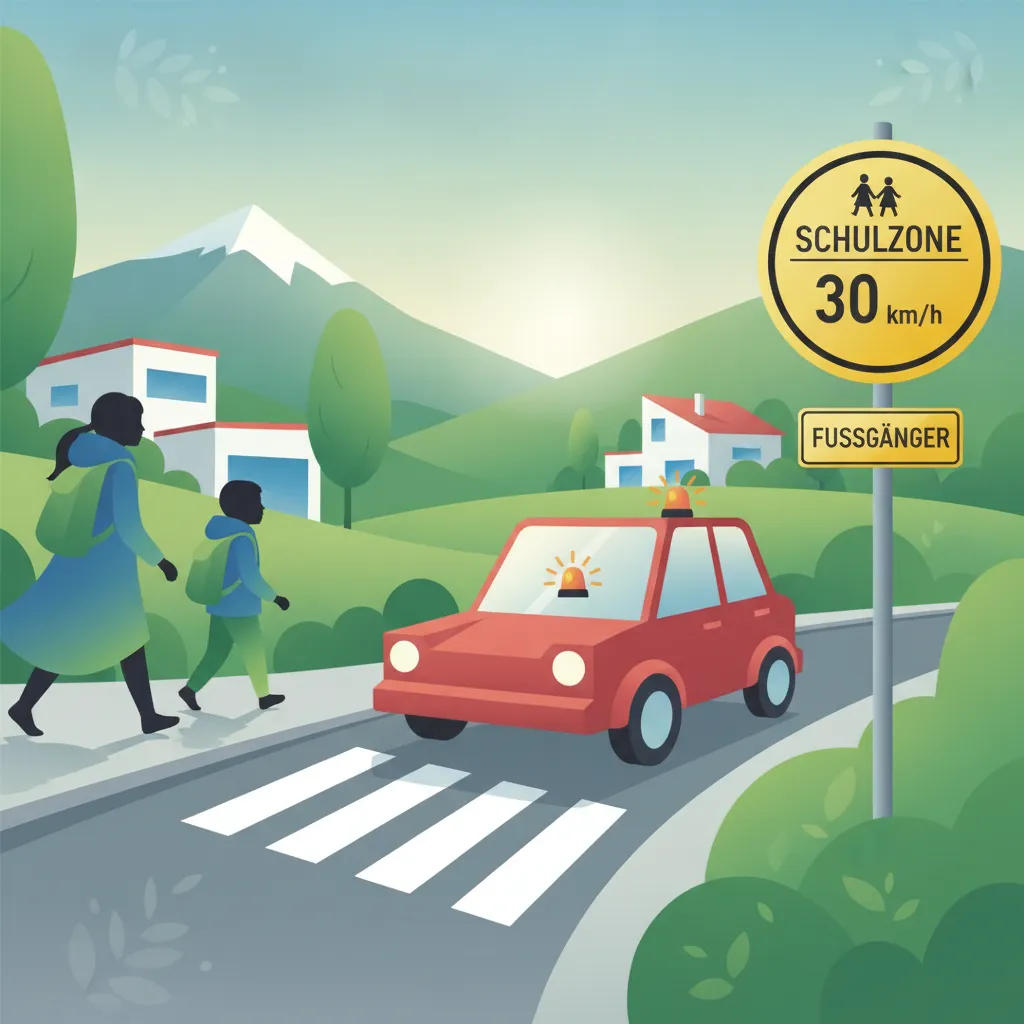
This lesson focuses on school zones, where special speed limits and cautionary measures are required. You will learn to recognize school zone signs, understand reduced speed limits, and be aware of designated child crossing zones. The content also emphasizes the need for heightened vigilance when school buses stop for students to ensure child safety.
Learn about typical driving errors related to visibility and adverse weather in Switzerland. This lesson focuses on avoiding hazards and incorrect lighting or speed choices to pass your driving theory exam.
This lesson examines the impact of various weather conditions on driving safety. It explains how to adjust speed in low visibility and the risks of aquaplaning in heavy rain. The content also covers using snow chains in snowy conditions, handling icy surfaces, and dealing with strong winds, particularly on bridges and open roads.
This lesson provides essential strategies for riding in adverse weather like rain and fog. It explains how to increase following distances, reduce speed, and use lights effectively to enhance visibility. The content also addresses the loss of traction on wet roads and the importance of smooth control inputs for braking, accelerating, and steering.
Weather has a profound impact on vehicle handling and visibility. This lesson teaches you how to reduce speed, increase following distances, and use controls smoothly to maintain traction in poor conditions. It also covers the legal requirements and practical application of snow chains in winter.
This lesson details how adverse weather conditions like rain, fog, and snow affect motorcycle safety. It explains how wet surfaces reduce tyre grip, requiring smoother control inputs and longer braking distances. Strategies for managing reduced visibility in fog and the extreme hazards of riding on snow and ice are also covered.
This lesson examines the different lighting systems on a vehicle, including headlamps, fog lights, and turn signals. It explains the appropriate use of low-beam and high-beam headlights and the conditions for activating fog lights. Understanding proper lighting usage improves visibility and safety, especially in low-light or adverse weather conditions.
This lesson covers the systematic use of rearview and side mirrors, combined with head checks, to maintain full awareness of surrounding traffic. It emphasizes frequent observation to detect vehicles in blind spots, especially during lane changes and turns. The content also details the proper timing for head checks and the role of scanning techniques in preventing collisions.
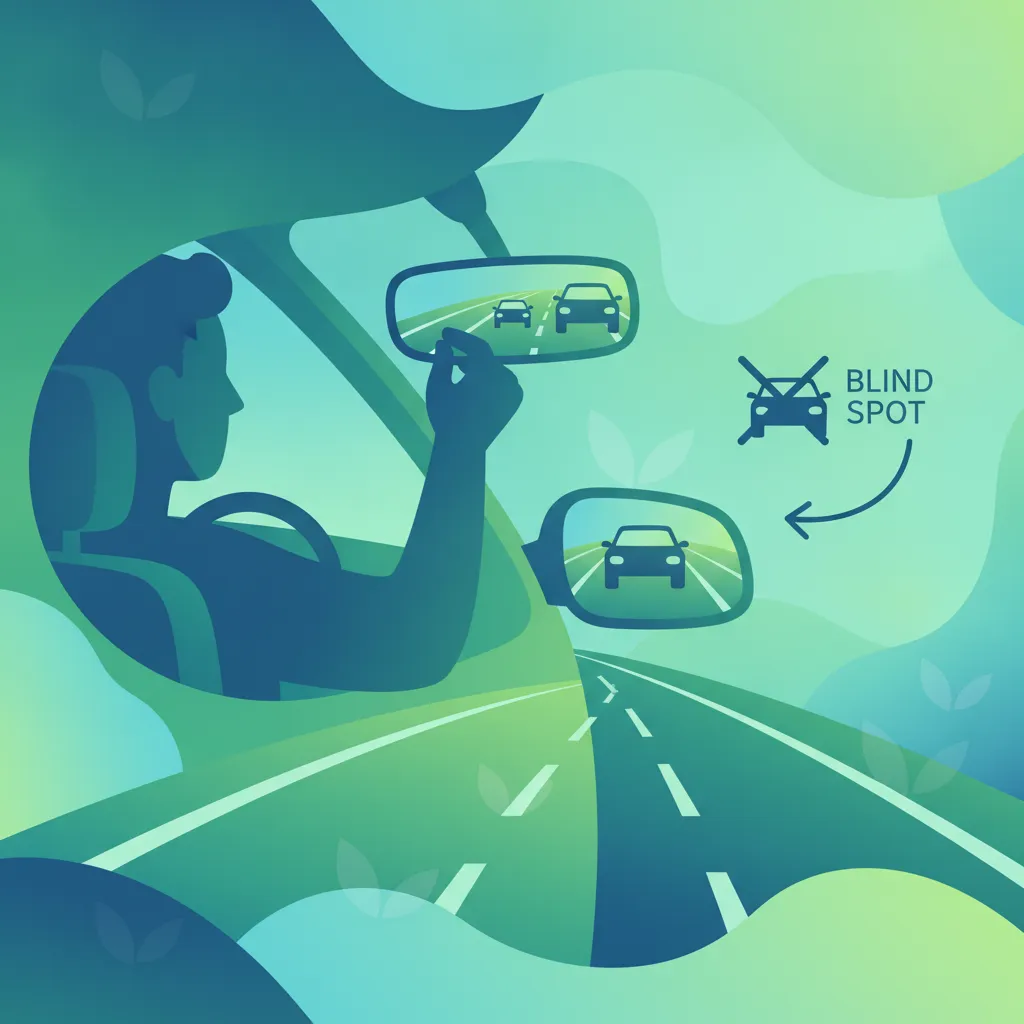
Despite the complex mirror systems, large areas around a truck remain hidden from the driver's view. This lesson maps out these significant blind spots: directly in front, behind, and along both sides of the vehicle. It teaches drivers to be constantly aware of these 'no-zones' and to anticipate that smaller vehicles, cyclists, or pedestrians may be hidden within them, especially before changing lanes or turning.
This lesson introduces the core behaviour rules governing safe communication, focusing on the use of signals, mirrors, and eye contact. It emphasizes the importance of timely indicator usage and the correct procedure for checking mirrors and blind spots. The content also covers non-verbal communication cues that help convey intent and foster predictable traffic flow.
This lesson focuses on warning signs that alert drivers to potential hazards ahead, such as curves, steep descents, and roadwork zones. You will understand how these signs prompt anticipatory driving behavior, allowing for adjustments in speed and position. The content also discusses the typical placement of warning signs to help you react safely to changing conditions.

Buses and coaches have significant blind spots to the front, sides, and rear. This lesson maps out these 'no-zones' and teaches a continuous and active scanning process using all available mirrors and direct vision. The goal is to minimize the time any other road user spends undetected in a blind spot.
Find clear answers to common questions learners have about Visibility, Weather Conditions, and Speed Adjustment. Learn how the lesson is structured, which driving theory objectives it supports, and how it fits into the overall learning path of units and curriculum progression in Switzerland. These explanations help you understand key concepts, lesson flow, and exam focused study goals.
In Switzerland, the law requires you to drive at a speed that allows you to stop safely within your range of vision. If fog, heavy rain, or darkness reduces how far you can see, you must slow down regardless of the posted limit to ensure you can stop before encountering an obstacle.
You may only switch on your rear fog light when visibility is extremely low, typically less than 50 meters, to avoid dazzling other drivers. Front fog lights can be used in fog, falling snow, or heavy rain if they improve your visibility without blinding others.
When roads are covered in snow or ice, your stopping distance increases significantly due to reduced tire grip. You should increase your following gap well beyond the standard 'two-second rule' to allow for slower reaction times and potential skidding.
Yes, you must switch on your low-beam headlights when entering any tunnel, regardless of how short it is or if it is well-lit, to ensure your vehicle is visible to others. Keep a safe distance from the vehicle ahead, as lighting conditions change abruptly at tunnel entrances and exits.
Pinpoint specific Swiss traffic rules, road signs, or driving situations you need to master. Use the practice search to start a focused revision session now and build confidence for your official driving theory exam.