
This lesson explores the critical factors affecting the stability of heavy goods vehicles, including the impact of speed, load distribution, and sudden maneuvers. By understanding these dynamics, you will learn to minimize rollover risks and maintain control, which is a vital part of your Category C training and the official theory exam.

Lesson content overview
Operating heavy goods vehicles, such as those requiring a Category C license in Denmark, demands a profound understanding of vehicle dynamics, particularly stability and rollover risk. Unlike passenger cars, lorries and combinations carry immense mass, often distributed unevenly, which dramatically influences how they react to driver inputs, road conditions, and external forces. This lesson delves into the critical factors that govern heavy vehicle stability and how drivers can mitigate the risk of a dangerous rollover.
Mastering the principles of stability is not just about adhering to regulations; it's about ensuring the safety of yourself, your cargo, and every other road user. A rollover incident can have catastrophic consequences, often resulting from a momentary lapse in judgment or an inadequate understanding of how a heavy vehicle's physics interacts with its environment. By comprehending the core concepts discussed here, you will be better equipped to make informed decisions behind the wheel and maintain control in challenging situations.
Vehicle stability refers to a heavy goods vehicle's ability to resist tipping or losing control during various driving maneuvers. For trucks and lorries, this is a complex interplay of physical forces, vehicle design, and load characteristics. When these forces are balanced, the vehicle maintains its intended path; when they become unbalanced, the risk of a rollover increases significantly.
The fundamental principles that govern stability include the vehicle's inherent design, the distribution of its load, and the dynamic forces acting upon it while in motion. A robust understanding of these concepts is essential for all professional drivers. This knowledge allows for proactive hazard identification and the application of preventive driving techniques, aligning with Danish safety guidelines for heavy transport.
At its heart, stability in heavy vehicles revolves around maintaining an equilibrium of forces.
The risk of a heavy vehicle rollover is not random; it stems from identifiable factors that, when combined, can overcome the vehicle's inherent stability. Understanding these factors is the first step towards preventing accidents.
Lateral forces are those forces that act perpendicular, or sideways, to the vehicle's direction of travel. These forces are most pronounced and dangerous during turning maneuvers, but can also arise from other sources.
Excessive lateral force is the primary mechanical trigger for heavy vehicle rollovers.
The center of gravity (CG) is a crucial concept in understanding vehicle stability. It represents the hypothetical point where the entire weight of the vehicle, including its load, is considered to be concentrated.
Track width is another fundamental design characteristic that significantly influences a heavy vehicle's resistance to rollover.
While vehicle design provides a foundation, it is the driver's actions and meticulous load management that ultimately determine a heavy vehicle's stability in real-world driving conditions. Proactive measures are always better than reactive corrections.
The relationship between speed, curves, and rollover risk is direct and critical for heavy vehicle drivers.
When approaching a curve, brake gently while still travelling in a straight line. Release the brake and maintain a steady, reduced speed through the curve, then gradually accelerate as you straighten out.
Proper load securing is not merely about preventing cargo from falling off; it is a critical component of maintaining a stable center of gravity and preventing dynamic instability.
The strategic placement of cargo directly dictates the vehicle's center of gravity and, consequently, its inherent stability.
Adhering to specific Danish regulations and adopting best practices is fundamental for safe heavy vehicle operation and mitigating rollover risk. These rules are designed to prevent situations that could compromise stability.
In Denmark, as in other EU countries, strict regulations govern the maximum permissible weight a heavy vehicle can carry.
Danish road safety guidelines are very clear about the necessity of proper load securing.
Speed limits for heavy vehicles are specifically set to account for their mass and stability characteristics, and these must be rigorously followed.
Always drive to the conditions, not just the speed limit. This is especially true for heavy vehicles where the consequences of losing control are severe.
While not directly about stability, cargo height restrictions are a contributing factor to maintaining a safe overall vehicle profile and CG.
Developing an intuitive understanding of situations that heighten rollover risk is crucial for every heavy vehicle driver. Prevention is always the best strategy.
Several common driver actions and load-related issues significantly increase the likelihood of a rollover:
The risk of rollover is not static; it changes dynamically with environmental and operational factors.
Understanding the direct cause-and-effect relationships between driver actions, load conditions, and vehicle behavior is paramount for preventing rollovers.
Stability and rollover risk are central concerns for every professional heavy vehicle driver, particularly those operating under a Category C license in Denmark. The safe operation of lorries and combinations hinges on a thorough understanding of how vehicle mass, load distribution, speed, and road geometry interact. A low center of gravity and a wide track width inherently increase static stability, while dynamic stability is a constant balance influenced by driver inputs and external conditions.
Crucially, proper load securing is not negotiable; it is essential to prevent dangerous shifts in the center of gravity during maneuvers. Reducing speed before entering curves, ensuring smooth and controlled steering inputs, and constant vigilance of road and weather conditions are vital for maintaining control. Drivers must not only understand but also meticulously respect load limits, axle loads, speed restrictions, and the fundamental physics governing heavy vehicle behavior. By integrating this knowledge into daily driving practices, you can effectively prevent rollovers and uphold the highest standards of safety on Danish roads.
This lesson covers the physics of heavy vehicle stability and rollover prevention for Danish Category C drivers. It explains how lateral forces during cornering interact with a vehicle's center of gravity and track width to determine rollover risk, emphasizing that centrifugal force grows quadratically with speed. Key preventive strategies include reducing speed before curves, placing heavy cargo low and centered, and using proper load securing techniques (blocking, bracing, strapping) to prevent cargo shifts. Danish regulations specify speed limits for heavy vehicles and require drivers to verify load limits and axle loads before and during journeys. Understanding these principles and applying defensive driving techniques is essential for safe professional transport and passing the Category C theory exam.
A short set of high-value points that capture the most important learning from this lesson.
Heavy vehicle stability depends on the balance between lateral forces (from turning or wind) and counteracting forces (gravity, tire grip).
A vehicle's center of gravity (CG) is critical: lowering the CG through proper load placement significantly improves stability, while raising it increases rollover risk.
Centrifugal force increases quadratically with speed, meaning doubling speed in a curve quadruples the lateral force and dramatically raises rollover risk.
Speed must always be reduced before entering a curve, not during it, because heavy vehicles cannot brake effectively while cornering.
Proper load securing (blocking, bracing, strapping) prevents cargo from shifting, which would instantly alter the vehicle's CG and stability characteristics.
Explore all units and lessons included in this driving theory course.
Lower CG + wider track width = greater static stability; higher CG + narrower track = more rollover prone.
Heavy vehicles need significantly slower speeds for the same curve than passenger cars; advisory speeds on signs are set for lighter vehicles.
Load securing must prevent movement in all directions (forward, backward, sideways, upward) including during emergency maneuvers.
Danish heavy vehicle speed limits: urban 50 km/h, rural 70 km/h, motorways 80 km/h, but always adjust downward for conditions.
An empty heavy vehicle behaves differently than a loaded one and can be more vulnerable to crosswinds and road surface irregularities.
Assuming curve advisory speeds set for cars are safe for heavy vehicles; heavy trucks require significantly lower speeds.
Believing load placement only matters if cargo might fall off, when in reality improper placement raises the CG and destabilizes the vehicle.
Entering a curve too fast and attempting to brake mid-corner, which dramatically increases lateral forces.
Failing to check load security during long journeys; cargo can shift over time and alter the intended CG position.
Neglecting to distribute load evenly across axle load limits, leading to overloading individual axles that compromises handling and stability.
Lesson content overview
A short set of high-value points that capture the most important learning from this lesson.
Heavy vehicle stability depends on the balance between lateral forces (from turning or wind) and counteracting forces (gravity, tire grip).
A vehicle's center of gravity (CG) is critical: lowering the CG through proper load placement significantly improves stability, while raising it increases rollover risk.
Centrifugal force increases quadratically with speed, meaning doubling speed in a curve quadruples the lateral force and dramatically raises rollover risk.
Speed must always be reduced before entering a curve, not during it, because heavy vehicles cannot brake effectively while cornering.
Proper load securing (blocking, bracing, strapping) prevents cargo from shifting, which would instantly alter the vehicle's CG and stability characteristics.
Explore all units and lessons included in this driving theory course.
Lower CG + wider track width = greater static stability; higher CG + narrower track = more rollover prone.
Heavy vehicles need significantly slower speeds for the same curve than passenger cars; advisory speeds on signs are set for lighter vehicles.
Load securing must prevent movement in all directions (forward, backward, sideways, upward) including during emergency maneuvers.
Danish heavy vehicle speed limits: urban 50 km/h, rural 70 km/h, motorways 80 km/h, but always adjust downward for conditions.
An empty heavy vehicle behaves differently than a loaded one and can be more vulnerable to crosswinds and road surface irregularities.
Assuming curve advisory speeds set for cars are safe for heavy vehicles; heavy trucks require significantly lower speeds.
Believing load placement only matters if cargo might fall off, when in reality improper placement raises the CG and destabilizes the vehicle.
Entering a curve too fast and attempting to brake mid-corner, which dramatically increases lateral forces.
Failing to check load security during long journeys; cargo can shift over time and alter the intended CG position.
Neglecting to distribute load evenly across axle load limits, leading to overloading individual axles that compromises handling and stability.
Explore search topics learners often look for when studying Stability and Rollover Risk. These topics reflect common questions about road rules, driving situations, safety guidance, and lesson level theory preparation for learners in Denmark.
Browse additional driving theory lessons that cover connected traffic rules, road signs, and common driving situations related to this topic. Improve your understanding of how different rules interact across everyday traffic scenarios.
Explore the physics of heavy vehicle stability and rollover risk relevant to Danish Category C theory. Understand how speed, load distribution, and vehicle dynamics impact control and safety on the road.

This lesson explains the fundamental physics of load distribution and its direct impact on a heavy vehicle's centre of gravity. It details how the positioning of cargo—whether high, low, forward, or back—alters handling characteristics and overall stability. The content emphasizes the importance of achieving a balanced load to minimize rollover risk and comply with Danish regulations for safe weight distribution.

This lesson delves into the unique dynamics of articulated vehicles, focusing on the behavior of the combination around its articulation point. It explains the concept of off-tracking, where the trailer's wheels follow a tighter path than the tractor's, and its implications for negotiating turns and corners. Understanding these dynamics is crucial for safe maneuvering in confined spaces and preventing collisions with curbs or other obstacles.

Proper axle load distribution is crucial for the safety and legality of heavy vehicle operations. This lesson explains how axle pressure is defined and regulated, highlighting the importance of distributing weight correctly across all axles. It covers how imbalanced loads can negatively affect braking performance, steering control, and overall vehicle stability, while also explaining the Danish regulations for maximum axle loads.
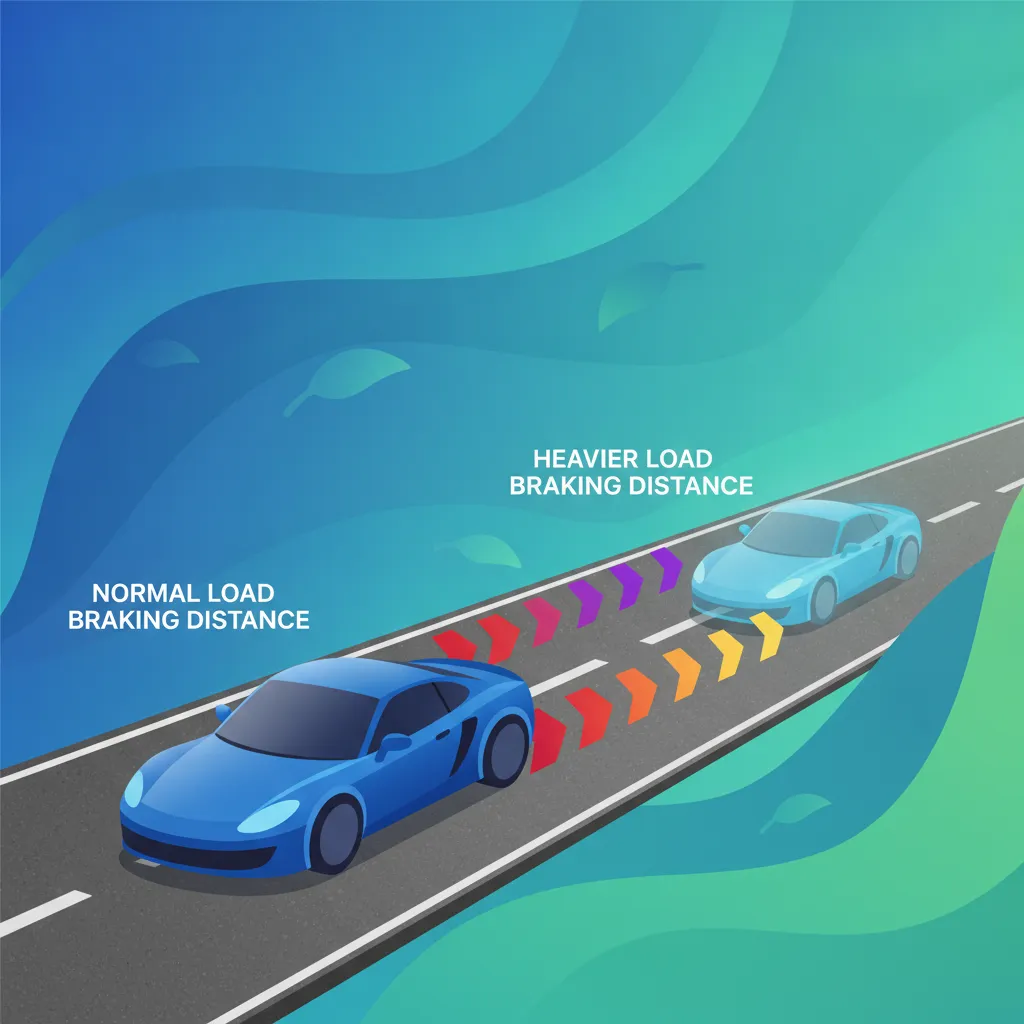
This lesson explores the direct relationship between a vehicle's mass, its speed, and the distance required to stop. It explains how increased load significantly lengthens the braking distance and details how road conditions like gradient and surface friction further affect this calculation. Learners will understand the importance of anticipating stops and maintaining a greater following distance to ensure safety.
This lesson introduces the fundamental concepts of vehicle mass, clarifying the legal distinctions between total weight, actual weight, and loaded weight under Danish law. It emphasizes the importance of strictly adhering to these limits to ensure safe vehicle operation and handling characteristics. The content also details the significant safety risks and legal penalties associated with exceeding weight limits, such as fines and vehicle impoundment.

This lesson addresses the causes and prevention of trailer sway and jack-knifing, two critical loss-of-control events. It explains how factors like improper braking, high speeds, crosswinds, and poor load distribution can trigger these dangerous situations. Learners will study avoidance strategies, including proper speed management and smooth steering inputs, as well as corrective actions to regain control if sway begins.

Crossing large bridges presents unique challenges, including strict weight restrictions and significant exposure to crosswinds. This lesson explains how to identify and respect these limits and teaches techniques for maintaining vehicle stability when hit by strong wind gusts. It covers the importance of reducing speed and making subtle steering corrections to counteract aerodynamic forces and stay safely in your lane.

This lesson explains the relationship between a bus's dimensions—length, width, and height—and its maneuverability. It covers key concepts such as turning radius, rear overhang, and swept path, which are critical for navigating turns and tight spaces safely. Learners will also understand how these physical characteristics create significant blind spots that require specific observation techniques to manage.

This lesson provides a step-by-step guide to safe loading and unloading practices. It covers the importance of ensuring proper weight distribution during the process, re-checking cargo securement, and adhering to safety protocols at loading docks. The content also includes ergonomic best practices to prevent driver injury and guidelines for the safe operation of equipment like tail lifts and pallet jacks.

This lesson focuses on the practical skills needed to maneuver a large vehicle in confined environments such as urban delivery zones and loading docks. It teaches how to accurately judge the required space, understand the vehicle's turning radius, and use reference points to position the vehicle precisely. The content covers strategies for navigating tight corners and avoiding fixed obstacles, which is essential for damage-free urban operations.
Learn essential driver actions for preventing heavy vehicle rollovers, focusing on proper load securing, speed management, and navigating curves safely according to Danish traffic rules.
This lesson explains the fundamental physics of load distribution and its direct impact on a heavy vehicle's centre of gravity. It details how the positioning of cargo—whether high, low, forward, or back—alters handling characteristics and overall stability. The content emphasizes the importance of achieving a balanced load to minimize rollover risk and comply with Danish regulations for safe weight distribution.
This lesson provides a step-by-step guide to safe loading and unloading practices. It covers the importance of ensuring proper weight distribution during the process, re-checking cargo securement, and adhering to safety protocols at loading docks. The content also includes ergonomic best practices to prevent driver injury and guidelines for the safe operation of equipment like tail lifts and pallet jacks.
This lesson addresses the causes and prevention of trailer sway and jack-knifing, two critical loss-of-control events. It explains how factors like improper braking, high speeds, crosswinds, and poor load distribution can trigger these dangerous situations. Learners will study avoidance strategies, including proper speed management and smooth steering inputs, as well as corrective actions to regain control if sway begins.
This lesson delves into the unique dynamics of articulated vehicles, focusing on the behavior of the combination around its articulation point. It explains the concept of off-tracking, where the trailer's wheels follow a tighter path than the tractor's, and its implications for negotiating turns and corners. Understanding these dynamics is crucial for safe maneuvering in confined spaces and preventing collisions with curbs or other obstacles.

This lesson provides practical instruction on various methods for securing cargo effectively. It covers the correct application of equipment such as straps, chains, and nets, as well as techniques like blocking and bracing to prevent load movement. The content is aligned with Danish and European standards for load securing, ensuring learners understand how to inspect and verify that their cargo is safe for transport.

This lesson provides a clear, safety-oriented protocol for handling a vehicle breakdown or tyre failure. It covers how to safely maneuver the vehicle to the roadside, the correct use of hazard lights and warning triangles to alert other traffic, and procedures for contacting assistance. Adhering to these steps, as required by Danish law, is critical for protecting yourself and other road users from further incident.

This lesson addresses the combined challenges of navigating narrow rural roads and driving in adverse weather. It explains how to adapt speed and braking techniques for conditions like heavy rain, fog, or ice, which are common on rural routes. The content also integrates these factors into route planning, teaching drivers how to select the safest and most appropriate path while avoiding local weight or height restrictions.
This lesson focuses on the practical skills needed to maneuver a large vehicle in confined environments such as urban delivery zones and loading docks. It teaches how to accurately judge the required space, understand the vehicle's turning radius, and use reference points to position the vehicle precisely. The content covers strategies for navigating tight corners and avoiding fixed obstacles, which is essential for damage-free urban operations.

Reversing a tractor-trailer combination requires skill and a clear understanding of vehicle dynamics. This lesson breaks down the technique, explaining how to use steering inputs to guide the trailer accurately while monitoring its position through mirrors and cameras. It emphasizes the importance of a slow, controlled speed and planning the entire maneuver before starting to ensure safety and precision.
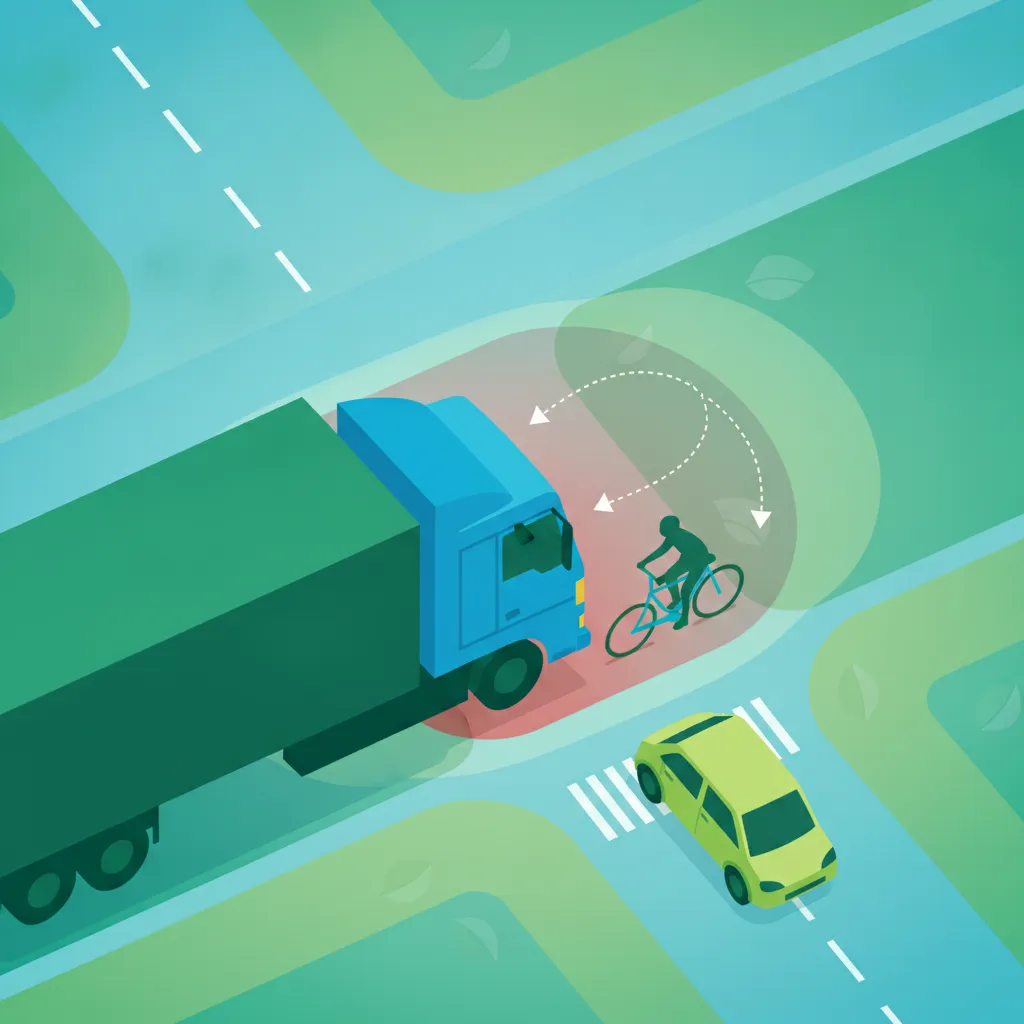
This lesson maps out the extensive blind spots, or 'no-zones,' that exist around a tractor-trailer combination, particularly to the sides and rear. It teaches the proper techniques for adjusting all mirrors to minimize these areas and explains how modern camera systems provide critical visibility. Understanding and compensating for these blind spots is a fundamental skill for preventing collisions, especially during lane changes and turns.
Find clear answers to common questions learners have about Stability and Rollover Risk. Learn how the lesson is structured, which driving theory objectives it supports, and how it fits into the overall learning path of units and curriculum progression in Denmark. These explanations help you understand key concepts, lesson flow, and exam focused study goals.
A high center of gravity significantly increases the risk of rollover during cornering or sharp steering. As a Category C driver, you must ensure your load is packed as low and centered as possible to keep the vehicle stable.
Even small increases in speed during cornering cause a disproportionate increase in lateral forces. These forces can easily overcome the stability of a high-sided lorry, leading to a rollover before the driver feels the vehicle losing grip.
Yes, the theory exam often tests your understanding of how load distribution and speed interact. You may be presented with scenarios where you must identify the safest speed or load placement to avoid tipping.
Road camber can either assist or hinder stability. When driving a heavy vehicle, a road that slopes outward on a curve can add to the outward lateral force, making a rollover more likely if you are traveling too fast.
Use our powerful search tool to pinpoint specific Danish driving theory topics, road signs, or traffic situations you need to review. Start exploring relevant practice sets now to reinforce your knowledge and build confidence for your upcoming driving licence exam.