
This lesson explores the essential rules for managing driver fatigue and complying with mandatory rest periods for professional goods vehicle drivers in Italy. Understanding these regulations is critical for your C, C1, C1E, or CE theory exam and for maintaining the professional safety standards required under the Codice della Strada.

Lesson content overview
Welcome to this essential lesson for the Italian Goods Vehicle License Theory Course. Professional driving, especially operating heavy goods vehicles, demands sustained concentration and physical endurance. One of the most significant risks in this profession is driver fatigue, a condition that severely impairs judgment and reaction time, leading to a heightened risk of accidents. This lesson will delve into the physiological impact of fatigue and provide a comprehensive overview of the strict EU regulations governing driving hours, mandatory breaks, and rest periods, which are legally mandated to prevent it. Understanding and adhering to these rules, along with proper tachograph use, is paramount for your safety, the safety of other road users, and the legal operation of your vehicle.
Fatigue is more than just feeling tired; it is a serious physiological state that can have devastating consequences when behind the wheel of a heavy goods vehicle. Recognizing its symptoms and understanding its impact is the first step towards effective fatigue management.
Fatigue is a state of reduced mental and physical alertness resulting from prolonged wakefulness, sleep deprivation, or continuous mental and physical activity. It significantly diminishes a driver's ability to operate a vehicle safely. Fatigue is broadly categorized into:
When a driver is fatigued, their brain's ability to process information slows down considerably. This impairment can be as dangerous as, or even more dangerous than, driving under the influence of alcohol. Studies indicate that driving while fatigued can lead to impairments comparable to having a blood alcohol concentration of 0.05%, which is above the legal limit for professional drivers in many jurisdictions. Practical manifestations of fatigue include:
Reaction time is the interval between a driver detecting a hazard and initiating an appropriate response, such as applying the brakes or steering away. Fatigue can increase a driver's reaction time by up to 50% after prolonged driving. For example, a fully rested driver might react in 1 second, while a fatigued driver might take 1.5 seconds. This seemingly small difference translates to significant additional stopping distance, especially in a heavy vehicle. At 90 km/h, an extra 0.5 seconds of reaction time means travelling an additional 12.5 metres before even beginning to brake – a distance that could be critical in preventing a collision. Understanding this direct link underscores why mandatory breaks and rest periods are not just legal obligations but life-saving requirements.
To counteract the dangers of driver fatigue, the European Union has implemented strict regulations, primarily EU Regulation (EC) No 561/2006, which governs driving times, breaks, and rest periods for professional drivers. These rules are directly applicable in Italy and are enforced through national legislation like the Codice della Strada.
EU Regulation 561/2006 applies to drivers of most commercial road transport vehicles exceeding 3.5 tonnes maximum permissible mass (MTW), including articulated vehicles and combinations, as well as those engaged in scheduled passenger transport. The core purpose of this regulation is to improve road safety, prevent driver fatigue, and ensure fair competition among transport operators. Compliance is mandatory, and ignorance of the rules is not an acceptable defence for violations.
The regulation sets clear limits on how long a driver can operate a vehicle within a 24-hour period:
It is crucial for drivers to plan their journeys carefully to remain within these limits, considering factors like traffic, loading/unloading times, and potential delays. Exceeding these limits without a valid, legally justifiable reason (such as needing to reach a safe stopping place) constitutes a violation.
To prevent acute fatigue from setting in during a shift, specific rules apply to continuous driving and mandatory breaks:
The 45-minute break can be split into two parts: the first break must be at least 15 minutes, followed by a second break of at least 30 minutes, taken within the 4.5-hour driving period. The 30-minute break must always be taken after the 15-minute break. This allows for greater flexibility in scheduling shorter pauses, but the cumulative 45 minutes must still be taken within the 4.5-hour driving window.
Beyond breaks during driving, substantial rest periods are essential for a driver's full cognitive and physical recovery, preventing the accumulation of chronic fatigue.
Adequate rest allows the body and mind to recover from the demands of driving, restoring alertness, concentration, and physical stamina. Skipping or shortening rest periods, even if compensated later, contributes to cumulative fatigue, which can impair health and significantly increase accident risk over time.
A daily rest period is the minimum off-duty time a driver must take within a 24-hour period.
The 24-hour period for daily rest begins at the end of the previous daily or weekly rest period. All driving and rest must occur within this rolling 24-hour window.
Weekly rest periods are designed for longer-term recovery and are crucial for reducing cumulative fatigue over an extended period.
Crucially, a driver cannot take two consecutive reduced weekly rest periods. Therefore, within any two consecutive weeks, a driver must take at least one regular weekly rest period (45 hours) and one reduced weekly rest period (24 hours).
Compensatory rest is additional rest required to offset any reduction in daily or weekly rest periods. Its purpose is to ensure that drivers eventually receive the full amount of rest prescribed by law, thereby preventing long-term fatigue accumulation.
The tachograph is a mandatory device in commercial vehicles that records driver activity. It is indispensable for monitoring compliance with driving and rest regulations and for enabling enforcement by authorities.
A tachograph is an electronic or analogue device that records:
There are two main types of tachographs:
The use of a tachograph is mandatory for most vehicles over 3.5 tonnes MTW (or for passenger vehicles designed to carry more than 9 people, including the driver) engaged in commercial road transport.
Maintaining accurate tachograph records is a joint responsibility of the driver and the transport undertaking. Drivers must:
Non-compliance with driving and rest regulations is not only dangerous but also carries significant legal penalties. Enforcement authorities, including the Italian Polizia Stradale, routinely inspect tachograph data to identify violations.
Violation: Failing to take the required 45-minute break after 4.5 hours of continuous driving. Why it's wrong: Directly violates Article 8 of EU Regulation 561/2006, significantly increasing fatigue and accident risk. Correct behavior: Always plan and take the full, uninterrupted 45-minute break, or correctly split it into 15+30 minutes, within the 4.5-hour driving period. Consequence: Fines, potential vehicle immobilization, and possible license points or suspension.
Violation: Driving more than 9 hours on more than two days in a week, or exceeding 10 hours on those two allowed days. Also, exceeding 56 hours in a single week or 90 hours in any two consecutive weeks. Why it's wrong: Violates Article 6 of EU Regulation 561/2006, leading to excessive fatigue accumulation. Correct behavior: Strictly adhere to the 9-hour daily limit, using the 10-hour extension only twice per week and staying within weekly and bi-weekly limits. Consequence: Administrative penalties, significant fines, and potential legal action against both driver and transport company.
Violation:
Violation: Driving without a driver card inserted, manipulating data, using another driver's card, or physically altering the tachograph device. Why it's wrong: Violates Article 12 of EU Regulation 561/2006 and constitutes a severe breach of trust and safety. It renders compliance checks impossible and is often indicative of other serious infractions. Correct behavior: Always ensure the tachograph is operational, the correct driver card is inserted, and all data are accurate and untampered. Consequence: Severe penalties, which can include substantial fines (e.g., up to €1,000 per violation), criminal charges, immediate vehicle immobilization, driver disqualification, and even imprisonment for serious tampering.
While regulations provide strict frameworks, professional drivers often face dynamic real-world conditions that require careful planning and situational awareness to maintain compliance and safety.
Human bodies operate on a natural 24-hour cycle known as the circadian rhythm, which dictates sleep-wake patterns. A natural dip in alertness typically occurs between 2 AM and 6 AM. Night driving, therefore, inherently aligns with these low points in human performance, making drivers particularly vulnerable to fatigue, even if they have had sufficient sleep. Drivers scheduled for night shifts must be extra vigilant, respect their body's natural rhythms, and strictly adhere to all rest regulations, recognizing that the risk of microsleeps and impaired judgment is significantly higher during these hours.
For drivers operating across different EU Member States, EU Regulation 561/2006 ensures a harmonised set of rules. However, national authorities (like the Italian Polizia Stradale) are responsible for enforcing these regulations within their territory, and while the core rules are consistent, specific administrative procedures or penalty scales might vary slightly. Drivers must always be aware of the enforcement practices in the countries they operate through and ensure their tachograph records are complete and accessible for inspection.
Effective fatigue management is a cornerstone of professional driving. It is a shared responsibility between the driver and the transport company, with significant implications for safety, legal compliance, and operational efficiency.
Non-compliance with driving and rest regulations poses severe risks. Beyond the immediate danger of accidents, legal penalties are substantial:
Effective risk management involves rigorous adherence to all regulations, thorough training for drivers, and a robust system for monitoring tachograph data and driver schedules. This proactive approach not only prevents penalties but, more importantly, saves lives.
The strict regulations around fatigue management and rest periods are fundamentally about protecting lives. They ensure that drivers are in a fit state to operate heavy vehicles safely, thereby reducing the incidence of fatigue-related accidents. For professional drivers in the Italian Goods Vehicle License Theory Course, mastering these rules is not merely an academic exercise; it is a fundamental aspect of their professional responsibility, contributing directly to their own well-being and the safety of everyone on the road.
Driver fatigue significantly impairs reaction time and judgment, with effects comparable to alcohol impairment, making strict rest regulations essential for road safety. EU Regulation 561/2006 mandates that professional drivers of vehicles over 3.5 tonnes maximum permissible mass limit daily driving to 9 hours (extendable to 10 hours twice weekly), take a 45-minute break after 4.5 hours of continuous driving, and observe daily rest periods of at least 11 hours (or 9 hours reduced, maximum three times between weekly rests). Weekly rest must be at least 45 hours regular or 24 hours reduced, with compensation required within three weeks and two consecutive reduced weekly rest periods prohibited. The tachograph, whether analogue or digital, is the mandatory compliance recording tool, and its misuse or tampering carries severe penalties including fines, disqualification, and criminal prosecution under both EU regulation and the Italian Codice della Strada.
A short set of high-value points that capture the most important learning from this lesson.
EU Regulation 561/2006 sets the maximum daily driving limit at 9 hours, extendable to 10 hours no more than twice weekly
A mandatory 45-minute uninterrupted break (or 15 + 30 minutes split) is required after every 4.5 hours of continuous driving
Regular daily rest must be at least 11 consecutive hours, with a reduced minimum of 9 hours permitted up to three times between weekly rests
Weekly rest requires at least 45 hours regular rest or 24 hours reduced rest, but two consecutive reduced weekly rest periods are prohibited
Digital tachograph driver cards must be inserted at shift start and removed at shift end; tampering is a serious criminal offence
Explore all units and lessons included in this driving theory course.
The 45-minute break after 4.5 hours of driving cannot be replaced by other work and must be genuine rest
Reduced rest taken below the 11-hour daily minimum must be compensated in one block before the end of the third week following the reduction
Circadian fatigue peaks between 2 AM and 6 AM, making night driving particularly hazardous even with adequate prior sleep
Analogue tachographs use paper charts while digital tachographs store data on a personal driver card for 28 days
Drivers must carry 28 days of tachograph records and be able to produce printouts on request from enforcement officers
Assuming continuous driving time resets when stopping for fuel or quick tasks without formally recording a break on the tachograph
Taking reduced daily rest more than three times between two weekly rest periods without realizing this violates the regulation
Planning only for weekly rest compensation while forgetting that reduced daily rest must also be compensated within three weeks
Believing that short periods of rest during loading or unloading count toward mandatory break requirements when they do not
Forgetting to make manual tachograph entries when switching vehicles or when the driver card was not inserted at shift start
Lesson content overview
A short set of high-value points that capture the most important learning from this lesson.
EU Regulation 561/2006 sets the maximum daily driving limit at 9 hours, extendable to 10 hours no more than twice weekly
A mandatory 45-minute uninterrupted break (or 15 + 30 minutes split) is required after every 4.5 hours of continuous driving
Regular daily rest must be at least 11 consecutive hours, with a reduced minimum of 9 hours permitted up to three times between weekly rests
Weekly rest requires at least 45 hours regular rest or 24 hours reduced rest, but two consecutive reduced weekly rest periods are prohibited
Digital tachograph driver cards must be inserted at shift start and removed at shift end; tampering is a serious criminal offence
Explore all units and lessons included in this driving theory course.
The 45-minute break after 4.5 hours of driving cannot be replaced by other work and must be genuine rest
Reduced rest taken below the 11-hour daily minimum must be compensated in one block before the end of the third week following the reduction
Circadian fatigue peaks between 2 AM and 6 AM, making night driving particularly hazardous even with adequate prior sleep
Analogue tachographs use paper charts while digital tachographs store data on a personal driver card for 28 days
Drivers must carry 28 days of tachograph records and be able to produce printouts on request from enforcement officers
Assuming continuous driving time resets when stopping for fuel or quick tasks without formally recording a break on the tachograph
Taking reduced daily rest more than three times between two weekly rest periods without realizing this violates the regulation
Planning only for weekly rest compensation while forgetting that reduced daily rest must also be compensated within three weeks
Believing that short periods of rest during loading or unloading count toward mandatory break requirements when they do not
Forgetting to make manual tachograph entries when switching vehicles or when the driver card was not inserted at shift start
Explore search topics learners often look for when studying Fatigue Management and Rest Regulations. These topics reflect common questions about road rules, driving situations, safety guidance, and lesson level theory preparation for learners in Italy.
Browse additional driving theory lessons that cover connected traffic rules, road signs, and common driving situations related to this topic. Improve your understanding of how different rules interact across everyday traffic scenarios.
Understand the mandatory EU driving hours, break, and rest period regulations. Learn essential tachograph operation, driver card usage, and compliance requirements for safe and legal professional driving in Italy.

This lesson focuses on the logistical aspects of long-haul driving. It teaches drivers how to plan journeys to comply with legal driving hours and mandatory rest periods, using a tachograph to record activity. The lesson also covers how to plan for fuel stops and select safe and secure overnight parking locations at motorway service areas or designated truck stops.

This lesson provides a comprehensive overview of the essential documentation required for both the driver and the vehicle. It covers the driver's license (patente), CQC card, vehicle registration (carta di circolazione), insurance certificate, and transport-specific documents like the cargo manifest. Learners will understand the importance of ensuring all documents are valid and readily available for inspection by authorities to avoid legal penalties and operational delays.
This lesson provides a clear overview of the legal consequences for failing to comply with road transport regulations in Italy. It covers the system of fines for common offenses like speeding, overloading, and violations of driving hours. The lesson also explains the penalty point system that can lead to license suspension and touches upon the responsibilities and potential liability of the transport company.

This lesson delves into the specific articles of the Italian Codice della Strada that apply to heavy goods vehicles. It outlines the core legal and professional obligations of a driver, including the heightened duty of care owed to other road users and the responsibility for the vehicle's roadworthiness and load. Learners will understand the legal consequences of non-compliance, such as fines and sanctions, reinforcing the importance of adhering to all traffic regulations.

This lesson explains the concept of 'Zone a Traffico Limitato' (ZTL), common in Italian city centers, which restricts vehicle access at certain times. It covers how to identify ZTL boundaries, understand the operating hours, and the procedures for obtaining permits for commercial deliveries. The lesson also touches on environmental zones that may restrict access based on a vehicle's emission standards.
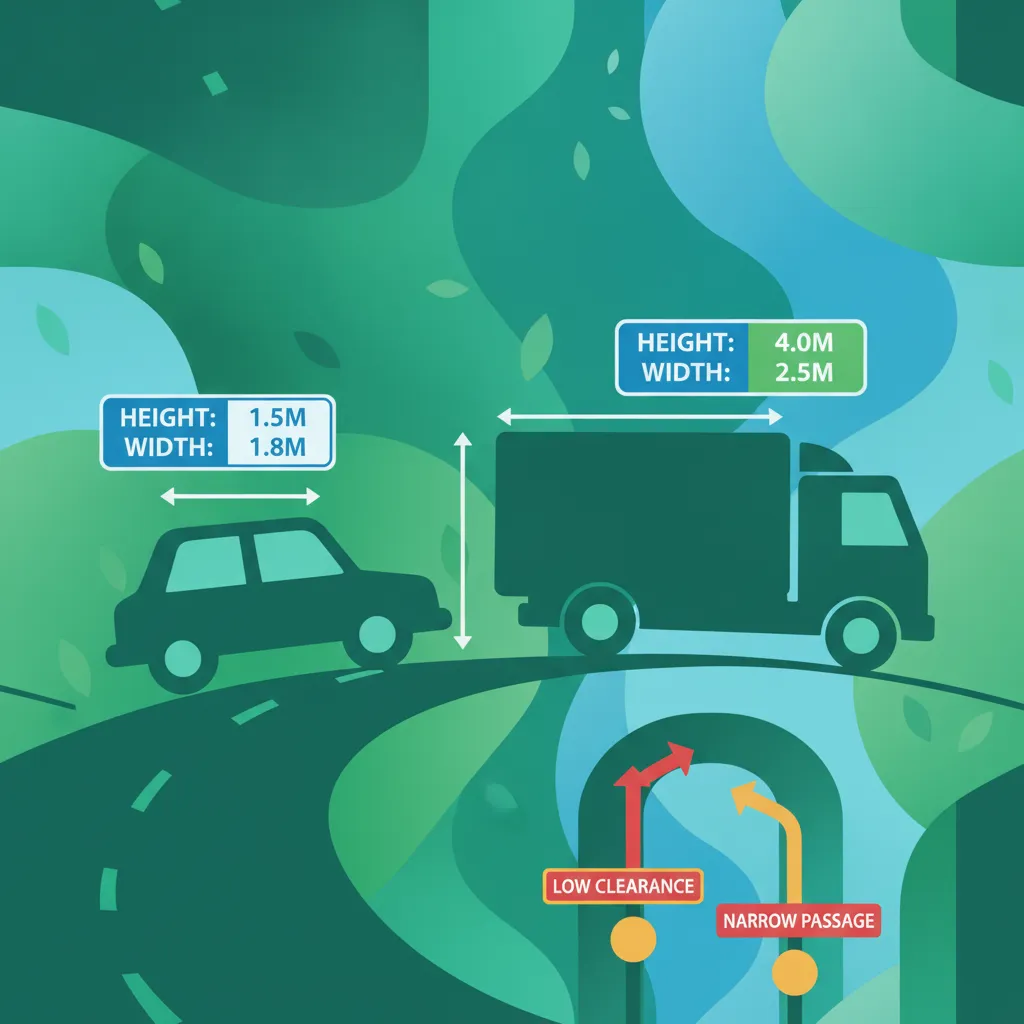
This lesson focuses on the specific dimensional limits that heavy goods vehicles must adhere to on Italian roads, as stipulated by the Codice della Strada. It covers the maximum permissible length, width, and height, explaining how these restrictions impact navigation through tunnels, under bridges, and within urban environments. Learners will also understand the conditions under which special permits for exceptional or oversized transport are required.

This lesson focuses on the specific regulations and techniques for operating a heavy vehicle on high-speed motorways. It covers mandatory lane discipline for trucks, the rules governing overtaking other heavy vehicles, and the specific speed limits that apply. Best practices for merging onto and exiting the motorway, maintaining safe following distances, and using the hard shoulder only in genuine emergencies are also detailed.

This lesson bridges the gap between general traffic laws and their specific application to heavy goods vehicles. It examines how rules regarding speed limits, lane discipline, overtaking, and priority are modified or have special considerations for trucks due to their size, weight, and reduced maneuverability. Drivers will learn to correctly interpret road signs and signals within the context of operating a large vehicle, ensuring safe and compliant integration with other traffic.

This lesson focuses on the importance of meticulous pre-journey planning for urban deliveries. It teaches drivers how to use maps and digital tools to plan routes that avoid physical restrictions (low bridges, narrow streets), legal restrictions (ZTLs, weight limits), and temporary disruptions. Effective route planning saves time, reduces stress, and ensures that all deliveries can be made legally and safely.

This lesson covers the complete set of lighting, reflective equipment, and protective guards mandated for heavy vehicles. It explains the function of each light, from headlights to side markers, and the importance of keeping them clean and operational to ensure the vehicle is visible to others. The lesson also details the legal requirements and safety purpose of side guards and rear underrun protection, which are designed to protect vulnerable road users in a collision.
Explore the physiological impacts of driver fatigue, including reduced reaction times and microsleeps. Learn proactive strategies to manage alertness, understand circadian rhythms, and maintain safety on long-distance driving routes.

This lesson examines the significant impact of human factors on driving safety. It details the warning signs and dangers of driving while fatigued, and identifies major sources of distraction, especially the illegal use of mobile phones. The content also explores how emotions like stress and anger can impair judgment and lead to aggressive or unsafe driving behaviors, emphasizing the need for self-awareness and control.

This lesson explores the significant dangers of rider fatigue and dehydration, which can severely degrade concentration and slow reaction times. It teaches riders to recognize the early warning signs and implement proactive strategies to stay alert, such as taking regular breaks and maintaining proper hydration. The content stresses that managing one's physical and mental condition is a critical aspect of road safety.
This lesson focuses on the logistical aspects of long-haul driving. It teaches drivers how to plan journeys to comply with legal driving hours and mandatory rest periods, using a tachograph to record activity. The lesson also covers how to plan for fuel stops and select safe and secure overnight parking locations at motorway service areas or designated truck stops.

This lesson covers three critical risks associated with heavy vehicle braking systems. It explains 'brake lag' in air brake systems, the delay between pedal application and brake activation, and 'brake fade', the loss of braking efficiency due to overheating. Learners will be taught to recognize the warning signs and, more importantly, to use correct driving techniques, such as utilizing endurance brakes, to prevent these potentially catastrophic failures.
This lesson covers the complete set of lighting, reflective equipment, and protective guards mandated for heavy vehicles. It explains the function of each light, from headlights to side markers, and the importance of keeping them clean and operational to ensure the vehicle is visible to others. The lesson also details the legal requirements and safety purpose of side guards and rear underrun protection, which are designed to protect vulnerable road users in a collision.

This lesson provides a step-by-step guide for managing a vehicle breakdown safely. It reinforces the procedure for stopping on the hard shoulder, activating hazard lights, and placing a warning triangle at the correct distance. The lesson emphasizes the importance of wearing high-visibility clothing, exiting the vehicle from the side away from traffic, and waiting in a safe location before contacting a roadside assistance service.

This lesson provides a structured, step-by-step guide to conducting a thorough pre-drive inspection. It outlines a systematic walk-around procedure, covering critical checks of tyres, wheels, lights, brakes, fluid levels, mirrors, and load security before starting any journey. Emphasizing this daily routine helps instill the professional habit of verifying vehicle roadworthiness and identifying potential issues before they become dangerous on the road.

This lesson highlights the large blind spots—or 'no-zones'—that exist to the front, back, and sides of a heavy vehicle, where smaller vehicles, cyclists, and pedestrians can disappear from view. It teaches proactive scanning techniques, the importance of anticipating hazards, and how to use mirrors and direct vision effectively to manage these high-risk areas. Awareness and mitigation of blind spots are crucial for preventing collisions, especially in urban traffic.
This lesson delves into the specific articles of the Italian Codice della Strada that apply to heavy goods vehicles. It outlines the core legal and professional obligations of a driver, including the heightened duty of care owed to other road users and the responsibility for the vehicle's roadworthiness and load. Learners will understand the legal consequences of non-compliance, such as fines and sanctions, reinforcing the importance of adhering to all traffic regulations.

This lesson details the profound and dangerous effects of alcohol and drugs on driving ability, including impaired coordination, slowed reaction time, and poor judgment. It specifies the legal blood alcohol concentration (BAC) limits in Italy, including the strict zero-tolerance policy for beginner drivers. The content also outlines the severe legal consequences of a DUI conviction, which can include heavy fines, license revocation, and imprisonment.
Find clear answers to common questions learners have about Fatigue Management and Rest Regulations. Learn how the lesson is structured, which driving theory objectives it supports, and how it fits into the overall learning path of units and curriculum progression in Italy. These explanations help you understand key concepts, lesson flow, and exam focused study goals.
These regulations exist to ensure road safety by preventing driver fatigue. By mandating specific periods of rest and limiting maximum driving hours, the law ensures that professional drivers remain alert and capable of operating heavy vehicles safely.
The tachograph is a legally required device that records your driving time, speed, and distance, as well as your periods of availability, rest, and break time. It serves as an objective record of your compliance with statutory driving and rest regulations during inspections.
Generally, the rules for driving and rest times fall under the same EU regulations for all professional goods vehicle categories. However, you must always be aware of the specific vehicle mass and load context associated with your license type when reviewing regulatory requirements.
Failure to take mandatory breaks is a violation of traffic law and can lead to severe fines, suspension of your driving license, or even criminal proceedings if it results in an accident. During the theory exam, expect questions that test your understanding of these specific consequences.
Start searching now to pinpoint exactly which Italian driving theory topics, road signs, or traffic rules you need to master. Use our advanced filters to build a custom practice session and ensure you're fully prepared for every aspect of your official driving licence exam.