
This lesson breaks down the science of total stopping distance, a critical concept for both your Patente B theory exam and everyday safe driving. By analyzing reaction and braking distances, you will learn how speed, vehicle maintenance, and road surface conditions directly influence your ability to stop safely.
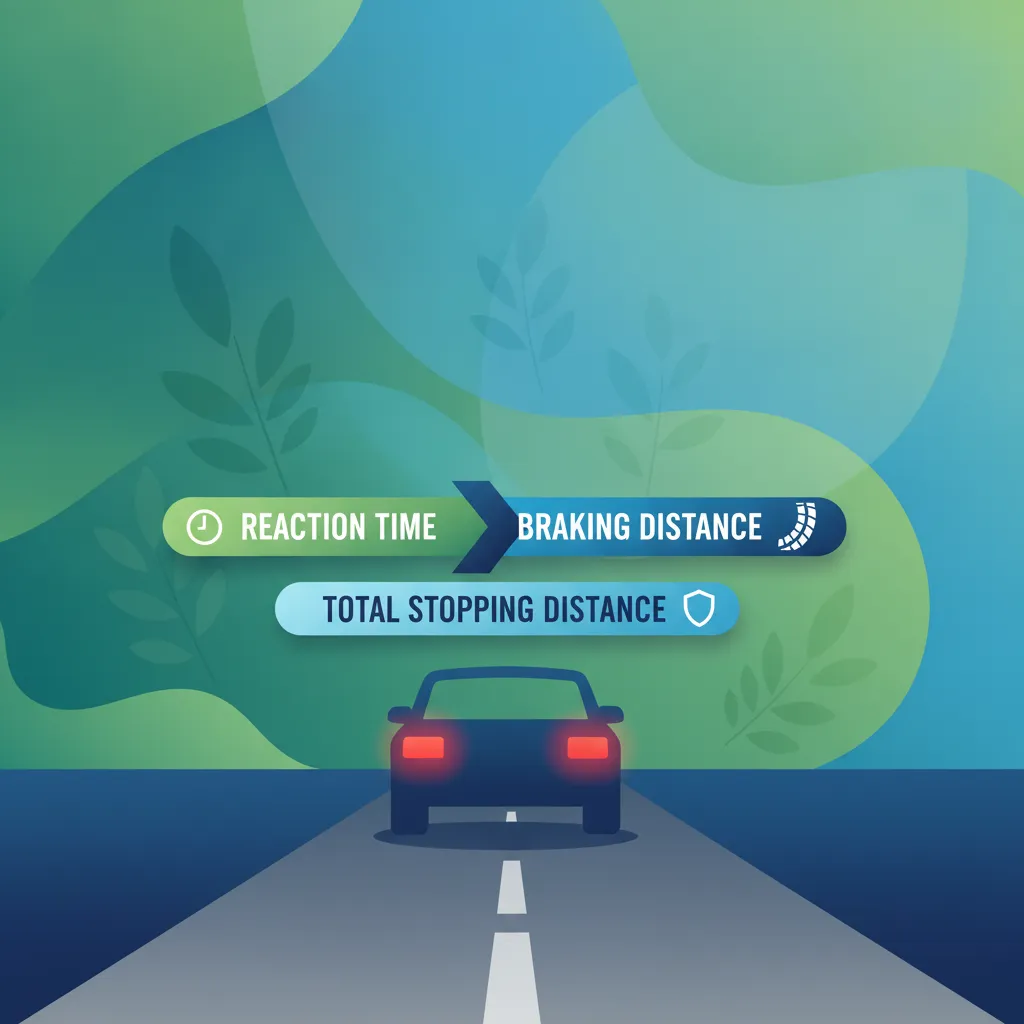
Lesson content overview
Driving safely in Italy, as anywhere, requires a deep understanding of how long it takes your vehicle to come to a complete stop. This crucial concept, known as total stopping distance, is fundamental for anticipating hazards, maintaining a safe following distance, and making informed decisions on the road. For your Italian Patente B theory course, mastering the components of stopping distance – reaction distance and braking distance – is key to becoming a responsible and prepared driver.
Total stopping distance refers to the entire distance your vehicle travels from the moment you perceive a hazard until your vehicle is completely stationary. It's not just about how good your brakes are; it's a combination of human reaction time and the physical capabilities of your vehicle.
Understanding total stopping distance is paramount for several reasons:
This lesson will break down total stopping distance into its essential components, explore the factors that influence each, and provide practical insights for safer driving in Italy.
Total stopping distance (TSD) is the sum of two distinct phases: the reaction distance (RD) and the braking distance (BD). Each phase is influenced by different factors, making TSD a dynamic measurement that changes with every driving situation.
The reaction distance (Distanza di Reazione) is the distance your vehicle covers from the instant you perceive a hazard until you actually apply the brakes. This is the "human factor" component of stopping distance, highlighting the critical role of driver alertness and responsiveness.
The distance a vehicle travels during the driver's perception-reaction interval before the brakes are applied.
This distance is directly proportional to your speed and the duration of your perception-reaction interval. At higher speeds, even a short reaction time translates into a significant distance covered before any braking action begins.
The time it takes for a driver to react to a hazard is known as the perception-reaction interval (PRI). This interval isn't instantaneous; it's a sequence of mental and physical processes:
For an alert driver under normal conditions, the typical perception-reaction interval is approximately 2.5 seconds. This value is a crucial baseline for estimating reaction distances.
Many factors can significantly lengthen your perception-reaction interval, directly increasing your reaction distance and, consequently, your total stopping distance:
Never underestimate the impact of distractions or fatigue on your reaction time. Even a momentary lapse can add critical metres to your stopping distance.
The braking distance (Distanza di Frenata) is the distance your vehicle travels from the moment you apply the brakes until it comes to a complete stop. Unlike reaction distance, braking distance is primarily a function of physics and vehicle dynamics.
The distance a vehicle travels from the moment the brakes are applied until it comes to a complete stop.
This distance is influenced by a range of factors related to the vehicle, the road, and the environment.
One of the most critical relationships in driving safety is that braking distance increases quadratically with speed. This means:
This non-linear relationship is why even small increases in speed have a dramatic impact on the distance required to stop. For instance, stopping at 100 km/h takes significantly more than double the distance required to stop at 50 km/h. This principle is derived from the laws of motion, where the kinetic energy that needs to be dissipated through braking is proportional to the square of the velocity.
The interaction between your tyres and the road surface is crucial for effective braking. This interaction is quantified by the coefficient of friction (coefficiente di attrito), often denoted by 'µ'.
Any condition that reduces tyre grip will increase braking distance. This includes:
Beyond speed and road surface, several other factors contribute to the braking distance:
While exact calculations require detailed physics, driving theory often uses simplified estimates to help drivers understand the magnitudes involved. It's not about memorizing complex formulas for every situation, but rather appreciating the principles.
The reaction distance is calculated using the simple formula:
RD (metres) = Speed (km/h) / 3.6 × Perception-Reaction Interval (seconds)
Or, more simply for quick mental calculation, particularly in Italy:
For every 10 km/h of speed, the vehicle travels approximately 3 metres during a 1-second reaction time. If using the typical 2.5 second PRI, then for every 10 km/h of speed, RD ≈ 7.5 metres.
Let's use the typical 2.5-second PRI for an alert driver:
These figures highlight how quickly reaction distance adds up, especially at higher speeds.
Braking distance is more complex as it depends heavily on the deceleration rate ('a'). A common formula is:
BD (metres) = v² / (2a) Where 'v' is speed in metres per second (m/s) and 'a' is the deceleration rate in m/s².
Typical deceleration rates:
Let's look at examples:
Scenario 1: Dry Asphalt (a ≈ 8 m/s²)
Scenario 2: Wet Asphalt (a ≈ 5 m/s²)
Notice how significantly braking distance increases on wet surfaces, even at relatively moderate speeds.
By combining reaction distance and braking distance, we get the total stopping distance (TSD).
Example 1: Urban Intersection, Dry Day
Example 2: Motorway, Light Rain
Example 3: Hilly Rural Road, Heavy Load, Downhill
These examples vividly demonstrate that stopping distance is far from constant and requires continuous adjustment based on conditions.
The practical application of understanding total stopping distance is maintaining a safe following distance, known in Italy as Distanza di Sicurezza. This is the space you leave between your vehicle and the vehicle directly in front of you.
The Italian Codice della Strada (Highway Code) mandates that drivers must always maintain a safe distance from the vehicle ahead. This distance must be sufficient to allow the driver to stop without colliding if the preceding vehicle brakes suddenly. While the law doesn't specify a fixed number of metres for all situations, it implies that your Distanza di Sicurezza must be at least equal to your total stopping distance under the prevailing conditions.
A common rule of thumb, used internationally and applicable for the Patente B exam, is the "two-second rule" (or three-second rule in adverse conditions):
This time-based method helps drivers gauge a dynamic safe distance that automatically adjusts with speed: the faster you go, the more distance you naturally cover in two seconds.
Maintaining a safe following distance isn't static; it requires constant adjustment based on various factors:
Always assume the vehicle in front of you might stop suddenly. The "two-second rule" is a minimum; extend it in any less-than-ideal condition.
Beyond the basic breakdown, several critical factors consistently influence your ability to stop safely. Being aware of these ensures you can make informed decisions behind the wheel.
The driver is the most variable element in the stopping distance equation.
The physical condition of your vehicle plays a direct role in its braking capability.
Environmental variables are often beyond a driver's control but must always be accounted for.
Do not rely solely on your vehicle's safety features like ABS in adverse conditions. They assist, but cannot defy the laws of physics. Your driving behaviour remains the most critical safety factor.
The Italian Codice della Strada (Legislative Decree 285/1992 and subsequent amendments) places significant emphasis on maintaining a safe driving distance, implicitly linking it to the principles of stopping distance. While specific metre values for Distanza di Sicurezza are not always explicitly stated for every scenario, the overarching principle is clear:
The Italian legal framework prioritises driver responsibility in assessing and adjusting to prevailing conditions to prevent accidents, with the concept of stopping distance as a fundamental underlying principle.
Many accidents, particularly rear-end collisions, stem from a misunderstanding or disregard for stopping distances.
Always be proactive. Assume others might make mistakes, and adjust your speed and distance to give yourself maximum time and space to react.
Understanding total stopping distance, reaction distance, and braking distance is not merely a theoretical exercise for your Italian Patente B exam; it is a critical life skill for safe driving. The ability to accurately assess and adapt to constantly changing road, vehicle, and driver conditions is the hallmark of a responsible motorist.
Remember these core principles:
By internalising these concepts, you equip yourself with the knowledge to make safer choices, reduce the risk of collisions, and confidently navigate the roads of Italy.
This lesson explains that total stopping distance consists of reaction distance (human factor, affected by alertness and distraction) and braking distance (physical factor, affected by speed, road surface, tyre condition, and vehicle load). The critical relationship is that braking distance increases quadratically with speed—doubling speed quadruples braking distance. Safe following distance in Italy (Distanza di Sicurezza) must at least equal your total stopping distance under current conditions, commonly estimated using the two-second rule, extended in adverse weather or when carrying heavy loads. Understanding these principles is essential for both passing the Patente B theory exam and practising defensive driving on Italian roads.
A short set of high-value points that capture the most important learning from this lesson.
Total stopping distance equals reaction distance plus braking distance, representing the entire distance traveled from hazard perception to a complete stop.
Reaction distance is determined by driver alertness and perception-reaction time (typically 2.5 seconds for an alert driver), multiplied by speed.
Braking distance increases quadratically with speed, meaning doubling speed quadruples braking distance.
Road surface conditions dramatically affect braking distance through the coefficient of friction, ranging from 0.7-0.9 on dry asphalt to approximately 0.1 on ice.
Italian traffic law requires maintaining a safe following distance (Distanza di Sicurezza) sufficient to stop without collision under prevailing conditions.
Explore all units and lessons included in this driving theory course.
Reaction distance at 50 km/h with 2.5s perception-reaction interval is approximately 35 metres; at 120 km/h it exceeds 80 metres.
Wet road conditions roughly double braking distance compared to dry conditions; icy conditions can increase it by a factor of three to four.
Use the two-second rule as a minimum safe following distance, extending to three seconds in adverse conditions.
Vehicle load, downhill gradients, worn tyres, and poor brake maintenance all increase braking distance and require greater following distances.
The deceleration rate on dry asphalt averages 7-9 m/s², dropping to 5-6 m/s² on wet surfaces and just 1-3 m/s² on ice.
Assuming braking distance doubles linearly with speed instead of quadratically, leading to dangerously close following distances at higher speeds.
Failing to adjust following distance for wet or icy conditions, maintaining the same gap as on dry roads.
Believing ABS always reduces stopping distance; ABS primarily maintains steering control during hard braking rather than shortening the stop.
Underestimating reaction distance when fatigued, distracted, or using a mobile phone, which can extend perception-reaction time beyond the standard 2.5 seconds.
Neglecting to account for heavy vehicle loads or downhill gradients when calculating safe stopping distance.
Lesson content overview
A short set of high-value points that capture the most important learning from this lesson.
Total stopping distance equals reaction distance plus braking distance, representing the entire distance traveled from hazard perception to a complete stop.
Reaction distance is determined by driver alertness and perception-reaction time (typically 2.5 seconds for an alert driver), multiplied by speed.
Braking distance increases quadratically with speed, meaning doubling speed quadruples braking distance.
Road surface conditions dramatically affect braking distance through the coefficient of friction, ranging from 0.7-0.9 on dry asphalt to approximately 0.1 on ice.
Italian traffic law requires maintaining a safe following distance (Distanza di Sicurezza) sufficient to stop without collision under prevailing conditions.
Explore all units and lessons included in this driving theory course.
Reaction distance at 50 km/h with 2.5s perception-reaction interval is approximately 35 metres; at 120 km/h it exceeds 80 metres.
Wet road conditions roughly double braking distance compared to dry conditions; icy conditions can increase it by a factor of three to four.
Use the two-second rule as a minimum safe following distance, extending to three seconds in adverse conditions.
Vehicle load, downhill gradients, worn tyres, and poor brake maintenance all increase braking distance and require greater following distances.
The deceleration rate on dry asphalt averages 7-9 m/s², dropping to 5-6 m/s² on wet surfaces and just 1-3 m/s² on ice.
Assuming braking distance doubles linearly with speed instead of quadratically, leading to dangerously close following distances at higher speeds.
Failing to adjust following distance for wet or icy conditions, maintaining the same gap as on dry roads.
Believing ABS always reduces stopping distance; ABS primarily maintains steering control during hard braking rather than shortening the stop.
Underestimating reaction distance when fatigued, distracted, or using a mobile phone, which can extend perception-reaction time beyond the standard 2.5 seconds.
Neglecting to account for heavy vehicle loads or downhill gradients when calculating safe stopping distance.
Explore search topics learners often look for when studying Stopping Distance, Reaction and Braking Distances. These topics reflect common questions about road rules, driving situations, safety guidance, and lesson level theory preparation for learners in Italy.
Browse additional driving theory lessons that cover connected traffic rules, road signs, and common driving situations related to this topic. Improve your understanding of how different rules interact across everyday traffic scenarios.
Understand how driver fatigue, distraction, impairment, and vehicle maintenance issues like tyre wear affect stopping distances. Essential theory for safe driving and passing your Italian Patente B exam.

This lesson details the profound and dangerous effects of alcohol and drugs on driving ability, including impaired coordination, slowed reaction time, and poor judgment. It specifies the legal blood alcohol concentration (BAC) limits in Italy, including the strict zero-tolerance policy for beginner drivers. The content also outlines the severe legal consequences of a DUI conviction, which can include heavy fines, license revocation, and imprisonment.

This lesson examines the significant impact of human factors on driving safety. It details the warning signs and dangers of driving while fatigued, and identifies major sources of distraction, especially the illegal use of mobile phones. The content also explores how emotions like stress and anger can impair judgment and lead to aggressive or unsafe driving behaviors, emphasizing the need for self-awareness and control.

This lesson explores the significant dangers of rider fatigue and dehydration, which can severely degrade concentration and slow reaction times. It teaches riders to recognize the early warning signs and implement proactive strategies to stay alert, such as taking regular breaks and maintaining proper hydration. The content stresses that managing one's physical and mental condition is a critical aspect of road safety.

This lesson addresses one of the biggest risks in professional driving: fatigue. It explains the physiological effects of fatigue on reaction time and decision-making and details the EU regulations on driving hours, breaks, and daily/weekly rest periods that are legally mandated to prevent it. Learners will understand how to use the tachograph to record their activity and the importance of taking all required breaks to maintain safety.
This lesson details the dangerous effects of alcohol, illegal drugs, and some prescription or over-the-counter medications on a rider's ability to operate a motorcycle safely. It explains how these substances impair coordination, judgment, vision, and reaction time. The content covers the strict legal blood alcohol concentration (BAC) limits in Italy and the severe legal penalties for riding under the influence.
This lesson focuses on the factors that determine a motorcycle's total stopping distance: perception time, reaction time, and braking distance. It provides a clear understanding of how speed exponentially increases the distance required to come to a complete stop. Learners will be able to apply principles like the two-second rule to maintain a safe and appropriate following distance in various traffic situations.

This lesson is dedicated to the vital concept of 'distanza di sicurezza', the safe following distance required to avoid a rear-end collision. It explains how this distance is not fixed but varies with speed and conditions, covering practical methods like the 'two-second rule' to help judge it accurately. Maintaining this space cushion provides the necessary time to react and brake safely if the vehicle ahead stops suddenly.
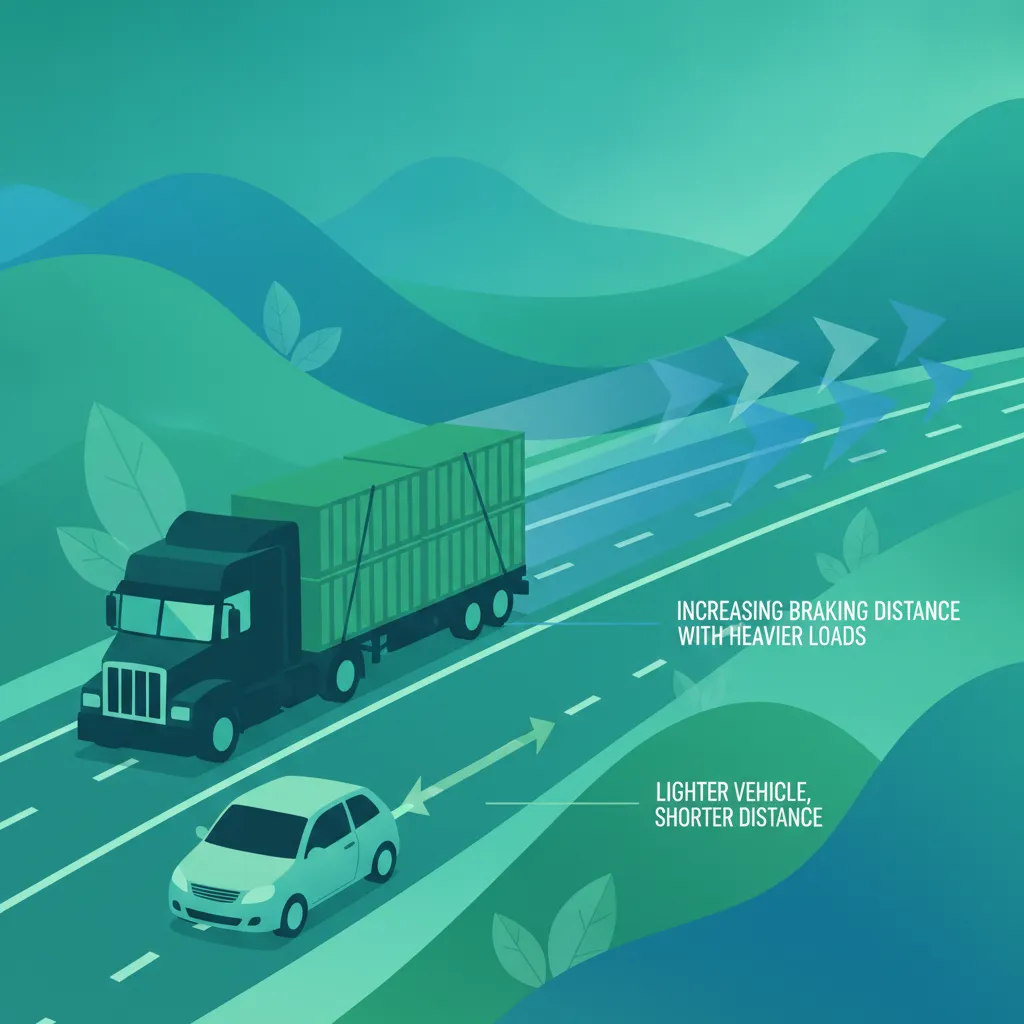
This lesson explores the critical physics behind stopping a heavy vehicle. It breaks down the components of total stopping distance—thinking distance and braking distance—and explains how this is significantly increased by vehicle mass and speed. Learners will understand the necessity of maintaining a much greater following distance than a car to allow enough space to stop safely in all conditions.
This lesson introduces modern Advanced Driver-Assistance Systems (ADAS) found in many contemporary vehicles. It explains the function of features such as lane-keeping assist, blind-spot monitoring, and adaptive cruise control. Crucially, the content emphasizes that these are assistance systems and do not replace the driver's responsibility to remain fully attentive and in control of the vehicle at all times.
Explore how road conditions, vehicle load, and weather impact your total stopping distance. Understand how to adjust your following distance (Distanza di Sicurezza) in Italy based on these critical factors to ensure road safety.
This lesson is dedicated to the vital concept of 'distanza di sicurezza', the safe following distance required to avoid a rear-end collision. It explains how this distance is not fixed but varies with speed and conditions, covering practical methods like the 'two-second rule' to help judge it accurately. Maintaining this space cushion provides the necessary time to react and brake safely if the vehicle ahead stops suddenly.
This lesson addresses two key aspects of defensive riding: maintaining a safe buffer and performing overtaking maneuvers. It details how to use time-based rules, such as the two-second rule, to ensure adequate following distance for reaction. The content also provides a structured approach to overtaking, covering observation, signalling, speed management, and ensuring sufficient clearance before returning to the lane.

This lesson teaches riders how to maintain a safe following distance using the two-second rule, which accounts for reaction time and braking distance. It covers grip management, explaining how tire condition and road surfaces like wet asphalt affect traction. Mastering these concepts is essential for anticipating hazards and preventing rear-end collisions.
This lesson focuses on the factors that determine a motorcycle's total stopping distance: perception time, reaction time, and braking distance. It provides a clear understanding of how speed exponentially increases the distance required to come to a complete stop. Learners will be able to apply principles like the two-second rule to maintain a safe and appropriate following distance in various traffic situations.
This lesson explores the critical physics behind stopping a heavy vehicle. It breaks down the components of total stopping distance—thinking distance and braking distance—and explains how this is significantly increased by vehicle mass and speed. Learners will understand the necessity of maintaining a much greater following distance than a car to allow enough space to stop safely in all conditions.

This lesson provides comprehensive guidance on the rules and best practices for safe overtaking. It explains how to assess whether it is legal and safe to pass, considering road markings, signs, and the distance of oncoming traffic. The content details the correct procedure, including signaling, accelerating, maintaining a safe distance during the maneuver, and returning to the original lane safely.
This lesson teaches the crucial skill of selecting a safe and appropriate speed that may be lower than the legal limit, based on prevailing conditions. It explains how to assess factors such as traffic flow, weather, visibility, and road surface quality to make prudent speed choices. The goal is to always maintain full control of the vehicle and have sufficient time to react to unexpected hazards.
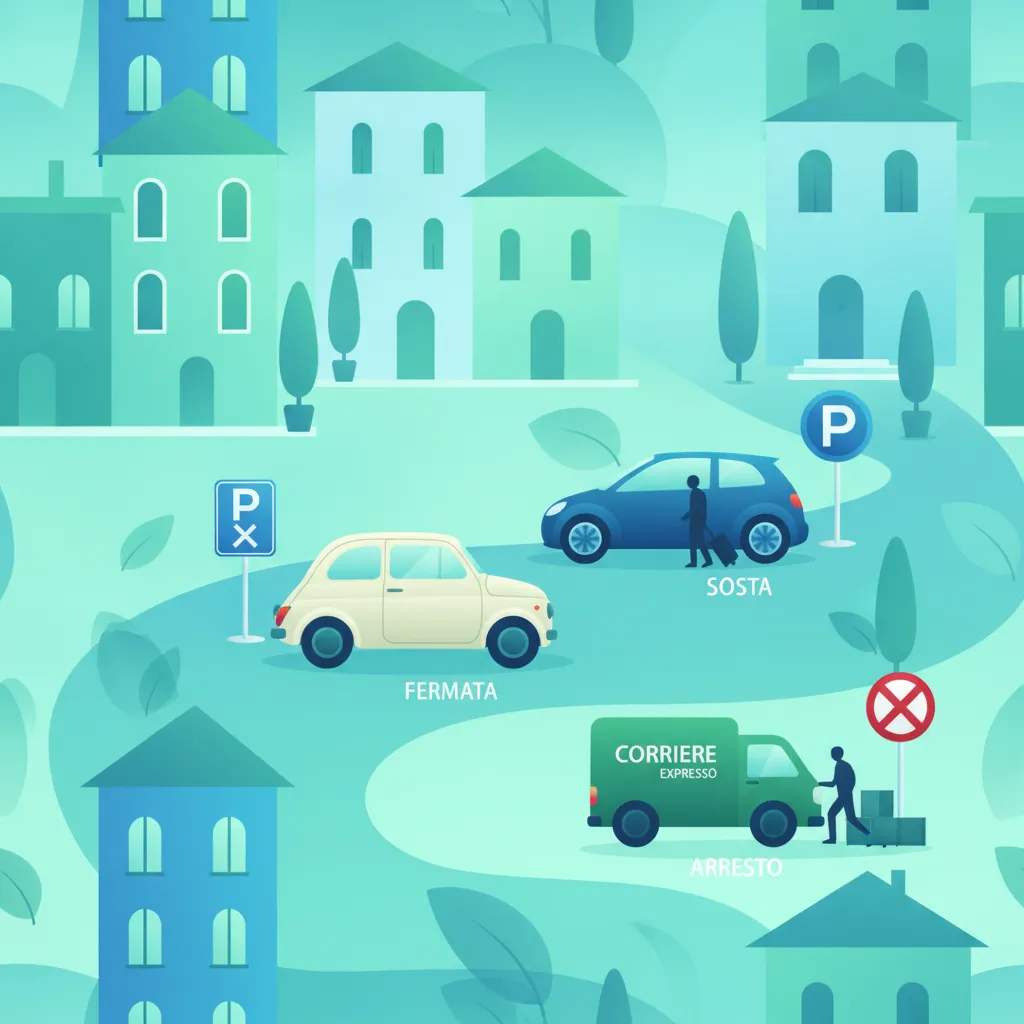
This lesson explains the important legal distinctions between three types of vehicle halts in Italy: 'fermata' (a brief stop for passengers/cargo without the driver leaving), 'sosta' (parking, where the driver may leave), and 'arresto' (a stop due to traffic or signals). Understanding these definitions is essential for knowing where and when it is legal to stop or park your vehicle without causing an obstruction or incurring a fine.
This lesson provides critical guidance on how to safely share the road with vulnerable users, including pedestrians, cyclists, motorcyclists, and children. It highlights the importance of increased awareness in specific areas like school zones and crosswalks. The content teaches techniques for maintaining a safe lateral distance when overtaking, checking blind spots thoroughly, and anticipating the often unpredictable movements of these users.

This lesson provides essential rules and techniques for driving on Italian motorways (autostrade) and major extra-urban roads. It explains how to safely merge onto the motorway from an entry ramp, the strict lane discipline required (drive right, overtake left), and how to exit correctly. The content also covers speed regulations, maintaining a safe following distance at high speed, and procedures for using service areas and handling emergencies.
Find clear answers to common questions learners have about Stopping Distance, Reaction and Braking Distances. Learn how the lesson is structured, which driving theory objectives it supports, and how it fits into the overall learning path of units and curriculum progression in Italy. These explanations help you understand key concepts, lesson flow, and exam focused study goals.
No, braking distance increases exponentially with speed, not linearly. This means that even a small increase in speed results in a significantly longer distance required to bring your vehicle to a full stop.
Nothing reduces your reaction time, but many factors increase it. Fatigue, alcohol, drugs, use of mobile phones, and general distraction significantly slow down your ability to respond to hazards, making your reaction distance much longer.
Road conditions like rain, snow, or gravel primarily affect your braking distance by reducing grip (adhesion). Your reaction distance remains dependent on your physical and mental state as a driver, but your braking distance will increase on slippery surfaces.
Yes, the Italian theory exam often features questions that test your understanding of how variables like speed and surface conditions influence stopping distance, often requiring you to choose the correct relationship between these factors.
Start searching now to pinpoint exactly which Italian driving theory topics, road signs, or traffic rules you need to master. Use our advanced filters to build a custom practice session and ensure you're fully prepared for every aspect of your official driving licence exam.