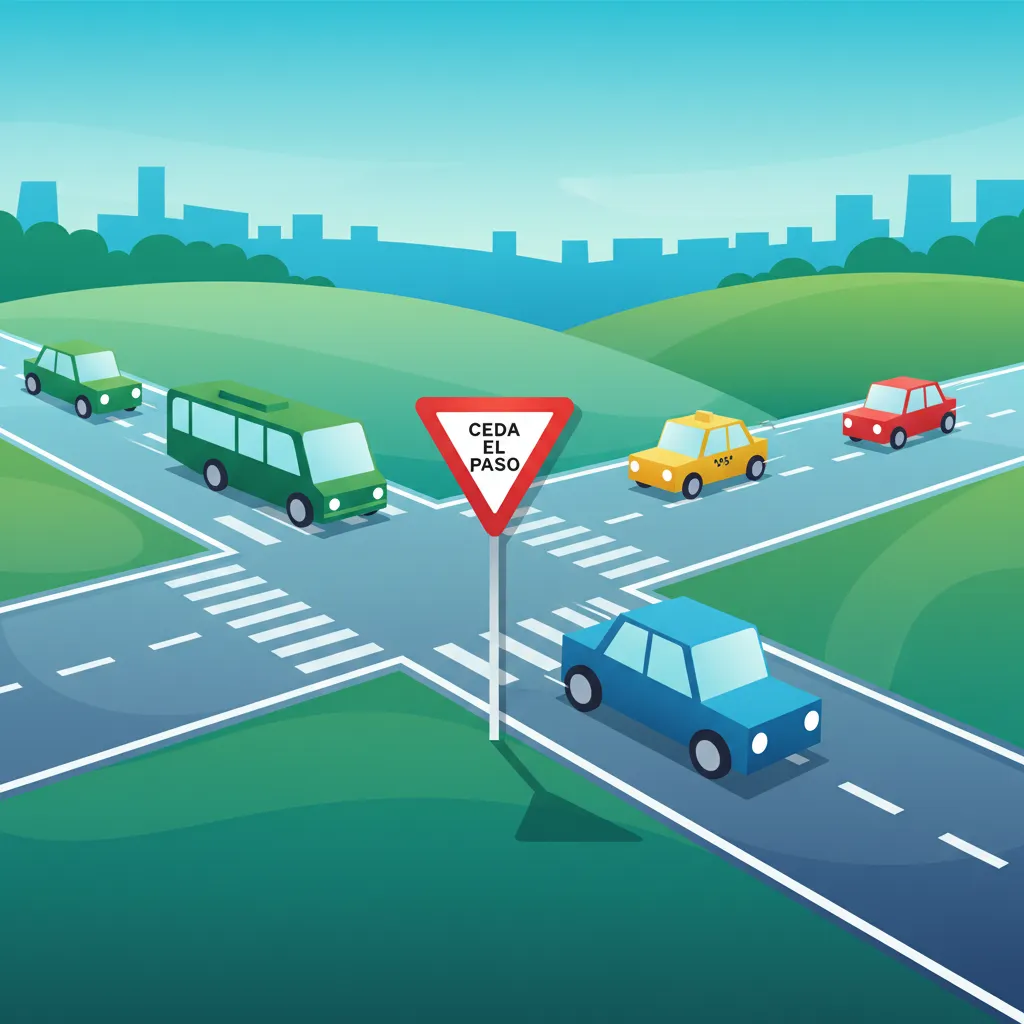
The Give Way sign, or 'Ceda el Paso' (R-1) in Spain, is a triangular sign that requires drivers to yield priority to vehicles on the intersecting road or lane. Unlike a Stop sign, a complete stop is not always mandatory, but you must be prepared to stop and only proceed when it is safe to do so without interrupting other traffic flow. Mastering this rule is fundamental for safe driving and passing the Spanish theory exam.
Theory topic content overview
Read the full theory topic guide for Give Way Sign (Ceda el Paso) with structured, easy-to-scan content built for learners in Spain. This detailed section explains the exact rule, meaning, traffic context, comparison points, and exam logic behind this Spanish driving theory topic so you can study faster, understand the concept more clearly, and avoid common interpretation mistakes on the theory test.
The Give Way sign, officially known as Ceda el Paso (Reglamento General de Circulación, R-1) in Spain, is a critical regulatory traffic sign that instructs drivers to yield priority to vehicles on the intersecting road or lane. Visually, it's an inverted equilateral triangle with a red border and a white background, often accompanied by the words "Ceda el Paso" on a complementary panel.
Its core meaning is straightforward: you do not have automatic right-of-way and must allow other traffic to pass before proceeding. While similar in purpose to a Stop sign, the Ceda el Paso carries a crucial distinction: a complete stop is only mandatory if necessary to yield to priority traffic or if visibility is insufficient to safely assess the situation.
Understanding the Ceda el Paso rule is not just about memorizing a sign; it's fundamental for safe driving and a frequent focus of the DGT theory exam for your Spanish driving license.
Ceda el Paso leads to hesitation or dangerous incursions into priority traffic, a common cause of accidents at intersections across Spain, from busy urban junctions to rural road merges onto an autovía.Ceda el Paso is a binding regulation. Failing to yield appropriately can result in fines and penalty points on your Spanish driving license.Dirección General de Tráfico (DGT) places significant emphasis on priority rules. Scenarios involving Ceda el Paso signs, especially comparing them with Stop signs, are common DGT exam questions and a key area where learners often make mistakes.When you encounter a Ceda el Paso sign in Spain, your actions should follow a clear decision-making process:
Ceda el Paso painted on the road surface, begin to reduce your speed. Scan the intersecting road or lane for approaching traffic from all relevant directions (usually left and right). Look for any supplementary panels, which sometimes indicate the distance to the intersection (e.g., "a 150 m").Ceda el Paso governs entry. Consider their speed and distance.Remember, the goal is to enter the traffic flow smoothly and safely, without causing any disruption to vehicles that have the right of way.
This is one of the most critical distinctions for any Spanish driver and a frequent source of confusion on the DGT exam.
| Feature | Ceda el Paso (R-1) | Stop Sign (R-2) |
|---|---|---|
| Shape | Inverted equilateral triangle | Octagonal (8-sided) |
| Action | Yield priority; stop only if necessary. | Always make a complete stop, even if clear. |
| Visibility | Stop if vision is poor. | Stop, then edge forward if vision is poor. |
| Legal Wording | Ceda el Paso (Yield the way) | STOP (Detención Obligatoria) |
The key takeaway for the DGT exam and practical driving: at a Ceda el Paso, your decision to stop is conditional on traffic. At a Stop sign, the stop itself is unconditional; only the duration of the stop and the timing of your re-entry are conditional on traffic.
Your decision to stop or proceed at a Ceda el Paso sign is dynamic and depends on several factors:
autovía or autopista from a slip road requires a much larger gap than crossing a quiet urban street.Carretera: You're driving on a small road and see a Ceda el Paso sign before a major carretera nacional. You slow down, check left and right. If the main road is clear for a sufficient distance, you smoothly accelerate and merge. If a car is approaching quickly, you stop completely before the junction line, wait for it to pass, and then proceed when safe.Ceda el Paso sign. You must yield to all vehicles already circulating inside the roundabout, regardless of their position relative to your entry point. Only enter when there's a clear gap that doesn't force existing roundabout traffic to brake.Autovía or Autopista: While many motorway entries use acceleration lanes, some older or less common junctions might feature a Ceda el Paso before you even reach the acceleration lane or at the very end of it. Here, the challenge is not only yielding to fast-moving traffic but also quickly building speed in the acceleration lane to match the flow.Learners frequently stumble on Ceda el Paso rules for various reasons:
Ceda el Paso like a Stop sign.regla de la derecha). The Ceda el Paso sign overrides this, specifically assigning priority.Ceda el Paso Mental ModelFor every Ceda el Paso in Spain, adopt this mental model: "Observe, Anticipate, and Act with Certainty."
You are responsible for ensuring your maneuver is safe and does not impede traffic with priority. This means:
Mastering the Ceda el Paso is a cornerstone of safe, confident, and legally compliant driving on Spanish roads.
The Ceda el Paso sign (R-1) instructs drivers to yield priority at intersections without mandating a complete stop unless traffic or poor visibility requires it. Unlike the Stop sign (R-2), where stopping is always mandatory and unconditional, the Ceda el Paso stop is situational—slow down, observe all directions, and proceed only when safe. The key decision factors are visibility, the speed and distance of approaching traffic, road type, and the presence of vulnerable road users. For roundabouts, you must yield to vehicles already circulating inside. Common learner mistakes include unnecessary stopping, failing to stop for poor visibility, incomplete observation, and confusion with unsigned intersection rules. Mastery of this distinction is essential for both safe driving and passing the DGT theory exam.
A short set of high-value points that capture the most important ideas from this theory explanation.
The Ceda el Paso sign (R-1) is a red-bordered inverted equilateral triangle requiring you to yield priority to other traffic without a mandatory stop unless conditions demand it.
Your stopping decision at a Ceda el Paso is conditional—stop only if priority traffic is present or visibility is poor, not simply because the sign exists.
At a Stop sign (R-2), you must always make a complete stop at the line first, regardless of whether the road appears clear.
Always slow down when approaching a Ceda el Paso, scan for priority traffic from all directions, and be prepared to stop before proceeding.
When entering a Spanish roundabout marked with Ceda el Paso, you must yield to all vehicles already circulating inside before entering.
Ceda el Paso (R-1) = inverted triangle = yield only if necessary; Stop (R-2) = octagon = always stop completely first.
If visibility is obstructed at a Ceda el Paso, you must stop until you can see clearly; at a Stop sign, you stop first and then edge forward to improve view.
At unsigned intersections in Spain, the 'regla de la derecha' applies—yield to traffic from the right—but a Ceda el Paso sign overrides this general rule.
Assess both speed and distance of approaching traffic; a visible vehicle may still be too close or too fast for a safe gap.
Vulnerable road users like pedestrians and cyclists generally have priority over vehicles when turning in Spain.
Treating every Ceda el Paso like a Stop sign and stopping unnecessarily when the path is clear, causing delays for following traffic.
Failing to stop when visibility is poor (blocked by parked cars, buildings, or weather), instead proceeding slowly without a complete stop.
Only checking one direction for traffic and missing motorcycles or bicycles that are common on Spanish roads.
Misjudging the speed and distance of priority traffic, attempting to proceed when the gap is insufficient and causing near-misses.
Confusing signed intersections with unsigned ones by forgetting that Ceda el Paso specifically assigns priority, overriding the general right-hand rule.
Start with a short, direct summary of Give Way Sign (Ceda el Paso) before reading the full explanation below.
The Give Way sign (Ceda el Paso) means you must yield priority to traffic on the road you are joining or crossing. This involves slowing down, assessing the traffic situation, and only proceeding when it's safe and clear. You are not required to come to a complete stop if the path is clear, but you must be ready to stop if necessary to allow other vehicles with priority to pass.
Review the most important terms, rule signals, and traffic concepts linked to Give Way Sign (Ceda el Paso).
Explore related theory topic pages connected to Give Way Sign (Ceda el Paso) and continue with the next useful rule explanation.
See the common search queries learners use when trying to understand Give Way Sign (Ceda el Paso) in Spain.

Continue your preparation by exploring specific Spanish driving theory topics in depth. Review road signs, understand priority rules, and master DGT traffic laws. This section provides the essential knowledge to pass your exam and drive safely across Spain.
Explore Spanish Driving Theory TopicsTheory topic content overview
A short set of high-value points that capture the most important ideas from this theory explanation.
The Ceda el Paso sign (R-1) is a red-bordered inverted equilateral triangle requiring you to yield priority to other traffic without a mandatory stop unless conditions demand it.
Your stopping decision at a Ceda el Paso is conditional—stop only if priority traffic is present or visibility is poor, not simply because the sign exists.
At a Stop sign (R-2), you must always make a complete stop at the line first, regardless of whether the road appears clear.
Always slow down when approaching a Ceda el Paso, scan for priority traffic from all directions, and be prepared to stop before proceeding.
When entering a Spanish roundabout marked with Ceda el Paso, you must yield to all vehicles already circulating inside before entering.
Ceda el Paso (R-1) = inverted triangle = yield only if necessary; Stop (R-2) = octagon = always stop completely first.
If visibility is obstructed at a Ceda el Paso, you must stop until you can see clearly; at a Stop sign, you stop first and then edge forward to improve view.
At unsigned intersections in Spain, the 'regla de la derecha' applies—yield to traffic from the right—but a Ceda el Paso sign overrides this general rule.
Assess both speed and distance of approaching traffic; a visible vehicle may still be too close or too fast for a safe gap.
Vulnerable road users like pedestrians and cyclists generally have priority over vehicles when turning in Spain.
Treating every Ceda el Paso like a Stop sign and stopping unnecessarily when the path is clear, causing delays for following traffic.
Failing to stop when visibility is poor (blocked by parked cars, buildings, or weather), instead proceeding slowly without a complete stop.
Only checking one direction for traffic and missing motorcycles or bicycles that are common on Spanish roads.
Misjudging the speed and distance of priority traffic, attempting to proceed when the gap is insufficient and causing near-misses.
Confusing signed intersections with unsigned ones by forgetting that Ceda el Paso specifically assigns priority, overriding the general right-hand rule.
Start with a short, direct summary of Give Way Sign (Ceda el Paso) before reading the full explanation below.
The Give Way sign (Ceda el Paso) means you must yield priority to traffic on the road you are joining or crossing. This involves slowing down, assessing the traffic situation, and only proceeding when it's safe and clear. You are not required to come to a complete stop if the path is clear, but you must be ready to stop if necessary to allow other vehicles with priority to pass.
Review the most important terms, rule signals, and traffic concepts linked to Give Way Sign (Ceda el Paso).
Explore related theory topic pages connected to Give Way Sign (Ceda el Paso) and continue with the next useful rule explanation.
See the common search queries learners use when trying to understand Give Way Sign (Ceda el Paso) in Spain.
Continue your preparation by exploring specific Spanish driving theory topics in depth. Review road signs, understand priority rules, and master DGT traffic laws. This section provides the essential knowledge to pass your exam and drive safely across Spain.
Explore Spanish Driving Theory TopicsUse this exam-focused revision tip to understand how Give Way Sign (Ceda el Paso) is likely to appear in theory questions for learners in Spain. This section helps you identify the most testable part of the rule, avoid common traps, and remember the concept more effectively during Spanish driving theory exam preparation.
A common DGT exam trap is confusing the Give Way (Ceda el Paso) sign with the Stop sign. Remember, at a Ceda el Paso, you only stop if there's priority traffic or poor visibility. At a Stop sign, you *always* stop completely at the line, even if the road appears clear. Pay close attention to the shape and wording of these critical signs.
Read direct answers to the most common learner questions about Give Way Sign (Ceda el Paso) in Spain. This FAQ focuses on rule confusion, practical meaning, comparison with similar concepts, and the exact uncertainties that appear most often in Spanish driving theory revision and exam preparation.
The Give Way sign (R-1), or 'Ceda el Paso' in Spain, indicates that you must yield priority to vehicles on the road you are approaching or entering. You must ensure that your entry does not force other drivers to slow down or change direction.
No, unlike a Stop sign, a complete stop is not always mandatory at a Give Way sign. You must slow down and be prepared to stop, only proceeding when the way is clear and safe, ensuring you do not interfere with priority traffic.
The main difference is that a Stop sign (STOP) always requires a full, compulsory stop at the marked line, regardless of traffic. A Give Way sign (Ceda el Paso) requires you to yield priority, but you only need to stop if necessary to do so safely.
You must give way to all vehicles approaching from the intersecting road or lane that have priority. This typically means traffic already on the main road or traffic approaching from the direction indicated by the sign.
Yes, a Give Way sign can often be complemented by a triangular road marking on the asphalt, which reinforces the same instruction. It may also have a supplementary panel indicating the distance to the intersection.
DGT exams often present images or descriptions of intersection scenarios. Questions will focus on whether a full stop is needed, to whom you must yield, and what actions (like slowing down and checking traffic) are correct when encountering a Ceda el Paso sign.
"Ceda el Paso" is the official Spanish term for the Give Way sign (R-1), a key priority sign. It's fundamental to Spanish traffic law for regulating flow at junctions, preventing collisions, and maintaining order on the roads.
Use our powerful search functionality to pinpoint specific Spanish DGT driving theory practice sets. Filter by road sign categories, traffic law topics, or question difficulty to build custom study sessions and reinforce your knowledge precisely where it matters for your official exam.