While both autopistas and autovías are high-speed roads governed by a standard 120 km/h limit for passenger cars, they represent distinct legal and design categories in Spain. This article explains the key structural differences, such as property access rights and toll management, and highlights essential exam rules regarding vehicle prohibitions. Mastering these concepts is vital for passing the DGT theory test and ensuring safe, compliant driving on Spain's major infrastructure.
Article content overview
Understanding the distinction between autopistas and autovías is a fundamental requirement for the DGT theory exam. While both serve as the backbone of Spain’s high-speed road network and share similar speed limits, they are governed by different administrative rules, design standards, and access requirements. Mastering these definitions will help you identify the correct answer in tricky exam questions regarding vehicle prohibitions and road usage.
In Spanish legislation, both autopistas and autovías are considered high-capacity roads. They are designed for the high-speed movement of motor vehicles, featuring physically separated carriageways and the absence of cross-traffic at the same level. Despite these similarities, they are distinct entities.
An autopista is a road specifically constructed for motor vehicles where access from adjacent properties is strictly prohibited. These roads are closed off by fencing, ensuring that traffic flows without interruption from local property entrances. Autopistas often involve a toll payment system, though some may be free. You will frequently identify these by the "AP" prefix in their naming convention (e.g., AP-7).
An autovía, on the other hand, is generally a road that has been adapted from older routes or designed with more flexibility. While they also feature separated carriageways and controlled access, they may occasionally allow limited access from properties situated alongside the road. Autovías are typically free to use and are usually identified with the "A" prefix (e.g., A-6).
When sitting for your theory exam, you must distinguish between these roads to correctly answer questions about safety and access. The following table highlights the essential operational differences.
| Feature | Autopista (e.g., AP-7) | Autovía (e.g., A-4) |
|---|---|---|
| Access Rights | No access from adjacent properties | Limited access permitted |
| Payment | Often a toll road | Typically free |
| Naming Convention | Usually starts with 'AP' | Usually starts with 'A' |
| Bicycle Access | Strictly prohibited | Allowed for 14+ on shoulder (unless signed) |
Common exam trap: Students often assume bicycles can never use high-capacity roads. Remember that while cyclists are forbidden from autopistas, those over the age of 14 are permitted to use the shoulder of an autovía unless specifically prohibited by vertical signage.
Safety is the primary concern for the DGT on both autopistas and autovías. Because these roads are designed for high-speed travel, any vehicle incapable of reaching a minimum speed of 60 km/h is prohibited from entering them. This includes pedestrians, animals, mopeds, and personal mobility vehicles (VMP), such as electric scooters.
Only vehicles capable of maintaining a speed of at least 60 km/h are permitted to circulate on motorways. If your vehicle suffers a mechanical failure and cannot maintain this speed, you must exit the road at the earliest opportunity.
Regarding maximum speeds, passenger cars and motorcycles are limited to 120 km/h. Other vehicles, such as buses or those towing trailers, have lower speed caps ranging from 80 km/h to 100 km/h depending on their classification. It is important to note that these limits must never be exceeded, even during overtaking maneuvers.
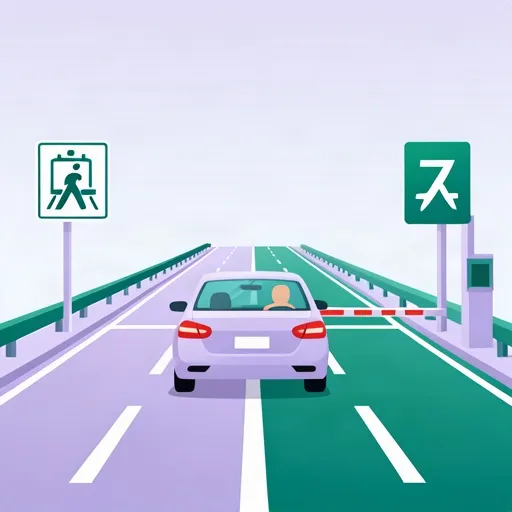
In Spain, many autopistas require a toll, which can be paid using cash, credit cards, or electronic toll collection systems like the VIA-T (telepeaje). If you encounter a toll station, you must obey the traffic signals above each lane. A green arrow indicates an open lane, while a red cross signifies that the lane is closed or reserved for specific traffic.
Autopistas and autovías are both high-capacity Spanish roads with a 120 km/h speed limit for passenger cars, but they differ in design, access, and cost. Autopistas feature no property access and often require tolls, while autovías may allow limited adjacent access and are typically free. Key exam distinctions include bicycle permissions (banned on autopistas, allowed on autovía shoulders for those 14+), minimum speed requirements of 60 km/h, and naming conventions that help identify each road type. Understanding these differences prevents common exam traps and ensures compliant driving on Spain's motorway infrastructure.
A short set of high-value points that capture the most important ideas from this article.
Autopistas prohibit access from adjacent properties and are often toll roads, identified by the 'AP' prefix (e.g., AP-7).
Autovías allow limited access from adjacent properties and are typically free to use, identified by the 'A' prefix (e.g., A-4).
Cyclists over age 14 are permitted on autovía shoulders unless vertical signage prohibits it, but are strictly forbidden on autopistas.
Only vehicles capable of maintaining at least 60 km/h may enter either road type; this excludes pedestrians, animals, mopeds, and personal mobility vehicles (VMP).
Speed limits for passenger cars and motorcycles reach 120 km/h on both road types, but vehicles towing trailers or buses face lower caps.
The 'AP' prefix indicates an autopista (often toll-based); the 'A' prefix indicates an autovía (typically free).
Bicycle access: prohibited on autopistas, permitted for ages 14+ on autovía shoulders unless signage says otherwise.
Minimum speed requirement: 60 km/h is the threshold for vehicles allowed on motorways.
Toll lanes at autopistas display green arrows for open lanes and red crosses for closed lanes.
Telepeaje (electronic toll) allows payment without stopping the vehicle at designated lanes.
Assuming all high-speed roads have identical rules; autopistas and autovías differ in access rights and toll obligations.
Believing bicycles are always banned from Spanish motorways; they are allowed on autovía shoulders for riders aged 14 and over.
Forgetting that vehicles unable to reach 60 km/h are prohibited, including personal mobility vehicles and mopeds.
Confusing the naming prefixes 'A' and 'AP' when identifying road types on maps or in exam questions.
Assuming speed limits can be exceeded briefly during overtaking; limits must never be surpassed on either road type.
Article content overview
A short set of high-value points that capture the most important ideas from this article.
Autopistas prohibit access from adjacent properties and are often toll roads, identified by the 'AP' prefix (e.g., AP-7).
Autovías allow limited access from adjacent properties and are typically free to use, identified by the 'A' prefix (e.g., A-4).
Cyclists over age 14 are permitted on autovía shoulders unless vertical signage prohibits it, but are strictly forbidden on autopistas.
Only vehicles capable of maintaining at least 60 km/h may enter either road type; this excludes pedestrians, animals, mopeds, and personal mobility vehicles (VMP).
Speed limits for passenger cars and motorcycles reach 120 km/h on both road types, but vehicles towing trailers or buses face lower caps.
The 'AP' prefix indicates an autopista (often toll-based); the 'A' prefix indicates an autovía (typically free).
Bicycle access: prohibited on autopistas, permitted for ages 14+ on autovía shoulders unless signage says otherwise.
Minimum speed requirement: 60 km/h is the threshold for vehicles allowed on motorways.
Toll lanes at autopistas display green arrows for open lanes and red crosses for closed lanes.
Telepeaje (electronic toll) allows payment without stopping the vehicle at designated lanes.
Assuming all high-speed roads have identical rules; autopistas and autovías differ in access rights and toll obligations.
Believing bicycles are always banned from Spanish motorways; they are allowed on autovía shoulders for riders aged 14 and over.
Forgetting that vehicles unable to reach 60 km/h are prohibited, including personal mobility vehicles and mopeds.
Confusing the naming prefixes 'A' and 'AP' when identifying road types on maps or in exam questions.
Assuming speed limits can be exceeded briefly during overtaking; limits must never be surpassed on either road type.
Explore related topics, search based questions, and concepts that learners often look up when studying Autopistas vs. Autovías Differences. These themes reflect real search intent and help you understand how this topic connects to wider driving theory knowledge in Spain.
Find clear and practical answers to common questions learners often have about Autopistas vs. Autovías Differences. This section helps explain difficult points, remove confusion, and reinforce the key driving theory concepts that matter for learners in Spain.
The main differences are administrative and design-based: autopistas are often toll roads with strictly limited access, while autovías are generally free, publicly maintained roads that may have slightly more flexible access points and design characteristics.
Yes, both autopistas and autovías share the same general speed limits for vehicles, with 120 km/h being the maximum limit for passenger cars and motorcycles under normal conditions.
Cyclists over the age of 14 are permitted to use the shoulder of an autovía unless specifically prohibited by road signs. However, they are strictly prohibited from circulating on autopistas.
Yes. Both roads prohibit pedestrians, animals, mopeds, bicycles (with the specific exception for autovías mentioned above), and vehicles for persons with reduced mobility or vehicles of mobility (VMP), like electric scooters.
Now that you have found specific articles, continue to deepen your understanding by exploring related DGT regulations or other driving theory topics. Strengthen your knowledge of road signs, traffic scenarios, and essential Spanish driving procedures to prepare for your official driving license exam.