
Mastering the distinctions between DGT environmental labels is a key requirement for the Spanish theory exam and modern urban driving. This guide breaks down how vehicle efficiency, from zero-emission technology to standard combustion, impacts your access to regulated zones and overall driving performance. Learn to identify which category your vehicle falls into to ensure compliance with current traffic legislation.
Article content overview
Understanding vehicle efficiency is no longer just a matter of mechanical interest; it is a fundamental pillar of modern driving theory in Spain. The Dirección General de Tráfico (DGT) has implemented a classification system that categorizes vehicles based on their environmental impact, directly influencing how and where you can drive in urban environments. For candidates preparing for the Spanish theory exam, mastering these labels is essential for both passing the test and understanding real-world mobility restrictions.
The primary goal of the DGT environmental labels is to improve air quality and promote the adoption of cleaner technologies. By grading vehicles from the most efficient to the most polluting, local authorities gain an effective tool to manage traffic flow, particularly during episodes of high pollution or within designated urban areas.
These classifications are not merely administrative labels; they are the gateway to accessing Low Emission Zones, or Zonas de Bajas Emisiones (ZBE). As a new driver, you must be able to recognize which label your vehicle carries, as this determines your legal right to enter specific city centers or restricted zones.
A defined urban area where access, circulation, and parking are restricted for certain vehicles based on their environmental label to reduce pollution levels.
The DGT labels are divided into four main categories. Each serves to identify the engine technology and the corresponding emission standards of the vehicle.
| Label Type | Characteristics | Vehicle Examples |
|---|---|---|
| 0 Emissions | BEV, REEV, PHEV (>40km), FCEV | Electric, Plug-in Hybrids |
| Eco | PHEV (<40km), HEV, CNG, GLP | Hybrid, Gas-powered |
| Label C | Green, Euro 4/5/6 standards | Modern Gasoline/Diesel |
| Label B | Yellow, older Euro standards | Older internal combustion |
Vehicles that do not meet the minimum environmental requirements—typically the 50% most polluting cars—are not issued any label. These vehicles face the most significant restrictions in ZBEs across Spanish municipalities.
A common area of confusion for students involves the technical difference between a '0 Emissions' vehicle and a 'Label C' vehicle. A 0 Emissions label is reserved for vehicles with significant electric autonomy, such as battery electric vehicles (BEVs) or plug-in hybrids (PHEVs) that can travel at least 40 kilometers on electric power alone. These vehicles are considered the most efficient.
In contrast, Label C applies to internal combustion vehicles that meet the latest Euro emissions standards. While these cars are cleaner than older models, they still rely heavily on gasoline or diesel combustion. Understanding this distinction is vital for exam questions regarding vehicle sustainability and the specific performance expectations of modern engines.
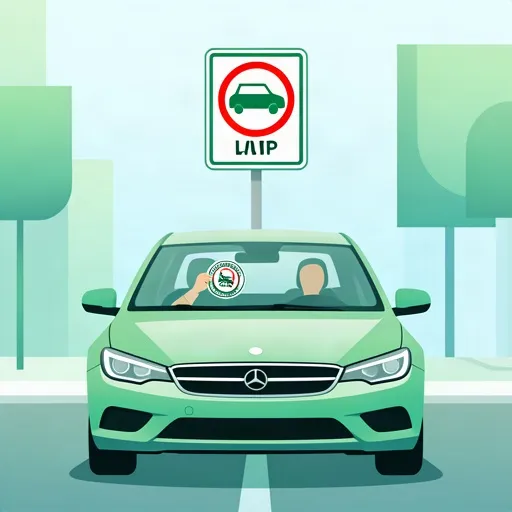
When driving in Spain, your label must be displayed correctly. According to the DGT, the label should be placed in the lower right corner of the windshield to ensure it is visible to traffic authorities. For motorcycles or vehicles without a windshield, it should be placed in a clearly visible location on the vehicle body.
Failure to understand these regulations can lead to fines, especially if you enter a restricted ZBE without the appropriate certification. Furthermore, being aware of your vehicle's powertrain—whether it is a full electric, a plug-in hybrid, or a traditional combustion engine—allows you to better plan your routes, particularly concerning charging infrastructure and refueling intervals.
The DGT environmental label system categorizes vehicles from 0 Emissions (pure electric or PHEVs with >40km range) down to unlabeled vehicles (most polluting). Each label determines legal access to Low Emission Zones, with 0 Emissions having full access and unlabeled vehicles facing the most restrictions. The distinction between 0 Emissions and Label C is particularly important for the theory exam, as both appear green but represent different powertrain technologies. Drivers must correctly identify their vehicle's label and display it visibly to avoid fines in restricted urban areas.
A short set of high-value points that capture the most important ideas from this article.
DGT environmental labels directly determine vehicle access to Low Emission Zones (ZBEs) in Spanish cities
The 0 Emissions label applies only to vehicles with at least 40km of pure electric range, including BEVs and qualifying PHEVs
Label C covers modern internal combustion vehicles meeting current Euro emissions standards, but they still rely on gasoline or diesel
Vehicles without any DGT label—the most polluting 50%—face the strictest restrictions in all ZBEs
Knowing your vehicle's powertrain type helps you plan routes around charging infrastructure and avoid fines
0 Emissions requires >40km electric range; Eco covers PHEVs under 40km, hybrids, and gas-powered vehicles; Label C is for Euro 4/5/6 combustion vehicles
The physical DGT label must be placed in the lower right corner of the windshield (or visible location on motorcycles)
ZBE access is determined by label category—always verify your vehicle's classification before entering restricted urban zones
Plug-in hybrids (PHEVs) split between categories depending on their electric-only range capability
DGT classification is based on emissions and engine technology, not vehicle age alone
Assuming all hybrid vehicles qualify for the 0 Emissions label—only PHEVs with >40km electric range do
Confusing Label C with 0 Emissions—both are shown as green but represent fundamentally different technologies
Forgetting that vehicles without any label face the harshest ZBE restrictions, not just older cars
Placing the physical label in the wrong location, making it invisible to traffic authorities
Believing Label C vehicles are exempt from ZBE restrictions—Label C is mid-tier, not the top exemption
Article content overview
A short set of high-value points that capture the most important ideas from this article.
DGT environmental labels directly determine vehicle access to Low Emission Zones (ZBEs) in Spanish cities
The 0 Emissions label applies only to vehicles with at least 40km of pure electric range, including BEVs and qualifying PHEVs
Label C covers modern internal combustion vehicles meeting current Euro emissions standards, but they still rely on gasoline or diesel
Vehicles without any DGT label—the most polluting 50%—face the strictest restrictions in all ZBEs
Knowing your vehicle's powertrain type helps you plan routes around charging infrastructure and avoid fines
0 Emissions requires >40km electric range; Eco covers PHEVs under 40km, hybrids, and gas-powered vehicles; Label C is for Euro 4/5/6 combustion vehicles
The physical DGT label must be placed in the lower right corner of the windshield (or visible location on motorcycles)
ZBE access is determined by label category—always verify your vehicle's classification before entering restricted urban zones
Plug-in hybrids (PHEVs) split between categories depending on their electric-only range capability
DGT classification is based on emissions and engine technology, not vehicle age alone
Assuming all hybrid vehicles qualify for the 0 Emissions label—only PHEVs with >40km electric range do
Confusing Label C with 0 Emissions—both are shown as green but represent fundamentally different technologies
Forgetting that vehicles without any label face the harshest ZBE restrictions, not just older cars
Placing the physical label in the wrong location, making it invisible to traffic authorities
Believing Label C vehicles are exempt from ZBE restrictions—Label C is mid-tier, not the top exemption
Explore related topics, search based questions, and concepts that learners often look up when studying Understanding DGT Emission Labels. These themes reflect real search intent and help you understand how this topic connects to wider driving theory knowledge in Spain.
Find clear and practical answers to common questions learners often have about Understanding DGT Emission Labels. This section helps explain difficult points, remove confusion, and reinforce the key driving theory concepts that matter for learners in Spain.
The '0 Emissions' label is for the most efficient vehicles, including battery-electric (BEV), plug-in hybrids (PHEV) with a range over 40 km, and hydrogen fuel cell vehicles. The 'C' label applies to more modern internal combustion engines that meet recent Euro emissions standards.
Yes, it is recommended to place the environmental label in the bottom right corner of the front windshield to allow authorities to quickly identify the vehicle's emissions category, especially when entering restricted zones.
Local authorities use these labels to manage traffic in Low Emission Zones (ZBEs). Vehicles with higher efficiency labels (like 0 or ECO) generally have fewer access restrictions during high-pollution episodes compared to vehicles with B or C labels, or those without any label.
Not necessarily. A plug-in hybrid (PHEV) must meet specific criteria, such as an electric range of at least 40 km, to qualify for the '0 Emissions' label. If it does not meet these criteria, it may be classified differently.
Now that you have found specific articles, continue to deepen your understanding by exploring related DGT regulations or other driving theory topics. Strengthen your knowledge of road signs, traffic scenarios, and essential Spanish driving procedures to prepare for your official driving license exam.