
Learners will discover how modern driver assistance features, particularly Intelligent Speed Assistance (ISA), work to help maintain safe speeds on Spanish roads. The content clarifies the driver's ongoing legal duty to obey official speed limits regardless of technology, while addressing common limitations like sensor errors and GPS inaccuracies. This knowledge is crucial for both passing the DGT theory exam and ensuring safe driving practices in real-world scenarios.
Article content overview
Modern vehicles are increasingly equipped with advanced driver assistance systems (ADAS) designed to improve road safety and help drivers comply with traffic laws. Among these, Intelligent Speed Assistance (ISA) has become a primary focus of both European Union regulations and the Dirección General de Tráfico (DGT) standards. Understanding the difference between these newer, proactive systems and traditional speed management tools is a critical part of the Spanish driving theory exam.
Learners often confuse driver assistance features, but for the purpose of road safety and exam preparation, it is essential to distinguish their functions. Cruise control is designed to maintain a set speed, primarily used on motorways and dual-carriageways (autovías and autopistas) to provide comfort. In contrast, a traditional speed limiter prevents the vehicle from exceeding a specific speed set by the driver, providing a physical resistance on the accelerator pedal or cutting fuel supply if the limit is reached.
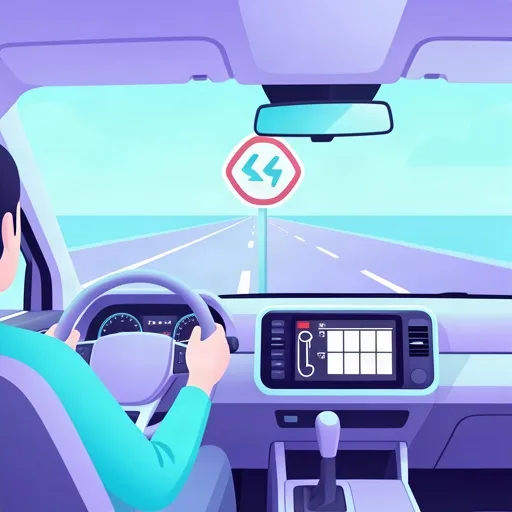
Intelligent Speed Assistance (ISA) represents a significant leap forward in vehicle safety technology. Unlike a static limiter, an ISA system utilizes a combination of front-facing cameras that read traffic signs and GPS mapping data to determine the current speed limit of the road. It then provides the driver with information, haptic feedback, or even active speed regulation to ensure the vehicle remains within the legal speed limits established by the Reglamento General de Circulación.
A driver assistance system that uses external information, such as traffic sign recognition cameras and GPS mapping data, to detect the prevailing speed limit and assist the driver in maintaining that speed to avoid traffic fines and reduce accident risks.
Under EU regulation 2019/2144, the implementation of ISA is mandatory for all new vehicle type approvals starting from July 2022 and for all new registered vehicles from July 2024. For students preparing for the Spanish theory exam, it is vital to remember that these systems are designed to be informative and supportive. Current legislation dictates that ISA systems must be deactivatable by the driver, but they must automatically reactivate every time the vehicle's ignition is switched on.
Technology is not a substitute for observation. While ISA systems are effective, the DGT reminds drivers that they remain legally responsible for their speed at all times. Reliance on GPS data or camera recognition can lead to errors, especially in construction zones or areas where permanent speed limits have been recently altered.
The DGT highlights that excessive speed remains a primary cause of fatal accidents on Spanish roads. Consequently, the primary role of ISA is to reduce the probability of accidental speeding. However, learners should be aware of the limitations of these technologies. In complex urban environments, a camera might misinterpret a sign on a side street, or GPS maps might be outdated due to recent infrastructure changes.
When a conflict between the system's detection and the actual traffic sign occurs, the physical traffic sign always takes precedence. In the context of the theory exam, you will be tested on your ability to recognize signs regardless of what your vehicle's computer displays.
Many exam questions focus on the interaction between the driver and the car's tech. It is a common misconception that ISA systems can replace the driver's duty to monitor the road. Furthermore, students should recognize that exceeding the limit, regardless of whether a limiter or ISA is active, results in penalties under the current fine structure.
Article content overview
Explore related topics, search based questions, and concepts that learners often look up when studying ISA and Speed Limiters Explained. These themes reflect real search intent and help you understand how this topic connects to wider driving theory knowledge in Spain.
Find clear and practical answers to common questions learners often have about ISA and Speed Limiters Explained. This section helps explain difficult points, remove confusion, and reinforce the key driving theory concepts that matter for learners in Spain.
ISA is currently mandatory for all new vehicle models and newly registered vehicles as part of EU-wide safety regulations integrated into Spanish legislation.
No. The driver remains fully responsible for complying with speed limits. ISA and limiters are assistance tools and can sometimes misinterpret traffic signs or GPS data.
Per EU and Spanish law, ISA systems must be active by default upon every vehicle startup. While drivers may be able to deactivate them, the system will automatically reactivate the next time the vehicle is started.
ISA systems rely on camera recognition of traffic signs and GPS mapping data. Factors like poor weather, obstructed signs, or outdated map databases can cause the system to display or act upon incorrect speed limits.
Now that you have found specific articles, continue to deepen your understanding by exploring related DGT regulations or other driving theory topics. Strengthen your knowledge of road signs, traffic scenarios, and essential Spanish driving procedures to prepare for your official driving license exam.