
Understanding the rights of vulnerable road users is a fundamental aspect of the Spanish driving theory syllabus. This guide clarifies the specific legal requirements for yielding to pedestrians at crosswalks and the importance of adhering to urban speed limits to ensure public safety. You will learn how to interpret traffic laws to avoid common exam pitfalls and cultivate responsible driving habits required by the Dirección General de Tráfico.
Article content overview
In the context of the Spanish Reglamento General de Circulación, pedestrians are classified as the most vulnerable road users. Statistics from the Observatorio Nacional de Seguridad Vial (ONSV) reveal that urban environments remain the primary setting for accidents involving walkers, with hundreds of fatalities recorded annually. Mastering the legal relationship between drivers and pedestrians is not merely a requirement for passing the DGT theoretical exam; it is a fundamental pillar of responsible driving in Spain. As a future license holder, understanding when to yield, how to approach crosswalks, and why urban speed limits exist is essential for maintaining safety on our streets.
Spain took a significant step forward in 2021 by modifying the general speed limits in urban areas. These changes were implemented to reduce the severity of collisions, as data indicates that the lethality of an impact decreases exponentially as vehicle speed drops. When a driver respects these limits, they provide themselves and the pedestrian more time to react, effectively turning a potential fatality into a minor incident or avoiding it entirely.
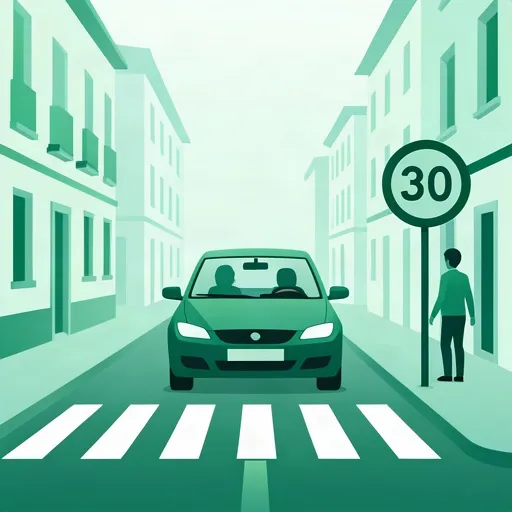
The generic speed limit in Spanish urban areas is 20 km/h on roads with a single platform (no curb separation between sidewalk and road), 30 km/h on roads with one lane per direction, and 50 km/h on roads with two or more lanes per direction of traffic.
It is important to note that the Autoridad Municipal retains the power to adjust these limits. Drivers must always remain vigilant for specific vertical signs that override these general rules. In your exam, remember that failing to adjust speed according to the physical layout of the road or specific signage is a common reason for missing points on theoretical assessments.
One of the most frequent scenarios in the DGT theory test involves the correct procedure for approaching a crosswalk (paso de cebra). The law is clear: drivers must anticipate the presence of pedestrians and prepare to stop well in advance. You must not enter a crosswalk if traffic conditions are such that your vehicle might become immobilized within it, obstructing the path of those walking.
While pedestrians generally have priority at marked crossings, this is not an absolute rule in all conditions. However, the hierarchy of signals is absolute. If a traffic agent is present at a crossing, their instructions prevail over traffic lights, road markings, and general priority rules. Even if a pedestrian is crossing when a light is technically green for you, the orders of an agent—or the need to avoid an accident—take precedence.
Never assume a pedestrian will follow the rules. Many accidents occur because pedestrians may be distracted by mobile devices. As a driver, the DGT expects you to adopt a "defensive driving" mindset, anticipating unpredictable behavior from vulnerable users to prevent collisions.
The modern "motor" of the city relies on shifting from a car-centric model to a more inclusive, pedestrian-friendly environment. Concepts such as the "15-minute city" emphasize the importance of safe walking routes. In the exam, you may encounter questions regarding the prohibition of pedestrians on certain road types, such as motorways (autopistas and autovías), where walking is strictly forbidden except in cases of emergency. Always remember that pedestrians are prohibited from crossing roundabouts through the interior; they must always use the designated perimeter paths.
Article content overview
Explore related topics, search based questions, and concepts that learners often look up when studying Pedestrian Safety and Urban Limits. These themes reflect real search intent and help you understand how this topic connects to wider driving theory knowledge in Spain.
Find clear and practical answers to common questions learners often have about Pedestrian Safety and Urban Limits. This section helps explain difficult points, remove confusion, and reinforce the key driving theory concepts that matter for learners in Spain.
The general speed limit on urban roads with a single lane in each direction is 30 km/h. On roads with a single platform (no curb between sidewalk and road), the limit is 20 km/h.
Drivers must stop whenever a pedestrian has clearly signaled their intention to cross or has already entered the crosswalk. Under the Reglamento General de Circulación, vehicles must yield to pedestrians who are on the road or about to enter it.
According to the ONSV, lowering urban speeds significantly reduces the fatality risk in the event of a collision. At 30 km/h, the survival probability for a pedestrian hit by a vehicle is drastically higher compared to 50 km/h.
While pedestrians must use designated crossings, drivers must always remain vigilant. If a pedestrian is already in the process of crossing the road, a driver must stop to prevent an accident, regardless of whether a formal crosswalk is present.
Now that you have found specific articles, continue to deepen your understanding by exploring related DGT regulations or other driving theory topics. Strengthen your knowledge of road signs, traffic scenarios, and essential Spanish driving procedures to prepare for your official driving license exam.