
As electric vehicles become increasingly common on Spanish streets, understanding their unique mechanical and digital characteristics is vital for every learner driver. This guide breaks down essential terminology like WLTP ranges, DC charging, and V2L capabilities, helping you recognize how these technologies influence vehicle behavior and road safety. By learning how to interact with modern electric drivetrains and infotainment interfaces, you will be better prepared to maintain focus and ensure safety as required by DGT standards.
Article content overview
As the automotive landscape in Spain evolves, the integration of electric vehicles (EVs) onto our roads is becoming a central theme in modern driving theory. Whether you are navigating urban environments or driving on major motorways like autovías, understanding the unique technical characteristics of electric drivetrains is essential for any learner driver. Beyond the mechanics, these vehicles introduce new considerations for safety, charging infrastructure usage, and the management of digital interfaces that demand high levels of driver concentration.
Electric vehicles differ significantly from internal combustion engine (ICE) cars in how they deliver power and manage energy. In the context of your DGT theory exam, you should be familiar with how battery capacity, measured in kilowatt-hours (kWh), dictates the vehicle's potential energy storage. Larger battery packs, such as those found in modern electric sedans like the ones now being produced in the Stellantis plant in Zaragoza, allow for greater travel distances but also require longer charging times depending on the charging station's output.
A crucial metric you will encounter is the WLTP range. This stands for Worldwide Harmonized Light Vehicles Test Procedure, a standardized laboratory test used to estimate the real-world range of a vehicle. It is vital to remember that the WLTP range is an estimate; actual performance on Spanish roads will vary based on terrain, speed, weather conditions, and driving style.
Understanding how to replenish your vehicle's energy is a fundamental part of responsible EV ownership and usage in Spain. You will frequently encounter two main types of charging: alternating current (AC) for slower, residential, or public charging, and direct current (DC) fast charging for rapid energy recovery on long journeys.
Another emerging technology is V2L, or Vehicle-to-Load. This allows an electric vehicle to act as a portable power bank, enabling the battery to power external electronic devices. While this is an innovative feature, it should never distract the driver from road safety protocols or the necessity of maintaining vehicle integrity for driving purposes.
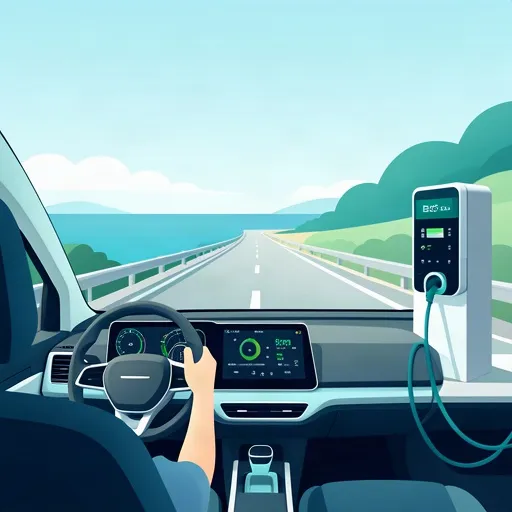
Modern electric vehicles are often equipped with sophisticated, large-format digital dashboards. While these provide essential information like remaining range and charging status, they can also become a significant source of distraction. The DGT places a high premium on driver focus, and interacting with complex infotainment systems while the vehicle is in motion is a leading cause of accidents.
Drivers must familiarize themselves with their vehicle's interface while stationary. By understanding the location of vital information—such as battery health, tire pressure, and navigation—before setting off, you reduce the time your eyes are off the road.
It is worth noting that Spain is rapidly positioning itself as a hub for electric vehicle production within Europe. The manufacturing of models like the Leapmotor B05 in local facilities highlights a shift toward domestic sustainability and technological growth. For a learner driver, this means that the vehicles you will encounter on the road are increasingly likely to be electric, making it even more important to master the nuances of EV driving dynamics, such as the instant torque provided by electric motors, which requires smoother and more controlled acceleration to ensure passenger comfort and road safety.
Article content overview
Explore related topics, search based questions, and concepts that learners often look up when studying Electric Vehicle Driving Basics. These themes reflect real search intent and help you understand how this topic connects to wider driving theory knowledge in Spain.
Find clear and practical answers to common questions learners often have about Electric Vehicle Driving Basics. This section helps explain difficult points, remove confusion, and reinforce the key driving theory concepts that matter for learners in Spain.
WLTP stands for Worldwide Harmonized Light Vehicles Test Procedure. It provides a standardized measure of a vehicle's range on a single charge, helping drivers understand how far they can travel before needing to recharge, which is crucial for route planning.
DC charging, or direct current charging, allows for significantly faster energy transfer to the vehicle's battery compared to standard home AC chargers, which is essential for rapid charging during long trips on Spanish motorways.
V2L, or Vehicle-to-Load, allows an electric vehicle to supply power to external electrical devices. While useful, drivers should be aware of these features to avoid unnecessary distractions while parked or using vehicle systems.
Modern digital dashboards often integrate complex infotainment and vehicle settings. Drivers must be proficient in accessing essential driving information quickly to avoid distraction, which is a key component of safe and attentive driving as evaluated by the DGT.
Now that you have found specific articles, continue to deepen your understanding by exploring related DGT regulations or other driving theory topics. Strengthen your knowledge of road signs, traffic scenarios, and essential Spanish driving procedures to prepare for your official driving license exam.