
Riding a motorcycle after dark presents unique challenges. This lesson in our Spanish Motorcycle Theory Exam course focuses on crucial night riding techniques and visibility measures, as mandated by DGT regulations. You'll learn how to ensure your motorcycle is properly lit and how to maximize your own visibility to other road users, preparing you for safe operation in low-light conditions and specific theory exam questions.
Lesson content overview
Riding a motorcycle at night introduces unique challenges that demand heightened awareness and specific safety measures. Reduced ambient light significantly impacts a rider's ability to see and be seen, dramatically increasing the risk of accidents. This comprehensive lesson for the Spanish Motorcycle Theory Exam (A, A1, A2 Licence Prep Course) details the essential aspects of safe nighttime riding, including mandatory lighting, headlight alignment, rear-light visibility, the crucial role of reflective gear, glare management, and strategies to combat rider fatigue under low-light conditions, all in accordance with Spanish DGT (Dirección General de Tráfico) requirements.
Night riding fundamentally alters the dynamics of road travel for motorcyclists. Human vision is less effective in low light, making it harder to perceive depth, contrast, and color. Objects blend into the background, and hazards become visible only at close range. For motorcyclists, who are inherently less conspicuous than larger vehicles, this reduction in visibility is a critical safety concern. Other road users may struggle to accurately judge the distance and speed of a motorcycle at night, increasing the likelihood of misjudgment and potential collisions.
The primary goal of night riding safety is to maximize the motorcycle's conspicuity – making it as easy as possible for others to see – while ensuring the rider maintains optimal vision and remains alert. Adhering to legal lighting requirements and adopting proactive safety habits are paramount to mitigating the increased risks associated with nighttime journeys.
The Reglamento General de Circulación (RGC), Spain's general traffic regulation, stipulates strict requirements for motorcycle lighting, particularly from sunset to sunrise and during any period of reduced visibility (e.g., fog, heavy rain, tunnels). These rules are designed to ensure both the rider's ability to see the road and the motorcycle's visibility to all other road users.
Motorcycles are legally required to use their headlamp (dipped beam) from sunset to sunrise, and at any time when visibility is significantly reduced. The dipped beam, also known as low beam, provides sufficient illumination for the rider to see the road ahead without dazzling oncoming traffic or drivers of vehicles being followed.
The high-beam headlamp is an optional but powerful light designed for use on open roads when there is no oncoming traffic and no vehicle being followed closely. It provides a longer range of illumination, crucial for detecting hazards further ahead at higher speeds. However, its use is strictly regulated: it must be switched off (dimmed to dipped beam) when approaching another vehicle within 150 metres or when following another vehicle. Misusing the high beam can cause temporary blindness for other drivers, leading to dangerous situations.
Always activate your dipped beam well before it gets dark. Do not wait for complete darkness or rely solely on automatic light sensors, which may not always activate lights precisely when needed.
Equally important for visibility from behind is the rear red light. This light must be steadily illuminated whenever the motorcycle is moving on a public road, regardless of the time of day, but its importance is magnified at night. It signals the motorcycle's presence to following traffic, allowing other drivers to maintain a safe distance and react appropriately. A non-functioning or dim rear light significantly increases the risk of a rear-end collision.
When a motorcycle is stationary on a public road, the tail-position light (a white light that illuminates the number plate) is required. This ensures the motorcycle's presence is marked even when parked, preventing it from becoming an unexpected obstruction. It is important to distinguish this from the rear red light, which is primarily for when the vehicle is in motion.
Side reflectors are small, passive safety devices mounted on both sides of the motorcycle. While they do not emit light, they are crucial for night riding as they reflect light from other vehicles back towards its source, making the motorcycle visible from side angles. These are a mandatory component on motorcycles in Spain.
The number plate illumination light, which typically shines a white light onto the rear number plate, must be functional to ensure the plate is legible at night when the vehicle is stationary. This is a legal requirement to aid identification and enforcement.
Proper headlight alignment is fundamental to both the rider's safety and the safety of other road users. The dipped beam must be precisely aimed to illuminate the road directly ahead without causing glare for oncoming drivers. Misaligned headlights are not only ineffective for the rider but can also be a significant hazard to others.
Vertical alignment ensures the beam height is within legal limits. In Spain, the RGC Article 12 specifies that headlights must not be aimed higher than 1.5° above the horizontal line for the vehicle's category. An excessively high beam will blind oncoming drivers, while a beam that is too low will reduce the rider's forward visibility, shortening reaction time.
Horizontal alignment ensures the beam is centered on the road axis, preventing it from spilling into the opposite lane or illuminating the roadside more than the intended path. Correct alignment allows the rider to see the lane ahead clearly and anticipate hazards.
Park your motorcycle on a level surface, approximately 5-10 meters from a wall.
Ensure the motorcycle is upright (not on its side stand) and has typical load (rider, and any usual cargo).
Measure the height from the ground to the center of your headlight lens. Mark this height on the wall with tape.
Turn on your dipped beam. Observe the top edge of the beam pattern on the wall.
For proper alignment, the top edge of the beam should be slightly below the mark you made, typically dropping by about 5 cm for every 5 meters of distance from the wall. This corresponds to the allowed downward angle.
Adjust the headlight (usually via screws or knobs on the headlight housing) until the beam pattern meets these specifications. Consult your motorcycle's manual for precise adjustment procedures.
Do not assume that a brighter bulb compensates for mis-alignment. A powerful, mis-aligned bulb is more dangerous than a standard, correctly aligned one. Always prioritize correct alignment.
While mandatory lighting makes your motorcycle visible, reflective and high-visibility gear makes you, the rider, more conspicuous. This is crucial because a motorcycle's lights are often seen as a single point of light, which can make judging distance and speed difficult for other drivers. Reflective gear helps define your silhouette, making you more recognizable as a human on a motorcycle.
When choosing gear, consider materials that use retro-reflection. These materials reflect light directly back to the source, making them incredibly effective at night when illuminated by vehicle headlights.
The DGT strongly recommends the use of reflective clothing and accessories during night riding, although it is not legally mandatory unless specific weather conditions (like certain levels of fog or rain) require it for all vehicles. For optimal safety, riders should aim to have at least one reflective element on each of their four limbs and on the torso, providing a 360-degree reflective profile.
Glare is a significant hazard for motorcyclists at night. It can come from various sources: oncoming headlights, streetlights, reflections from wet surfaces, and even your own improperly aimed lights. Glare causes temporary vision impairment, reducing contrast sensitivity and reaction time. Effective glare management involves both minimizing your exposure to intense light and preventing your lights from dazzling others.
Rider fatigue is a serious risk factor, particularly during nighttime rides when the body's natural circadian rhythm predisposes to sleepiness. Fatigue impairs judgment, slows reaction times, and reduces perception, making you more susceptible to accidents.
Ignoring fatigue is akin to riding under the influence of alcohol. Your judgment and reaction times are severely compromised. Prioritize rest over reaching your destination quickly.
Compliance with Spanish traffic law is paramount for night riding. Violations of lighting regulations carry penalties and, more importantly, put you and other road users at risk.
| Regulation Area | RGC Article | Rule Summary | Legal Status | Consequences of Violation |
|---|---|---|---|---|
| Mandatory Lighting | Art. 61-65 | Headlamp (dipped beam), rear red light (moving), tail-position light (stopped) and side reflectors required sunset-sunrise. | Mandatory | Fine (e.g., €200 - €500), potential loss of points. Increased crash risk. |
| Headlight Alignment | Art. 12 | Headlights must be correctly aimed, not exceeding 1.5° above horizontal, to avoid dazzling others. | Mandatory | Fine (e.g., €100 - €250). |
| Glare Prohibition | Art. 12 & 13 | High beam prohibited when approaching or following a vehicle within 150 m. | Mandatory | Fine (e.g., €150 - €300). |
| Reflective Gear | DGT Circular | Recommended for increased conspicuity during night riding. | Advisory | No direct penalty, but significantly increases accident risk without it. |
| Fatigue Management | DGT Advisory | Recommended rest intervals (15 min after 2 hrs of riding) to combat fatigue. | Advisory | No direct penalty, but poses severe safety risks. |
Understanding common mistakes can help you avoid them and ensure a safer ride.
Night riding safety isn't a one-size-fits-all approach. Your actions and equipment may need to adapt based on the environment and weather.
Understanding the underlying science of night vision and perception can deepen your appreciation for visibility measures.
Let's consider how these concepts apply in real-world situations:
Setting: You are riding through a busy residential street in a Spanish town just after sunset. There are parked cars, pedestrians, and streetlights.
Correct Behavior: You activate your dipped beam headlight and ensure your rear red light is steadily on. You wear a reflective vest over your riding jacket and position your motorcycle centrally in the lane to maximize your presence. You maintain a slower speed, actively scanning for pedestrians and vehicles pulling out from driveways, compensating for the reduced visibility despite street lighting.
Incorrect Behavior: You only have your daytime running light on, neglecting the rear red light. A car pulling out from a parking spot fails to see you approaching from behind, leading to a sudden brake or swerve to avoid a collision.
Setting: You are on a two-lane Spanish highway (one lane in each direction) with clear weather, traveling at 90 km/h. Occasionally, there are oncoming vehicles.
Correct Behavior: You use your high beam on open stretches to illuminate the road far ahead. As soon as you spot an oncoming car in the distance, you smoothly switch to your dipped beam well before the 150-meter legal threshold, preventing any glare for the other driver. Once the vehicle passes, and the road ahead is clear, you switch back to high beam.
Incorrect Behavior: You keep your high beam on for too long, directly shining into the eyes of an oncoming driver. They flash their lights at you, and for a few dangerous seconds, their vision is compromised, increasing the risk of an accident.
Setting: You embarked on a 3-hour ride through mixed urban and rural roads starting at 22:00, and it's now past midnight. You're starting to feel drowsy.
Correct Behavior: Recognizing the early signs of fatigue (e.g., yawning, difficulty focusing, heavy eyelids), you proactively pull over at the next safe service area or rest stop. You take a mandatory 15-minute break, stretch, walk around, and rehydrate, allowing your mind and body to briefly reset. You might delay your journey if the fatigue is too severe.
Incorrect Behavior: You decide to push through the drowsiness, reasoning that you're close to your destination. You start to experience micro-sleeps, momentarily losing awareness while navigating a gentle curve, leading to drifting off your line and nearly crossing into the opposite lane.
Safe night riding on a motorcycle in Spain hinges on a combination of legal compliance, proactive visibility measures, and astute self-awareness.
By diligently applying these measures, you significantly extend your detection range, enhance your reaction time, and dramatically reduce the probability of accidents, ensuring a safer and more confident night riding experience in Spain.
Night riding safety in Spain is governed by specific DGT regulations under the Reglamento General de Circulación, requiring motorcycles to display dipped beam headlights, a rear red light while in motion, and side reflectors from sunset to sunrise. High beam use is permitted only on open roads without nearby traffic and must be dimmed within 150 metres of other vehicles. Rider conspicuity is enhanced through reflective gear that defines the rider's human silhouette against the motorcycle's single light source. Glare management requires correct headlight alignment (maximum 1.5 degrees above horizontal), clear visors, and appropriate beam selection. Fatigue poses serious risks due to circadian rhythm effects; riders should take 15-minute breaks after every 2 hours of riding and avoid early morning travel when alertness naturally dips.
A short set of high-value points that capture the most important learning from this lesson.
From sunset to sunrise, motorcycles must display dipped beam headlight, rear red light while moving, and side reflectors as mandatory requirements under RGC Article 61-65.
High beam must be switched to dipped beam when approaching or following another vehicle within 150 metres to avoid dazzling other road users.
Reflective gear makes the rider visible as a human silhouette, defining the rider separate from the motorcycle's single-point light.
Fatigue risk peaks during early morning hours (02:00-06:00) due to the body's circadian rhythm; microsleeps can occur without the rider's awareness.
Headlight alignment must not exceed 1.5 degrees above horizontal to prevent dangerously dazzling oncoming drivers.
Explore all units and lessons included in this driving theory course.
Dipped beam is mandatory; high beam is optional and strictly regulated with a 150-metre distance rule.
Rear red light is for when the motorcycle is moving; tail-position light is only required when the motorcycle is stationary.
Bright colours alone (without reflective properties) are ineffective in true darkness; retro-reflective materials return light to its source.
DGT recommends at least one reflective element on each of the four limbs and torso for a 360-degree profile.
Rider fatigue can be as dangerous as alcohol impairment; a 15-minute break is advised after every 2 hours of continuous night riding.
Relying on daytime running light only and forgetting to activate the rear red light, leaving following traffic unable to detect the motorcycle.
Keeping high beam on when approaching other vehicles, causing temporary blindness and potential head-on collisions.
Failing to re-check headlight alignment after bulb replacement or maintenance, creating glare hazards for oncoming traffic.
Wearing bright-coloured clothing without reflective properties, assuming colour alone provides sufficient night visibility.
Pushing through drowsiness and continuing to ride during peak fatigue hours (02:00-06:00) when microsleeps are most likely.
Lesson content overview
A short set of high-value points that capture the most important learning from this lesson.
From sunset to sunrise, motorcycles must display dipped beam headlight, rear red light while moving, and side reflectors as mandatory requirements under RGC Article 61-65.
High beam must be switched to dipped beam when approaching or following another vehicle within 150 metres to avoid dazzling other road users.
Reflective gear makes the rider visible as a human silhouette, defining the rider separate from the motorcycle's single-point light.
Fatigue risk peaks during early morning hours (02:00-06:00) due to the body's circadian rhythm; microsleeps can occur without the rider's awareness.
Headlight alignment must not exceed 1.5 degrees above horizontal to prevent dangerously dazzling oncoming drivers.
Explore all units and lessons included in this driving theory course.
Dipped beam is mandatory; high beam is optional and strictly regulated with a 150-metre distance rule.
Rear red light is for when the motorcycle is moving; tail-position light is only required when the motorcycle is stationary.
Bright colours alone (without reflective properties) are ineffective in true darkness; retro-reflective materials return light to its source.
DGT recommends at least one reflective element on each of the four limbs and torso for a 360-degree profile.
Rider fatigue can be as dangerous as alcohol impairment; a 15-minute break is advised after every 2 hours of continuous night riding.
Relying on daytime running light only and forgetting to activate the rear red light, leaving following traffic unable to detect the motorcycle.
Keeping high beam on when approaching other vehicles, causing temporary blindness and potential head-on collisions.
Failing to re-check headlight alignment after bulb replacement or maintenance, creating glare hazards for oncoming traffic.
Wearing bright-coloured clothing without reflective properties, assuming colour alone provides sufficient night visibility.
Pushing through drowsiness and continuing to ride during peak fatigue hours (02:00-06:00) when microsleeps are most likely.
Explore search topics learners often look for when studying Night Riding and Visibility Measures. These topics reflect common questions about road rules, driving situations, safety guidance, and lesson level theory preparation for learners in Spain.
Browse additional driving theory lessons that cover connected traffic rules, road signs, and common driving situations related to this topic. Improve your understanding of how different rules interact across everyday traffic scenarios.
Understand the mandatory DGT regulations for motorcycle lighting, including headlight and rear light requirements in Spain. Learn essential measures to ensure rider visibility and safety during night rides according to Spanish traffic law.
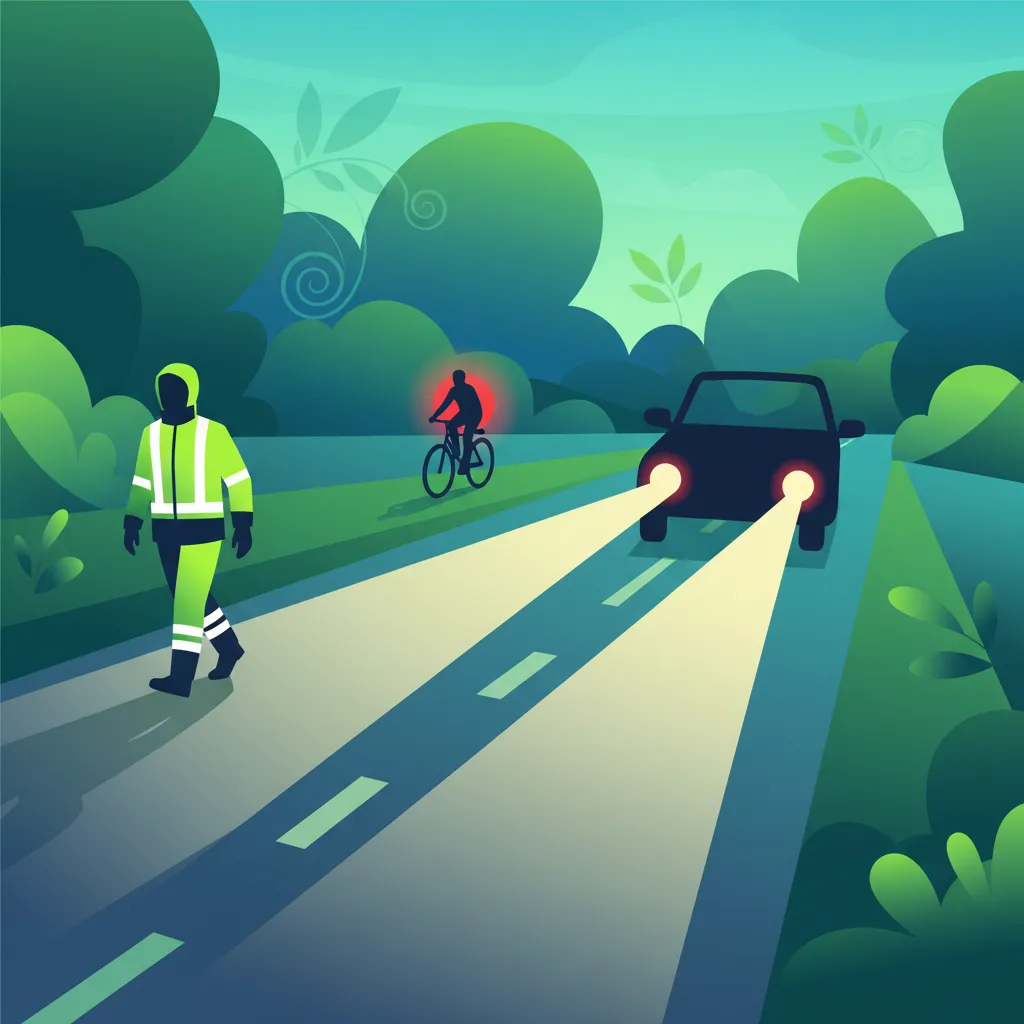
This lesson outlines the mandatory lighting and visibility equipment as per DGT regulations. It covers the correct use of headlights (low and high beams), taillights, and turn signals, ensuring the moped is visible to others, especially at night or in poor weather. The importance of wearing high-visibility or reflective clothing is also emphasized as a critical measure to enhance personal safety by making the rider more conspicuous.
This lesson focuses on strategies for maximizing rider visibility in daylight and nighttime conditions, covering high-visibility apparel, reflective vests, and LED accessories. It delves into rider posture and lane positioning that improve sightlines and reduce collision risk. The content aligns with DGT regulations for illumination levels on motorcycles.
This lesson outlines the proper use and legal requirements of vehicle lighting and mirror systems. It covers headlamps, fog lights, turn signals, and brake lights, clarifying when each must be used according to DGT regulations. The lesson also explains the correct adjustment of rearview and side mirrors and strategies for effective blind-spot monitoring.
This lesson focuses on nighttime driving, emphasizing proper headlight usage and glare management from oncoming vehicles. It discusses DGT regulations for night driving, the appropriate use of high-beam and low-beam headlights, and techniques to reduce eye strain. Additionally, the lesson highlights the signs of driver fatigue and the importance of taking breaks.
This lesson covers how environmental conditions such as rain, fog, and darkness affect driving safety. It instructs drivers on adjusting speed, using appropriate lighting, and increasing following distance to compensate for reduced visibility and traction. The lesson incorporates DGT safety recommendations for handling adverse weather to mitigate risk and maintain control.
Explore the challenges of night motorcycle riding in Spain, including managing headlight glare from other vehicles, combating rider fatigue, and recognizing specific road hazards. Learn strategies for safer night journeys.
This lesson focuses on strategies for maximizing rider visibility in daylight and nighttime conditions, covering high-visibility apparel, reflective vests, and LED accessories. It delves into rider posture and lane positioning that improve sightlines and reduce collision risk. The content aligns with DGT regulations for illumination levels on motorcycles.
This lesson focuses on nighttime driving, emphasizing proper headlight usage and glare management from oncoming vehicles. It discusses DGT regulations for night driving, the appropriate use of high-beam and low-beam headlights, and techniques to reduce eye strain. Additionally, the lesson highlights the signs of driver fatigue and the importance of taking breaks.
This lesson outlines the mandatory lighting and visibility equipment as per DGT regulations. It covers the correct use of headlights (low and high beams), taillights, and turn signals, ensuring the moped is visible to others, especially at night or in poor weather. The importance of wearing high-visibility or reflective clothing is also emphasized as a critical measure to enhance personal safety by making the rider more conspicuous.
This lesson focuses on identifying blind spot zones created by larger vehicles and the rider’s own positioning. It covers effective mirror usage, lateral awareness techniques, and the importance of head checks before lane changes. DGT blind spot guidelines are referenced, emphasizing situational scanning to maintain safety in traffic.
This lesson covers how environmental conditions such as rain, fog, and darkness affect driving safety. It instructs drivers on adjusting speed, using appropriate lighting, and increasing following distance to compensate for reduced visibility and traction. The lesson incorporates DGT safety recommendations for handling adverse weather to mitigate risk and maintain control.
Find clear answers to common questions learners have about Night Riding and Visibility Measures. Learn how the lesson is structured, which driving theory objectives it supports, and how it fits into the overall learning path of units and curriculum progression in Spain. These explanations help you understand key concepts, lesson flow, and exam focused study goals.
The DGT mandates that motorcycles must have a working headlight (low and high beam), a rear position light, a brake light, and indicators. All lights must be visible and correctly aligned. This lesson details the specifications and importance of each for safe night riding.
Reflective gear is extremely important for night riding visibility in Spain. The DGT regulations emphasize conspicuity. Wearing a high-visibility jacket or incorporating reflective elements on your clothing and motorcycle significantly increases the chances of other road users seeing you, thereby reducing accident risk.
To manage glare, avoid looking directly into oncoming headlights. Instead, focus on the right edge of your lane or road. If you wear glasses, anti-glare coatings can help. Ensuring your own headlight is clean and correctly aimed also prevents unnecessary dazzling of others.
Rider fatigue significantly impairs reaction time and judgment, which is even more critical at night. The DGT recommends taking regular breaks during long night rides, staying hydrated, and avoiding riding when feeling tired. Planning your journey to minimize riding during peak fatigue hours is also advisable.
No, understanding night riding rules and visibility measures is essential for passing the Spanish A, A1, and A2 license theory exams. The DGT includes questions on lighting, visibility, and hazard perception in low-light conditions. This lesson ensures you are prepared for these specific exam topics.
Use our powerful search functionality to pinpoint specific Spanish DGT driving theory practice sets. Filter by road sign categories, traffic law topics, or question difficulty to build custom study sessions and reinforce your knowledge precisely where it matters for your official exam.