
This lesson details the Swiss administrative system for traffic violations, specifically focusing on the penalty point consequences for Category B licence holders. Understanding these rules is essential for maintaining your driving privileges and successfully answering complex legal theory exam questions.

Lesson content overview
Driving in Switzerland requires not only skill and adherence to traffic rules but also a clear understanding of the legal consequences of traffic violations. The Swiss penalty points system is a crucial mechanism designed to deter unsafe driving practices and promote road safety. This comprehensive lesson for your Swiss Category B Driving Theory Course will detail how this system operates, from the allocation of points for various infractions to the thresholds that can lead to licence suspension and the administrative processes involved.
By understanding these regulations, drivers can make informed decisions, maintain a clean driving record, and ensure continued driving privileges on Swiss roads. It serves as a cornerstone of responsible driver behaviour and legal compliance.
Penalty points are numerical values assigned to a driver's licence record following a traffic violation in Switzerland. These points are not merely symbolic; they accumulate over time and directly impact a driver's eligibility to hold a valid driving licence. The system acts as a progressive deterrent, meaning that repeated or increasingly serious infractions lead to higher point totals and more severe consequences.
The core principle behind penalty points is to encourage safe and responsible driving by attaching tangible, progressive consequences to offences. Each point reflects the severity of a violation and its potential impact on overall road safety. These points are defined by the Swiss Road Traffic Act (SVG) and the Vehicle Traffic Ordinance (VTV), which codify the legal framework for traffic penalties.
Each traffic violation carries a specific point value, ranging from 0.5 points for minor infractions to 2.0 points for severe offences. These points are recorded on a driver's official record and remain active for a fixed duration, typically three years, before they automatically expire, provided no further offences are recorded. This system ensures that a driver's long-term driving behaviour is taken into account.
For instance, exceeding the speed limit by 21–30 km/h is typically assigned 1 point, while more dangerous actions like reckless driving or driving under the influence of alcohol or drugs can result in 2 points. The specific number of points depends on the nature and gravity of the offence, reflecting the risk posed to other road users and the general public.
Traffic violations are categorised based on their potential to cause harm, directly influencing the number of points assigned.
It is a common misunderstanding that points are charged immediately upon violation. In reality, points are assessed only after the administrative process, including potential appeals, is complete and the decision becomes legally binding. This means there is a period between the initial detection of an offence and the official recording of points.
The accumulation of penalty points is the primary trigger for licence suspension. This temporary withdrawal of driving authority is a significant consequence designed to encourage corrective behaviour among drivers who repeatedly violate traffic laws. The thresholds for suspension vary depending on the type of driving licence held.
Understanding these thresholds is paramount for all drivers, as reaching them means losing the privilege to drive for a defined period. Licence suspension not only disrupts daily life but also necessitates specific actions to regain full driving privileges, ensuring the driver undergoes a period of reflection and potentially re-education.
For holders of a standard Category B driving licence, which permits the driving of passenger cars, the threshold for licence suspension is 8 accumulated penalty points. Once a driver reaches or exceeds this total, the Road Traffic Authority (RSA) will initiate proceedings for a licence suspension.
The duration of the suspension period is not fixed and depends on several factors, including the total number of points accumulated, the severity of the specific offences, and whether it is a first or repeat suspension. Suspension periods can range from a few months to much longer, with repeat offenders facing progressively harsher penalties and potentially a permanent revocation in extreme cases.
Always keep track of your driving record. While points are officially managed by the Road Traffic Authority, being aware of your own accumulated points can help you adjust your driving behaviour to avoid reaching the suspension threshold.
New drivers in Switzerland typically hold a probationary licence, often referred to as a Category B-1 licence, for an initial period. This probationary status comes with stricter regulations due to the higher risk associated with novice drivers. For holders of a probationary licence, the threshold for licence suspension is significantly lower: 4 accumulated penalty points.
This lower threshold reflects the emphasis on encouraging exemplary behaviour from the outset of a driving career. Reaching this threshold for a probationary licence holder can lead to immediate and more severe consequences, often requiring additional training or a re-evaluation of driving aptitude before the licence can be reinstated or converted to a full licence.
When a driving licence is suspended, the individual is legally prohibited from driving any motor vehicle for the duration of the suspension period. Driving during a suspension is a serious offence that can lead to further, much more severe penalties, including substantial fines, additional points, and even criminal charges, potentially resulting in imprisonment.
To regain full driving privileges after a suspension, a driver often needs to undergo a qualified supervision period and may be required to pass a revision exam to demonstrate renewed understanding of traffic laws and safe driving practices. It is a common mistake to assume that suspension ends automatically after the points expire; a driver must actively re-apply for licence reinstatement and fulfil all conditions set by the authorities.
In addition to penalty points, traffic violations in Switzerland frequently incur monetary penalties, known as fines (often referred to as 'Verwarngeld' for minor infractions). These fines serve as an immediate financial consequence for breaking traffic laws and are levied alongside or independently of penalty points, depending on the severity and nature of the offence.
Understanding the structure of these fines and the implications of non-payment is crucial for all drivers. Fines are an integral part of the Swiss traffic enforcement system, reinforcing the message that adherence to regulations is mandatory.
The amount of a fine is tiered based on the severity of the offence and, in some cases, the driver's licence category. Minor infractions might incur relatively small fixed fines, while more serious violations can result in substantial monetary penalties. For example, a minor speed excess might lead to a fine of CHF 40–120, whereas significant speeding could result in fines exceeding several hundred francs, along with points.
The Vehicle Traffic Ordinance (VTV) codifies these fine amounts. In certain situations, such as for professional drivers or repeat offenders, the fines may be adjusted or increased. The purpose of these varying amounts is to ensure that the penalty is proportionate to the risk and harm caused by the violation.
Prompt payment of fines is essential. Failure to pay a fine within the specified deadline can lead to additional complications and consequences. Primarily, neglecting to pay a fine can result in the assessment of additional penalty points, typically 0.5 points, as a penalty for demonstrating disregard for legal obligations. This accelerates the accumulation of points towards a licence suspension.
Beyond additional points, non-payment can trigger legal enforcement measures. This may include reminder fees, increased fine amounts, seizure of assets, or even conversion of the fine into a custodial sentence. Therefore, it is always advisable to pay fines promptly or to contest them within the legal timeframe if you believe there has been an error.
The process through which traffic offences are managed, points are recorded, and fines are levied follows a specific administrative pathway. Understanding these procedural steps is vital for knowing what to expect after a violation and how to respond appropriately.
The administrative process ensures that legal due process is followed, allowing drivers opportunities to understand and, if necessary, contest decisions made by the authorities. Timely engagement with this process can prevent escalation of penalties.
Detection: An offence is identified either by law enforcement officers (e.g., police observation, traffic stops) or through automated systems (e.g., speed cameras, red-light cameras).
Citation: Following detection, a ticket (often a 'Verwarngeld' for minor offences) is issued to the driver. This citation outlines the alleged violation and the initial fine amount.
Assessment: The relevant Road Traffic Authority (RSA) processes the violation. Based on the evidence and the applicable laws (SVG and VTV), the RSA records any associated penalty points onto the driver's licence record and finalises the fine.
Notification: The driver receives an official notice (sometimes referred to as a 'Vollstreckungsbegehren' for fine payment requests) via mail or electronic means, detailing the violation, the imposed fine, and the points assessed. This notice also informs the driver of their rights and the deadlines for response. This notification might be linked to the electronic driving licence (eID) system.
Appeal: Drivers have the right to contest the decision if they believe it is incorrect. An appeal must be filed within a legally defined timeframe, usually specified in the notification. Ignoring this appeal period leads to an automatic conviction and the finality of the penalties.
Timely payment of fines avoids extra points and further legal action. Conversely, a successful appeal can result in the reduction or complete removal of points and fines. It's crucial not to ignore any official communication regarding traffic violations.
While penalty points are a serious consequence of traffic violations, the Swiss system does provide mechanisms for their reduction or removal under specific conditions. These provisions offer a rehabilitative path for drivers and acknowledge that behaviour can improve over time.
These mechanisms are designed to promote responsible driving in the long term, either through consistent good behaviour or through proactive educational efforts. It is important for drivers to understand these options to manage their driving record effectively.
The most common mechanism for point removal is automatic expiry. Points are typically removed from a driver's record after a fixed duration, which is usually three years from the date of the offence, provided that no further offences are recorded during this period. This "good behaviour" clause incentivises drivers to maintain a clean record.
This means that if a driver commits an offence and receives points, but then drives without any further violations for three years, those specific points will lapse and be removed from their active total. This rolling expiry helps prevent older, less relevant infractions from perpetually contributing to a driver's risk profile.
In certain circumstances, drivers may be able to reduce their accumulated penalty points by completing approved road safety courses. These voluntary courses are designed to re-educate drivers on safe practices, traffic laws, and risk awareness.
Successful completion of such a course can lead to a reduction of points, often by up to 3 points, from the driver's active record. The specific procedures and approved courses are stipulated in the VTV. It is a common misunderstanding that point reduction is automatic; drivers must actively apply for and complete these courses. This mechanism provides a proactive way for drivers to improve their record and demonstrate a commitment to safer driving.
Numerous traffic offences can result in penalty points. Familiarity with the most common violations helps drivers avoid them and maintain a clean record. These rules are fundamental to road safety in Switzerland and are strictly enforced for all licence categories, including Category B.
Exceeding the speed limit is one of the most frequent violations and often leads to both fines and penalty points. The severity of the penalty directly correlates with how much the speed limit was exceeded:
Be aware that speed limits vary significantly between urban areas, rural roads, and motorways. Always observe signage and adjust your speed accordingly to avoid severe penalties.
Driving under the influence of alcohol, drugs, or certain medications is considered a very serious offence in Switzerland and carries severe penalties.
Numerous other everyday driving infractions can also lead to points:
The assessment of penalty points and fines is not always absolute; it can be influenced by contextual factors, demonstrating the nuanced application of traffic law. These conditional variations reflect an increased risk or specific circumstances that warrant a more severe or lenient approach.
Understanding these variations is crucial as they can directly impact the outcome of a traffic violation, leading to higher penalties in situations of heightened danger or vulnerability.
These conditional variations underscore the principle that the law considers the overall safety context of a driving offence, not just the technical breach of a rule.
Understanding the theoretical aspects of the penalty points system is best solidified by examining practical scenarios. These examples illustrate how rules translate into real-world consequences on Swiss roads.
Scenario: Moderate Speeding on a Rural Road A driver with a standard Category B licence exceeds the speed limit by 25 km/h on a rural road (where the limit is 80 km/h).
Scenario: Novice Driver Using a Handheld Phone A novice driver, holding a probationary (B-1) licence, is stopped at a red light and uses a handheld mobile phone to check messages.
Scenario: Unpaid Parking Fine A driver receives a ticket for illegal parking but fails to pay the fine within the stipulated 30-day deadline, ignoring subsequent reminders.
Scenario: Illegal Overtaking on a Motorway A driver overtakes another vehicle on a solid line section of a motorway, where overtaking is prohibited due to safety reasons (e.g., nearing an exit, curve, or restricted visibility).
The Swiss penalty points system is more than just a punitive measure; it is a fundamental component of the country's comprehensive approach to road safety. Its underlying logic is rooted in behavioural psychology and risk management.
In essence, the Swiss penalty points system is a proactive and reactive tool that not only punishes infractions but also educates drivers on the importance of vigilance, compliance, and responsible road use, ultimately contributing to safer roads for everyone.
The Swiss penalty points system assigns numerical values (0.5 to 2.0) to traffic violations based on severity, with points remaining active for three years before automatic expiry. Standard Category B drivers face licence suspension at 8 accumulated points, while probationary B-1 drivers face suspension at only 4 points, reflecting stricter rules for novice drivers. Penalties increase in adverse weather or when vulnerable road users are involved, and unpaid fines result in additional points plus legal enforcement. Completing approved road safety courses can reduce points by up to 3, offering a rehabilitative path for drivers seeking to maintain their driving privileges.
A short set of high-value points that capture the most important learning from this lesson.
Penalty points in Switzerland range from 0.5 for minor infractions to 2.0 for severe offences like DUI or excessive speeding
Standard Category B licence holders face suspension at 8 accumulated points, while probationary B-1 licence holders face suspension at only 4 points
Points automatically expire after 3 years if no further offences are recorded, but point reduction courses can also lower totals
Traffic fines are separate from penalty points and non-payment adds additional 0.5 points plus enforcement measures
Adverse weather conditions and proximity to vulnerable road users can increase penalties for equivalent violations
Explore all units and lessons included in this driving theory course.
Probationary licence (B-1) drivers have double the suspension risk due to the lower 4-point threshold
Points are only recorded after the administrative process concludes and decisions become legally binding, not immediately upon violation
Speed violations escalate progressively: minor excess (0 points) → moderate (0.5-1 point) → significant 21-30 km/h over (1 point) → excessive 31+ km/h over (2 points)
Failing to pay a fine within deadlines adds 0.5 additional points and triggers legal enforcement including potential asset seizure
Driving under suspension is a criminal offence carrying 2 points, substantial fines, and possible imprisonment
Assuming points are added immediately at the time of violation rather than after the administrative process concludes
Confusing the fine amount with point values—fines and points are separate consequences issued together
Believing that licence suspension automatically ends when points expire—drivers must actively re-apply and fulfil conditions for reinstatement
Thinking point reduction courses automatically apply—drivers must actively apply for and complete approved courses to receive reduction
Underestimating the probationary licence threshold—novice drivers reach suspension risk at only 4 points compared to 8 for standard licences
Lesson content overview
A short set of high-value points that capture the most important learning from this lesson.
Penalty points in Switzerland range from 0.5 for minor infractions to 2.0 for severe offences like DUI or excessive speeding
Standard Category B licence holders face suspension at 8 accumulated points, while probationary B-1 licence holders face suspension at only 4 points
Points automatically expire after 3 years if no further offences are recorded, but point reduction courses can also lower totals
Traffic fines are separate from penalty points and non-payment adds additional 0.5 points plus enforcement measures
Adverse weather conditions and proximity to vulnerable road users can increase penalties for equivalent violations
Explore all units and lessons included in this driving theory course.
Probationary licence (B-1) drivers have double the suspension risk due to the lower 4-point threshold
Points are only recorded after the administrative process concludes and decisions become legally binding, not immediately upon violation
Speed violations escalate progressively: minor excess (0 points) → moderate (0.5-1 point) → significant 21-30 km/h over (1 point) → excessive 31+ km/h over (2 points)
Failing to pay a fine within deadlines adds 0.5 additional points and triggers legal enforcement including potential asset seizure
Driving under suspension is a criminal offence carrying 2 points, substantial fines, and possible imprisonment
Assuming points are added immediately at the time of violation rather than after the administrative process concludes
Confusing the fine amount with point values—fines and points are separate consequences issued together
Believing that licence suspension automatically ends when points expire—drivers must actively re-apply and fulfil conditions for reinstatement
Thinking point reduction courses automatically apply—drivers must actively apply for and complete approved courses to receive reduction
Underestimating the probationary licence threshold—novice drivers reach suspension risk at only 4 points compared to 8 for standard licences
Explore search topics learners often look for when studying Legal Consequences and Penalty Points System. These topics reflect common questions about road rules, driving situations, safety guidance, and lesson level theory preparation for learners in Switzerland.
Browse additional driving theory lessons that cover connected traffic rules, road signs, and common driving situations related to this topic. Improve your understanding of how different rules interact across everyday traffic scenarios.
Understand the crucial differences in penalty point thresholds and licence suspension rules between probationary (B-1) licences and standard Category B licences in Switzerland. Essential for new drivers avoiding early licence loss.
Explore the probationary phase that follows the acquisition of a Category B licence, including the specific restrictions imposed on new drivers. This lesson outlines the zero tolerance policy for alcohol and the potential consequences of infractions during this period. It also discusses the process for remedial training and the conditions for full licence renewal.

This lesson explores the specific restrictions that apply during the probationary licence period for beginner drivers. It covers the legal requirement for a beginner driver badge, zero tolerance for alcohol, and speed limitations. Understanding these regulations helps new drivers comply with legal obligations and reduce accident risk during the early driving phase.
For professional drivers, traffic violations can have career-altering consequences beyond standard fines. This lesson details the heightened penalties for infringements such as speeding, overloading, insecure loads, and violations of driving time regulations. It outlines the process of warnings, license suspension or withdrawal, and potential criminal liability, emphasizing the importance of strict legal compliance in the transport industry.
This lesson outlines the legal repercussions for breaking traffic laws in Switzerland. It details the system of fines and administrative measures, including the potential for license withdrawal for serious offenses. The content also explains a rider's legal duties after being involved in an accident, including reporting and insurance obligations.
This lesson outlines the legal and administrative repercussions of committing traffic violations or being involved in an accident. It covers the system of fines, licence points, and potential licence revocation under Swiss law. Understanding these consequences reinforces the importance of lawful and responsible riding.
This lesson explores the various methods of speed enforcement in Switzerland, including speed cameras and police checks. It explains the legal consequences of speeding, such as fines, penalty points, and possible licence suspension. Understanding enforcement mechanisms helps drivers maintain compliance with the law and avoid legal repercussions.
Explore the most frequent traffic violations in Switzerland, including speeding, impaired driving, and phone use. Learn how each offence is assessed for penalty points, fines, and potential licence suspension.
This lesson outlines the legal repercussions for breaking traffic laws in Switzerland. It details the system of fines and administrative measures, including the potential for license withdrawal for serious offenses. The content also explains a rider's legal duties after being involved in an accident, including reporting and insurance obligations.
For professional drivers, traffic violations can have career-altering consequences beyond standard fines. This lesson details the heightened penalties for infringements such as speeding, overloading, insecure loads, and violations of driving time regulations. It outlines the process of warnings, license suspension or withdrawal, and potential criminal liability, emphasizing the importance of strict legal compliance in the transport industry.
This lesson outlines the legal and administrative repercussions of committing traffic violations or being involved in an accident. It covers the system of fines, licence points, and potential licence revocation under Swiss law. Understanding these consequences reinforces the importance of lawful and responsible riding.
This lesson explores the various methods of speed enforcement in Switzerland, including speed cameras and police checks. It explains the legal consequences of speeding, such as fines, penalty points, and possible licence suspension. Understanding enforcement mechanisms helps drivers maintain compliance with the law and avoid legal repercussions.

Overloading is a serious offence with severe safety and legal ramifications. This lesson details how excess weight drastically increases braking distances, puts extreme stress on tyres leading to blowouts, and negatively affects steering and overall stability. Furthermore, it discusses the substantial fines, potential license withdrawal, and driver liability that result from violating Swiss weight regulations.
This lesson focuses on the Kein Vortritt rule, which applies when a vehicle must yield to all other traffic. You will learn to recognize scenarios where this rule is in effect, such as at minor roads or when entering a main road. The content also discusses how priority signs and traffic signals override the default right-hand rule, clarifying when you must yield.

The driver is legally responsible for the roadworthiness of their vehicle at the start of and during every journey. This lesson outlines the formal process for reporting any identified defects to the transport manager or maintenance staff. It stresses the critical rule that a vehicle with a known safety-critical defect must not be driven until it has been professionally repaired and declared safe.
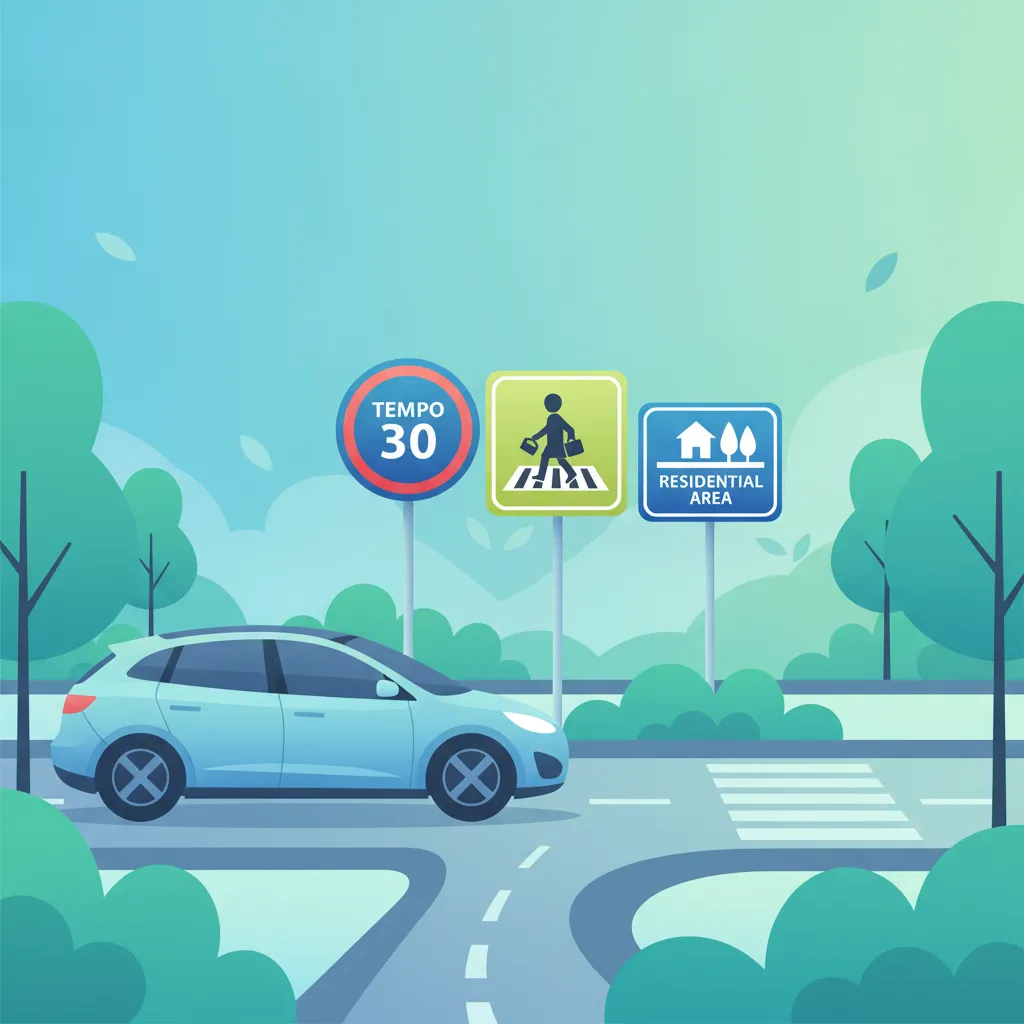
This lesson covers areas with special traffic regulations designed to protect vulnerable road users. Learners will understand the rules and reduced speed limits applicable in Tempo-30 zones, residential areas, and around schools. The content emphasizes the need for heightened awareness and a defensive riding style in these designated zones.
Find clear answers to common questions learners have about Legal Consequences and Penalty Points System. Learn how the lesson is structured, which driving theory objectives it supports, and how it fits into the overall learning path of units and curriculum progression in Switzerland. These explanations help you understand key concepts, lesson flow, and exam focused study goals.
During the three-year probationary period, receiving points for serious traffic offences can lead to an extension of your probationary status or the immediate revocation of your licence. It is a critical period where compliance is strictly monitored.
No, not all fines result in penalty points. Many minor administrative infractions are handled via standard fines, while more serious violations that endanger road safety are those that trigger the penalty point assessment process.
Information regarding your driving record is managed by the cantonal road traffic office. If you accumulate points or face suspension, you will be notified officially through the administrative process.
While the basic principles of the point system apply generally, the severity of the consequences can vary based on the type of violation and your status as a new or experienced driver, particularly regarding the probationary phase.
Pinpoint specific Swiss traffic rules, road signs, or driving situations you need to master. Use the practice search to start a focused revision session now and build confidence for your official driving theory exam.