
This lesson details how speed limits are enforced across Switzerland and the legal repercussions of violating them. By understanding these mechanisms, you will be better prepared to maintain compliance during your driving test and throughout your driving career.
Lesson content overview
Adhering to speed limits is not merely a legal obligation but a fundamental aspect of road safety. In Switzerland, a robust system of speed enforcement is in place to ensure compliance, reduce accidents, and protect all road users. This lesson will delve into the various methods employed by authorities to monitor vehicle speeds, the classification of speeding infractions, and the associated legal consequences, including fines, penalty points, and potential driving licence suspension. Understanding these mechanisms is crucial for every driver seeking to navigate Swiss roads safely and responsibly.
Speed enforcement in Switzerland leverages a combination of advanced technology and traditional policing methods to maintain road safety and ensure adherence to posted speed limits. These mechanisms are designed to detect violations across different road environments, from urban streets to motorways.
Fixed speed cameras are permanently installed devices that monitor vehicle speeds at specific locations or over designated road sections. While some fixed cameras measure speed at a single point, a significant and increasingly common type in Switzerland is the "section control" system. These systems measure a vehicle's average speed over a predefined distance.
Upon entering a section control zone, a camera records a vehicle's licence plate and the exact time. Another camera at the exit point of the section records the same details. By comparing the entry and exit times against the known distance of the section, the system precisely calculates the average speed. If this average speed exceeds the posted limit, a violation is recorded. This method encourages drivers to maintain a consistent, safe speed throughout the entire monitored segment, rather than just slowing down at specific camera locations.
Mobile speed checks are temporary enforcement operations conducted by police using various portable devices. These checks offer flexibility and can be deployed rapidly in accident hotspots, temporary speed limit zones (e.g., construction sites), or areas identified for increased enforcement.
Common technologies used in mobile speed checks include:
Mobile checks serve as a visible deterrent and can be positioned strategically, making it difficult for drivers to predict enforcement locations.
Similar in principle to section control, average speed cameras (often referred to as point-to-point cameras) specifically calculate a vehicle's average speed between two distinct points. While section control might encompass a relatively short segment, average speed cameras can span longer distances, such as several kilometres on a motorway or rural road. This ensures that drivers maintain legal speeds over an extended journey, rather than just momentarily reducing speed for a single camera. The methodology involves recording entry and exit times and calculating average speed, just like section control, but typically covers a broader range.
Drivers should always assume that any unknown speed camera or police presence could be an active enforcement zone. Maintaining a consistent, legal speed is the safest approach.
The legal consequences of speeding in Switzerland are directly proportional to the degree to which the speed limit is exceeded. The Federal Act on Road Traffic (SVG) and its associated ordinances categorize speeding infractions, leading to a graduated scale of penalties.
A minor speed exceedance generally refers to driving:
These infractions are typically handled with a fixed, lower fine, often referred to as an "order fine." They usually do not result in penalty points unless combined with other minor offenses.
Significant speed exceedances involve driving between 6 km/h and 20 km/h over the posted limit, depending on the road type:
These infractions carry higher fines and will generally result in the allocation of penalty points to the driver's record. They are considered more serious due to the increased risk posed by higher speeds.
Serious speed exceedances represent a substantial violation of the speed limit and pose a significantly higher risk to road safety. These include driving:
Such violations lead to substantial fines, mandatory penalty points, and may trigger immediate administrative measures, including the temporary suspension of the driving licence, even for a first offense. Repeated serious exceedances can lead to longer suspensions or even permanent revocation of driving privileges.
Be aware that the precise thresholds for specific penalties can vary slightly and are subject to regular updates in Swiss law. Always drive well within the posted limits to avoid any infractions.
Switzerland operates a cumulative penalty points system, which tracks traffic violations and serves as a crucial component of driver responsibility. This system aims to deter dangerous driving behavior by imposing increasingly severe consequences for repeat offenders.
Points are assigned to a driver's record based on the severity of the traffic offense. While the exact allocation can vary, general guidelines are:
Points added to a driver’s record for traffic offenses. Accumulating a certain number of points within a specified period can lead to the temporary or permanent suspension of driving privileges.
The penalty points accumulate over a three-year period. If a driver accrues 8 penalty points within three years, their driving licence will be temporarily suspended. The duration of this suspension depends on the number of previous suspensions and the total points accumulated. For instance, a first suspension might be for one month, while subsequent suspensions for accumulating points could be significantly longer.
The system ensures that drivers who repeatedly disregard traffic laws face progressively stricter administrative measures, reinforcing the importance of maintaining a clean driving record.
Monetary fines are the most common initial consequence for speeding infractions in Switzerland. The amount of the fine is directly linked to the severity of the speed excess and the specific road environment where the violation occurred.
The fine structure is graduated, meaning higher speeds above the limit result in substantially larger fines.
The precise fine amounts are regularly updated and vary based on cantonal regulations and federal ordinances. For exact, current figures, official government sources should be consulted.
Beyond the degree of speed excess, several factors can influence the final fine amount:
Driving licence suspension is a severe administrative measure, signifying the temporary withdrawal of driving privileges. It is imposed for serious traffic offenses or the accumulation of too many penalty points.
A driving licence can be suspended under several conditions:
The temporary withdrawal of a driver's legal permission to operate a motor vehicle, imposed as a consequence of severe traffic violations or the accumulation of penalty points.
During a licence suspension, the driver is legally prohibited from operating any vehicle for which their licence is required. Driving during a suspension period is a serious criminal offense, leading to even harsher penalties, including significant fines, extended suspensions, and potential imprisonment.
The duration of a suspension varies:
Upon the end of the suspension period, the licence is usually returned, provided all administrative requirements have been met. However, certain conditions might apply, such as requiring a medical psychological assessment or additional driving tests in some cases, particularly for very serious or repeated offenses.
The integrity of speed enforcement relies heavily on the accuracy of the measuring devices used. Swiss law, specifically the Ordinance on Technical Requirements for Speed Measurement (OStV), sets strict standards for the calibration, operation, and tolerance margins of these devices. This ensures that legal penalties are based on reliable and verifiable measurements.
All speed measurement devices, whether fixed cameras, mobile radar, or laser guns, must undergo regular calibration and maintenance.
Recognizing that no measurement is absolutely perfect, Swiss law incorporates tolerance margins for speed measuring devices. These margins account for potential minor inaccuracies in the equipment.
An allowable margin of error for speed detection devices, which ensures that minor measurement inaccuracies do not lead to unfair penalties.
It's important for drivers to understand that these tolerance margins are applied in their favor. While a measurement of 53 km/h in a 50 km/h zone might technically be "over the limit," the tolerance could mean no penalty is issued. However, this does not grant a "free 3 km/h." Drivers should always aim to stay within the posted limit, as relying on tolerance margins is risky and does not excuse exceeding the limit.
Swiss road traffic legislation provides the legal framework for speed limits, enforcement, and penalties. Understanding these foundational regulations is essential for all drivers.
These regulations work in concert to create a comprehensive legal system designed to promote road safety and deter dangerous driving practices. Drivers are expected to be aware of and comply with these laws at all times.
Even experienced drivers can sometimes fall prey to common misunderstandings or overlook certain aspects of speed limits and enforcement. Awareness of these scenarios can help prevent unintentional violations.
Construction zones often have significantly reduced temporary speed limits, typically enforced strictly due to the presence of workers and changed road conditions. Drivers sometimes fail to notice or adhere to these temporary signs, leading to violations. It is crucial to always pay attention to temporary signage, especially in construction areas.
On motorways and major arterial roads, electronic variable speed limit signs (VSL) are used to dynamically adjust limits based on traffic flow, weather conditions, or incidents. Drivers may sometimes ignore these, assuming the default speed limit still applies. Failure to adapt to VSLs can result in penalties, as these are legally binding limits.
Speed limits can change abruptly after motorways exits, major intersections, or entering residential areas. Drivers might assume the previous higher limit still applies. Always look for new speed limit signs after passing junctions or entering different road environments. The absence of a sign means the default limit for that type of road applies, but it's safer to actively look for new signage.
While many GPS navigation systems display speed limits, these are often based on general map data and may not always reflect current, temporary, or variable speed limits. Drivers must always prioritize actual road signage over information from their navigation device. The driver remains solely responsible for obeying posted signs.
Some drivers mistakenly believe that speed cameras are inaccurate or that they can exceed the limit by a small margin without consequence due to tolerance margins. As explained, tolerance margins exist but do not grant a "buffer zone." Driving over the limit, even slightly, is a violation and can be penalized. The safest approach is to always stay within the posted limit.
When in doubt about the current speed limit, always err on the side of caution and reduce your speed.
While legal speed limits provide a maximum threshold, safe driving often requires adapting speed below the posted limit based on prevailing conditions. These contextual factors are critical for defensive driving and avoiding accidents.
Adverse weather significantly reduces visibility and traction, demanding a reduction in speed.
The design and condition of a road dictate the safe speed.
The characteristics of the vehicle and its load can affect its handling and braking capabilities.
In areas with pedestrians, cyclists, or children, drivers must exercise extreme caution and reduce speed significantly, even if the posted limit is higher. These users are difficult to see, less protected, and their movements can be unpredictable. Residential zones, school areas, and busy shopping streets demand the highest level of vigilance and speed adaptation.
By consciously evaluating these factors, drivers can select a safe speed that allows for adequate reaction time, sufficient stopping distance, and full control of their vehicle, thereby preventing accidents and ensuring compliance with the spirit of road safety, not just the letter of the law.
The strict enforcement of speed limits in Switzerland is fundamentally driven by their critical role in road safety. Excessive speed significantly amplifies the risks and consequences of accidents.
A higher speed dramatically increases the distance required to bring a vehicle to a complete stop. This is due to two main components:
Therefore, even a small increase in speed can lead to a considerable increase in the total stopping distance, making it much harder to avoid a collision.
Higher speeds lead to more severe accidents. The kinetic energy of a moving vehicle increases with the square of its speed (E = 0.5 * m * v²). This means that a collision at 100 km/h has four times the destructive energy of a collision at 50 km/h. This increased energy translates directly into:
By promoting adherence to speed limits, enforcement mechanisms directly contribute to reducing accident frequency and mitigating their severity, making Swiss roads safer for everyone.
This lesson covers Swiss speed enforcement methods including fixed cameras, mobile police checks, and section control systems, explaining how authorities monitor compliance across urban, rural, and motorway environments. It details the graduated penalty system with specific exceedance thresholds, penalty point accumulation rules (8 points in 3 years triggers suspension), and corresponding fine structures ranging from CHF 40 to thousands of francs depending on severity. The content also clarifies tolerance margins applied to measurement devices and addresses common misunderstandings about buffer zones and GPS reliance. Understanding these mechanisms and their legal consequences is essential for passing the Category B theory exam and maintaining a clean driving record in Switzerland.
A short set of high-value points that capture the most important learning from this lesson.
Switzerland uses fixed speed cameras with section control, mobile radar/laser checks, and average speed cameras to enforce speed limits across all road types.
Speeding infractions are classified by degree of exceedance: minor (up to 5 km/h over), significant (6-20 km/h over), and serious (21+ km/h over in urban areas, 26+ rural, 31+ motorway).
Accumulating 8 penalty points within a 3-year period triggers mandatory driving licence suspension, with duration increasing for repeat offenders.
Tolerance margins of +/- 3 km/h for speeds up to 100 km/h and +/- 3% for higher speeds are applied in the driver's favor but should never be relied upon as a buffer.
Speed enforcement relies on annually calibrated devices meeting strict technical standards defined in Swiss road traffic ordinances.
Explore all units and lessons included in this driving theory course.
Fine structure is graduated: minor exceedances CHF 40-120, significant CHF 120-600+, serious fines are court-determined and can reach thousands of francs.
First-time licence suspension for points accumulation is typically one month; subsequent suspensions increase to three months, six months, or longer.
Variable speed limit (VSL) signs on motorways display legally binding limits that must be obeyed regardless of the default maximum.
Section control measures average speed over a road segment, meaning slowing down only at cameras provides no benefit.
Construction zones enforce temporary speed limits strictly, and drivers must watch for changing signage after exits or intersections.
Believing that tolerance margins grant a 'buffer zone' to exceed the speed limit by 3 km/h or 3% without consequence.
Relying on GPS navigation systems to know current speed limits instead of observing actual road signage.
Assuming a serious speed exceedance will only result in a fine without risking immediate licence suspension.
Ignoring variable speed limit signs, believing the default motorway limit still applies when electronic signs show a reduced speed.
Failing to notice temporary speed limits in construction zones, which are strictly enforced due to worker safety risks.
Lesson content overview
A short set of high-value points that capture the most important learning from this lesson.
Switzerland uses fixed speed cameras with section control, mobile radar/laser checks, and average speed cameras to enforce speed limits across all road types.
Speeding infractions are classified by degree of exceedance: minor (up to 5 km/h over), significant (6-20 km/h over), and serious (21+ km/h over in urban areas, 26+ rural, 31+ motorway).
Accumulating 8 penalty points within a 3-year period triggers mandatory driving licence suspension, with duration increasing for repeat offenders.
Tolerance margins of +/- 3 km/h for speeds up to 100 km/h and +/- 3% for higher speeds are applied in the driver's favor but should never be relied upon as a buffer.
Speed enforcement relies on annually calibrated devices meeting strict technical standards defined in Swiss road traffic ordinances.
Explore all units and lessons included in this driving theory course.
Fine structure is graduated: minor exceedances CHF 40-120, significant CHF 120-600+, serious fines are court-determined and can reach thousands of francs.
First-time licence suspension for points accumulation is typically one month; subsequent suspensions increase to three months, six months, or longer.
Variable speed limit (VSL) signs on motorways display legally binding limits that must be obeyed regardless of the default maximum.
Section control measures average speed over a road segment, meaning slowing down only at cameras provides no benefit.
Construction zones enforce temporary speed limits strictly, and drivers must watch for changing signage after exits or intersections.
Believing that tolerance margins grant a 'buffer zone' to exceed the speed limit by 3 km/h or 3% without consequence.
Relying on GPS navigation systems to know current speed limits instead of observing actual road signage.
Assuming a serious speed exceedance will only result in a fine without risking immediate licence suspension.
Ignoring variable speed limit signs, believing the default motorway limit still applies when electronic signs show a reduced speed.
Failing to notice temporary speed limits in construction zones, which are strictly enforced due to worker safety risks.
Explore search topics learners often look for when studying Speed Enforcement and Legal Consequences. These topics reflect common questions about road rules, driving situations, safety guidance, and lesson level theory preparation for learners in Switzerland.
Browse additional driving theory lessons that cover connected traffic rules, road signs, and common driving situations related to this topic. Improve your understanding of how different rules interact across everyday traffic scenarios.
Explore how to select safe speeds beyond legal limits in Switzerland. Learn about the impact of weather, road type, vehicle state, and vulnerable road users on appropriate speed selection for safe driving.

This lesson examines the impact of weather and visibility on driving safety and speed selection. It covers how fog, rain, snow, and darkness affect visibility and reaction times, providing guidelines on adjusting speed. It also includes strategies for improving visibility, such as proper headlamp use, to ensure you can adapt to varying weather conditions.

This lesson examines the impact of various weather conditions on driving safety. It explains how to adjust speed in low visibility and the risks of aquaplaning in heavy rain. The content also covers using snow chains in snowy conditions, handling icy surfaces, and dealing with strong winds, particularly on bridges and open roads.

The legal speed limit is a maximum, not a target. This lesson teaches the professional driver's approach to speed management, which involves constantly assessing traffic, road, and weather conditions. You will learn to adjust your speed to ensure you can always stop safely within the distance you can see to be clear.
Weather has a profound impact on vehicle handling and visibility. This lesson teaches you how to reduce speed, increase following distances, and use controls smoothly to maintain traction in poor conditions. It also covers the legal requirements and practical application of snow chains in winter.
This lesson details the different speed limits applicable in urban, rural, and motorway environments across Switzerland. It explains speed limit signs, temporary restrictions, and how to adapt speed safely based on visibility and road conditions. Understanding these principles helps you comply with legal limits while ensuring an appropriate speed for the circumstances.

This lesson focuses on driving on mountain roads, addressing steep gradients, hairpin bends, and altitude-related challenges. You will learn proper techniques for climbing ascents and using engine braking on descents. The content also covers the use of snow chains, recognizing avalanche risks, and interpreting mountain road signs for safe alpine navigation.

This lesson focuses on general driving safety in areas with a high concentration of children. It stresses the importance of significantly reducing speed, being prepared for unexpected events, and scanning for children between parked cars. The driver must exhibit maximum vigilance in these high-risk environments at all times.

Wet or icy roads drastically reduce tyre grip and can double or triple braking distances. This lesson stresses the importance of significantly reducing overall speed and increasing following distances in such conditions. It advises on using brakes with extreme care to avoid skidding and explains how the vehicle's retarder should be used with caution as it can cause the drive wheels to lock up on slippery surfaces.

This lesson details how adverse weather conditions like rain, fog, and snow affect motorcycle safety. It explains how wet surfaces reduce tyre grip, requiring smoother control inputs and longer braking distances. Strategies for managing reduced visibility in fog and the extreme hazards of riding on snow and ice are also covered.

Rural roads present challenges like narrow lanes, poor surfaces, sharp bends, and limited visibility. This lesson teaches drivers how to position their large vehicle to maximize space and visibility, anticipate oncoming traffic at blind corners, and be aware of specific rural hazards. These hazards include slow-moving agricultural vehicles, animals on the road, and concealed farm entrances.
Understand how speed enforcement works in Switzerland, including fixed and mobile cameras. Learn about the tiered legal consequences, including fines, penalty points, and licence suspension, as detailed in Swiss traffic law.

This lesson explains the Swiss penalty points system, detailing how points are assigned for various traffic violations. You will understand the thresholds for point accumulation and the legal consequences, such as licence suspension. The content also covers fine structures and the administrative process for point assessment for all driver license types.

This lesson outlines the legal repercussions for breaking traffic laws in Switzerland. It details the system of fines and administrative measures, including the potential for license withdrawal for serious offenses. The content also explains a rider's legal duties after being involved in an accident, including reporting and insurance obligations.
This lesson details the different speed limits applicable in urban, rural, and motorway environments across Switzerland. It explains speed limit signs, temporary restrictions, and how to adapt speed safely based on visibility and road conditions. Understanding these principles helps you comply with legal limits while ensuring an appropriate speed for the circumstances.
For professional drivers, traffic violations can have career-altering consequences beyond standard fines. This lesson details the heightened penalties for infringements such as speeding, overloading, insecure loads, and violations of driving time regulations. It outlines the process of warnings, license suspension or withdrawal, and potential criminal liability, emphasizing the importance of strict legal compliance in the transport industry.
Explore the probationary phase that follows the acquisition of a Category B licence, including the specific restrictions imposed on new drivers. This lesson outlines the zero tolerance policy for alcohol and the potential consequences of infractions during this period. It also discusses the process for remedial training and the conditions for full licence renewal.
This lesson outlines the legal and administrative repercussions of committing traffic violations or being involved in an accident. It covers the system of fines, licence points, and potential licence revocation under Swiss law. Understanding these consequences reinforces the importance of lawful and responsible riding.

This lesson details the definition of Category B within the Swiss licensing system, focusing on vehicle types, weight capacities, and passenger limits. It clarifies the maximum authorized mass for Category B cars and the specific restrictions on towing trailers. You will learn the legal framework defining which vehicles you may operate and the boundaries of this license category.

Gain insight into the two-stage examination process for the Swiss Category B licence, covering both the theory exam and the practical driving test. This lesson outlines the question format, passing score thresholds, and the nature of the practical assessment. Administrative aspects such as registration procedures, test locations, and retake policies are also addressed.
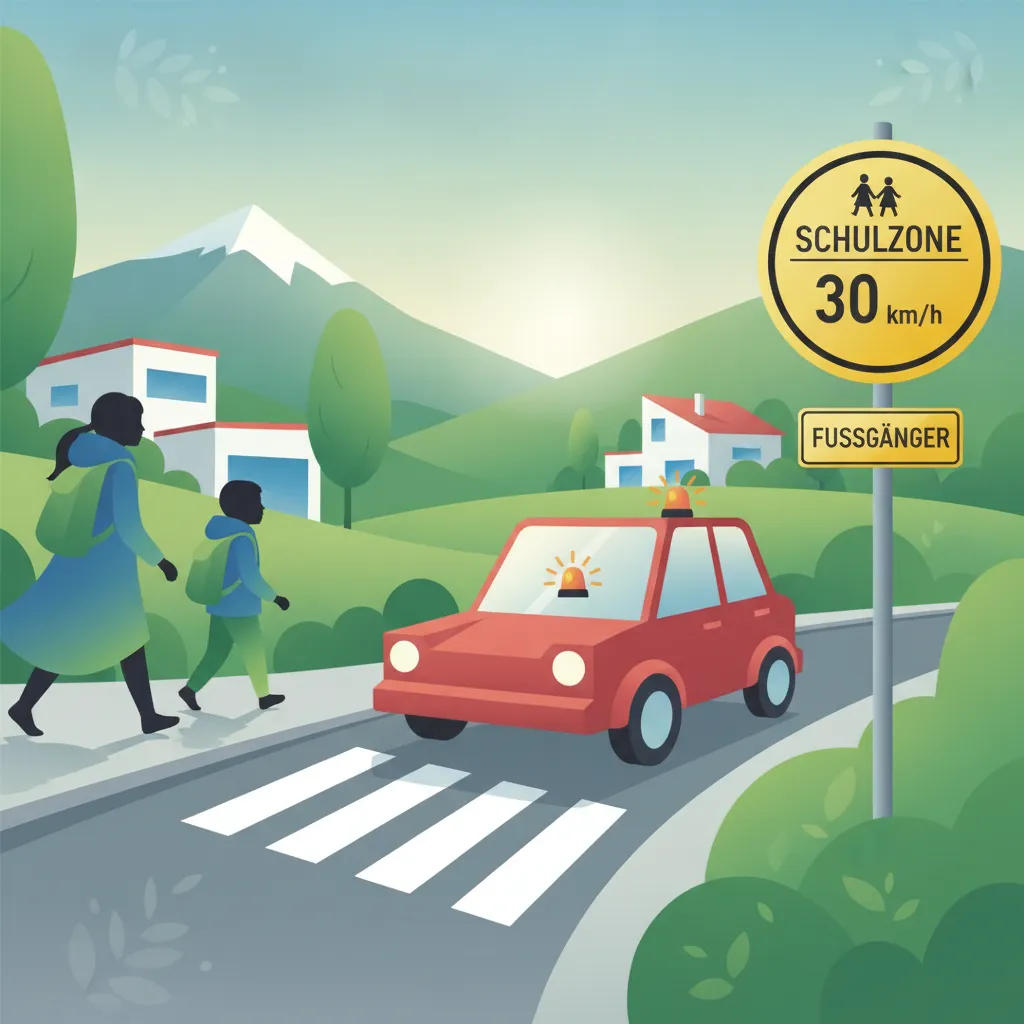
This lesson focuses on school zones, where special speed limits and cautionary measures are required. You will learn to recognize school zone signs, understand reduced speed limits, and be aware of designated child crossing zones. The content also emphasizes the need for heightened vigilance when school buses stop for students to ensure child safety.

This lesson details the maximum legal speed limits applicable to Category M vehicles in Switzerland. It explains how to identify speed limits through signage and differentiates between built-up areas, rural roads, and motorways where permitted. The content stresses that the legal limit is a maximum, and riders must always adapt their speed to traffic, weather, and road conditions.
Find clear answers to common questions learners have about Speed Enforcement and Legal Consequences. Learn how the lesson is structured, which driving theory objectives it supports, and how it fits into the overall learning path of units and curriculum progression in Switzerland. These explanations help you understand key concepts, lesson flow, and exam focused study goals.
Yes, even minor traffic violations in Switzerland can lead to an extension of your probationary period or the withdrawal of your license. It is critical to strictly adhere to all posted speed limits.
A fine is typically a financial penalty for minor offences, while administrative measures involve the road traffic office taking action against your license, such as a warning, suspension, or even permanent revocation.
While some speed cameras are visible, Swiss law relies on general driver compliance. You must assume that speed enforcement can occur anywhere, regardless of whether a specific warning sign is present.
Switzerland utilizes a system of administrative measures where repeat offenses lead to increasingly severe consequences, starting with warnings and potentially moving to long-term bans for serious or repeated speed violations.
Pinpoint specific Swiss traffic rules, road signs, or driving situations you need to master. Use the practice search to start a focused revision session now and build confidence for your official driving theory exam.