
This lesson details the essential documents you must carry as a professional heavy vehicle driver in Switzerland. Mastering these legal obligations is crucial for both passing your theory exam and maintaining compliance during official roadside inspections.

Lesson content overview
Operating a heavy goods vehicle in Switzerland, whether for Category C, C1, C1E, or CE, involves significant responsibility. Beyond mastering vehicle operation and road safety, professional drivers must meticulously manage and carry a set of mandatory documents. These documents are not mere formalities; they form the bedrock of legal compliance, ensuring the driver's qualifications, the vehicle's roadworthiness, and the legality of the transport operation itself. Failure to present the correct documentation during a roadside inspection by authorities can lead to severe consequences, including substantial fines, vehicle seizure, or even the temporary suspension of driving privileges.
This lesson, part of the Official Swiss Driving Theory Course for Category C & C1 Goods Vehicles, delves into the specific documentation required for professional transport activities in Switzerland. It explains each essential document's purpose, legal implications, and how it connects to broader aspects of road safety and professional accountability. Understanding these requirements is fundamental for any driver aspiring to operate heavy goods vehicles legally and safely on Swiss roads.
Every professional driver of a goods vehicle in Switzerland must always carry and be ready to present specific documents upon request. These foundational documents verify the driver's legal permission to operate the vehicle, their professional competence, and the vehicle's registration status. Think of these as your professional identity and the vehicle's passport.
These core documents include:
In addition to these, certain transport operations or vehicle types necessitate further documentation, such as consignment notes for cargo and roadworthiness certificates for vehicle inspections. Ensuring all these documents are current, correctly filled out, and readily accessible is a non-negotiable part of a professional driver's duty.
The Fahrzeugausweis, often translated as the vehicle registration document, is the official proof that a vehicle is legally registered with the cantonal road traffic authorities in Switzerland. This critical document contains vital information about the vehicle, including its type, make, model, chassis number, weight limits, and details of the registered owner. It confirms that the vehicle meets the necessary technical specifications and is approved for use on Swiss roads.
The primary purpose of the Fahrzeugausweis is to identify the vehicle unequivocally and to verify its legal status. It is a legal requirement that the original paper document must be carried in the vehicle at all times whenever it is in operation on public roads. This applies to all vehicles, including heavy goods vehicles, and their trailers if they have separate registration.
Upon request from police officers or road traffic control personnel, the driver must immediately produce this document. Presenting a photocopy, a digital image on a phone, or any other reproduction is generally not accepted as legal fulfillment of this obligation.
Crucial Note: Always carry the original Fahrzeugausweis. A copy or digital photograph is not legally sufficient and can lead to fines.
One of the most frequent errors drivers make is assuming a digital copy or a photograph of the Fahrzeugausweis will suffice during an inspection. This is a critical misunderstanding that can lead to fines. While authorities are exploring digital solutions (e-Fahrzeugausweis), the current legal requirement mandates the original physical document. Another common issue arises when the vehicle has been recently purchased or transferred, and the new registration document has not yet been issued or received. In such cases, interim documentation from the road traffic office might be required.
Your driving license is personal proof of your authorization to operate specific categories of vehicles. For professional goods vehicle drivers in Switzerland, this typically means holding a valid Category C or Category C1 license, possibly with an "E" endorsement for trailers (CE or C1E). These categories signify that you have passed the necessary theoretical and practical examinations to safely and legally operate heavy goods vehicles within the specified mass limits.
Permits the operation of motor vehicles, other than those in Category D, with a total permissible mass exceeding 3,500 kg, designed for the transport of goods, and with no more than 8 passenger seats in addition to the driver's seat.
Permits the operation of motor vehicles, other than those in Category D, with a total permissible mass between 3,500 kg and 7,500 kg, designed for the transport of goods, and with no more than 8 passenger seats in addition to the driver's seat.
Just like the Fahrzeugausweis, your valid driving license must be carried on your person whenever you are driving. It must be current, not expired, and clearly correspond to the category of the vehicle you are operating. For example, driving a 12-tonne truck (Category C) with only a Category B (car) license is a serious offense with severe legal consequences.
When requested by law enforcement, you must present your physical driving license. The officer will verify your identity against the license and confirm your entitlement to drive the specific vehicle. Any restrictions or conditions noted on your license (e.g., requirement to wear glasses) must also be adhered to.
It is crucial to understand that a provisional driving license, often issued to learners, is generally not sufficient for professional transport activities. Provisional licenses come with significant restrictions, such as the requirement to be accompanied by a qualified instructor and prohibitions against carrying goods for commercial purposes. Professional transport necessitates a full, unrestricted driving license for the appropriate category.
Regularly check the expiry date of your driving license. Renew it well in advance to avoid any interruptions to your professional driving activities.
For all professional drivers engaged in the commercial transport of goods in Switzerland, holding a valid Operator Certificate of Professional Qualification (OACP) card is mandatory. The OACP (known in French as OACP, in German as CZV - Chauffeurzulassungsverordnung, and in Italian as OACP) is proof that a driver has completed the required professional training and undergoes continuous education, ensuring they possess the necessary competence for professional transport tasks. This goes beyond the basic driving license, focusing specifically on aspects pertinent to professional operations, such as load securing, driving and rest times, and economic driving.
The OACP ensures a high standard of professionalism and safety within the transport sector. It confirms that drivers are not only capable of operating a heavy vehicle but also understand the complex regulations and practical challenges associated with professional goods transport. This qualification is vital for promoting road safety, minimizing environmental impact, and enhancing the overall quality of professional driving services.
The OACP qualification card must be carried by the driver at all times while engaged in professional transport activities. It must be presented alongside the driving license and the vehicle registration document during any roadside inspection. A common misconception is that the OACP is only required for international transport or for specific types of goods. This is incorrect; the OACP is mandatory for all professional goods vehicle drivers operating within Switzerland, regardless of the nature of the transport. Non-professional drivers, such as those driving a heavy vehicle for personal use (e.g., moving personal belongings), are typically exempt from the OACP requirement.
The OACP qualification is not a one-time achievement. It requires periodic renewal through mandatory continuous training. Drivers must complete a set number of hours of further training within a specified period to maintain their OACP validity. Failure to do so will result in the OACP card expiring, rendering the driver unqualified for professional transport until the training is completed and the card is revalidated.
Valid Driving License: Matching the vehicle category.
Vehicle Registration Document (Fahrzeugausweis): The original paper document.
OACP Qualification Card: For all professional transport operations.
Beyond the personal and vehicle-specific documents, the cargo being transported also requires documentation. For commercial transport of goods, a consignment note (or an equivalent transport document) is typically mandatory. This document provides crucial information about the cargo, its journey, and the parties involved, serving as a contract of carriage and a record for inspections.
The Consignment Note, particularly the CMR Convention document for international road transport, is a standard document that details the goods being carried, their quantity, weight, origin, and destination. It also identifies the consignor (sender), carrier (transport company), and consignee (recipient), and outlines the terms and conditions of carriage, including liability. For domestic transport within Switzerland, similar transport documents fulfilling the same purpose are required, even if they are not explicitly called "CMR."
An international transport document (under the CMR Convention) or a national equivalent, detailing the goods carried, their quantity, weight, origin, destination, and the parties involved in the transport. It serves as proof of contract for carriage.
The consignment note must accurately reflect the cargo being carried. It typically includes:
This document is paramount for traceability, particularly for hazardous materials, and for verifying compliance with load limits and regulations. During a roadside inspection, authorities will often request the consignment note to cross-reference the cargo with the vehicle's permissible loads and to ensure proper load securing, as documented. It also plays a vital role in determining liability in the event of damage or loss of goods.
Special Cargo: For dangerous goods (ADR), additional specific documentation such as safety data sheets, transport emergency cards, and special permits must be carried in addition to the consignment note.
The consignment note, or equivalent transport document, must accompany the cargo throughout the entire journey and be available for immediate inspection. Failure to produce this document or if the document contains inaccuracies can lead to significant penalties, including fines, delays, or even the impoundment of the vehicle until the documentation issues are resolved. Do not treat a simple invoice as a sufficient transport document; while it details financial transactions, it often lacks the specific transport-related information required by law.
The Roadworthiness Certificate (MFK Prüfbewilligung) serves as official proof that a vehicle has undergone and passed the mandatory technical inspection in Switzerland. This inspection, known as the "Motorfahrzeugkontrolle" (MFK), ensures that the vehicle meets stringent safety and environmental standards. It checks everything from braking systems and steering to lighting, tires, and exhaust emissions.
Upon successful completion of the MFK inspection, a valid sticker is typically affixed to the vehicle, often on the windshield. This sticker indicates the date of the next due inspection. For goods vehicles, the frequency of these inspections can vary depending on the vehicle's age, type, and weight. Generally, new vehicles have their first inspection after a certain number of years, with subsequent inspections every one or two years thereafter.
It is a legal obligation for all motor vehicles in Switzerland to undergo these periodic technical inspections. Operating a vehicle with an expired MFK sticker or without a valid roadworthiness certificate is a serious offense. During a roadside inspection, police officers will often check for the validity of the MFK sticker. If the sticker is expired, or if there is no proof of a valid inspection, the driver may face fines, and the vehicle could be ordered off the road until it passes inspection, or even seized immediately if deemed unsafe.
Drivers should not assume that because the vehicle "feels" fine, it is roadworthy. The MFK inspection is a comprehensive technical assessment performed by certified experts to identify potential defects that might not be immediately apparent to the driver. Regular maintenance and pre-departure checks by the driver complement, but do not replace, the mandatory MFK.
The meticulous management and presentation of vehicle and driver documentation are not merely administrative tasks; they are strict legal obligations under Swiss road traffic law. Non-compliance can lead to a range of penalties, reflecting the severity of the infraction and its potential impact on road safety and professional conduct.
Beyond immediate fines, repeated documentation infringements can negatively impact a professional driver's reputation and employment prospects. Furthermore, in the event of an accident, a lack of proper documentation could complicate insurance claims, potentially leading to the voiding of coverage or increased personal liability for damages. Adherence to these regulations is a fundamental aspect of professional responsibility and duty of care.
Understanding which documents are needed is only half the battle; knowing when and how to present them effectively is equally important for a smooth interaction with authorities.
Imagine you are driving your goods vehicle on a motorway and are signaled by a police officer to pull over for a routine check.
Remain Calm and Follow Instructions: Safely pull over to the designated area. Turn off the engine and open your window.
Be Polite and Cooperative: Greet the officer respectfully.
Prepare Documents: Have your valid driving license, Fahrzeugausweis (original), and OACP qualification card readily accessible. If carrying commercial goods, also prepare the consignment note.
Present Upon Request: Hand over the requested documents clearly. Do not offer other documents unless asked.
Answer Questions Honestly: Respond to any questions related to your journey or cargo truthfully and concisely.
You are transporting hazardous chemicals and approach a tunnel entrance where a special checkpoint is in operation.
Your vehicle, which is four years old, is stopped for a random roadside inspection.
The essential vehicle documents and legal obligations discussed in this lesson do not exist in isolation. They are intricately linked to other critical aspects of professional driving, reinforcing a comprehensive framework for safety and compliance within the Official Swiss Driving Theory Course for Category C & C1 Goods Vehicles.
Understanding these connections highlights why each document is critical and how they collectively contribute to safe and lawful operation of heavy goods vehicles.
The importance of essential vehicle documents and legal obligations cannot be overstated for professional goods vehicle drivers in Switzerland. These documents are not bureaucratic hurdles but fundamental tools that ensure road safety, enforce compliance, and uphold the professionalism of the transport industry.
Remember these key takeaways:
Mastering these documentary requirements is as crucial as mastering the operation of your heavy goods vehicle. It is a cornerstone of responsible and lawful professional driving within Switzerland.
This lesson covers the mandatory documentation requirements for professional Category C and C1 goods vehicle drivers operating in Switzerland. Learners must understand that three core documents—the original Fahrzeugausweis, a valid Category C or C1 driving license, and an OACP qualification card—must be carried and presented at all roadside inspections. The lesson clarifies that the OACP is required for all professional transport regardless of route, that only the original physical registration document is legally acceptable, and that consignment notes serve as contracts of carriage containing specific cargo and party information. Additional requirements include MFK roadworthiness certificates and, for hazardous materials, specialized ADR documentation. Non-compliance can result in substantial fines, vehicle seizure, and suspension of driving privileges.
A short set of high-value points that capture the most important learning from this lesson.
The original Fahrzeugausweis (vehicle registration document) must always be carried in physical form; photocopies or digital images are not legally sufficient.
Professional goods vehicle drivers must carry three core documents: valid driving license (Category C/C1), original Fahrzeugausweis, and OACP qualification card.
The OACP qualification is mandatory for ALL professional goods transport in Switzerland, not just international routes, and requires periodic renewal through continuous training.
Consignment notes (or equivalent transport documents) must accompany cargo and contain specific details about goods, parties, and carriage terms.
The MFK roadworthiness certificate and its sticker confirm mandatory technical inspection compliance, which is a legal requirement for all vehicles.
Explore all units and lessons included in this driving theory course.
Category C license: vehicles over 3,500 kg gross weight for goods transport; Category C1 license: vehicles between 3,500 kg and 7,500 kg.
The OACP (Operator Certificate of Professional Qualification) is legally required for professional transport regardless of trip distance or cargo type.
A consignment note must include: cargo description, weight, packaging, consignor/consignee details, loading/delivery locations, and signatures.
Dangerous goods (ADR) require additional documentation beyond the standard consignment note, including safety data sheets and transport emergency cards.
Provisional driving licenses are generally insufficient for professional transport activities.
Assuming a digital photograph or photocopy of the Fahrzeugausweis will suffice during inspection; only the original paper document is legally accepted.
Believing the OACP qualification is only needed for international transport; it applies to all professional goods vehicle operations within Switzerland.
Using a simple invoice as a substitute for a proper consignment note, which lacks the required transport-specific information.
Driving a Category C vehicle (over 3,500 kg) with only a Category B or C1 license, which is a serious offense.
Failing to renew the OACP qualification through required continuous training, leading to an expired card and loss of professional driving eligibility.
Lesson content overview
A short set of high-value points that capture the most important learning from this lesson.
The original Fahrzeugausweis (vehicle registration document) must always be carried in physical form; photocopies or digital images are not legally sufficient.
Professional goods vehicle drivers must carry three core documents: valid driving license (Category C/C1), original Fahrzeugausweis, and OACP qualification card.
The OACP qualification is mandatory for ALL professional goods transport in Switzerland, not just international routes, and requires periodic renewal through continuous training.
Consignment notes (or equivalent transport documents) must accompany cargo and contain specific details about goods, parties, and carriage terms.
The MFK roadworthiness certificate and its sticker confirm mandatory technical inspection compliance, which is a legal requirement for all vehicles.
Explore all units and lessons included in this driving theory course.
Category C license: vehicles over 3,500 kg gross weight for goods transport; Category C1 license: vehicles between 3,500 kg and 7,500 kg.
The OACP (Operator Certificate of Professional Qualification) is legally required for professional transport regardless of trip distance or cargo type.
A consignment note must include: cargo description, weight, packaging, consignor/consignee details, loading/delivery locations, and signatures.
Dangerous goods (ADR) require additional documentation beyond the standard consignment note, including safety data sheets and transport emergency cards.
Provisional driving licenses are generally insufficient for professional transport activities.
Assuming a digital photograph or photocopy of the Fahrzeugausweis will suffice during inspection; only the original paper document is legally accepted.
Believing the OACP qualification is only needed for international transport; it applies to all professional goods vehicle operations within Switzerland.
Using a simple invoice as a substitute for a proper consignment note, which lacks the required transport-specific information.
Driving a Category C vehicle (over 3,500 kg) with only a Category B or C1 license, which is a serious offense.
Failing to renew the OACP qualification through required continuous training, leading to an expired card and loss of professional driving eligibility.
Explore search topics learners often look for when studying Essential Vehicle Documents and Legal Obligations. These topics reflect common questions about road rules, driving situations, safety guidance, and lesson level theory preparation for learners in Switzerland.
Browse additional driving theory lessons that cover connected traffic rules, road signs, and common driving situations related to this topic. Improve your understanding of how different rules interact across everyday traffic scenarios.
Understand the mandatory documents required for operating heavy goods vehicles in Switzerland, including the Fahrzeugausweis, driving license, and OACP card. Learn about legal requirements and consequences for professional drivers.

This lesson details the specific documents that must be present in the vehicle and on the driver's person during service. It covers the driving license, OACP card, vehicle registration, and tachograph records. You will learn the importance of ensuring all paperwork is current and correct to ensure legal compliance at all times.

For professional drivers, traffic violations can have career-altering consequences beyond standard fines. This lesson details the heightened penalties for infringements such as speeding, overloading, insecure loads, and violations of driving time regulations. It outlines the process of warnings, license suspension or withdrawal, and potential criminal liability, emphasizing the importance of strict legal compliance in the transport industry.
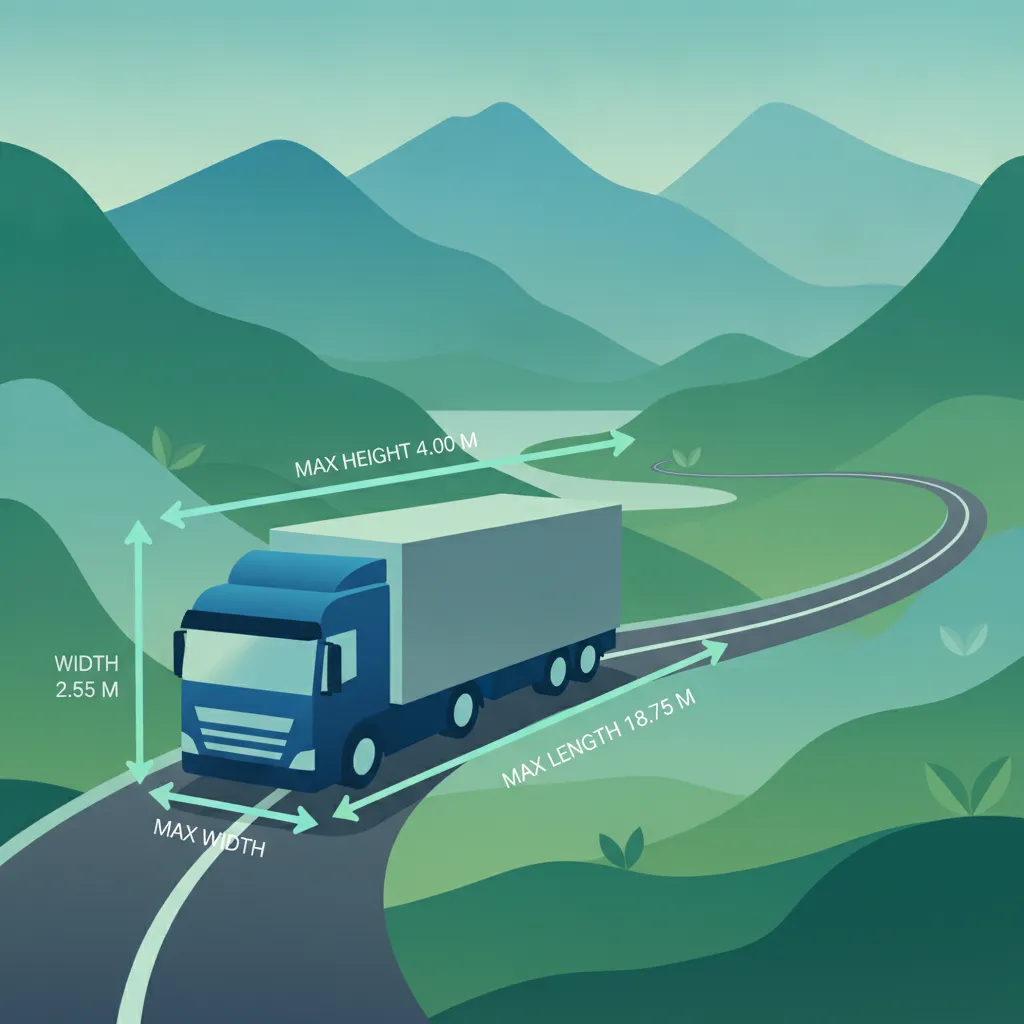
Swiss law strictly regulates the maximum dimensions of commercial vehicles to ensure they can safely navigate the infrastructure. This lesson specifies the standard limits for vehicle height (4.0m), width (2.55m), and length for various lorry and trailer combinations. Adhering to these dimensions is crucial for avoiding collisions with bridges, tunnels, and other structures, and for navigating narrow roads.

Operating a heavy goods vehicle involves a significant responsibility for the safety of all road users. This lesson emphasizes the professional driver's enhanced duty of care due to the vehicle's size, mass, and potential impact in a collision. It covers the importance of a professional attitude, constant vigilance, and adherence to all traffic regulations to prevent incidents and maintain a high standard of road safety.

The driver is legally responsible for the roadworthiness of their vehicle at the start of and during every journey. This lesson outlines the formal process for reporting any identified defects to the transport manager or maintenance staff. It stresses the critical rule that a vehicle with a known safety-critical defect must not be driven until it has been professionally repaired and declared safe.

Overloading is a serious offence with severe safety and legal ramifications. This lesson details how excess weight drastically increases braking distances, puts extreme stress on tyres leading to blowouts, and negatively affects steering and overall stability. Furthermore, it discusses the substantial fines, potential license withdrawal, and driver liability that result from violating Swiss weight regulations.

Unlike cars, heavy vehicles cannot travel on every road. This lesson stresses the importance of using HGV-specific satellite navigation systems or carefully checking maps to plan routes that avoid low bridges, weak bridges, and roads with weight or width restrictions. Proper planning saves time, fuel, and prevents dangerous situations or costly damage.

Transporting loads that are wider, longer, taller, or heavier than standard regulations allow requires special authorization. This lesson explains the concept of exceptional transport and the legal requirement to obtain a special permit from the relevant cantonal authorities. It highlights that such operations require careful route planning, often mandating specific times of travel and sometimes the use of escort vehicles.
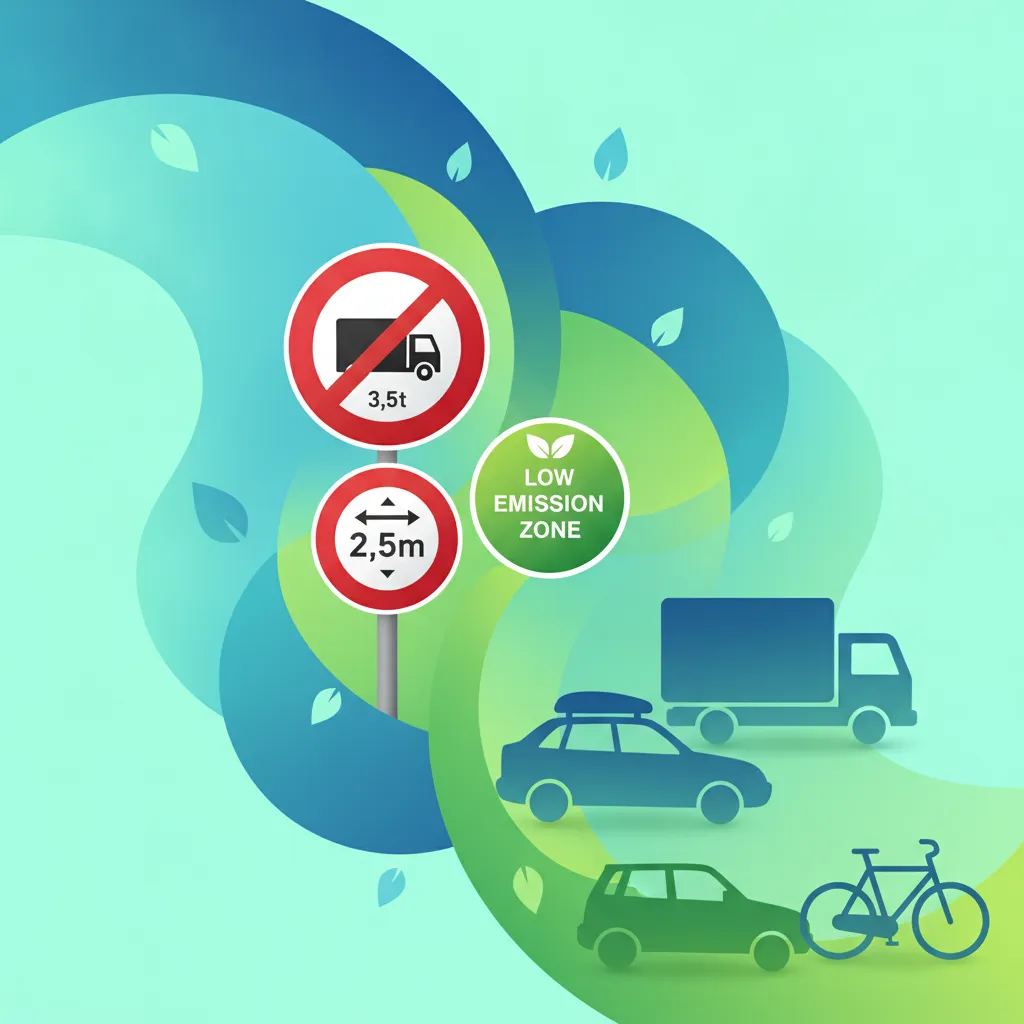
Many urban areas have restrictions to manage traffic and protect infrastructure. This lesson teaches drivers to identify and interpret traffic signs that prohibit access based on gross vehicle weight, axle load, height, or width. It also covers the growing prevalence of environmental or low-emission zones, which may restrict entry for older, more polluting vehicles.
Learn about the specific requirements for Category C and C1 driving licenses in Switzerland, and the importance of the OACP qualification card for professional transport operations and driver competence.

This lesson explains that obtaining a Category D license is the first step, while the OACP (Chauffeur Admission Ordinance) is a separate, mandatory professional qualification. It outlines the purpose of the OACP, including initial qualification and periodic training requirements. Understanding this distinction is crucial for a compliant and successful career in professional driving.
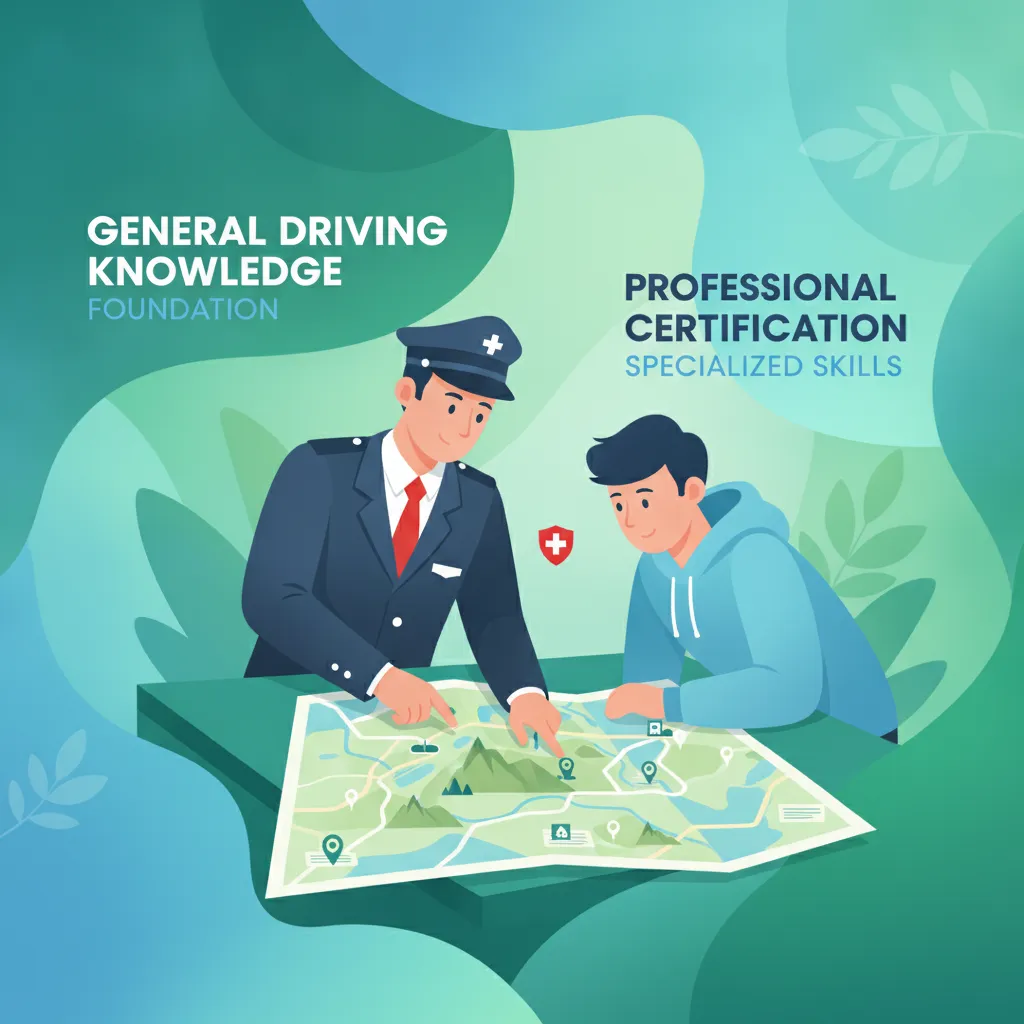
Obtaining a Category C license is the first step; driving professionally requires an additional qualification. This lesson distinguishes between the knowledge needed for the theory test and the requirements of the Chauffeur Admission Ordinance (OACP). It explains that the OACP involves further training and periodic courses focused on practical skills, safety, and economic driving, which are mandatory for commercial goods transport.
This lesson details the specific documents that must be present in the vehicle and on the driver's person during service. It covers the driving license, OACP card, vehicle registration, and tachograph records. You will learn the importance of ensuring all paperwork is current and correct to ensure legal compliance at all times.
Operating a heavy goods vehicle involves a significant responsibility for the safety of all road users. This lesson emphasizes the professional driver's enhanced duty of care due to the vehicle's size, mass, and potential impact in a collision. It covers the importance of a professional attitude, constant vigilance, and adherence to all traffic regulations to prevent incidents and maintain a high standard of road safety.

This lesson provides a clear definition of the Swiss heavy goods vehicle license categories. It details the weight limits and vehicle configurations for Category C (lorries over 3.5t) and C1 (lorries from 3.5t to 7.5t). Furthermore, it explains how categories CE and C1E grant the entitlement to tow heavy trailers, forming articulated vehicles or road trains, which is crucial for professional transport operations.

Motorway driving requires constant concentration due to high speeds. This lesson emphasizes the importance of staying in the right-hand lane unless overtaking and the specific restrictions on lorry overtaking in Switzerland. It reinforces the need for a following distance of at least four seconds to compensate for the vehicle's long stopping distance and provides guidance on safely merging and exiting.
For professional drivers, traffic violations can have career-altering consequences beyond standard fines. This lesson details the heightened penalties for infringements such as speeding, overloading, insecure loads, and violations of driving time regulations. It outlines the process of warnings, license suspension or withdrawal, and potential criminal liability, emphasizing the importance of strict legal compliance in the transport industry.

Urban driving requires heightened awareness and careful planning. This lesson covers the challenges of narrow streets, heavy traffic, and the need to identify designated loading and unloading zones. It emphasizes the importance of planning routes in advance to account for time-based access restrictions and to avoid unsuitable roads.
Find clear answers to common questions learners have about Essential Vehicle Documents and Legal Obligations. Learn how the lesson is structured, which driving theory objectives it supports, and how it fits into the overall learning path of units and curriculum progression in Switzerland. These explanations help you understand key concepts, lesson flow, and exam focused study goals.
The Fahrzeugausweis is the central document that confirms the vehicle's roadworthiness and registration details; you must always have the original version available when driving.
No, for professional driving, you must hold both your valid Category C or C1 license and the OACP qualification card as proof of your professional certification.
Failure to present mandatory documents like the license or registration can result in fines and, in some cases, being prohibited from continuing your journey until the documents are provided.
Consignment notes are vital for professional transport, as they detail the goods, origin, and destination; they are legally required for tracking and inspection purposes in the transport industry.
Pinpoint specific Swiss traffic rules, road signs, or driving situations you need to master. Use the practice search to start a focused revision session now and build confidence for your official driving theory exam.