
This lesson explains the legal requirements for transporting loads that exceed standard dimensions or weights on Swiss roads. You will learn the importance of obtaining special permits, planning routes, and following specific safety protocols essential for heavy goods vehicle operators. Understanding these rules is a critical component of your Category C or C1 professional certification.

Lesson content overview
Transporting exceptionally large or heavy loads presents unique challenges and requires strict adherence to specialized regulations. In Switzerland, any vehicle or vehicle combination carrying a load that exceeds standard legal dimensions (height, width, length) or masses (gross vehicle mass, axle loads, gross combination mass) is classified as an "abnormal load." Such operations are not permitted under general traffic rules and necessitate a special permit (Ausnahmebewilligung) to ensure the safety of all road users and to protect critical infrastructure.
This comprehensive lesson, part of your Official Swiss Driving Theory Course for Category C & C1 Goods Vehicles, delves into the legal framework, procedural requirements, and practical considerations for handling abnormal loads. It builds upon your understanding of vehicle dimensions, masses, and axle loads, which are foundational to identifying when a special permit is needed.
An abnormal load refers to any load carried by a vehicle or vehicle combination that surpasses the statutory limits for height, width, length, total weight, axle load, or gross combination mass as defined by Swiss road traffic regulations. These limits are in place to ensure road safety, prevent damage to roads and bridges, and manage traffic flow effectively.
The movement of such loads is termed exceptional transport. This category of transport does not conform to standard permissions and thus requires a bespoke authorization. It facilitates the movement of essential but oversized items, such as industrial machinery, large construction components, wind turbine parts, or specialized vehicles like cranes. Without proper regulation, these transports could pose severe risks, including collisions, structural damage to bridges or tunnels, and significant traffic disruptions.
A load that exceeds the statutory limits for height, width, length, weight, axle load, or gross combination mass as defined by Swiss road traffic regulations.
The transport of a vehicle/load combination that does not conform to standard permissions, necessitating special treatment and a specific permit from authorities.
Abnormal loads can be broadly categorized into:
Both types of abnormal loads present unique challenges and require meticulous planning, specialized equipment, and, most critically, official authorization.
The cornerstone of legally transporting abnormal loads in Switzerland is the special permit (Ausnahmebewilligung). This is a formal, written authorization granted by the relevant governmental body, allowing the transport of loads that would otherwise be illegal due to their dimensions or mass.
The primary purpose of an Ausnahmebewilligung is to enable the controlled and safe movement of oversized or overweight items while simultaneously mitigating risks to other road users and protecting public infrastructure. The permit acts as a regulatory control, detailing precisely how and when the transport must occur.
In Switzerland, the responsibility for issuing these special permits is primarily delegated to the cantonal road and transport authorities (Kantonale Behörden). This decentralized approach allows each canton to account for its unique regional road characteristics, infrastructure capabilities (such as specific bridge capacities or tunnel clearances), and traffic conditions.
Drivers and transport companies must apply to the cantonal authority in the canton where the transport originates or, if the journey crosses multiple cantons, to the authorities of all cantons involved. This means that permit requirements, application procedures, and associated fees can vary significantly from one canton to another. Therefore, it is crucial for drivers and operators to thoroughly understand and comply with the specific regulations of each canton their route traverses.
A formal, written authorization granted by the cantonal road authority permitting the transport of loads exceeding standard legal dimension or mass limits.
The regional governmental body in Switzerland responsible for issuing special permits for abnormal loads, taking into account local road and infrastructure characteristics.
The application for a special permit typically requires detailed information, including:
Once issued, the special permit is not merely a formality; it is a legally binding document that outlines specific conditions for the transport.
Successful and compliant abnormal load transport hinges on careful planning and strict adherence to several key operational aspects.
Route planning for abnormal loads is arguably the most critical step after securing a permit. It involves systematically determining a safe and compliant path for the oversized transport, specifically tailored to the unique dimensions and mass of the load. This planning must proactively address and avoid any physical constraints on the road network.
Key considerations in route planning include:
Cantonal permits will often explicitly dictate the permissible routes, and any deviation can lead to severe penalties and safety hazards. It's not uncommon for routes to be surveyed physically before the transport to ensure all clearances are correctly identified.
Escort vehicles (Begleitfahrzeuge) are additional vehicles that accompany an abnormal load to enhance safety, provide warnings to other road users, and assist in managing traffic around the oversized transport. Their presence is often a mandatory condition stipulated in the special permit.
There are generally two types of escort vehicles:
The number, type, and placement of escort vehicles depend on the dimensions of the abnormal load and the specific route. For example, a very wide load might require both front and rear escorts, especially on two-lane roads. Escort vehicles are typically equipped with distinctive markings, flashing amber lights, and clear signage to alert other drivers. Their role is crucial in signaling the presence of an unusual vehicle combination, guiding traffic, and assisting the driver of the abnormal load, particularly in challenging sections or during turns.
To minimize disruption to normal traffic flow and reduce the risk of collisions, special permits for abnormal loads often include travel time restrictions. These specify particular periods during which the abnormal load is permitted to move.
Common restrictions include:
Adhering to these time restrictions is not just a matter of compliance but a critical safety measure that contributes to smoother operations for the transport company and less inconvenience for the general public.
Understanding and respecting infrastructure limitations is paramount for any abnormal load transport. These are the physical constraints of roads, bridges, tunnels, and other structures that directly impact whether an oversized or overweight load can safely pass.
Before any abnormal load transport, comprehensive checks of all relevant infrastructure data along the planned route are essential. Ignoring these limitations is a direct pathway to accidents, severe fines, and extensive damage.
Compliance with Swiss regulations for abnormal loads is mandatory and strictly enforced. The special permit is a legal document that dictates the terms of transport.
Regulation 1: Special Permit Requirement. All loads exceeding statutory dimension or mass limits must obtain a special permit (Ausnahmebewilligung) from the relevant cantonal authority before commencing transport.
Rationale: This ensures that every exceptional transport has been vetted for safety, route feasibility, and infrastructure protection.
Regulation 2: Visible Permit Display. The special permit must be displayed prominently on the vehicle throughout the entire transport journey.
Rationale: This allows enforcement officers (police, road authorities) and other road users to easily identify the abnormal load and verify its legitimacy.
Regulation 3: Mandatory Escort Vehicles. If required by the permit, escort vehicles (Begleitfahrzeuge) must accompany the abnormal load. The number, type (pilot/rear), and placement will be specified.
Rationale: Escorts provide critical visual warnings to other road users, manage traffic, and assist the main driver in complex maneuvers, significantly enhancing safety.
Regulation 4: Adherence to Travel Time Restrictions. The movement of abnormal loads is restricted to designated times if stipulated in the permit.
Rationale: These restrictions reduce the impact on regular traffic flow, minimize congestion, and lower the likelihood of accidents during peak hours.
Regulation 5: Approved Route Conformity. The entire journey must strictly conform to the route specified in the permit, avoiding all prohibited roads or structures.
Rationale: The approved route has been vetted for its ability to safely accommodate the abnormal load, taking into account infrastructure limitations. Deviations can lead to severe structural damage or accidents.
Important Verification Note: Drivers must always verify the exact dimension limits, permit application processes, specific escort vehicle requirements, and distance regulations with the relevant cantonal road authorities, as these can be subject to change and regional variation.
Failing to comply with the regulations surrounding abnormal loads carries significant risks, not only for the driver and company but also for other road users and public infrastructure. Violations can lead to substantial fines, legal prosecution, and the immediate cessation of transport.
The complexity of abnormal load transport means that various external and internal factors can influence operations and require adjustments, often specified in the special permit.
This lesson on special permits and abnormal loads is deeply integrated with other key topics in your Official Swiss Driving Theory Course for Category C & C1 Goods Vehicles.
To solidify your understanding, consider these practical scenarios involving abnormal loads:
Scenario: Transporting a 5-metre wide steel beam through a Swiss canton.
Scenario: Moving a 4.3-metre tall industrial dryer through a mountainous region of Switzerland, where a key tunnel has a 4.2-metre clearance.
Successfully navigating the regulations for abnormal loads in Switzerland requires meticulous planning, strict adherence to legal requirements, and a deep understanding of practical safety considerations.
Understanding and respecting these principles is fundamental to ensuring safe, legal, and efficient operations when transporting oversized and overweight loads within Switzerland.
This lesson covers the legal requirements and practical procedures for transporting abnormal loads in Switzerland under the Ausnahmebewilligung (special permit) system. Drivers must obtain authorization from cantonal authorities before transporting any load exceeding standard dimension or mass limits, and the permit must be displayed prominently throughout the journey. Successful abnormal load transport requires meticulous route planning that accounts for vertical and horizontal clearances, bridge weight limits, and road geometry, often supplemented by mandatory escort vehicles. Special permits also impose travel time restrictions, typically confining movement to off-peak hours, and any deviation from permit conditions or unauthorized transport can result in severe penalties, infrastructure damage, and significant safety hazards.
A short set of high-value points that capture the most important learning from this lesson.
An abnormal load exceeds statutory limits for height, width, length, weight, axle load, or gross combination mass, and requires a special permit (Ausnahmebewilligung) to transport legally.
Special permits are issued by cantonal road authorities (Kantonale Behörden) and must be obtained before transport commences; the permit is legally binding and must be visibly displayed.
Route planning is critical and must account for vertical clearance (bridges, tunnels), horizontal clearance (road width), weight limits, road geometry, and traffic conditions.
Escort vehicles (Begleitfahrzeuge), including pilot vehicles (Vorsichtes Begleitfahrzeug) and rear escort vehicles (Nachlauffahrzeug), are mandatory when specified by the permit and provide essential safety warnings to other road users.
Special permits include travel time restrictions, typically prohibiting movement during peak hours, weekends, and public holidays to minimize traffic disruption.
Explore all units and lessons included in this driving theory course.
Abnormal loads are categorized as either dimensional (exceeding height, width, or length limits) or mass-related (exceeding axle load or gross combination mass limits).
When a route crosses multiple cantons, permits must be obtained from all cantonal authorities involved, as requirements and fees can vary.
The special permit specifies the approved route, travel times, escort vehicle requirements, and speed limits—all of which must be strictly followed without deviation.
Infrastructure limitations include vertical clearance in tunnels and underpasses, horizontal clearance for width, bridge weight capacities, and turning radius constraints.
Adverse weather conditions may mandate additional safety measures, lower speeds, or transport postponement as specified in permit conditions.
Transporting an abnormal load without first obtaining a special permit, which is a severe offense carrying heavy fines and potential vehicle impoundment.
Veering from the approved route specified in the permit, risking encounters with infrastructure that cannot safely accommodate the load (e.g., low bridges, weak bridges).
Proceeding without required escort vehicles, leaving other road users without adequate warning of the oversized transport approaching.
Starting transport outside permitted hours, such as during rush hour when travel is restricted to nighttime windows.
Failing to visibly display the permit on the vehicle, which can lead to enforcement stops, delays, and fines even when a valid permit exists.
Lesson content overview
A short set of high-value points that capture the most important learning from this lesson.
An abnormal load exceeds statutory limits for height, width, length, weight, axle load, or gross combination mass, and requires a special permit (Ausnahmebewilligung) to transport legally.
Special permits are issued by cantonal road authorities (Kantonale Behörden) and must be obtained before transport commences; the permit is legally binding and must be visibly displayed.
Route planning is critical and must account for vertical clearance (bridges, tunnels), horizontal clearance (road width), weight limits, road geometry, and traffic conditions.
Escort vehicles (Begleitfahrzeuge), including pilot vehicles (Vorsichtes Begleitfahrzeug) and rear escort vehicles (Nachlauffahrzeug), are mandatory when specified by the permit and provide essential safety warnings to other road users.
Special permits include travel time restrictions, typically prohibiting movement during peak hours, weekends, and public holidays to minimize traffic disruption.
Explore all units and lessons included in this driving theory course.
Abnormal loads are categorized as either dimensional (exceeding height, width, or length limits) or mass-related (exceeding axle load or gross combination mass limits).
When a route crosses multiple cantons, permits must be obtained from all cantonal authorities involved, as requirements and fees can vary.
The special permit specifies the approved route, travel times, escort vehicle requirements, and speed limits—all of which must be strictly followed without deviation.
Infrastructure limitations include vertical clearance in tunnels and underpasses, horizontal clearance for width, bridge weight capacities, and turning radius constraints.
Adverse weather conditions may mandate additional safety measures, lower speeds, or transport postponement as specified in permit conditions.
Transporting an abnormal load without first obtaining a special permit, which is a severe offense carrying heavy fines and potential vehicle impoundment.
Veering from the approved route specified in the permit, risking encounters with infrastructure that cannot safely accommodate the load (e.g., low bridges, weak bridges).
Proceeding without required escort vehicles, leaving other road users without adequate warning of the oversized transport approaching.
Starting transport outside permitted hours, such as during rush hour when travel is restricted to nighttime windows.
Failing to visibly display the permit on the vehicle, which can lead to enforcement stops, delays, and fines even when a valid permit exists.
Explore search topics learners often look for when studying Special Permits for Abnormal Loads and Dimensions. These topics reflect common questions about road rules, driving situations, safety guidance, and lesson level theory preparation for learners in Switzerland.
Browse additional driving theory lessons that cover connected traffic rules, road signs, and common driving situations related to this topic. Improve your understanding of how different rules interact across everyday traffic scenarios.
Explore the critical process of planning routes for abnormal loads in Switzerland. This lesson covers how to identify and navigate infrastructure limitations like bridge heights, weight capacities, and tunnel clearances, ensuring safe and compliant transport.

Unlike cars, heavy vehicles cannot travel on every road. This lesson stresses the importance of using HGV-specific satellite navigation systems or carefully checking maps to plan routes that avoid low bridges, weak bridges, and roads with weight or width restrictions. Proper planning saves time, fuel, and prevents dangerous situations or costly damage.

Urban driving requires heightened awareness and careful planning. This lesson covers the challenges of narrow streets, heavy traffic, and the need to identify designated loading and unloading zones. It emphasizes the importance of planning routes in advance to account for time-based access restrictions and to avoid unsuitable roads.

Rural roads present challenges like narrow lanes, poor surfaces, sharp bends, and limited visibility. This lesson teaches drivers how to position their large vehicle to maximize space and visibility, anticipate oncoming traffic at blind corners, and be aware of specific rural hazards. These hazards include slow-moving agricultural vehicles, animals on the road, and concealed farm entrances.

Motorway driving requires constant concentration due to high speeds. This lesson emphasizes the importance of staying in the right-hand lane unless overtaking and the specific restrictions on lorry overtaking in Switzerland. It reinforces the need for a following distance of at least four seconds to compensate for the vehicle's long stopping distance and provides guidance on safely merging and exiting.
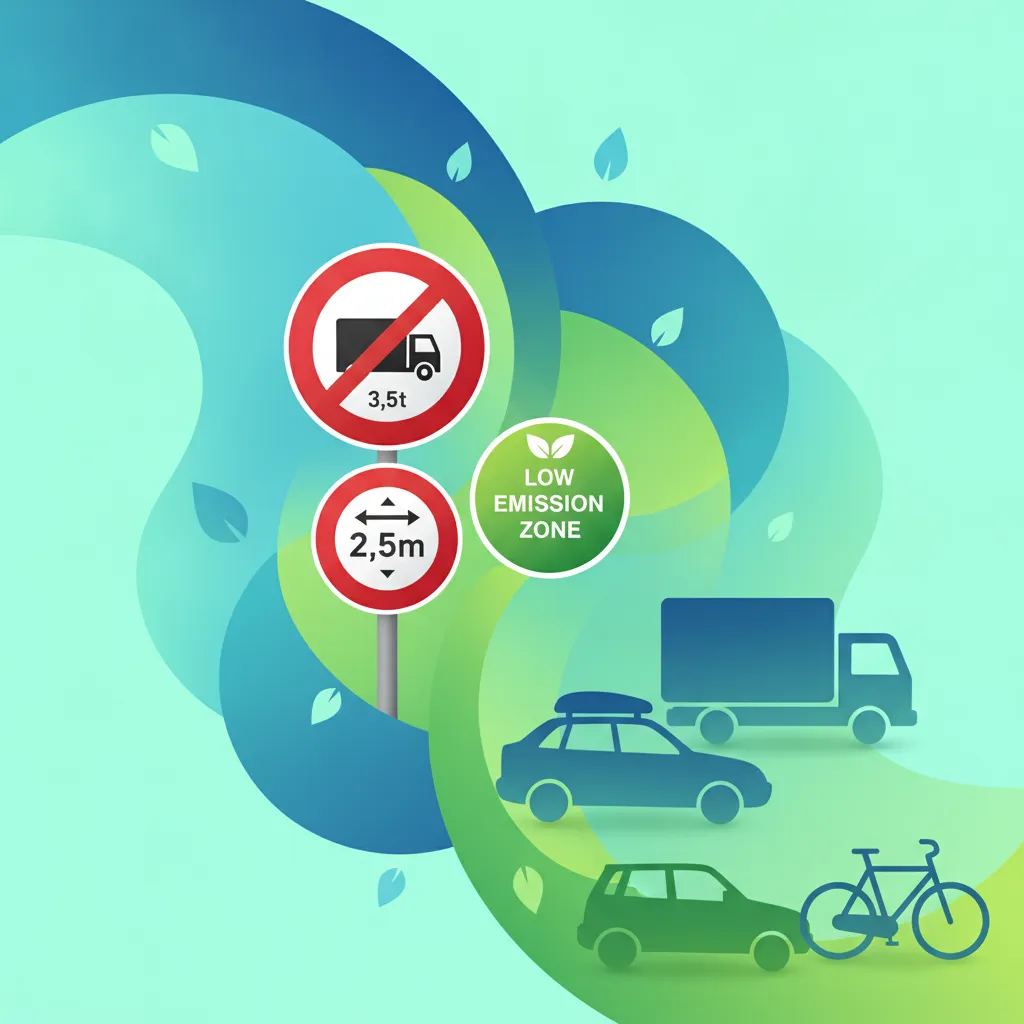
Many urban areas have restrictions to manage traffic and protect infrastructure. This lesson teaches drivers to identify and interpret traffic signs that prohibit access based on gross vehicle weight, axle load, height, or width. It also covers the growing prevalence of environmental or low-emission zones, which may restrict entry for older, more polluting vehicles.

Driving in the Alps requires a high level of skill and vehicle sympathy. This lesson covers techniques for climbing steep gradients by selecting the correct gear to maintain momentum without straining the engine. It reiterates the critical importance of using low gears and auxiliary brakes for descending, to ensure the service brakes remain cool and effective for the entire descent.

Swiss law strictly regulates the maximum dimensions of commercial vehicles to ensure they can safely navigate the infrastructure. This lesson specifies the standard limits for vehicle height (4.0m), width (2.55m), and length for various lorry and trailer combinations. Adhering to these dimensions is crucial for avoiding collisions with bridges, tunnels, and other structures, and for navigating narrow roads.

Overloading is a serious offence with severe safety and legal ramifications. This lesson details how excess weight drastically increases braking distances, puts extreme stress on tyres leading to blowouts, and negatively affects steering and overall stability. Furthermore, it discusses the substantial fines, potential license withdrawal, and driver liability that result from violating Swiss weight regulations.

Driving a large vehicle on mountain passes is a demanding skill. This lesson covers selecting the correct gear for both ascents and descents to maintain control and avoid overheating the brakes. It also explains the specific priority rules that apply on mountain roads and the importance of being aware of sudden weather changes.

Rural driving requires a different mindset from urban driving. This lesson covers how to position your vehicle on narrow roads, how to use passing places effectively, and how to anticipate hazards like slow-moving farm machinery, animals, and concealed junctions. Managing vehicle width and height is a key focus.
Understand the legal framework for exceptional transport in Switzerland. Learn about the necessity of special permits (Ausnahmebewilligung), the role of cantonal authorities, and the mandatory requirements for escort vehicles.

Transporting children carries the highest level of responsibility. This lesson covers the specific legal requirements for school buses in Switzerland, including the use of special signs and warning lights. It details the safe procedures for stopping, boarding, and alighting, and the driver's role in supervising children.

This lesson outlines the mandatory documentation required during any professional transport journey in Switzerland. Drivers must be able to present the vehicle registration document ('Fahrzeugausweis'), their valid driving license, and the OACP qualification card upon request. It also touches upon transport-specific documents like consignment notes, which are crucial for legal compliance during roadside inspections by authorities.
Motorway driving requires constant concentration due to high speeds. This lesson emphasizes the importance of staying in the right-hand lane unless overtaking and the specific restrictions on lorry overtaking in Switzerland. It reinforces the need for a following distance of at least four seconds to compensate for the vehicle's long stopping distance and provides guidance on safely merging and exiting.
Driving a large vehicle on mountain passes is a demanding skill. This lesson covers selecting the correct gear for both ascents and descents to maintain control and avoid overheating the brakes. It also explains the specific priority rules that apply on mountain roads and the importance of being aware of sudden weather changes.

This lesson details the specific documents that must be present in the vehicle and on the driver's person during service. It covers the driving license, OACP card, vehicle registration, and tachograph records. You will learn the importance of ensuring all paperwork is current and correct to ensure legal compliance at all times.

This lesson focuses on general driving safety in areas with a high concentration of children. It stresses the importance of significantly reducing speed, being prepared for unexpected events, and scanning for children between parked cars. The driver must exhibit maximum vigilance in these high-risk environments at all times.

This lesson provides a comprehensive overview of the Swiss learner permit (Lernfahrausweis), detailing eligibility criteria and the role of the accompanying driver. It places emphasis on the legal responsibilities of both the learner and supervisor, including age and experience requirements. The lesson clarifies procedural steps and common misconceptions about supervised driving practice.

Motorway driving involves high speeds and requires constant concentration. This lesson covers correct lane discipline, safe procedures for joining and leaving the motorway, and techniques for overtaking other large vehicles. Maintaining appropriate speed and a safe following distance is emphasized throughout.
Driving in the Alps requires a high level of skill and vehicle sympathy. This lesson covers techniques for climbing steep gradients by selecting the correct gear to maintain momentum without straining the engine. It reiterates the critical importance of using low gears and auxiliary brakes for descending, to ensure the service brakes remain cool and effective for the entire descent.

Proper visibility is paramount for the safety of large vehicles, especially at night or in poor weather. This lesson covers the full range of required lights, including headlights, indicators, brake lights, and side and rear marker lights. It also explains the function of reflectors and the mandatory high-visibility conspicuity markings that outline the vehicle's shape to other drivers.
Find clear answers to common questions learners have about Special Permits for Abnormal Loads and Dimensions. Learn how the lesson is structured, which driving theory objectives it supports, and how it fits into the overall learning path of units and curriculum progression in Switzerland. These explanations help you understand key concepts, lesson flow, and exam focused study goals.
An abnormal load is any vehicle or cargo that exceeds the standard maximum legal dimensions or gross vehicle mass permitted under Swiss law. These vehicles require specific evaluation and special permits from the relevant cantonal authorities before they can legally use the road network.
Generally, special permits are issued by the cantonal authorities where the transport originates or is taking place. While there is a high degree of harmonization, you must ensure your permit is valid for all cantons on your planned route, as local restrictions may apply.
The theory exam often presents scenarios where you must decide if a vehicle requires a special permit based on provided weight or dimension data. You might also be tested on the procedural steps, such as when an escort vehicle is mandatory.
Yes, for any load requiring a special permit, careful route planning is a legal necessity. This ensures that the vehicle can physically pass through tunnels, over bridges, or negotiate tight corners without causing damage or obstructing traffic flow.
Pinpoint specific Swiss traffic rules, road signs, or driving situations you need to master. Use the practice search to start a focused revision session now and build confidence for your official driving theory exam.