
This lesson details the strict legal limits for heavy vehicle dimensions in Switzerland, covering height, width, and length requirements. Understanding these specifications is vital for safely navigating bridges, tunnels, and narrow roads while ensuring your vehicle remains within regulatory boundaries for Category C and C1 licenses.

Lesson content overview
Operating heavy goods vehicles (HGVs) on Swiss roads requires a thorough understanding of the legal limits concerning their physical dimensions. These regulations are not arbitrary; they are meticulously designed to ensure road safety, protect vital infrastructure like bridges and tunnels, and maintain efficient traffic flow across the diverse Swiss landscape, from urban centers to challenging mountain passes. This lesson, part of the Official Swiss Driving Theory Course for Category C & C1 Goods Vehicles, delves into the specific maximum permissible dimensions for vehicle height, width, and length, including various lorry and trailer combinations.
The dimensions of heavy goods vehicles directly impact their safe operation and interaction with road infrastructure. An oversized vehicle, even by a small margin, can have catastrophic consequences, ranging from minor damage to severe accidents involving critical structures or other road users. Switzerland's strict adherence to these limits is a cornerstone of its road safety and infrastructure preservation policies.
Swiss law, particularly the Road Traffic Act (SVG) and the Road Traffic Regulations (VRV), sets out precise limits for the dimensions of vehicles, especially those in Category C and C1. These regulations ensure that all commercial vehicles can navigate the existing road network without posing a risk. Compliance is paramount for every professional driver. These legal frameworks govern everything from the overall vehicle height to the specific lengths of complex vehicle combinations.
Vehicle height is one of the most critical dimensions, particularly when encountering overhead structures such as bridges, tunnels, and overpasses. Exceeding the maximum permissible height can lead to severe collisions, vehicle damage, and significant infrastructure disruption.
In Switzerland, the standard maximum permissible height for heavy goods vehicles and their combinations is 4.00 metres. This limit applies to the entire vehicle, including any load carried, from the ground to the highest point. This universal standard is crucial for guaranteeing sufficient clearance under most bridges and within tunnels across the Swiss road network.
The 4.00 m height limit includes all parts of the vehicle and its load. Drivers must always account for any load that extends above the vehicle's roofline.
Drivers must be diligent in verifying their vehicle's total height, especially when carrying unusual or high loads. The measurement should always be taken with the vehicle loaded and ready for transport, as the suspension might compress, or the load itself might shift slightly, affecting the overall height. It is a common misconception to assume the height only includes the main vehicle structure; it extends to the very highest point, be it an antenna, a tarpaulin, or the peak of a cargo stack.
Ignoring height restrictions can have severe repercussions. A vehicle exceeding the 4.00 metre limit risks striking bridges, tunnel ceilings, or overhead power lines. Such incidents can cause extensive damage to the vehicle and the infrastructure, lead to significant traffic delays, and result in substantial fines or even legal prosecution for the driver and the operating company. In cases of significant damage, driving privileges may also be suspended.
The width of a heavy goods vehicle is another fundamental dimension that dictates its safe passage on lanes, through narrow sections, and when encountering other traffic. Maintaining adequate lateral clearance is vital to prevent collisions with roadside objects, oncoming vehicles, or adjacent lanes.
The standard maximum permissible width for heavy goods vehicles in Switzerland is 2.55 metres. This limit is measured from the outermost left edge to the outermost right edge of the vehicle, including any fixed parts like side mirrors, mudguards, and any portion of the load that extends laterally. It is critical to account for all these elements when determining the total width.
When measuring vehicle width, always include elements that extend beyond the main body, such as side mirrors, marker lights, and load securing devices. These count towards the overall width.
The width limit ensures that vehicles can safely pass one another on two-lane roads and that there is sufficient clearance from guardrails, road signs, and other roadside furniture. Drivers must be particularly cautious on narrow roads, construction zones, or in urban environments where space is often restricted. Ignoring temporary width restrictions posted by road signs can be as dangerous as violating the standard legal limit.
Operating a vehicle that exceeds the 2.55 metre width limit without a special permit can lead to serious risks. These include side-swipe collisions with other vehicles, striking roadside objects or infrastructure, and encroaching upon adjacent lanes, which can endanger other road users. Penalties for width violations typically involve significant fines and may require the vehicle to be taken off the road until the issue is resolved.
The length of a heavy goods vehicle or a combination vehicle is crucial for its maneuverability, especially when navigating turns, intersections, and roundabouts. Excessive length can lead to difficulties in cornering, blocking traffic, and potentially hazardous situations. Different types of vehicles and combinations have specific length limits.
A rigid lorry (or solo-LKW) is a single vehicle without a trailer, where the engine, cab, and load body are all on one chassis. For Category C vehicles, the maximum permissible length for a rigid lorry is generally 12.00 metres. This limit ensures that these vehicles can effectively navigate urban environments and standard road geometry without excessive lane encroachment during turns.
A drawbar combination (Anhängerzug) consists of a tractor unit towing a drawbar trailer, which has its own front axle and is coupled to the tractor via a drawbar. For these combinations, the maximum permissible total length is 18.75 metres. This calculation must account for the overlap between the tractor and the trailer at the coupling point, which typically reduces the perceived combined length.
A semi-trailer combination (Sattelmotorfahrzeug) involves a tractor unit pulling a semi-trailer, which has no front axle and is supported at its front by the tractor's fifth wheel coupling. The maximum permissible total length for a tractor and semi-trailer combination is 16.50 metres. Similar to drawbar combinations, the calculation must factor in the specific overlap at the fifth wheel coupling.
Triple combinations, consisting of a tractor, a semi-trailer, and a drawbar trailer, represent the longest permissible vehicle configurations. These are typically used for specific heavy haulage operations. The maximum total length for such a combination is 25.25 metres, which includes accounting for both overlap points within the combination. Operating these extensive setups requires exceptional skill and careful route planning due to their increased turning radius and space requirements.
When calculating the total length of a vehicle combination, it is crucial to understand and apply the concept of overlap (Überlappung). Overlap refers to the portion of the combined length that is shared or "overlaps" between the tractor unit and the trailer(s) at their coupling points. This effectively reduces the overall measured length compared to simply adding the individual lengths of each component.
The specific overlap value varies depending on the type of coupling:
Correctly applying these overlap values is essential to avoid miscalculating the total length and inadvertently exceeding legal limits, which can lead to significant penalties.
There are instances where the transport of certain goods necessitates dimensions that exceed the standard legal limits. In such cases, a special permit (Ausnahmegenehmigung) is required to legally operate the oversized vehicle or combination on Swiss roads.
Special permits are granted for exceptional cargo that cannot be divided or transported within standard dimensions. The application process typically involves submitting a detailed request to the cantonal authorities responsible for road traffic, outlining the exact dimensions, weight, proposed route, and necessity of the transport. Route planning is a critical aspect, as authorities must verify that the chosen route can safely accommodate the oversized load, often requiring specific timings or escorts.
Assess the load's exact dimensions and determine if a permit is required.
Prepare a detailed application, including route plan, vehicle specifications, and load details.
Submit the application to the relevant cantonal road traffic authority well in advance of the planned transport date.
Await approval and adhere strictly to any conditions imposed, such as escort requirements or specific travel times.
Drivers operating under a special permit have increased responsibilities. They must strictly adhere to the approved route, time restrictions, and any requirements for escort vehicles or special signage. Failure to comply with the conditions of a special permit can lead to severe penalties, including fines, impoundment of the vehicle, and revocation of the permit. The safety of other road users and the protection of infrastructure remain paramount even with a permit.
Strict adherence to maximum permissible dimensions is not merely a legal obligation; it is a fundamental aspect of safe and responsible heavy goods vehicle operation in Switzerland. These regulations have practical implications for every aspect of driving, from route selection to actual road navigation.
One of the most critical aspects for HGV drivers is meticulous route planning. This involves not only identifying the shortest or most efficient path but also ensuring that the selected route can safely accommodate the vehicle's dimensions. Drivers must:
Weather conditions like heavy rain or snow can reduce the visibility of height and width restriction signs. Always consult maps and pre-planned routes for known clearances.
The dimensions of a heavy vehicle profoundly affect its handling characteristics:
Violating dimension regulations in Switzerland carries significant legal consequences. These can range from immediate roadside fines to more severe penalties depending on the extent of the violation and any resulting damage or danger caused.
Compliance not only protects you and your vehicle but also contributes to the overall safety and efficiency of the Swiss road network.
Understanding the specific terminology associated with heavy goods vehicle dimensions is crucial for all drivers in the Official Swiss Driving Theory Course for Category C & C1 Goods Vehicles.
This lesson covers Switzerland's strict legal limits for heavy goods vehicle dimensions, which are essential for Category C and C1 theory exam preparation and safe professional driving. The standard limits are 4.00 metres height, 2.55 metres width, with length limits varying by vehicle combination type. Understanding the overlap concept is critical for correctly calculating the total length of tractor-trailer combinations. Drivers must apply for special permits when transporting loads that exceed standard dimensions, and violations can result in fines, vehicle immobilisation, or criminal charges. Route planning must account for infrastructure clearances, turning radii, and weather conditions that may affect visibility of restriction signs.
A short set of high-value points that capture the most important learning from this lesson.
The maximum height limit for HGVs in Switzerland is 4.00 metres, measured from ground to the highest point including any load.
The maximum width limit is 2.55 metres, which must include side mirrors, marker lights, and any load extensions.
Length limits vary by vehicle type: rigid lorries (12.00m), drawbar combinations (18.75m), semi-trailer combinations (16.50m), and triple combinations (25.25m).
Overlap (Überlappung) reduces the calculated total length of combinations: 1.00m for drawbar trailers and 1.60m for semi-trailers at the coupling point.
Special permits (Ausnahmegenehmigungen) from cantonal authorities are required for any load exceeding standard dimensions.
Explore all units and lessons included in this driving theory course.
Height includes everything: vehicle structure, load, tarpaulins, antennas, and any cargo that extends above the roofline.
Width measurement must include side mirrors, mudguards, marker lights, and load securing devices—not just the main body.
When calculating combination length, subtract the overlap value before comparing to the legal limit.
Different vehicle types have different length limits; know whether you are driving a rigid lorry, drawbar combination, semi-trailer, or triple combination.
Special permits specify exact routes, times, and escort requirements—violating these conditions leads to severe penalties.
Assuming the 4.00m height limit only applies to the vehicle body and not to loads that extend above the roofline.
Forgetting to include side mirrors and other protruding elements when measuring total vehicle width.
Miscalculating combination lengths by adding individual vehicle lengths without subtracting the overlap value.
Believing any oversized load can be transported freely without obtaining a special permit from cantonal authorities.
Not accounting for reduced sign visibility during poor weather conditions when planning routes with height or width restrictions.
Lesson content overview
A short set of high-value points that capture the most important learning from this lesson.
The maximum height limit for HGVs in Switzerland is 4.00 metres, measured from ground to the highest point including any load.
The maximum width limit is 2.55 metres, which must include side mirrors, marker lights, and any load extensions.
Length limits vary by vehicle type: rigid lorries (12.00m), drawbar combinations (18.75m), semi-trailer combinations (16.50m), and triple combinations (25.25m).
Overlap (Überlappung) reduces the calculated total length of combinations: 1.00m for drawbar trailers and 1.60m for semi-trailers at the coupling point.
Special permits (Ausnahmegenehmigungen) from cantonal authorities are required for any load exceeding standard dimensions.
Explore all units and lessons included in this driving theory course.
Height includes everything: vehicle structure, load, tarpaulins, antennas, and any cargo that extends above the roofline.
Width measurement must include side mirrors, mudguards, marker lights, and load securing devices—not just the main body.
When calculating combination length, subtract the overlap value before comparing to the legal limit.
Different vehicle types have different length limits; know whether you are driving a rigid lorry, drawbar combination, semi-trailer, or triple combination.
Special permits specify exact routes, times, and escort requirements—violating these conditions leads to severe penalties.
Assuming the 4.00m height limit only applies to the vehicle body and not to loads that extend above the roofline.
Forgetting to include side mirrors and other protruding elements when measuring total vehicle width.
Miscalculating combination lengths by adding individual vehicle lengths without subtracting the overlap value.
Believing any oversized load can be transported freely without obtaining a special permit from cantonal authorities.
Not accounting for reduced sign visibility during poor weather conditions when planning routes with height or width restrictions.
Explore search topics learners often look for when studying Maximum Permissible Dimensions: Height, Width, and Length. These topics reflect common questions about road rules, driving situations, safety guidance, and lesson level theory preparation for learners in Switzerland.
Browse additional driving theory lessons that cover connected traffic rules, road signs, and common driving situations related to this topic. Improve your understanding of how different rules interact across everyday traffic scenarios.
Learn how to accurately calculate the total length of rigid lorries, drawbar trailers, and semi-trailer combinations in Switzerland, including the crucial concept of overlap at coupling points.
The immense mass of a loaded truck means its braking distance is far greater than that of a car. This lesson breaks down total stopping distance into reaction distance and braking distance, explaining how speed, weight, and road conditions have an exponential effect. It reinforces the necessity of maintaining a significantly larger following distance to ensure enough space to stop safely in an emergency.
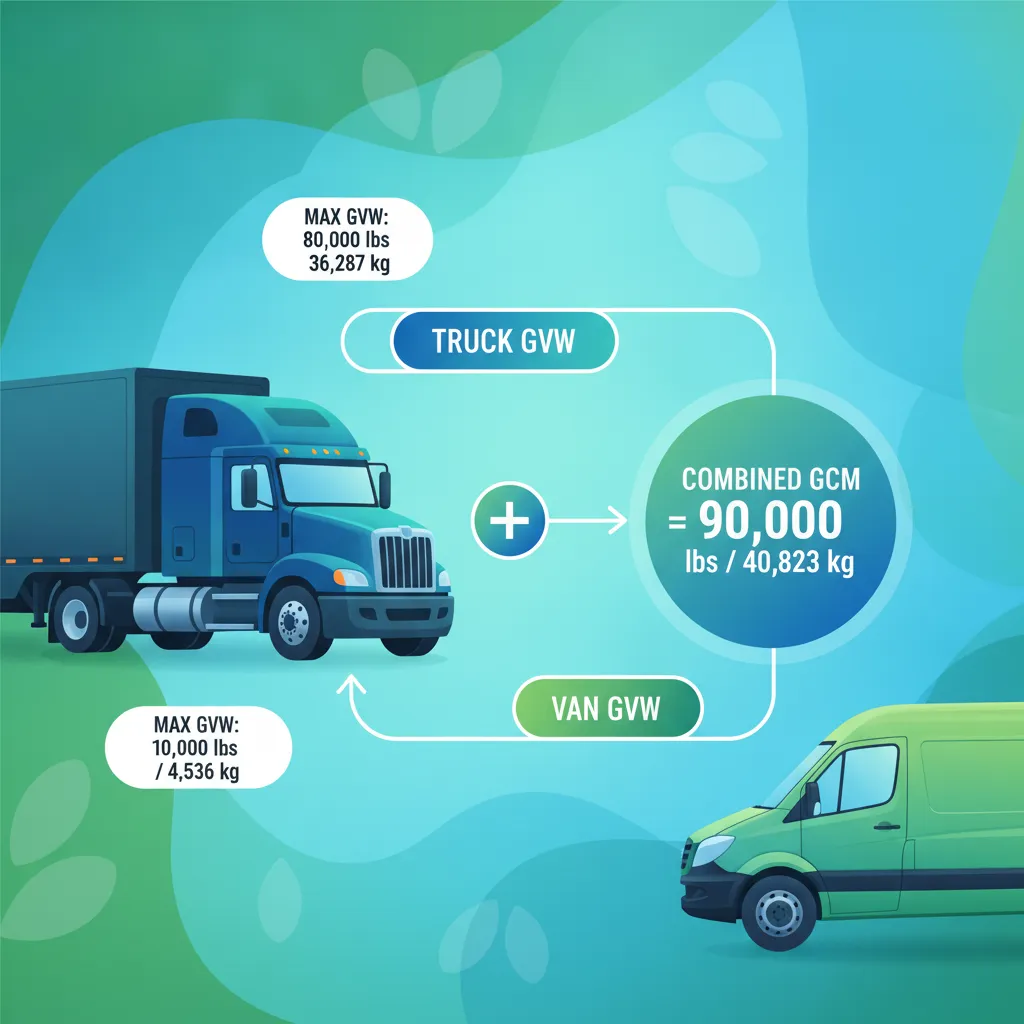
When a lorry tows a trailer, the total weight of the entire combination must not exceed the gross combination mass limit. This lesson explains how to find this value and why it is critical for ensuring the vehicle's engine, transmission, and brakes can safely handle the entire load. Exceeding the GCM compromises braking effectiveness, acceleration, and the ability to climb gradients, creating a significant safety risk.

Overloading is a serious offence with severe safety and legal ramifications. This lesson details how excess weight drastically increases braking distances, puts extreme stress on tyres leading to blowouts, and negatively affects steering and overall stability. Furthermore, it discusses the substantial fines, potential license withdrawal, and driver liability that result from violating Swiss weight regulations.

Buses and coaches require significantly more distance to stop than cars. This lesson explains why the 'two-second rule' is insufficient and teaches the appropriate methods for calculating a safe gap in various conditions. Maintaining an adequate safety cushion is one of the most important defensive driving skills.

Coupling and uncoupling are high-risk manoeuvres if not performed correctly. This lesson provides a theoretical, sequential guide to the process, covering aligning the tractor unit, raising the trailer's landing gear, locking the fifth-wheel mechanism onto the kingpin, and performing a 'tug test' to confirm a secure connection. The uncoupling process is also detailed, emphasizing the importance of a firm, level surface.

Adding a trailer (D1E) or driving an articulated bus (DE) changes the vehicle's dynamics significantly. This lesson covers the key differences in handling, braking, and reversing. It explains the concept of the pivot point and how to manage the increased length and swept path when turning and manoeuvring.

Motorway driving requires constant concentration due to high speeds. This lesson emphasizes the importance of staying in the right-hand lane unless overtaking and the specific restrictions on lorry overtaking in Switzerland. It reinforces the need for a following distance of at least four seconds to compensate for the vehicle's long stopping distance and provides guidance on safely merging and exiting.

This lesson breaks down total stopping distance into its two components: thinking (reaction) distance and braking distance. You will learn how factors like speed, vehicle weight, driver fatigue, and road surface conditions dramatically affect how long it takes to come to a complete stop. This understanding is critical for proactive hazard management.

Despite the complex mirror systems, large areas around a truck remain hidden from the driver's view. This lesson maps out these significant blind spots: directly in front, behind, and along both sides of the vehicle. It teaches drivers to be constantly aware of these 'no-zones' and to anticipate that smaller vehicles, cyclists, or pedestrians may be hidden within them, especially before changing lanes or turning.

Unlike cars, heavy vehicles cannot travel on every road. This lesson stresses the importance of using HGV-specific satellite navigation systems or carefully checking maps to plan routes that avoid low bridges, weak bridges, and roads with weight or width restrictions. Proper planning saves time, fuel, and prevents dangerous situations or costly damage.
Understand the process and requirements for obtaining special permits for oversized or overweight vehicles in Switzerland. Learn about route planning and legal responsibilities when exceeding standard dimensions.

Transporting loads that are wider, longer, taller, or heavier than standard regulations allow requires special authorization. This lesson explains the concept of exceptional transport and the legal requirement to obtain a special permit from the relevant cantonal authorities. It highlights that such operations require careful route planning, often mandating specific times of travel and sometimes the use of escort vehicles.
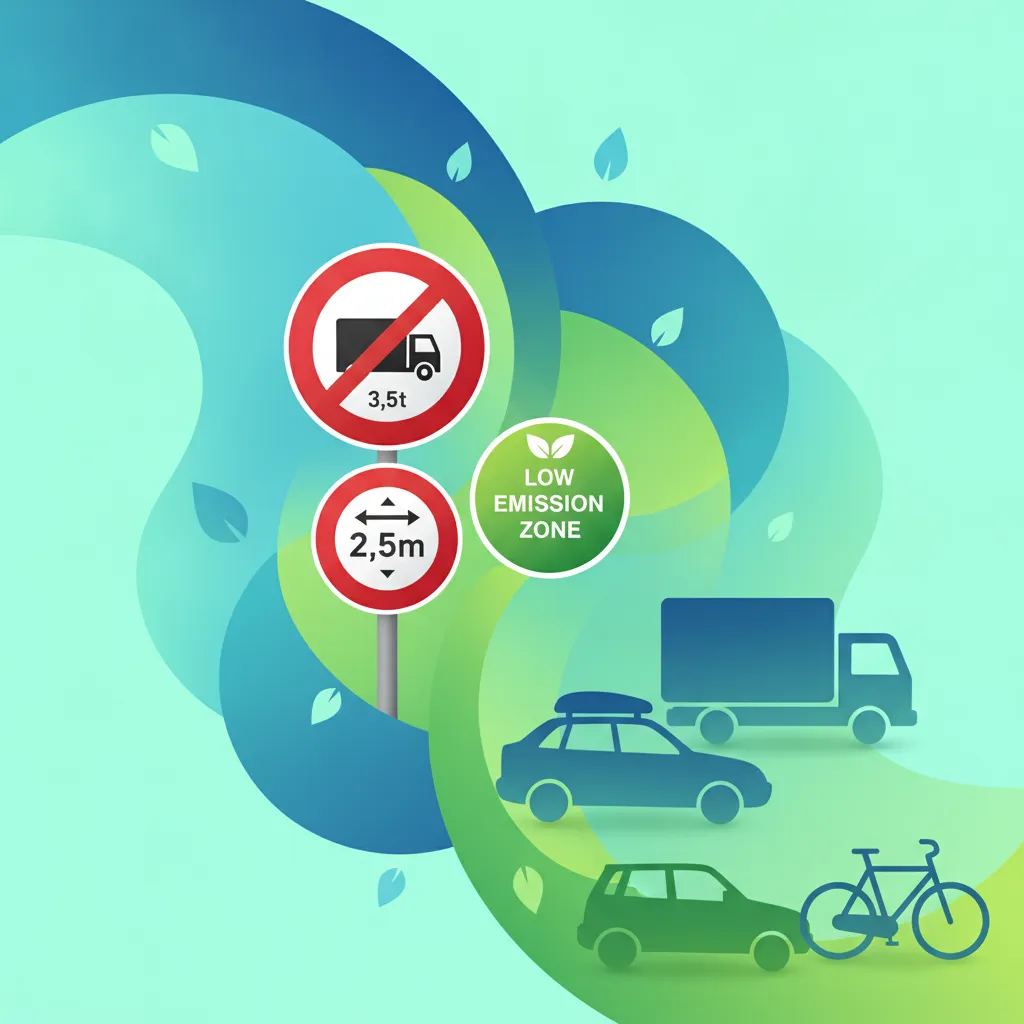
Many urban areas have restrictions to manage traffic and protect infrastructure. This lesson teaches drivers to identify and interpret traffic signs that prohibit access based on gross vehicle weight, axle load, height, or width. It also covers the growing prevalence of environmental or low-emission zones, which may restrict entry for older, more polluting vehicles.
Unlike cars, heavy vehicles cannot travel on every road. This lesson stresses the importance of using HGV-specific satellite navigation systems or carefully checking maps to plan routes that avoid low bridges, weak bridges, and roads with weight or width restrictions. Proper planning saves time, fuel, and prevents dangerous situations or costly damage.
Overloading is a serious offence with severe safety and legal ramifications. This lesson details how excess weight drastically increases braking distances, puts extreme stress on tyres leading to blowouts, and negatively affects steering and overall stability. Furthermore, it discusses the substantial fines, potential license withdrawal, and driver liability that result from violating Swiss weight regulations.
Find clear answers to common questions learners have about Maximum Permissible Dimensions: Height, Width, and Length. Learn how the lesson is structured, which driving theory objectives it supports, and how it fits into the overall learning path of units and curriculum progression in Switzerland. These explanations help you understand key concepts, lesson flow, and exam focused study goals.
The standard maximum height is 4.0 meters. Exceeding this height requires careful route planning and, in some cases, special permits to ensure safe passage under bridges and through tunnels.
Generally, the maximum width for most motor vehicles is 2.55 meters. Staying within this width is crucial for safely sharing the road with other traffic, especially on narrower mountain or rural roads.
Yes, you must be able to recognize height restriction signs and understand how they apply to the dimensions of your specific vehicle. Always prioritize checking your vehicle's physical height against posted limits.
If your vehicle or load exceeds the maximum permitted dimensions, you must apply for a special permit through the appropriate cantonal authority. Operating an oversized vehicle without authorization is illegal and dangerous.
Pinpoint specific Swiss traffic rules, road signs, or driving situations you need to master. Use the practice search to start a focused revision session now and build confidence for your official driving theory exam.