
This lesson details the legal obligation of heavy goods vehicle drivers to ensure all cargo is properly secured before moving onto public roads. You will learn how to conduct effective pre-drive inspections and understand why you, as the driver, are ultimately liable for any load-related incidents. This knowledge is essential for both passing your Swiss Category C and C1 theory exam and maintaining professional safety standards.

Lesson content overview
For drivers operating heavy goods vehicles (HGVs) in Switzerland under the Official Swiss Driving Theory Course for Category C & C1 Goods Vehicles, understanding load security is paramount. While others may be involved in the loading process, the legal and practical responsibility for ensuring a secure load on public roads ultimately rests with the driver. This crucial point of law safeguards both the driver and other road users from the potentially catastrophic consequences of cargo shifting or falling during transit. This lesson clarifies the driver's comprehensive obligations, covering essential inspections, in-journey monitoring, and the severe legal penalties for non-compliance.
The foundation of load securing in professional transport is the driver's ultimate legal responsibility. Regardless of who physically loaded the vehicle or supervised the process, once the vehicle is on a public highway, the driver becomes the final authority and is held accountable for the security of its cargo. This responsibility stems from the fact that the driver is in direct control of the vehicle's movement and is the primary individual able to assess and react to changes in load stability throughout the journey.
Swiss road traffic regulations, notably the Road Traffic Act (SVG) and the Ordinance on Road Traffic (VRV), explicitly define the driver's role. SVG Article 54 establishes liability for accidents caused by improperly secured goods, unequivocally placing this burden on the driver. Furthermore, SVG Article 66 outlines penalties for endangering road safety, which includes infringements related to insecure loads. This legal framework ensures that safety standards are upheld and provides a clear chain of accountability.
The legal obligation of the driver to ensure that the vehicle's load is properly secured before and during any journey on public roads, irrespective of who performed the loading.
The practical meaning of this legal stance is profound. It mandates that a driver must personally verify the load's security before departure, even if a dedicated loading crew or warehouse staff has already secured the cargo. This verification is not a mere formality but a critical safety measure designed to catch any overlooked issues or inadequacies in the securing arrangements.
An unsecured or improperly secured load poses significant dangers. It can shift during acceleration, braking, or cornering, leading to:
Beyond the immediate safety risks, drivers face severe legal consequences for insecure loads. These can include substantial fines, driving license sanctions, and even criminal charges in cases resulting in serious injury or death. The legal system views the driver's failure to ensure load security as a direct breach of their duty of care, holding them responsible for preventable incidents.
A thorough pre-departure inspection is the driver's first and most critical step in fulfilling their responsibility for a secure load. This systematic check must be performed before commencing any journey on public roads. Its purpose is to detect any insecure arrangements early, preventing potential hazards once the vehicle is in motion.
The pre-departure inspection involves both visual and tactile (touch-based) examinations of the cargo and its securing devices.
Visual Inspection: Walk around the entire vehicle, carefully observing the load. Look for visible gaps between cargo items, signs of uneven stacking, or any loose items. Check that covers, nets, or tarpaulins are properly fastened and intact. Pay close attention to securing equipment for visible wear, tears, fraying, or damage.
Tactile Inspection: Physically check the tension of all lashing straps, chains, ropes, or other restraints. Pull on them to ensure they are taut and firmly holding the cargo in place. Verify that any locking mechanisms, such as those on load bars or bulkhead fittings, are engaged and secure.
Clearance Checks: Ensure that the load does not obstruct the driver's view, obscure lights, indicators, or number plates. Verify that the load does not extend beyond the permissible dimensions of the vehicle or trailer without appropriate marking.
Common mistakes during this phase include skipping the walk-around or assuming that because a load appears neat, it is automatically secure. A diligent driver understands that appearances can be deceptive and that only a comprehensive physical check can confirm true security.
Beyond the physical restraints, the pre-departure inspection also encompasses a compliance check to ensure that the load respects permissible limits. This includes:
VRV Article 12.1.2 places the onus on the driver to ensure the load is properly secured against all forms of movement and respects these crucial limits before the journey begins.
The driver's responsibility for load security does not end once the vehicle departs. It is an ongoing obligation that continues throughout the entire journey. In-transit monitoring involves continuous observation and periodic checks to ensure the load remains stable despite the dynamic forces exerted during travel.
While driving, a vigilant driver uses various means to monitor the load:
For longer journeys, it is highly recommended to schedule physical re-inspection points. These could be at rest areas, service stations, or after significant changes in road conditions, such as transitioning from motorways to winding mountain roads.
Beyond scheduled checks, certain events should trigger an immediate assessment:
Understanding how a load can shift is vital for effective monitoring and prevention. Load shift dynamics refer to the physical movement of cargo due to inertia and the forces generated by vehicle motion:
Drivers must anticipate these dynamics and ensure that their securing methods are robust enough to counteract them. For instance, a load secured only against longitudinal forces might still shift laterally in a sharp bend.
If a driver detects any signs of load movement, damage to securing equipment, or believes that conditions have changed sufficiently to compromise security, they are under a legal obligation to stop safely and re-secure the load. This is a non-negotiable aspect of the driver's responsibility.
Early detection of load instability is crucial. Signs can include:
The mandatory action taken by a driver to tighten, adjust, or reapplying load restraints after detecting any movement, instability, or compromise in cargo security during a journey.
VRV Article 12.1.2 (d) explicitly states that if the load shows signs of movement, the driver must stop and re-secure it. Failure to comply with this regulation not only escalates the risk of an accident but also significantly increases the driver's legal liability. Continuing to drive with a known insecure load is considered gross negligence.
When re-securing is necessary, the driver must follow safe procedures:
Never attempt to adjust or re-secure a load while the vehicle is in motion or stopped in an unsafe location. Prioritise personal safety and the safety of other road users.
The way a load is secured directly impacts the vehicle's handling characteristics, braking performance, and overall stability. Drivers must understand this interplay to operate HGVs safely and comply with all regulations.
Drivers must adapt their driving style based on the nature of their load and its securing conditions.
By understanding how load security influences vehicle performance, drivers can proactively mitigate risks and maintain control, even under challenging conditions.
Compliance with Swiss road traffic regulations is non-negotiable for all professional drivers. The specific articles concerning load security are designed to prevent accidents and protect all road users.
The primary regulations governing load security for heavy goods vehicles in Switzerland are found in:
These regulations apply to all heavy goods vehicles (Category C & C1) operating on public roads within Switzerland. While some exceptions exist for inherently fixed loads (e.g., built-in containers), the driver's verification obligation remains.
Non-compliance with load securing regulations can lead to a range of penalties, depending on the severity of the offense and whether an accident occurred. These can include:
The rationale behind these stringent rules is clear: securing cargo prevents road hazards, protects other road users, and ensures the driver maintains control of their vehicle. Proper application involves not just initial securing but continuous vigilance and a readiness to re-secure whenever necessary.
Understanding common mistakes and how to navigate complex scenarios is key to responsible driving. Many violations stem from negligence or a lack of understanding of load dynamics and legal obligations.
Load securing responsibilities also vary with external conditions:
| Condition | Variation and Driver Action | Reasoning |
|---|---|---|
| Wet or Icy Weather | Increase lashing tension (if possible and safe), reduce speed significantly, increase following distances. | Reduced road friction means greater braking distances and more pronounced load shift on slippery surfaces. Lashing knots may also loosen in wet or cold conditions. |
| Nighttime Driving | Use auxiliary lighting (e.g., high-beam headlamps, portable lights) for pre-departure and in-transit checks. | Low visibility makes it harder to spot subtle load shifts, damaged equipment, or loose items. Reflective straps can aid detection. |
| Mountain Passes | Perform additional load checks after steep ascents and descents. Drive at lower speeds, especially downhill and through curves. | Sustained gradients and heavy braking (downhill) or strong acceleration (uphill) exert significant longitudinal forces on cargo, increasing the risk of shifting. Vertical forces can also be higher over uneven mountain roads. |
| Motorways | Ensure maximum security; consider using additional restraints for long hauls. Maintain larger safety margins. | Higher speeds generate greater inertial forces; longer travel distances with fewer opportunities for intermediate checks demand robust initial securing. |
| Urban Deliveries | Pay extra attention to securing small, loose items. Be prepared for frequent stops and starts. | Frequent braking and acceleration in stop-and-go traffic increase longitudinal forces. Loose items can become dangerous projectiles in dense urban environments. |
| Damaged Securing Equipment | Immediately replace any frayed straps, bent chains, or malfunctioning tensioners. Never use compromised equipment. | Damaged equipment has significantly reduced strength and is prone to failure, rendering the securing method ineffective and highly dangerous. |
| Mixed Cargo Loads | Ensure segregation and independent securing for different types of cargo. Use dunnage, nets, or partitions. | Dissimilar items (e.g., pallets and loose boxes) require different securing approaches. Preventing them from interacting or shifting into each other is crucial for overall load stability. |
The driver's responsibility for a secure load is deeply rooted in physics, safety principles, and interconnected with other aspects of heavy vehicle operation.
Drivers may sometimes fall prey to "confirmation bias," assuming that if a loading crew secured the cargo, it must be correct. Overcoming this bias is crucial for enforcing personal responsibility and conducting independent checks. Fatigue also plays a significant role; a tired driver is less likely to detect subtle signs of load shift or perform thorough inspections. For longer trips, scheduled rest stops should also include load re-inspection points to counteract the effects of fatigue.
Statistics from transport authorities often highlight that unsecured or improperly secured loads are a significant contributing factor to heavy vehicle accidents. While the exact percentage varies, such incidents frequently lead to severe injuries or fatalities due to the sheer mass and momentum involved. This data underscores the critical importance of diligent load securing practices.
This lesson builds upon several foundational concepts covered in previous units of the Official Swiss Driving Theory Course for Category C & C1 Goods Vehicles:
The knowledge gained here is also essential for understanding future topics:
Understanding the theory of load security is vital, but its application in real-world driving scenarios truly reinforces its importance.
The driver's responsibility for a secure load is a cornerstone of safe heavy goods vehicle operation in Switzerland. This lesson has highlighted several critical aspects:
By mastering these principles, drivers contribute significantly to road safety, protect their cargo, and uphold their professional obligations within the Official Swiss Driving Theory Course for Category C & C1 Goods Vehicles.
This lesson establishes that Swiss Category C and C1 drivers bear ultimate legal responsibility for load security on public roads under SVG Articles 54 and 66, a duty that cannot be delegated even if others performed the loading. The driver's obligation includes a thorough pre-departure inspection combining visual assessment with tactile verification of all securing equipment, plus ongoing in-transit monitoring using mirrors, vehicle feedback, and scheduled re-inspection points. VRV Article 12.1.2 mandates securing cargo against longitudinal, lateral, and vertical movement and requires drivers to stop and re-secure immediately upon detecting any instability. These requirements directly impact vehicle handling, braking performance, and rollover risk, making proper load security essential for both legal compliance and road safety.
A short set of high-value points that capture the most important learning from this lesson.
The driver holds ultimate legal accountability for load security on public roads, regardless of who performed the loading
Cargo must be secured against three types of movement: longitudinal (forward/backward), lateral (sideways), and vertical (up/down)
A mandatory pre-departure inspection must include both visual checks and physical tactile verification of all lashing equipment
If any load movement or instability is detected during transit, the driver must immediately stop and re-secure before continuing
Unsecured loads directly affect vehicle handling, braking distance, and significantly increase rollover risk, especially on curves and mountain roads
Explore all units and lessons included in this driving theory course.
SVG Article 54 assigns driver liability for accidents caused by improperly secured goods; SVG Article 66 outlines penalties for endangering road safety
VRV Article 12.1.2 (a)-(c) mandates securing cargo against longitudinal, lateral, and vertical movement; (d) requires stopping and re-securing if movement is detected
Pre-departure checks must verify weight limits, axle loads, dimension limits, and load distribution alongside physical restraint verification
In-transit monitoring uses mirrors, auditory cues, and vehicle handling feedback to detect load shifts early
Swiss mountain passes and steep gradients require additional load checks due to sustained braking and acceleration forces
Skipping or rushing the pre-departure inspection, assuming that neat-looking cargo is automatically secure
Ignoring auditory cues such as rattling or thudding sounds, dismissing them as minor when they indicate load instability
Using insufficient or damaged lashing equipment without matching the securing method to the cargo's weight and characteristics
Failing to re-check and re-secure after emergency braking, sharp cornering, or significant road surface changes
Not adapting driving style to load conditions, using sudden acceleration, harsh braking, or excessive speed that amplifies inertial forces on cargo
Lesson content overview
A short set of high-value points that capture the most important learning from this lesson.
The driver holds ultimate legal accountability for load security on public roads, regardless of who performed the loading
Cargo must be secured against three types of movement: longitudinal (forward/backward), lateral (sideways), and vertical (up/down)
A mandatory pre-departure inspection must include both visual checks and physical tactile verification of all lashing equipment
If any load movement or instability is detected during transit, the driver must immediately stop and re-secure before continuing
Unsecured loads directly affect vehicle handling, braking distance, and significantly increase rollover risk, especially on curves and mountain roads
Explore all units and lessons included in this driving theory course.
SVG Article 54 assigns driver liability for accidents caused by improperly secured goods; SVG Article 66 outlines penalties for endangering road safety
VRV Article 12.1.2 (a)-(c) mandates securing cargo against longitudinal, lateral, and vertical movement; (d) requires stopping and re-securing if movement is detected
Pre-departure checks must verify weight limits, axle loads, dimension limits, and load distribution alongside physical restraint verification
In-transit monitoring uses mirrors, auditory cues, and vehicle handling feedback to detect load shifts early
Swiss mountain passes and steep gradients require additional load checks due to sustained braking and acceleration forces
Skipping or rushing the pre-departure inspection, assuming that neat-looking cargo is automatically secure
Ignoring auditory cues such as rattling or thudding sounds, dismissing them as minor when they indicate load instability
Using insufficient or damaged lashing equipment without matching the securing method to the cargo's weight and characteristics
Failing to re-check and re-secure after emergency braking, sharp cornering, or significant road surface changes
Not adapting driving style to load conditions, using sudden acceleration, harsh braking, or excessive speed that amplifies inertial forces on cargo
Explore search topics learners often look for when studying Driver's Responsibility for a Secure Load. These topics reflect common questions about road rules, driving situations, safety guidance, and lesson level theory preparation for learners in Switzerland.
Browse additional driving theory lessons that cover connected traffic rules, road signs, and common driving situations related to this topic. Improve your understanding of how different rules interact across everyday traffic scenarios.
Understand the driver's ultimate legal accountability for cargo security in Swiss heavy vehicle theory. Learn about liability under SVG and VRV, and the severe penalties for failing to secure loads properly.

Operating a heavy goods vehicle involves a significant responsibility for the safety of all road users. This lesson emphasizes the professional driver's enhanced duty of care due to the vehicle's size, mass, and potential impact in a collision. It covers the importance of a professional attitude, constant vigilance, and adherence to all traffic regulations to prevent incidents and maintain a high standard of road safety.

Overloading is a serious offence with severe safety and legal ramifications. This lesson details how excess weight drastically increases braking distances, puts extreme stress on tyres leading to blowouts, and negatively affects steering and overall stability. Furthermore, it discusses the substantial fines, potential license withdrawal, and driver liability that result from violating Swiss weight regulations.

This lesson outlines the mandatory documentation required during any professional transport journey in Switzerland. Drivers must be able to present the vehicle registration document ('Fahrzeugausweis'), their valid driving license, and the OACP qualification card upon request. It also touches upon transport-specific documents like consignment notes, which are crucial for legal compliance during roadside inspections by authorities.

This lesson explores the correct use of seat belts, the installation of child restraints, and the importance of securing loads. It covers weight distribution guidelines, maximum load limits, and conditions for towing a trailer. Guidance is also provided for safely transporting animals and ensuring all loads are properly secured to prevent movement.

Losing part of a load on the road creates an immediate and serious hazard for other drivers. This lesson outlines the driver's responsibilities: stop in a safe place, assess the situation from a safe distance, and immediately alert the police. The driver's primary role is to warn other road users and not to attempt to retrieve the load from a live carriageway.

There is no one-size-fits-all solution for load securing. This lesson provides examples of how to secure different common cargo types, from standard palletized goods to challenging loads like pipes, which can roll, or heavy coils. It highlights that the securing method must be tailored to the specific characteristics of the load to be effective.

The driver is legally responsible for the roadworthiness of their vehicle at the start of and during every journey. This lesson outlines the formal process for reporting any identified defects to the transport manager or maintenance staff. It stresses the critical rule that a vehicle with a known safety-critical defect must not be driven until it has been professionally repaired and declared safe.

This lesson provides a clear definition of the Swiss heavy goods vehicle license categories. It details the weight limits and vehicle configurations for Category C (lorries over 3.5t) and C1 (lorries from 3.5t to 7.5t). Furthermore, it explains how categories CE and C1E grant the entitlement to tow heavy trailers, forming articulated vehicles or road trains, which is crucial for professional transport operations.

Proper visibility is paramount for the safety of large vehicles, especially at night or in poor weather. This lesson covers the full range of required lights, including headlights, indicators, brake lights, and side and rear marker lights. It also explains the function of reflectors and the mandatory high-visibility conspicuity markings that outline the vehicle's shape to other drivers.

Correct load distribution is essential for safe handling and braking. This lesson explains that loads should be placed as low as possible and distributed evenly to maintain a low centre of gravity and comply with axle weight limits. A high or poorly positioned centre of gravity dramatically increases the risk of rollover, especially when cornering or in an emergency manoeuvre.
Explore essential best practices for securing loads on heavy goods vehicles in Switzerland. Learn about pre-departure checks, in-transit monitoring, and techniques to prevent cargo shift and maintain vehicle stability.
There is no one-size-fits-all solution for load securing. This lesson provides examples of how to secure different common cargo types, from standard palletized goods to challenging loads like pipes, which can roll, or heavy coils. It highlights that the securing method must be tailored to the specific characteristics of the load to be effective.

This lesson details the main techniques used for effective load securing. Blocking involves placing cargo snugly against fixed structures like the headboard or using dunnage to fill gaps and prevent sliding. Lashing involves using devices like straps or chains to either tie the load down, increasing friction (friction lashing), or to directly restrain it against movement (direct lashing).
Correct load distribution is essential for safe handling and braking. This lesson explains that loads should be placed as low as possible and distributed evenly to maintain a low centre of gravity and comply with axle weight limits. A high or poorly positioned centre of gravity dramatically increases the risk of rollover, especially when cornering or in an emergency manoeuvre.
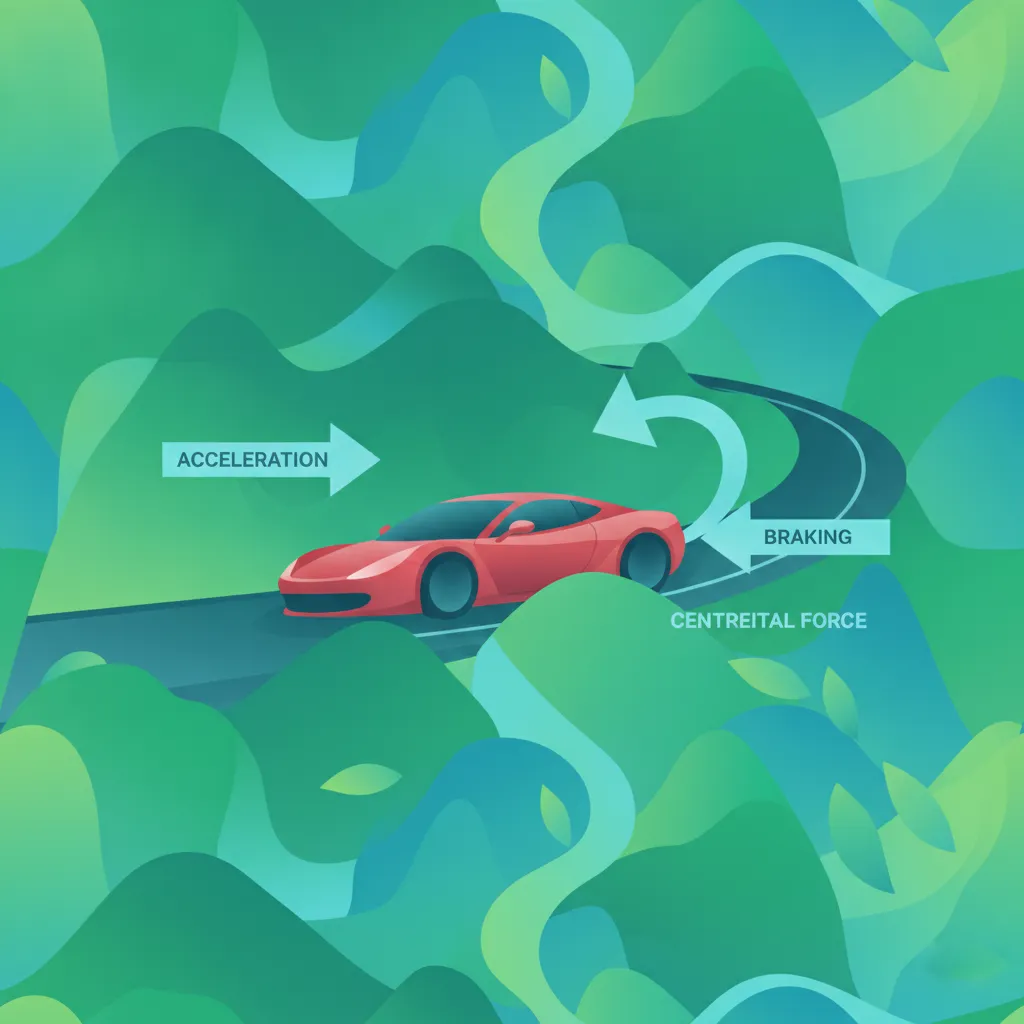
A load is not static; it is subjected to significant forces during transport. This lesson explains how acceleration, braking (deceleration), and cornering create powerful inertial forces that try to move the cargo. Load securing systems must be strong enough to counteract these forces to prevent the load from sliding forward during braking, backward during acceleration, or sideways when turning.

Using the right equipment is crucial for effective load securing. This lesson introduces common lashing equipment, including synthetic webbing straps with ratchets and heavy-duty chains with binders. It emphasizes the importance of inspecting all equipment for cuts, wear, or damage before use and understanding the labels that indicate their load capacity (Lashing Capacity - LC).
Losing part of a load on the road creates an immediate and serious hazard for other drivers. This lesson outlines the driver's responsibilities: stop in a safe place, assess the situation from a safe distance, and immediately alert the police. The driver's primary role is to warn other road users and not to attempt to retrieve the load from a live carriageway.

Heavy vehicles, especially those with a high centre ofgravity, are susceptible to rolling over. This lesson examines the primary causes, including excessive speed on bends or roundabouts, sudden steering manoeuvres, and the 'sloshing' effect of liquid loads in tankers. It reinforces that maintaining a sensible speed and driving smoothly are the best ways to mitigate this serious risk.

The total weight of a vehicle is supported by its axles, and Swiss regulations set strict limits on the load each axle can bear. This lesson explains how to correctly distribute a load to comply with maximum axle load (Achslast) limits, which is vital for vehicle stability, steering control, and braking efficiency. Incorrect distribution can lead to dangerous handling characteristics and cause significant damage to road surfaces.
Overloading is a serious offence with severe safety and legal ramifications. This lesson details how excess weight drastically increases braking distances, puts extreme stress on tyres leading to blowouts, and negatively affects steering and overall stability. Furthermore, it discusses the substantial fines, potential license withdrawal, and driver liability that result from violating Swiss weight regulations.

Unlike cars, heavy vehicles cannot travel on every road. This lesson stresses the importance of using HGV-specific satellite navigation systems or carefully checking maps to plan routes that avoid low bridges, weak bridges, and roads with weight or width restrictions. Proper planning saves time, fuel, and prevents dangerous situations or costly damage.
Find clear answers to common questions learners have about Driver's Responsibility for a Secure Load. Learn how the lesson is structured, which driving theory objectives it supports, and how it fits into the overall learning path of units and curriculum progression in Switzerland. These explanations help you understand key concepts, lesson flow, and exam focused study goals.
Yes. Under Swiss traffic legislation, the driver of the vehicle has the final, absolute legal responsibility to ensure that the load is secured correctly before departing and remains safe throughout the entire journey.
You should check the load during your pre-departure walk-around, at every stop, and if you notice any changes in vehicle handling or abnormal noises. Regular checks are mandatory for safe operation.
If your load shifts, you are liable for any resulting road hazards, accidents, or damage. This can lead to heavy fines, legal proceedings, and potential loss of your professional driving privileges in Switzerland.
The legal requirement for a secure load is the same regardless of distance. Every time the vehicle moves, it is your responsibility to ensure the cargo cannot shift, tip, or fall, whether you are driving through an urban center or across a mountain pass.
Pinpoint specific Swiss traffic rules, road signs, or driving situations you need to master. Use the practice search to start a focused revision session now and build confidence for your official driving theory exam.