
This lesson clarifies the vital rules of priority on Belgian roads, specifically focusing on the rule of priority from the right and how it interacts with designated priority roads. By mastering these concepts, you will build the foundation necessary to navigate intersections safely and pass the Category B theory exam. This unit provides the critical knowledge required for predictable and responsible driving behavior.
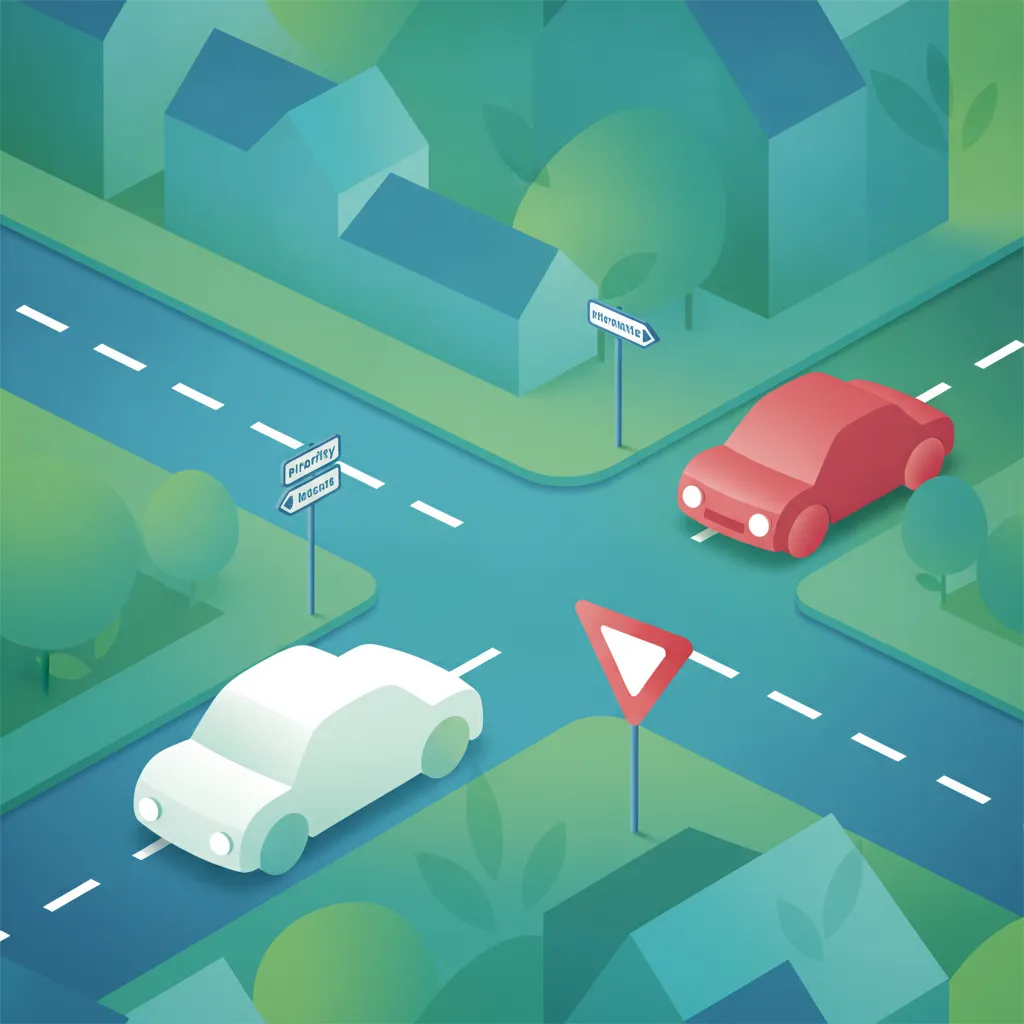
Lesson content overview
Navigating intersections safely and efficiently is a cornerstone of responsible driving. In Belgium, like many other countries, specific rules dictate which vehicle has the right of way. This lesson delves into two fundamental concepts: the default "priority from the right" rule and the designated "priority roads." Mastering these distinctions is crucial for predictable traffic flow, preventing accidents, and ensuring you pass your Belgian Category B theoretical exam.
This comprehensive guide will explain how to identify priority situations, interpret the relevant traffic signs, and understand your obligations as a driver, whether you are yielding or proceeding. A solid grasp of these principles ensures smoother journeys for everyone and contributes significantly to overall road safety.
The priority from the right (in French, priorité de droite; in Dutch, voorrang van rechts) is the fundamental default rule applied at intersections in Belgium. It dictates that at any uncontrolled intersection, drivers must yield to traffic approaching from their right. This means the vehicle coming from your right-hand side has the right of way, and you must wait for them to pass before proceeding.
This rule serves to create a predictable order of movement where no other traffic controls are present, ensuring that drivers know whose turn it is to go. Without this default, every uncontrolled intersection would be a point of confusion and potential collision.
The priority from the right rule is specifically applicable at:
It is important to remember that this rule applies universally, regardless of the size of the road you are on or the type of vehicle you are driving (with some exceptions for vulnerable road users, as discussed later).
Many new drivers make assumptions that can lead to dangerous situations. Avoid these common pitfalls:
When approaching any intersection, always scan carefully for signs, signals, and road markings first. If none are present, mentally prepare to yield to any traffic that might be approaching from your right.
A priority road (in French, route à caractère prioritaire; in Dutch, voorrangsweg) is a designated road where traffic has continuous right of way over vehicles entering from side roads. This status is clearly indicated by specific traffic signs. The purpose of priority roads is to facilitate smoother and faster traffic flow on major routes, reducing the need for vehicles to stop at every intersection along the way.
The beginning of a priority road is marked by a distinctive sign:
This sign signifies that from this point onward, your road has priority over all intersecting roads until you encounter a sign indicating the end of the priority road. When driving on a priority road, you generally do not need to yield to traffic from side streets, regardless of whether they are coming from your left or your right.
Just as important as knowing where a priority road begins is knowing where it ends. The end of a priority road is indicated by this sign:
Once you pass this sign, the priority you previously held is no longer valid. At subsequent uncontrolled intersections, the default "priority from the right" rule will apply, unless new signs (like a yield sign or another priority road sign) indicate otherwise. Failing to recognize this sign can lead to dangerous situations where a driver mistakenly assumes they still have priority.
In some cases, especially at complex intersections or where the priority road takes a turn, supplementary signs may be used in conjunction with the priority road sign to clarify its trajectory. These signs often show a bold line indicating the priority road and thinner lines for intersecting roads, illustrating how the priority continues.
When you see such a sign, pay close attention to the thick line, which represents the priority road. If you are following the thick line, you retain priority. If you are turning off the thick line onto a thinner line, or vice versa, your priority status might change, and you should be prepared to yield or proceed accordingly.
Yield signs (in French, cédez le passage; in Dutch, voorrang verlenen), also known as "give way" signs, are crucial for controlling traffic flow where priority roads intersect with other roads or where specific yielding is required. A yield sign explicitly instructs drivers to give way to other traffic.
When you encounter a yield sign:
Many drivers mistakenly believe a yield sign only requires them to slow down. However, the rule is clear: you must be prepared to stop and only proceed when it is safe to do so without affecting the flow of traffic that has priority.
Yield signs explicitly override the default priority from the right rule. If you are at an intersection where you would normally have priority from the right, but there is a yield sign facing you, you must yield according to the sign, not the default rule. Similarly, if you are approaching a priority road, you will almost always find a yield sign (or a stop sign) prompting you to give way.
Understanding the legal framework behind priority rules ensures compliance and enhances safety.
B15) until you encounter an "End of Priority Road" sign (B17).B1). This requires slowing down and, if necessary, coming to a complete stop to allow priority traffic to pass safely.B17), the special priority status of the road ceases. At subsequent uncontrolled intersections, the default priority from the right rule resumes unless other signs dictate new priority rules.B17 sign.B17 sign, potentially causing conflicts with vehicles that now rightfully have priority from the right.Understanding common mistakes is key to preventing them and maintaining safety on Belgian roads.
Ignoring a Priority Road Sign (B15):
Failing to Yield at a Yield Sign (B1):
Assuming Continued Priority After an End Sign (B17):
B17 sign and immediately revert to applying the priority from the right rule at subsequent uncontrolled junctions.Yielding to Vehicles on the Right While on a Priority Road:
Misjudging Priority at Roundabouts:
Driving conditions are rarely static, and priority rules must be applied dynamically.
The consistent application of priority rules has clear and predictable outcomes:
To solidify your understanding, consider these practical Belgian driving scenarios:
You are driving through a small Belgian village. You approach an intersection with no signs or road markings. From your right, another car is approaching.
You are on a main road, and you see a B15 "Start of Priority Road" sign. You then approach several intersections with smaller side streets.
B15 sign designates your road as a priority road, overriding the default priority from the right for intersecting roads.You have been driving on a priority road for some time. You then encounter a B17 "End of Priority Road" sign. Immediately after this, you approach an intersection with another road from your right, and there are no further signs.
B17 sign, the default priority from the right rule resumes. Therefore, you must yield to any traffic approaching from your right at the next uncontrolled intersection.B17 sign explicitly cancels the priority status of your road, returning priority decisions to the default rules.Mastering priority rules is fundamental for safe and confident driving in Belgium.
B15 signs) grant continuous right-of-way, overriding the default rule.B1) explicitly instruct you to give way, regardless of other default rules.B17) signals a return to the default priority from the right rule.By consistently applying these rules, you contribute to a safer and more efficient road network for everyone using the Belgian roads.
This lesson covers Belgium's two fundamental priority systems: the default priority-from-the-right rule that applies at all uncontrolled intersections, and designated priority roads marked by specific signs. Understanding when each rule applies is essential for safe intersection navigation and theory exam success. The B15 sign starts a priority road where you have right-of-way over all intersecting traffic, while the B17 sign ends that priority and restores the default rule. Yield signs (B1) explicitly override default rules and require drivers to give way regardless of other priority considerations. Consistent application of these rules ensures predictable traffic flow and prevents dangerous collisions at intersections.
A short set of high-value points that capture the most important learning from this lesson.
Priority from the right is the default rule at all uncontrolled intersections in Belgium, requiring drivers to yield to traffic approaching from their right.
A priority road (indicated by the yellow diamond B15 sign) grants continuous right-of-way over all intersecting side roads, overriding the default priority-from-right rule.
The B17 'End of Priority Road' sign cancels priority status and restores the default priority from the right rule at subsequent intersections.
Yield signs (B1) explicitly override the default priority-from-right rule and require drivers to slow down and give way to intersecting traffic.
Road size, vehicle type, and speed do not affect the default priority-from-right rule at uncontrolled intersections.
Explore all units and lessons included in this driving theory course.
B15 = Start of Priority Road (yellow diamond, white border); B17 = End of Priority Road (yellow diamond, black diagonal stripe); B1 = Yield sign (white inverted triangle, red border).
At uncontrolled intersections with no signs, signals, or markings, always yield to traffic coming from your right.
After passing a B17 sign, immediately apply priority-from-the-right logic at any subsequent uncontrolled junctions.
When on a side street approaching a priority road, you must yield to ALL traffic on the priority road, regardless of direction.
Treat every uncontrolled intersection as a priority-from-the-right situation unless specific signs indicate otherwise.
Assuming a larger or busier road has automatic priority over smaller intersecting roads without a B15 sign.
Failing to recognize the B17 'End of Priority Road' sign and continuing to claim priority at subsequent intersections.
Treating a yield sign as merely an advisory to slow down rather than a requirement to stop if necessary.
Yielding unnecessarily to traffic from the right while already on a clearly marked priority road, disrupting traffic flow.
Assuming other drivers know and will follow priority rules, rather than driving defensively to anticipate their mistakes.
Lesson content overview
A short set of high-value points that capture the most important learning from this lesson.
Priority from the right is the default rule at all uncontrolled intersections in Belgium, requiring drivers to yield to traffic approaching from their right.
A priority road (indicated by the yellow diamond B15 sign) grants continuous right-of-way over all intersecting side roads, overriding the default priority-from-right rule.
The B17 'End of Priority Road' sign cancels priority status and restores the default priority from the right rule at subsequent intersections.
Yield signs (B1) explicitly override the default priority-from-right rule and require drivers to slow down and give way to intersecting traffic.
Road size, vehicle type, and speed do not affect the default priority-from-right rule at uncontrolled intersections.
Explore all units and lessons included in this driving theory course.
B15 = Start of Priority Road (yellow diamond, white border); B17 = End of Priority Road (yellow diamond, black diagonal stripe); B1 = Yield sign (white inverted triangle, red border).
At uncontrolled intersections with no signs, signals, or markings, always yield to traffic coming from your right.
After passing a B17 sign, immediately apply priority-from-the-right logic at any subsequent uncontrolled junctions.
When on a side street approaching a priority road, you must yield to ALL traffic on the priority road, regardless of direction.
Treat every uncontrolled intersection as a priority-from-the-right situation unless specific signs indicate otherwise.
Assuming a larger or busier road has automatic priority over smaller intersecting roads without a B15 sign.
Failing to recognize the B17 'End of Priority Road' sign and continuing to claim priority at subsequent intersections.
Treating a yield sign as merely an advisory to slow down rather than a requirement to stop if necessary.
Yielding unnecessarily to traffic from the right while already on a clearly marked priority road, disrupting traffic flow.
Assuming other drivers know and will follow priority rules, rather than driving defensively to anticipate their mistakes.
Explore search topics learners often look for when studying Priority from the Right and Priority Roads. These topics reflect common questions about road rules, driving situations, safety guidance, and lesson level theory preparation for learners in Belgium.
Browse additional driving theory lessons that cover connected traffic rules, road signs, and common driving situations related to this topic. Improve your understanding of how different rules interact across everyday traffic scenarios.
Explore advanced priority rules beyond the basics. Understand complex situations at multi-lane junctions, intersections involving trams, and other challenging scenarios specific to Belgian road law. Essential theory for confident intersection navigation.
This lesson details the safe and systematic approach to different types of intersections, both signal-controlled and uncontrolled. It explains how to use road signs and markings to determine right-of-way and when to stop or yield. The importance of comprehensive scanning for traffic from all directions and adjusting approach speed is emphasized to ensure safe passage.
This lesson delves into the complex priority rules that govern Belgian roadways, with a strong focus on the default 'priority from the right' principle. It explains how to interpret priority signs, such as 'give way' and 'stop', and apply the correct right-of-way at various types of junctions. You will learn the hierarchy of road users and the specific rules for yielding in different traffic scenarios.

This lesson focuses on the rules governing pedestrian crossings, including marked zebra crossings and signal-controlled crossings. Special attention is given to school zones and residential areas where pedestrian activity is high. Learners will understand how to recognize and respect pedestrian priority in various crossing scenarios to ensure their safety.
In this lesson, learners will examine the fundamental priority rules that dictate traffic flow at unmarked intersections. The lesson focuses on the principle of priority from the right, the hierarchy of traffic signs and signals, and situations requiring yielding or stopping. Understanding these principles is crucial for safe and lawful navigation of Belgian road networks.

This lesson provides detailed guidance on navigating various intersections, focusing on yielding behaviors at give way signs and mandatory stops at stop signs. Learners will explore how traffic lights override other priority rules and the importance of granting right-of-way to pedestrians and cyclists. The lesson emphasizes safe crossing procedures and correct yielding.
This lesson examines the interactions between private vehicles and public transport, focusing on buses and trams. Learners will understand the priority rules for these vehicles, recognizing dedicated lanes and stopping positions. Special considerations for motorcyclists, school buses, and other vulnerable users are also discussed to ensure safe coexistence.
This lesson provides a systematic approach to navigating intersections, emphasizing the importance of observation, speed control, and correct positioning. It reinforces the application of priority-from-the-right and other right-of-way rules in real-world junction scenarios. You will learn effective visual scanning techniques to anticipate the actions of other road users and ensure a safe passage.
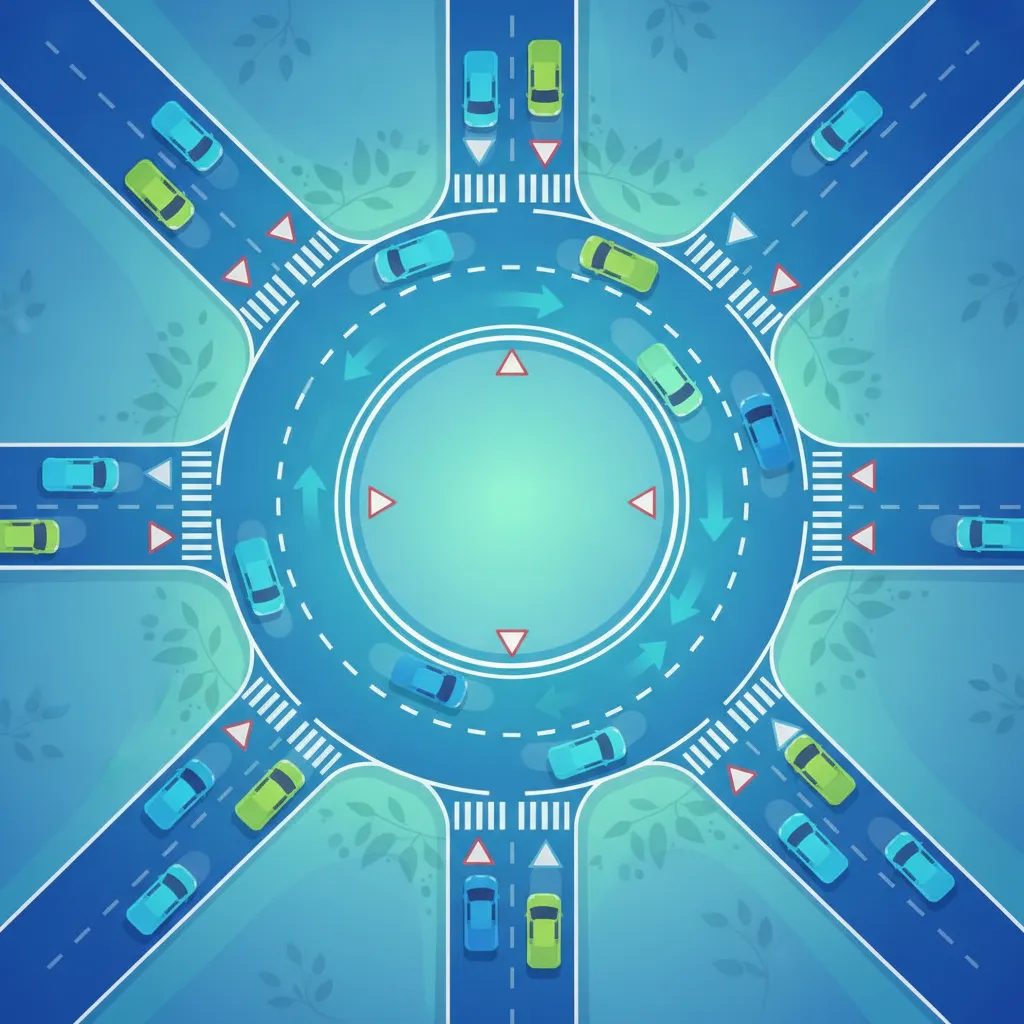
Roundabouts are a key feature of Belgian traffic management. This lesson explains how to approach, enter, navigate, and exit a roundabout safely, with a focus on yielding priority to traffic already circulating. Learners will also study correct lane positioning on multi-lane roundabouts and the appropriate use of signals.
This lesson examines the operation of traffic light systems in Belgium, clarifying the meaning of red, amber, and green signals, including flashing lights and directional arrows. It details a motorcyclist's legal obligations when approaching and navigating signal-controlled intersections. The content also addresses specialized signals for pedestrians and trams that riders must recognize and respond to correctly.
This lesson addresses unique traffic environments and special zones commonly found in Belgian urban areas. It clarifies the specific regulations concerning tramways, including where trams have absolute priority, and the conditions under which motorcycles may use bus lanes. The lesson also explains how to identify and comply with restrictions in low-emission zones.
Learn to identify and avoid frequent errors drivers make with priority from the right and priority road signs. This lesson clarifies typical misunderstandings to help prevent accidents and ensure correct application of Belgian traffic rules.
In this lesson, learners will examine the fundamental priority rules that dictate traffic flow at unmarked intersections. The lesson focuses on the principle of priority from the right, the hierarchy of traffic signs and signals, and situations requiring yielding or stopping. Understanding these principles is crucial for safe and lawful navigation of Belgian road networks.
This lesson details the safe and systematic approach to different types of intersections, both signal-controlled and uncontrolled. It explains how to use road signs and markings to determine right-of-way and when to stop or yield. The importance of comprehensive scanning for traffic from all directions and adjusting approach speed is emphasized to ensure safe passage.
This lesson delves into the complex priority rules that govern Belgian roadways, with a strong focus on the default 'priority from the right' principle. It explains how to interpret priority signs, such as 'give way' and 'stop', and apply the correct right-of-way at various types of junctions. You will learn the hierarchy of road users and the specific rules for yielding in different traffic scenarios.
This lesson introduces the core principles of priority that govern traffic flow in Belgium, with a primary focus on the 'priority from the right' rule. It explains how to identify priority roads indicated by signs and how to act at uncontrolled intersections where the default rule applies. Understanding these rules is critical for AM riders to navigate junctions, intersections, and roundabouts safely and without conflict.
This lesson focuses on the rules governing pedestrian crossings, including marked zebra crossings and signal-controlled crossings. Special attention is given to school zones and residential areas where pedestrian activity is high. Learners will understand how to recognize and respect pedestrian priority in various crossing scenarios to ensure their safety.

This lesson focuses on warning signs designed to alert drivers to potential hazards ahead. Topics include warnings for sharp curves, steep gradients, slippery surfaces, and zones with high pedestrian or wildlife activity. Learners will understand how to correctly interpret these signs and adjust their driving behavior to maintain safety on the road.
This lesson provides a systematic approach to navigating intersections, emphasizing the importance of observation, speed control, and correct positioning. It reinforces the application of priority-from-the-right and other right-of-way rules in real-world junction scenarios. You will learn effective visual scanning techniques to anticipate the actions of other road users and ensure a safe passage.
This lesson provides detailed guidance on navigating various intersections, focusing on yielding behaviors at give way signs and mandatory stops at stop signs. Learners will explore how traffic lights override other priority rules and the importance of granting right-of-way to pedestrians and cyclists. The lesson emphasizes safe crossing procedures and correct yielding.
This lesson details a motorcyclist's obligations when approaching various types of crossings, including marked pedestrian and bicycle lanes. It emphasizes the legal requirement to yield to vulnerable road users and the importance of thorough visual checks before proceeding. You will learn how to maintain a safe distance and anticipate the movements of pedestrians and cyclists in urban areas.
Directional symbols and arrows painted on the road surface guide drivers on permitted lane movements and turning directions. This lesson explains the interpretation of these arrows, covering rules for one-way streets, mandatory turns, and lane-specific instructions. Learners will understand how to comply with these symbols to navigate complex intersections safely and efficiently.
Find clear answers to common questions learners have about Priority from the Right and Priority Roads. Learn how the lesson is structured, which driving theory objectives it supports, and how it fits into the overall learning path of units and curriculum progression in Belgium. These explanations help you understand key concepts, lesson flow, and exam focused study goals.
The rule of priority from the right is the default rule at intersections. However, it does not apply if you are on a priority road, if there are specific priority signs, or if traffic lights are present.
You are on a priority road if you see the yellow diamond-shaped sign with a white border. This sign indicates you have priority at all upcoming intersections until you see the same sign with a black stripe through it.
In the absence of traffic signs, signals, or road markings, you must always yield to the driver coming from your right. This is the fundamental priority from the right rule.
Yes, if the priority rule grants the cyclist the right of way, you must yield. In Belgium, protecting vulnerable road users is a priority, and failing to yield at an intersection is a common reason for failing the theory exam.
Ready to focus your Belgian driving theory revision? Utilize our powerful search tool to pinpoint exact topics, road signs, or difficulty levels. Engage with practice questions that directly address your learning needs and solidify your understanding of Belgian traffic laws for your upcoming exam.