
This lesson focuses on the critical safety skills required to navigate urban environments as a stor knallert rider in Denmark. You will learn how to anticipate hidden dangers from pedestrians, bus stops, and parked vehicles to ensure your safety and compliance with traffic laws.
Lesson content overview
Navigating urban environments on a stor knallert (Category AM moped) presents a unique set of challenges and risks. Cities are dynamic spaces with a dense mix of road users, including many vulnerable pedestrians and cyclists, alongside static obstacles like parked cars and bus stops. This lesson delves into specific hazards common in built-up areas, equipping Category AM riders with the knowledge to anticipate, identify, and mitigate these risks effectively. Understanding these scenarios is crucial for ensuring your safety and the safety of others on Danish roads.
Urban areas, by their nature, are high-risk environments for all road users, but especially for those on two wheels. The sheer volume of traffic, diverse user groups, and frequent changes in road conditions demand heightened awareness. For Category AM riders, the smaller size and different handling characteristics of a stor knallert mean that vigilance and proactive hazard identification are even more critical.
City streets are characterized by frequent stops and starts, varied speed limits, numerous intersections, and constant interactions with pedestrians and cyclists. This unpredictability means that situations can change in an instant, requiring quick reactions and constant adaptation. Obstacles, both moving and stationary, can obscure views and create sudden hazards.
Pedestrians are among the most vulnerable road users. They can appear suddenly, change direction without warning, and are often less predictable than other vehicles. Near bus stops, schools, shopping areas, and residential streets, the risk of encountering pedestrians is significantly higher. As a stor knallert rider, you have a responsibility to protect these individuals, as any collision can have severe consequences.
To effectively manage the risks in urban zones, Category AM riders must adopt several core safety principles. These principles form the foundation of defensive riding in busy environments, allowing for increased reaction time and reduced accident potential.
Vigilance in urban zones means continuous observation and anticipation of potential hazards. This is not just about looking straight ahead but involves a 360-degree scan of your surroundings: checking mirrors frequently, glancing over your shoulder, and actively looking for clues that might indicate a developing hazard. The purpose is to detect sudden movements of pedestrians, cyclists, and vehicles, particularly around obstacles that may obscure visibility. This heightened awareness requires slower speeds to allow sufficient time to process information and react safely.
Adjusting your riding speed to suit the increased risk environment is paramount. Lower speeds increase your reaction time, giving you more opportunity to brake or maneuver if a hazard suddenly appears. It also significantly reduces the severity of potential collisions, should one occur. Your speed should always be matched to visibility conditions, road design, and traffic density, not just the posted speed limit. In dense urban areas, it is often safer and necessary to ride well below the maximum speed limit.
Maintaining a safe lateral clearance, or protective passing distance, from parked cars, bus stops, and other obstacles is essential. This buffer zone prevents collisions with suddenly opening doors, pedestrians stepping onto the road, or other unexpected hazards. Danish traffic laws, like many others, emphasize the importance of giving sufficient space to stationary vehicles and vulnerable road users. This distance creates a margin of safety, giving you crucial seconds to react.
Think 'Escape Route': Always consider where you would go if a hazard suddenly appeared. Maintaining speed and protective passing distance gives you options to brake, swerve, or adjust your path safely.
Certain situations in urban areas consistently present elevated risks. Recognizing these specific hazards and knowing how to respond is key to safe riding.
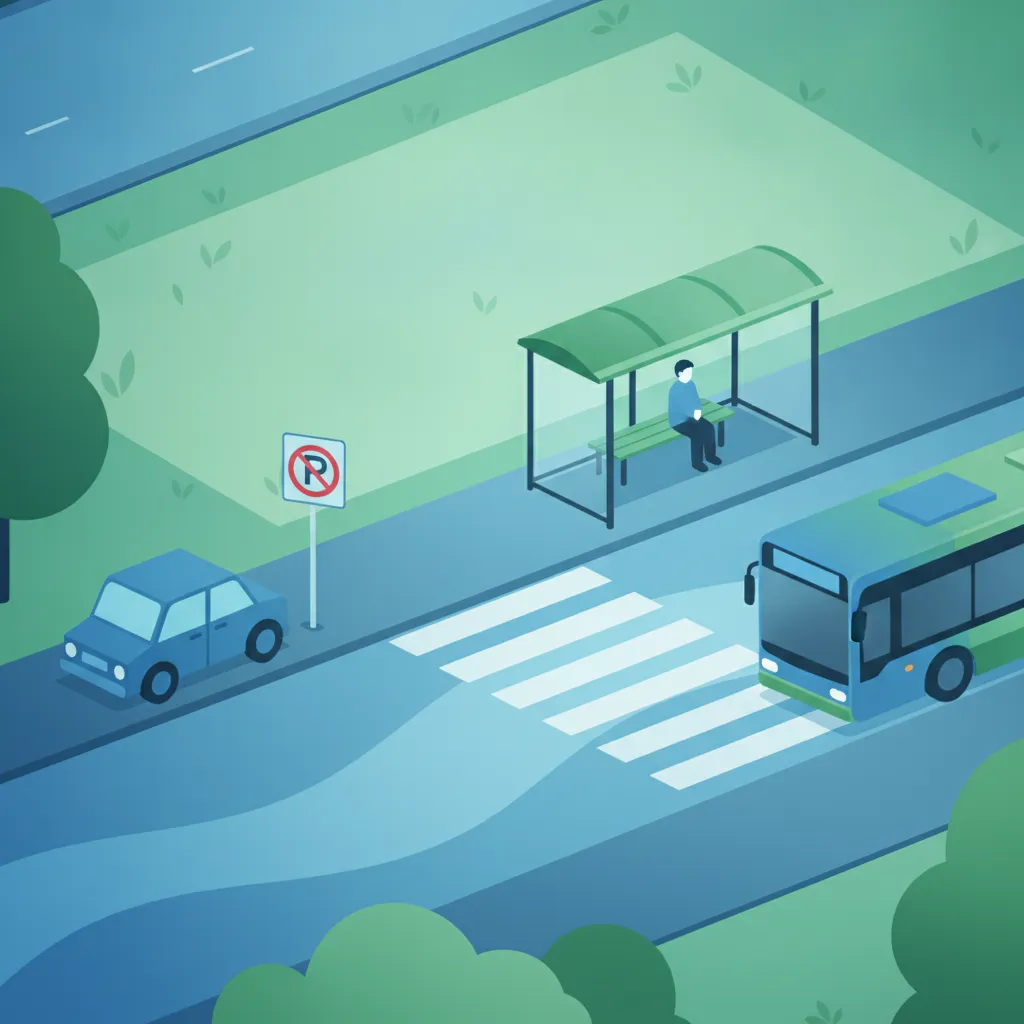
Bus stops are zones of high pedestrian activity and unpredictability. Individuals wait for, board, or alight from buses, and their movements can be sudden and unexpected.
When a bus stops, its doors open, and passengers may immediately step onto the roadway to cross, or exit and walk in front of or behind the bus. These pedestrians may be distracted, in a hurry, or simply assume that traffic will stop for them. Your view of these pedestrians can be completely obscured by the bus itself until the last moment.
In Denmark, Category AM riders must yield to pedestrians who have established themselves on the roadway from a bus stop. This means if a pedestrian steps off the bus and begins to cross the street, you must be prepared to stop and let them pass. This rule emphasizes the priority of vulnerable road users in these situations.
Large vehicles like buses create significant blind spots. As you approach a bus stop, assume that a pedestrian might emerge from in front of or behind the bus. Reduce your speed significantly and cover your brakes, ready to stop instantly.
One of the most insidious urban hazards is a pedestrian stepping onto the roadway from a position obscured by a parked vehicle. This could be someone walking between two parked cars, or a child darting out from behind a large van.
A row of parked cars creates a series of visual obstructions. You cannot see what is happening on the sidewalk or between the cars until you are almost abreast of them. This "pedestrian emergence" can catch even an attentive rider off guard, especially if riding too fast or too close to the parked vehicles.
Assume that pedestrians, especially children, might unexpectedly appear from behind any parked vehicle. Scan for any sign of movement, such as feet visible under a car, or shadows. Your speed should be low enough to allow you to stop safely if someone suddenly steps into your path. This constant mental preparation is a cornerstone of defensive riding.
'Dooring' refers to the sudden opening of a vehicle door into the path of a cyclist or moped rider. This type of accident is a significant cause of injuries in urban areas, particularly for two-wheeled vehicles.
When you pass a parked car, there is always a possibility that an occupant will open their door without checking for oncoming traffic. This often happens quickly, leaving you with very little time to react. The door can swing open directly into your path, leading to a direct collision or causing you to swerve suddenly into other traffic or obstacles.
The primary defense against dooring is to maintain a generous protective passing distance from all parked vehicles. This means riding far enough away from the parked car that if a door were to open suddenly, you would have sufficient space and time to react without colliding with it.
Never assume a parked car is empty or that its occupants will check. Always ride as if a door could open at any second.
While specific numerical rules may vary, the general principles of Danish traffic law align with international best practices for urban safety.
Within built-up areas, the general speed limit is 50 km/h, unless otherwise indicated by signage. However, the Danish Road Traffic Act (Færdselsloven) implicitly requires riders to adjust their speed to the conditions, meaning you must often ride significantly slower than the posted limit in congested or high-risk areas. Near bus stops, schools, pedestrian crossings, or rows of parked cars, reducing your speed to 20-30 km/h or even less is often a necessary safety measure.
As mentioned, at bus stops, you must yield to pedestrians who have begun crossing the street. This also applies at unmarked pedestrian crossings where a pedestrian has stepped onto the roadway. In all other situations, such as pedestrians crossing mid-block, they are generally expected to yield to traffic. However, as a Category AM rider, it is always safer to anticipate unpredictable pedestrian behavior and be prepared to stop, especially for children or the elderly.
While specific meters may not always be explicitly legislated for every scenario, the principle of maintaining a safe passing distance (sikkerhedsafstand) is mandatory. When passing parked cars, a generally accepted and safe practice is to maintain a clearance of at least 1 meter. This distance provides a crucial buffer against sudden door openings or pedestrians stepping out. If space is limited, slow down significantly or wait until it is safe to pass with adequate clearance.
Being aware of common mistakes can help you proactively avoid them.
Passing Too Close to Parked Cars:
Failure to Yield at Bus Stops:
Excessive Speed Near Parked Cars:
Neglecting to Watch for Pedestrians Behind Vehicles:
Crossing a Bus Stop without Caution:
Safe urban riding isn't static; it requires constant adaptation to changing conditions.
In rain, fog, or icy conditions, visibility is dramatically reduced, and stopping distances increase. This requires even greater speed reductions and increased following and passing distances. Road markings and signs can be harder to see, and glare from wet surfaces can be blinding.
During low-light conditions (dawn, dusk, night), the risk of not seeing pedestrians or open doors increases significantly. Pedestrians may wear dark clothing, making them almost invisible. Ensure your stor knallert's lighting is correctly adjusted and functional, and reduce your speed to compensate for reduced visual information.
Narrow streets or streets with many parked cars on both sides demand more caution than wider urban avenues. Limited space means less room for error. Areas with frequent deliveries (e.g., commercial districts) often have vehicle doors opening and closing more frequently. Residential areas, especially those near schools or playgrounds, warrant extra vigilance due to children.
A stor knallert that is fully loaded with cargo or carrying a passenger may have reduced maneuverability and increased braking distances. This reduction in performance necessitates even slower speeds and larger safety margins, as your ability to react swiftly is impaired.
Understanding the rationale behind these rules reinforces their importance for your safety and the safety of others.
Speed is directly related to stopping distance. Doubling your speed roughly quadruples your braking distance. In urban areas, where unexpected hazards can appear with little warning, a lower speed provides a shorter braking distance, which can be the difference between a near miss and a serious collision. The energy of an impact also increases exponentially with speed, meaning even a slight increase in speed can lead to a much more severe outcome in a crash.
Your brain needs time to perceive a hazard, process the information, decide on a course of action, and then for your body to execute that action (e.g., applying brakes). This "reaction time" can be delayed if a pedestrian is hidden behind an obstacle, or if you are distracted. A slower riding speed compensates for this inherent human delay, giving your brain and body more valuable seconds to respond effectively.
'Dooring' is indeed a leading cause of urban accidents involving two-wheeled vehicles. Similarly, collisions with pedestrians emerging from behind parked cars are distressingly common. By consistently applying the principles of vigilance, speed reduction, and maintaining protective passing distances, Category AM riders can significantly reduce their statistical risk of being involved in these preventable accidents.
Applying these concepts in real-world situations helps solidify your understanding.
Setting: You are riding your stor knallert on a narrow city street. Ahead, a public bus is stopped at a bus stop on the right, with passengers alighting. Some individuals are beginning to step into the street. Rule/Decision: You must yield to pedestrians crossing from the bus stop and anticipate others emerging. Correct Action: You reduce your speed significantly, cover your brakes, and prepare to stop. You make eye contact with any visible pedestrians if possible. As a pedestrian steps onto the road, you come to a complete stop, allowing them to cross safely. Once the pedestrians have cleared and it's safe, you proceed cautiously, looking for more pedestrians. Incorrect Action: You maintain speed, assuming pedestrians will wait. You pass the bus quickly, potentially forcing a pedestrian to stop or swerve. Explanation: Yielding prevents accidents with unpredictable pedestrians who have priority when leaving a bus and crossing the road.
Setting: You are riding past a long row of parked cars on a busy street. You notice movement in the driver's seat of one of the cars. Rule/Decision: Maintain a protective passing distance and be prepared for 'dooring'. Correct Action: You position your stor knallert at least 1 meter away from the parked cars. Your speed is reduced, and you are actively scanning the car doors and looking for occupants inside. You notice the driver's hand move towards the door handle and are ready to brake or swerve if the door opens. Incorrect Action: You ride close to the parked cars to save space or avoid other traffic. You are not actively looking at the car doors. Explanation: Maintaining adequate distance provides a buffer, giving you crucial time and space to react to a suddenly opening car door, preventing a collision or forcing a dangerous swerve.
Setting: You are approaching a large delivery van parked partially in your lane. You cannot see the sidewalk on the other side of the van. Rule/Decision: Anticipate pedestrians stepping out from behind the obstruction. Correct Action: You significantly reduce your speed before reaching the van. You actively scan for any signs of movement (e.g., feet, shadows, reflections) and keep your eyes moving, looking for potential hazards. You are prepared to stop or swerve if a pedestrian, especially a child, darts out. Incorrect Action: You speed past the van, assuming the road ahead is clear because you cannot see anyone. Explanation: Anticipation and speed reduction allow you to respond safely to hidden hazards. Assuming the path is clear when visibility is obstructed is a dangerous mistake.
Mastering urban risks is fundamental for any Category AM rider. By consistently applying the principles learned in this lesson, you can significantly enhance your safety and contribute to a safer environment for all road users in Danish cities.
By embracing these strategies, you will ride your stor knallert with greater confidence and safety through the dynamic and challenging urban landscapes of Denmark.
This lesson covers essential urban hazard perception skills for Danish Category AM stor knallert riders, focusing on three primary risk areas: bus stops where pedestrians have priority when crossing from the vehicle, parked car zones where dooring and pedestrian emergence create hidden dangers, and the critical importance of maintaining at least 1 meter passing distance. Effective risk mitigation requires continuous 360-degree vigilance, significant speed reduction in high-risk zones, and always anticipating that pedestrians may appear unexpectedly from behind obstacles. The lesson emphasizes that defensive riding principles—reduced speed, increased distance, and constant observation—directly reduce both the likelihood and severity of urban accidents.
A short set of high-value points that capture the most important learning from this lesson.
Always yield to pedestrians crossing from bus stops (Fodgænger Vigepligt) - they have priority once they step onto the roadway
Maintain at least 1 meter protective passing distance from parked vehicles to avoid dooring accidents
Reduce speed significantly near bus stops, parked cars, and anywhere visibility is limited
Anticipate pedestrians emerging from behind parked vehicles, especially children near larger obstructions like vans
Continuous 360-degree scanning and vigilance are essential in unpredictable urban environments
Explore all units and lessons included in this driving theory course.
Fodgænger Vigepligt means pedestrians crossing from a bus stop have right-of-way and must be yielded to
The 1-meter minimum passing distance from parked cars provides a safety buffer against opening doors and hidden pedestrians
Bus stops create blind spots - always assume pedestrians may emerge from in front of or behind the bus
Speed reduction directly increases reaction time and reduces collision severity exponentially
Low-light conditions (dawn, dusk, night) dramatically increase hazard risk - ensure proper lighting and slower speeds
Riding too close to parked cars within arm's reach, which leaves no reaction space for opening doors
Failing to stop for pedestrians who have begun crossing from a bus stop, violating Fodgænger Vigepligt
Maintaining high speed in zones with parked cars despite low visibility and hidden pedestrian risks
Not scanning between parked vehicles for feet, shadows, or movement indicating hidden pedestrians, especially children
Passing through bus stop areas at normal cruising speed when a bus is present or has just departed
Lesson content overview
A short set of high-value points that capture the most important learning from this lesson.
Always yield to pedestrians crossing from bus stops (Fodgænger Vigepligt) - they have priority once they step onto the roadway
Maintain at least 1 meter protective passing distance from parked vehicles to avoid dooring accidents
Reduce speed significantly near bus stops, parked cars, and anywhere visibility is limited
Anticipate pedestrians emerging from behind parked vehicles, especially children near larger obstructions like vans
Continuous 360-degree scanning and vigilance are essential in unpredictable urban environments
Explore all units and lessons included in this driving theory course.
Fodgænger Vigepligt means pedestrians crossing from a bus stop have right-of-way and must be yielded to
The 1-meter minimum passing distance from parked cars provides a safety buffer against opening doors and hidden pedestrians
Bus stops create blind spots - always assume pedestrians may emerge from in front of or behind the bus
Speed reduction directly increases reaction time and reduces collision severity exponentially
Low-light conditions (dawn, dusk, night) dramatically increase hazard risk - ensure proper lighting and slower speeds
Riding too close to parked cars within arm's reach, which leaves no reaction space for opening doors
Failing to stop for pedestrians who have begun crossing from a bus stop, violating Fodgænger Vigepligt
Maintaining high speed in zones with parked cars despite low visibility and hidden pedestrian risks
Not scanning between parked vehicles for feet, shadows, or movement indicating hidden pedestrians, especially children
Passing through bus stop areas at normal cruising speed when a bus is present or has just departed
Explore search topics learners often look for when studying Urban Risks: Pedestrians, Bus Stops, and Parking. These topics reflect common questions about road rules, driving situations, safety guidance, and lesson level theory preparation for learners in Denmark.
Browse additional driving theory lessons that cover connected traffic rules, road signs, and common driving situations related to this topic. Improve your understanding of how different rules interact across everyday traffic scenarios.
Explore complex urban driving scenarios for Category AM riders, focusing on pedestrians, bus stops, and parked cars. Understand how to apply Danish traffic laws and defensive riding techniques in challenging city environments.

This lesson covers the core principles of defensive driving in an urban context. It teaches drivers how to anticipate the actions of other road users, maintain safe following distances in dense traffic, and navigate complex intersections with multiple signals. The content emphasizes heightened awareness of pedestrians, cyclists, and unexpected events common in Danish city environments.

This lesson addresses the unique challenges of driving in tourist-heavy urban centers alongside cyclists. It teaches drivers to anticipate the behavior of individuals who may be distracted or unfamiliar with local traffic rules. The content provides strategies for communicating intentions clearly and navigating safely around large groups, luggage, and cyclists.
This lesson contrasts the driving techniques required for rural roads and motorways. It covers managing speed on narrow, winding lanes with potential hazards like farm machinery or animals. The content also explains the principles of safe motorway driving, including maintaining lane discipline, managing high-speed stability, and executing safe overtaking maneuvers.
This lesson provides critical guidance for driving in environments with heavy cycle traffic, typical of Danish cities. It focuses on identifying and yielding to cyclists in dedicated bike lanes, especially when turning right across their path. The content emphasizes advanced observation skills to detect cyclists in blind spots and the importance of giving adequate space.
This lesson addresses the combined challenges of navigating narrow rural roads and driving in adverse weather. It explains how to adapt speed and braking techniques for conditions like heavy rain, fog, or ice, which are common on rural routes. The content also integrates these factors into route planning, teaching drivers how to select the safest and most appropriate path while avoiding local weight or height restrictions.
This lesson reinforces the driver's responsibility to protect pedestrians, particularly in busy urban areas and near schools. It details the procedures for approaching pedestrian crossings, the legal requirement to reduce speed significantly in marked school zones, and how to anticipate the unpredictable actions of pedestrians. The content covers traffic calming measures and the legal rights of pedestrians in various settings.
This lesson provides practical guidance for navigating the challenges of urban deliveries. It details Danish regulations for using loading zones, including time restrictions and parking rules, and offers strategies for effective route planning in dense traffic. The content emphasizes awareness of pedestrian-heavy areas and the importance of maneuvering with caution to ensure public safety during delivery operations.
This lesson teaches you to identify warning signs that alert drivers to upcoming hazards and changing road conditions. It covers common signs such as sharp curves, school zones, animal crossings, and temporary conditions like roadworks or slippery surfaces. Understanding these signs is crucial for anticipating risks and adjusting your driving to ensure safety on all types of Danish roads.
This lesson focuses on the practical skills needed to maneuver a large vehicle in confined environments such as urban delivery zones and loading docks. It teaches how to accurately judge the required space, understand the vehicle's turning radius, and use reference points to position the vehicle precisely. The content covers strategies for navigating tight corners and avoiding fixed obstacles, which is essential for damage-free urban operations.

This lesson equips you with the knowledge to drive safely in challenging weather conditions. It explains the risk of aquaplaning in heavy rain, how to counteract strong crosswinds, and the correct use of lights in darkness and fog. The core principle is adapting your speed and increasing your following distance to compensate for reduced visibility and traction.
Learn essential defensive riding principles for Category AM riders navigating urban Denmark. Focuses on vigilance, speed reduction, and protective passing distances to manage risks from pedestrians, bus stops, and parked vehicles.
This lesson addresses the unique challenges of streets with dedicated cycle lanes and numerous bus stops. It teaches riders how to anticipate pedestrians moving to and from buses and how to position themselves to avoid conflict with cyclists. The goal is to navigate these complex environments smoothly and safely.
This lesson covers the core principles of defensive driving in an urban context. It teaches drivers how to anticipate the actions of other road users, maintain safe following distances in dense traffic, and navigate complex intersections with multiple signals. The content emphasizes heightened awareness of pedestrians, cyclists, and unexpected events common in Danish city environments.
This lesson provides critical guidance for driving in environments with heavy cycle traffic, typical of Danish cities. It focuses on identifying and yielding to cyclists in dedicated bike lanes, especially when turning right across their path. The content emphasizes advanced observation skills to detect cyclists in blind spots and the importance of giving adequate space.
This lesson focuses on safe interactions with Denmark's large population of cyclists and other vulnerable road users. It covers the rules for passing cyclists, yielding at pedestrian crossings, and the specific hazard of turning across a bike lane. Developing heightened awareness for these interactions is critical for urban riding.
This lesson emphasizes the professional driver's heightened responsibility to protect vulnerable road users. It revisits Danish regulations concerning cyclist priority, particularly during right turns, and details the correct procedures for maintaining safe overtaking distances. The content focuses on developing advanced situational awareness, using mirrors and cameras effectively, and anticipating the behavior of pedestrians and cyclists in urban environments.
This lesson provides in-depth guidance on safely interacting with cyclists and e-bike riders, a daily reality in Danish cities. It explains how to provide adequate space when overtaking, how to anticipate their movements at intersections, and how to respect their right-of-way in designated lanes. Understanding these dynamics is essential for preventing common accidents and ensuring a safe urban driving experience for everyone.

This lesson prepares riders for the specific hazards of rural roads, which often have less visibility and more unpredictable surfaces. It covers strategies for approaching blind curves, safely passing agricultural machinery, and being vigilant for animals on the road. Adjusting speed to match visibility is a core principle.
This lesson addresses the critical skill of safely coexisting with cyclists and cargo bikes, which are prevalent in Denmark. It explains how to maintain a safe distance, overtake properly, and be vigilant for cyclists, especially when turning right. Understanding the infrastructure of cycle lanes and predicting cyclist behavior is a key focus.
This lesson introduces the essential principles of defensive driving, shifting the focus from reacting to hazards to proactively anticipating them. You will learn techniques for systematic scanning of the driving environment, maintaining a safety cushion around your vehicle, and identifying potential risks before they develop. These proactive strategies are fundamental to becoming a safer, more confident driver.
This lesson provides critical instruction on executing right turns safely, a high-risk maneuver for heavy vehicles in urban settings. It places strong emphasis on Danish traffic laws concerning cyclist priority and teaches drivers how to position their vehicle to account for off-tracking. The content focuses on defensive driving techniques, such as scanning for cyclists and making intentions clear, to prevent right-turn collisions.
Find clear answers to common questions learners have about Urban Risks: Pedestrians, Bus Stops, and Parking. Learn how the lesson is structured, which driving theory objectives it supports, and how it fits into the overall learning path of units and curriculum progression in Denmark. These explanations help you understand key concepts, lesson flow, and exam focused study goals.
You should maintain sufficient lateral distance to avoid being hit by a suddenly opening door. In theory, aim for at least one meter if traffic conditions allow, and always reduce your speed when passing.
In Denmark, if a bus is indicating to move away from a stop in a built-up area, other traffic must generally facilitate this when safe, but as a rider, you must always ensure you are not creating a dangerous situation by overtaking or squeezing through.
Pedestrians, especially children, often emerge from behind or in front of stationary buses without checking for traffic. This makes bus stops critical points for heightened observation and speed reduction.
Yes, regardless of your vehicle size, you have a legal obligation to show special consideration for vulnerable road users, including pedestrians at crossings or emerging from behind obstacles, as emphasized in the Danish Highway Code.
Use our powerful search tool to pinpoint specific Danish driving theory topics, road signs, or traffic situations you need to review. Start exploring relevant practice sets now to reinforce your knowledge and build confidence for your upcoming driving licence exam.