
Welcome to the lesson on Braking While Cornering, a crucial skill for motorcycle riders preparing for the Spanish DGT theory exam. This lesson builds on your understanding of general braking techniques and cornering basics, focusing specifically on how to safely reduce speed as you enter a turn. Mastering this technique is vital for maintaining control and adhering to DGT safety standards on Spain's diverse roads.

Lesson content overview
Navigating bends and curves safely is a fundamental skill for any motorcyclist. While many riders understand the basics of braking in a straight line, reducing speed effectively and safely while entering or within a corner presents a unique challenge. This lesson explores the critical technique of "braking while cornering," often referred to as trail braking, a skill essential for maintaining control, optimizing your line, and ensuring safety, especially when preparing for the Spanish Motorcycle Theory Exam for A, A1, and A2 licences.
Mastering this technique allows riders to adjust their speed precisely as they enter a turn, enhancing stability and preventing common errors that lead to loss of traction. We will delve into the underlying physics, practical applications, and crucial DGT (Dirección General de Tráfico) safety standards that govern this advanced riding skill.
To safely brake while cornering, a rider must first grasp the complex interplay of forces acting on the motorcycle. Unlike straight-line braking, where the primary concern is stopping efficiently, braking in a turn involves balancing deceleration with the lateral forces of cornering. This balance dictates how much grip each tire can provide and, ultimately, the stability of the motorcycle.
Controlled deceleration before and during a corner is paramount. It allows the rider to enter the turn at an appropriate speed, select an optimal line, and maintain a reserve of traction. Abrupt braking or an incorrect approach can overload the tires, leading to a loss of grip, often resulting in a fall. The goal is to achieve smooth transitions between braking, cornering, and acceleration, ensuring the motorcycle remains stable throughout the maneuver.
The Spanish DGT emphasizes the need for riders to maintain constant control of their vehicle, particularly in situations that require speed adjustments and changes in direction. Proper braking while cornering directly supports this principle by allowing riders to adapt to road conditions and unexpected hazards seamlessly.
Several interconnected principles govern the safe execution of braking while cornering. Understanding these will form the foundation of your trail braking technique.
When you apply the brakes, the motorcycle's weight shifts forward, increasing the load on the front wheel and decreasing it on the rear wheel. This longitudinal weight transfer is crucial because the front tire is designed to handle significantly more braking force than the rear. During a turn, lateral weight transfer also occurs, with some load shifting to the outside wheel as the bike leans.
Understanding how load shifts informs your brake application. An increased load on the front tire means it can generate more grip for braking and steering, up to a point. Conversely, a decreased load on the rear tire means it has less grip available for braking. Balancing these forces is key to preventing a skid.
Every tire has a finite amount of grip, represented by the "friction circle." This circle defines the total traction available. If a tire is using 100% of its grip for cornering (at maximum lean), it has no remaining grip for braking or acceleration. Conversely, if it's using 100% of its grip for braking in a straight line, it has no grip left for steering or leaning.
When braking while cornering, you are simultaneously demanding both longitudinal (braking) and lateral (cornering) forces from the tires. The sum of these forces must remain within the tire's friction circle. Exceeding this limit, even slightly, will cause the tire to slide. This concept is fundamental to understanding why heavy braking at deep lean angles is dangerous.
Trail braking is the primary technique for safely reducing speed while entering a bend. It involves carrying a diminishing amount of front-brake pressure from the initial turn-in point deep into the corner. As the motorcycle leans more and the lateral forces increase, the brake pressure is smoothly and progressively reduced.
The benefits of trail braking are substantial:
Trail braking is about modulation, not heavy braking. The idea is to trail off the brake pressure as you increase lean, smoothly transitioning from braking to cornering.
The angle at which your motorcycle is tilted (lean angle) directly affects how much grip the tires have available for braking. As the lean angle increases, more of the tire's friction circle is used for lateral (cornering) forces, leaving less for longitudinal (braking) forces.
Heavy braking at maximum lean can easily overwhelm the front tire, leading to a loss of traction and a "low-side" crash, where the bike slides out from underneath the rider. Therefore, the majority of your significant braking should be completed before achieving maximum lean. Trail braking manages this balance by gradually reducing brake pressure as lean increases, never demanding too much from the front tire at its limit.
Effective brake modulation is the cornerstone of trail braking. It involves using your fingers (for the front brake) and foot (for the rear brake) with sensitivity, feeling the feedback from the tires and adjusting pressure accordingly. Rather than an "on/off" approach, successful modulation is a continuous, fluid adjustment of pressure.
For A, A1, and A2 licence holders, developing this tactile feedback is crucial. It ensures that braking remains predictable and smooth, preventing sudden shifts in weight or loss of traction, which could destabilize the motorcycle.
Let's explore each concept in more detail, with practical insights and common pitfalls to avoid.
Definition: Weight transfer is the dynamic shift of the motorcycle's mass. When you brake, inertia tries to keep the motorcycle moving forward, effectively pushing weight onto the front wheel. Conversely, accelerating shifts weight to the rear, and leaning shifts weight laterally.
Practical Meaning: Anticipating weight transfer allows you to use it to your advantage. For instance, the forward weight transfer caused by front braking increases the front tire's contact patch pressure, thereby improving its grip for both braking and steering. However, this simultaneously reduces the load on the rear wheel, making it more prone to locking if the rear brake is applied too forcefully.
Common Misunderstandings: Many novice riders mistakenly believe that the rear brake is safer to use in a corner. While the rear brake can offer some stability in very gentle curves or at low speeds, relying heavily on it during a leaned turn, especially if abrupt, can cause the rear wheel to lock. A locked rear wheel can lead to a "high-side" crash, where the rear tire skids, then suddenly regains traction, violently flipping the rider over the bike.
Definition: The friction circle is not a physical object but a conceptual tool that helps riders visualize the limits of tire adhesion. Imagine it as a "budget" of grip: you can spend it on braking, accelerating, or cornering, but you can't exceed the total budget.
Practical Meaning: In a corner, a significant portion of the tire's grip budget is already allocated to lateral forces (keeping the bike leaned over and turning). This leaves a smaller portion for longitudinal forces (braking or acceleration). As your lean angle increases, the available longitudinal grip decreases. Therefore, braking force must be progressively reduced as the lean angle deepens to stay within the friction circle.
Associated Rules: Riders must always operate within the tire's limits. Exceeding the friction circle inevitably leads to a slide. This is a primary reason why aggressive braking while deeply leaned is extremely dangerous.
Definition: Trail braking involves smoothly decreasing front-brake pressure from the point of initial turn-in all the way to the apex, where the brakes are fully released, and the rider transitions to throttle control.
Types:
Practical Meaning: Trail braking enables a rider to maintain control and adjust their trajectory and speed more precisely throughout a turn. By keeping some weight on the front wheel, the front suspension remains slightly compressed, which sharpens steering and provides better feedback. This allows for later apexing and smoother, more controlled exits.
Examples: Imagine approaching a sharp urban corner. Instead of braking entirely before leaning, you'd apply a controlled amount of front brake, begin to lean, and gradually ease off the brake as your lean angle increases and you approach the apex. This helps you maintain control and potentially tighten your line if needed.
Definition: Lean angle is the degree to which a motorcycle is tilted relative to the road surface during a turn. This tilt is necessary to counteract centrifugal force and keep the bike from falling over.
Practical Meaning: As the motorcycle leans, the effective contact patch of the tires changes, and the forces acting on the tires shift. Critically, as lean angle increases, the vertical load on the front tire that supports braking decreases, while the lateral forces increase. This means the front tire's capacity for braking diminishes significantly with increased lean.
Common Misunderstandings: A common mistake is assuming that tires have uniform grip regardless of lean. In reality, a tire at maximum lean has very little grip left for braking. Applying too much brake when heavily leaned can easily overwhelm the front tire.
Definition: Brake modulation is the nuanced ability to control the exact amount of braking force applied, from a feather-light touch to maximum pressure, and everything in between.
Types:
Practical Meaning: Smooth, progressive brake modulation is vital for maintaining stability and preventing wheel lock-up, especially when trail braking. It allows the rider to constantly adapt to changing conditions and traction levels. ABS (Anti-lock Braking System) can assist, but it does not remove the need for skilled manual modulation, particularly in high-lean situations where the physics of grip are complex.
The DGT places a strong emphasis on maintaining control and adapting speed to conditions, principles directly applicable to braking while cornering.
Statement: Drivers must adjust their speed to the road's curvature and prevailing traffic conditions, always ensuring safe steerability of the vehicle.
Applicability: This rule applies to all cornering situations, mandating that riders assess the bend and reduce speed sufficiently before entering it, to navigate it safely without having to make abrupt maneuvers.
Rationale: Excessive speed in a curve generates centrifugal force that can push the motorcycle wide, making it difficult or impossible to maintain the intended line and potentially leading to a run-off-road accident.
Statement: When entering a curve, riders may apply the front brake, but this must be done progressively and smoothly to prevent loss of traction.
Applicability: This is directly related to trail braking. While not explicitly stated as "trail braking" in the law, the principle of progressive front brake use aligns with DGT's general safety guidelines for control.
Rationale: The front brake provides the majority of a motorcycle's stopping power. Using it progressively allows for controlled deceleration and weight transfer, enhancing front-end grip and stability for the turn. Abrupt application, especially while leaned, is highly dangerous.
Statement: Drivers are prohibited from performing maneuvers that could cause the vehicle to slide, particularly on wet or slippery surfaces.
Applicability: This rule has critical implications for braking while cornering in adverse conditions. Any braking technique that causes a wheel to lock or slide on a wet road is a violation of safe practice and potentially illegal.
Rationale: Sliding on wet surfaces dramatically reduces control and significantly increases the risk of an accident. On wet roads, tire grip is severely reduced, demanding much lighter and smoother inputs for both braking and cornering.
Statement: Drivers must always maintain effective control of their vehicle and must not endanger other road users through erratic or unpredictable maneuvers.
Applicability: This overarching rule underpins all aspects of motorcycle riding, including braking while cornering. Any technique that leads to loss of control, such as sudden braking mid-curve, would be considered a violation of this fundamental principle.
Rationale: Consistent and predictable riding enhances safety for the rider and all other road users. Controlled trail braking is a technique that promotes this predictability.
Understanding common errors is as important as learning the correct technique.
The ideal braking while cornering technique is not static; it must adapt to various external and internal conditions.
Let's consider how these principles apply in real-world driving situations.
Braking while cornering is an advanced yet crucial skill for safe motorcycle operation, particularly relevant for A, A1, and A2 licence candidates. It transforms a potentially hazardous maneuver into a controlled and fluid action.
By integrating these principles, you will gain the confidence and skill to negotiate corners safely, efficiently, and with greater control, preparing you comprehensively for your Spanish Motorcycle Theory Exam and ensuring a safer riding experience.
Trail braking is an advanced technique where the rider applies light, progressive front-brake pressure while entering a turn, gradually releasing it as lean angle increases. The core physics involve weight transfer (forward shift under braking increases front-wheel grip) and the friction circle (a finite tyre grip budget shared between braking and cornering forces). As lean angle increases, the portion of grip available for braking decreases, so significant deceleration must happen before achieving deep lean to avoid exceeding tyre limits and causing a slide. DGT regulations mandate appropriate speed adaptation for curves and progressive brake use to maintain control, making this technique essential for both safe riding and the A, A1, A2 licence theory exam.
A short set of high-value points that capture the most important learning from this lesson.
Trail braking requires smoothly decreasing front-brake pressure as lean angle increases, fully releasing brakes by the apex.
Weight transfer during braking shifts load to the front wheel, increasing its capacity for braking and steering grip.
The friction circle represents the finite grip available to a tire—demanding both braking and cornering forces simultaneously means staying within this limit.
Heavy braking at maximum lean overwhelms the front tire and risks a low-side crash.
Most significant deceleration should be completed before achieving deep lean angles to preserve tire grip for cornering.
Explore all units and lessons included in this driving theory course.
Trail braking is modulation, not heavy braking—ease off progressively as lean increases.
Front brake provides most of the motorcycle's stopping power and must be used progressively, especially when leaned.
On wet or slippery surfaces, drastically reduce brake force, brake earlier, and release earlier.
A locked rear wheel while leaned can cause a violent high-side crash when traction suddenly returns.
DGT regulations require adjusting speed to road curvature and maintaining vehicle control at all times.
Applying full front brake while already significantly leaned, causing front-wheel lock-up and a low-side crash.
Waiting too late to brake, then needing to brake heavily mid-corner when tire grip is already compromised by lean.
Over-relying on the rear brake while leaned, risking rear-wheel lock-up and a high-side crash.
Using dry-road braking force on wet surfaces, causing wheel lock-up and loss of control.
Maintaining excessive brake pressure as lean angle deepens, overloading the front tire beyond its friction limits.
Lesson content overview
A short set of high-value points that capture the most important learning from this lesson.
Trail braking requires smoothly decreasing front-brake pressure as lean angle increases, fully releasing brakes by the apex.
Weight transfer during braking shifts load to the front wheel, increasing its capacity for braking and steering grip.
The friction circle represents the finite grip available to a tire—demanding both braking and cornering forces simultaneously means staying within this limit.
Heavy braking at maximum lean overwhelms the front tire and risks a low-side crash.
Most significant deceleration should be completed before achieving deep lean angles to preserve tire grip for cornering.
Explore all units and lessons included in this driving theory course.
Trail braking is modulation, not heavy braking—ease off progressively as lean increases.
Front brake provides most of the motorcycle's stopping power and must be used progressively, especially when leaned.
On wet or slippery surfaces, drastically reduce brake force, brake earlier, and release earlier.
A locked rear wheel while leaned can cause a violent high-side crash when traction suddenly returns.
DGT regulations require adjusting speed to road curvature and maintaining vehicle control at all times.
Applying full front brake while already significantly leaned, causing front-wheel lock-up and a low-side crash.
Waiting too late to brake, then needing to brake heavily mid-corner when tire grip is already compromised by lean.
Over-relying on the rear brake while leaned, risking rear-wheel lock-up and a high-side crash.
Using dry-road braking force on wet surfaces, causing wheel lock-up and loss of control.
Maintaining excessive brake pressure as lean angle deepens, overloading the front tire beyond its friction limits.
Explore search topics learners often look for when studying Braking while Cornering. These topics reflect common questions about road rules, driving situations, safety guidance, and lesson level theory preparation for learners in Spain.
Browse additional driving theory lessons that cover connected traffic rules, road signs, and common driving situations related to this topic. Improve your understanding of how different rules interact across everyday traffic scenarios.
Learn advanced motorcycle braking techniques, including trail braking, for safe cornering. This lesson explains how to manage speed and lean angle according to DGT regulations, crucial for the Spanish A licence theory exam.

This lesson presents advanced cornering scenarios common on Spanish roads, such as mountain hairpins and high-speed autovía exits. It outlines specific techniques for descent control, ascent maneuvers, and safely merging into traffic after cornering. Interaction with cyclists and emergency cornering strategies are also covered in accordance with DGT regulations.

This lesson focuses on counter-steering at higher speeds, highlighting how pre-steer torque initiates a lean. It outlines the rider input timing required for effective torque steer and discusses how speed affects the front-wheel angle necessary for stable cornering. The content includes dynamic lean initiation techniques and DGT guidelines for fast turns.

This lesson details the protocol for performing an emergency stop, emphasizing full-force application of both front and rear brakes while maintaining optimal rider posture. It covers the importance of visual fixation and the role of ABS in stabilizing the bike under panic conditions. Learners also study the calculation of stopping distances based on speed and road conditions.

This lesson focuses on adapting braking techniques for wet and slippery roads. Topics include hydroplaning risk, reduced tire friction, and how ABS assists in preventing wheel lock-up. Learners are taught to employ progressive braking, reduce speed, and assess tire tread depth to maintain adequate grip.

This lesson covers the principles of anti-lock braking systems (ABS), describing how wheel slip detection prevents wheel lock-up. It explains combined braking operation, where front and rear brakes are applied in a calibrated ratio to maintain stability. Learners also explore how ABS enhances safety on low-traction surfaces and review DGT braking regulations.

This lesson explains the physics of counter-steering, where the rider initiates a turn by briefly steering the front wheel opposite to the desired direction. It details how body shift and rider lean influence the turn entry and exit phases. Understanding these principles enables riders to achieve precise directional control and maintain turning stability.

This lesson examines the optimal body positioning during a turn, covering rider lean, hip shift, and foot placement to maintain balance. It explains how adjusting body posture improves mass distribution through the motorcycle. Different phases of the turn are described, with guidance on how posture should adapt at each stage.

This lesson teaches riders how to react effectively in a sudden, critical situation. It explains the technique for applying maximum braking force without locking the wheels, ensuring the shortest possible stopping distance while maintaining stability. The content also covers how to perform a swift and controlled swerve to avoid an obstacle when stopping is not possible, emphasizing the importance of looking where you want to go.

This lesson explores the concept of the traction circle and how slip angle influences grip limits during a curve. Learners study the impact of road camber and surface friction on tyre performance. Strategies for maintaining apex and exit speeds while preventing traction loss are presented, including rider feedback cues.
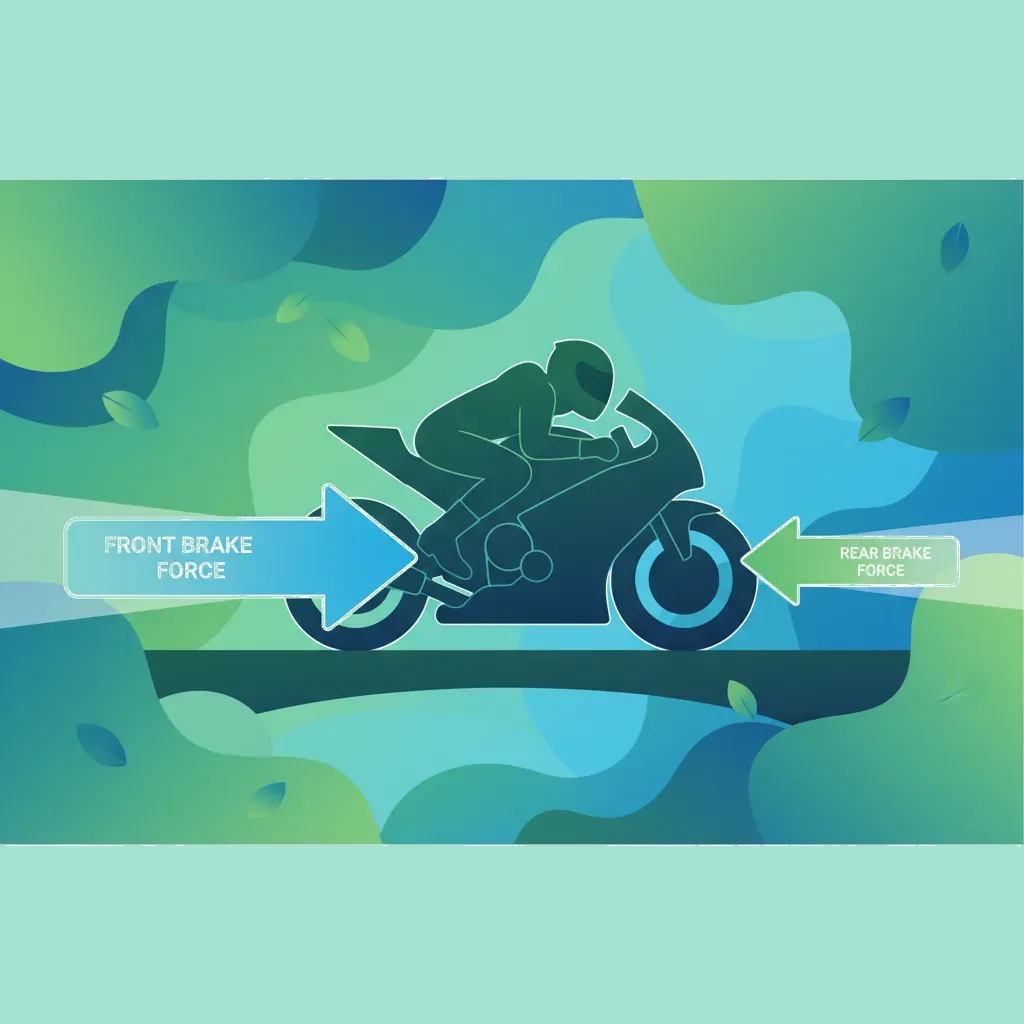
This lesson explores the physics behind brake torque distribution, explaining why the front brake provides greater stopping power due to weight shift during deceleration. It discusses the optimal brake bias for various speeds and surface conditions. Understanding these principles enables riders to modulate braking forces effectively.
Understand and avoid common mistakes when braking and cornering on a motorcycle. This lesson details errors like abrupt braking at lean angles and how to prevent low-side and high-side crashes, aligned with DGT safety standards.
This lesson identifies frequent beginner errors such as over-application of throttle, misuse of the clutch, and improper braking timing. It analyzes the underlying causes of these mistakes and offers corrective techniques to develop safe riding habits. By referencing DGT exam examples, learners gain insight into how to avoid these common pitfalls.
This lesson focuses on adapting braking techniques for wet and slippery roads. Topics include hydroplaning risk, reduced tire friction, and how ABS assists in preventing wheel lock-up. Learners are taught to employ progressive braking, reduce speed, and assess tire tread depth to maintain adequate grip.
This lesson explores the concept of the traction circle and how slip angle influences grip limits during a curve. Learners study the impact of road camber and surface friction on tyre performance. Strategies for maintaining apex and exit speeds while preventing traction loss are presented, including rider feedback cues.
This lesson details the protocol for performing an emergency stop, emphasizing full-force application of both front and rear brakes while maintaining optimal rider posture. It covers the importance of visual fixation and the role of ABS in stabilizing the bike under panic conditions. Learners also study the calculation of stopping distances based on speed and road conditions.
This lesson presents advanced cornering scenarios common on Spanish roads, such as mountain hairpins and high-speed autovía exits. It outlines specific techniques for descent control, ascent maneuvers, and safely merging into traffic after cornering. Interaction with cyclists and emergency cornering strategies are also covered in accordance with DGT regulations.
This lesson focuses on counter-steering at higher speeds, highlighting how pre-steer torque initiates a lean. It outlines the rider input timing required for effective torque steer and discusses how speed affects the front-wheel angle necessary for stable cornering. The content includes dynamic lean initiation techniques and DGT guidelines for fast turns.
This lesson explains the physics of counter-steering, where the rider initiates a turn by briefly steering the front wheel opposite to the desired direction. It details how body shift and rider lean influence the turn entry and exit phases. Understanding these principles enables riders to achieve precise directional control and maintain turning stability.
This lesson covers the principles of anti-lock braking systems (ABS), describing how wheel slip detection prevents wheel lock-up. It explains combined braking operation, where front and rear brakes are applied in a calibrated ratio to maintain stability. Learners also explore how ABS enhances safety on low-traction surfaces and review DGT braking regulations.

This lesson outlines procedures for handling emergency situations and accidents. It covers emergency braking techniques, hazard avoidance strategies, and the DGT emergency protocol for accident reporting. Emphasis is placed on rider protective actions, post-crash first aid, roadside safety, and legal obligations after an incident.
This lesson explores the physics behind brake torque distribution, explaining why the front brake provides greater stopping power due to weight shift during deceleration. It discusses the optimal brake bias for various speeds and surface conditions. Understanding these principles enables riders to modulate braking forces effectively.
Find clear answers to common questions learners have about Braking while Cornering. Learn how the lesson is structured, which driving theory objectives it supports, and how it fits into the overall learning path of units and curriculum progression in Spain. These explanations help you understand key concepts, lesson flow, and exam focused study goals.
Trail braking is the technique of applying slight brake pressure as you enter and navigate a corner. Yes, it is a recognized and essential technique for maintaining control and stability, fully aligning with safe riding practices taught for the Spanish DGT motorcycle theory exam.
Braking while cornering can be risky if done incorrectly because it shifts the motorcycle's weight and can reduce tyre grip. Applying brakes, especially the front brake too heavily, can cause the suspension to compress, steepen the steering angle, and potentially lead to a loss of traction and a fall.
As the motorcycle leans into a corner, the contact patch of the tyres is angled, which reduces the maximum grip available. Braking significantly while the motorcycle is leaned over can exceed this reduced grip limit, leading to a slide or loss of control. Trail braking involves very gentle application of brakes to manage this.
The DGT emphasizes completing most of your braking *before* entering the corner, while the motorcycle is upright. If trail braking is necessary, it should involve very light pressure, primarily on the front brake, to help stabilize the bike and maintain a smooth transition into the turn, rather than significant deceleration.
When trail braking, the primary focus is on the front brake, used very gently. The rear brake's effectiveness is significantly reduced when leaned, and improper use can cause instability. Use the front brake to manage speed and maintain a stable turn, and minimize rear brake application in corners.
Use our powerful search functionality to pinpoint specific Spanish DGT driving theory practice sets. Filter by road sign categories, traffic law topics, or question difficulty to build custom study sessions and reinforce your knowledge precisely where it matters for your official exam.