
This lesson is crucial for mastering safe motorcycle control. It explores the vital balance between front and rear braking, building on your understanding of emergency procedures. You'll learn how weight transfer impacts stopping power, which is key for both your Spanish DGT motorcycle theory exam and confident riding on diverse Spanish roads.
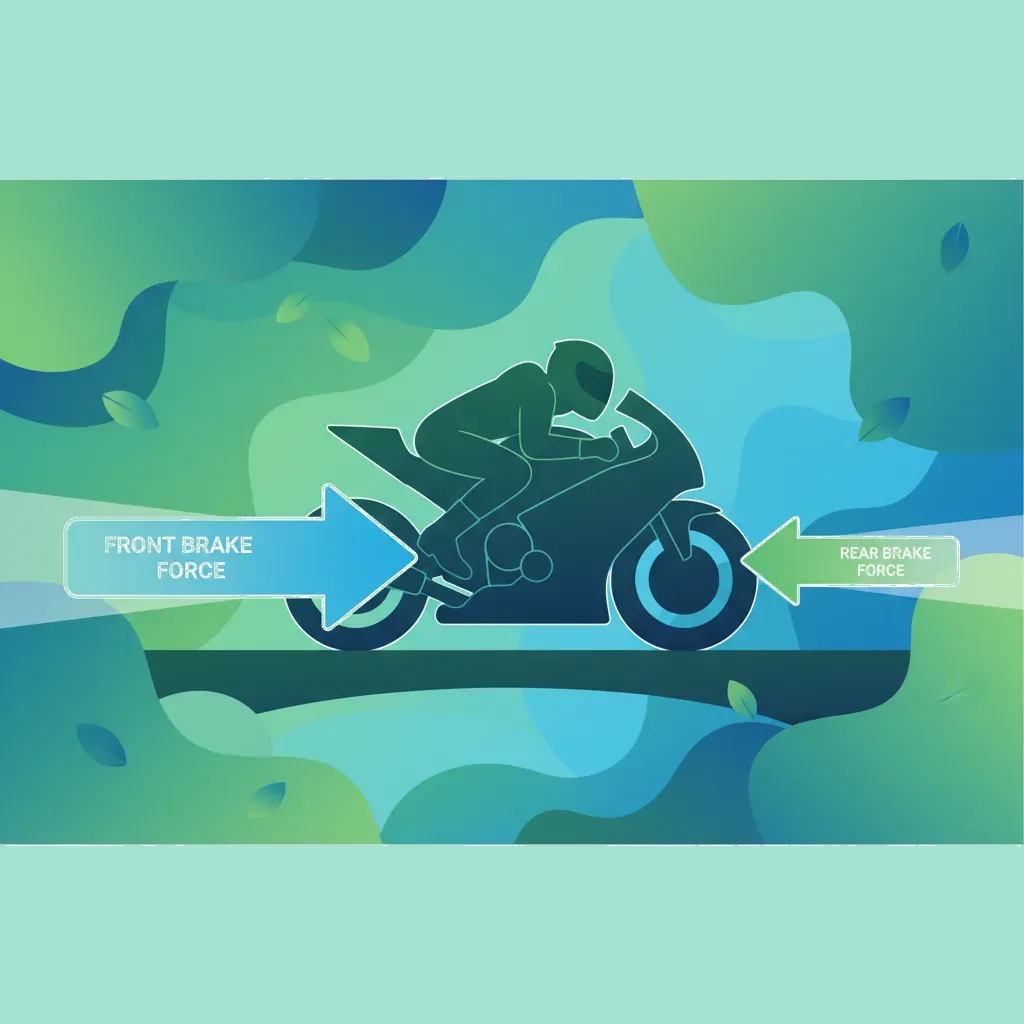
Lesson content overview
Understanding how to effectively use your motorcycle's front and rear brakes is fundamental for safe riding and is a critical component of the Spanish Motorcycle Theory Exam for A, A1, and A2 licences. Unlike cars, motorcycles experience significant dynamic weight transfer during braking, which profoundly impacts the effectiveness of each brake. This lesson delves into the physics and techniques behind optimal brake distribution, helping you achieve shorter stopping distances and maintain stability under various road conditions.
A motorcycle's ability to stop relies heavily on the available traction between its tires and the road surface. This traction is directly influenced by the load, or weight, pressing down on each tire. During braking, the motorcycle's weight distribution changes dramatically, a phenomenon known as dynamic weight transfer.
When you apply the brakes on a motorcycle, the inertia of the moving vehicle causes its mass to shift forward. This forward movement of the motorcycle's center of gravity (CoG) significantly increases the load on the front wheel while simultaneously decreasing the load on the rear wheel. This dynamic shift is the core reason why the front brake provides the majority of a motorcycle's stopping power.
For instance, under hard braking, the load on the front wheel can increase from a static 55-60% to as much as 70% or more of the motorcycle's total weight. Conversely, the rear wheel's load might drop significantly, sometimes to less than 30%. This increased load on the front tire enhances its grip, allowing it to generate much greater braking force before reaching its traction limit and locking up. The reduced load on the rear tire means it has less grip and can lock up much more easily with less braking force.
It is important to distinguish between static and dynamic weight distribution. Static weight distribution refers to how the motorcycle's weight is balanced when it is stationary, with no braking or acceleration occurring. Typically, a motorcycle has a slight front-end bias even at rest.
Dynamic weight transfer, however, is a real-time change in load distribution caused by the forces of acceleration, deceleration, road grade, and surface conditions. Riders must constantly be aware of this dynamic shift and adjust their braking inputs accordingly. Neglecting this crucial principle can lead to premature wheel lock-up, loss of control, and increased stopping distances, posing a significant safety risk.
Effective braking is about applying the right amount of force to each wheel to maximize deceleration without exceeding the tires' traction limits. This requires understanding brake torque and how to achieve optimal brake bias.
Brake torque, often referred to as braking force, is the rotational force applied to a wheel by the brake system. It is essentially the product of the braking pressure exerted by the calipers and the effective radius of the brake rotor or drum. Higher brake torque translates to greater deceleration, provided the tire maintains grip.
Given the significant increase in front wheel load during braking, the front brake can generate substantially higher torque before the tire loses traction. Attempting to apply the same level of torque to the rear wheel under hard braking would almost certainly cause it to lock up, leading to a loss of stability. Modern hydraulic brake systems, sometimes enhanced with electronic assistance like Anti-Lock Braking Systems (ABS), are designed to convert rider input into precise brake torque.
Brake bias, or the distribution ratio, is the proportion of total braking force allocated to the front versus the rear brakes. This ratio is crucial for maximizing stopping efficiency and maintaining vehicle stability. While a motorcycle's brake system has a factory-set inherent bias, the rider's input determines the actual applied bias in any given situation.
On dry, high-traction surfaces, the optimal brake bias typically ranges from 60-70% front and 30-40% rear. This front-heavy bias accounts for the dynamic weight transfer and allows the front wheel to perform the majority of the braking work. However, this ratio is not fixed; it must be adjusted based on riding conditions. On wet or slippery surfaces, where overall traction is reduced, a rider should shift the bias slightly more towards the rear, perhaps to 55% front and 45% rear, to mitigate the risk of front wheel lock-up. Proper modulation of both brake levers is essential to achieve this dynamic balance.
Beyond simply stopping, maintaining control during braking is paramount. This involves understanding the limits of tire grip and how advanced systems like ABS contribute to safety.
The concept of the traction circle is a fundamental principle in vehicle dynamics, including motorcycles. It is a theoretical representation of the maximum combined longitudinal (braking or acceleration) and lateral (cornering) forces a tire can generate before losing grip. Any force applied to the tire, whether for braking, accelerating, or turning, uses up a portion of the available traction.
Imagine a circle: if you are accelerating hard, you are using the top part of the circle. If you are braking hard, you are using the bottom part. If you are cornering, you are using the sides. The critical insight for braking is that if you are already using a significant amount of the tire's grip for cornering, there is less available grip remaining for braking. Applying too much brake pressure while cornering, especially to the front wheel, can push the total force vector outside the traction circle, leading to a loss of grip and a potential fall. Therefore, it is generally safer to complete most of your braking before entering a turn, or to apply extremely gentle, progressive braking if necessary within a turn.
The Anti-Lock Braking System (ABS) is a crucial safety feature that significantly enhances braking performance, especially in challenging conditions. Its primary function is to prevent wheel lock-up during hard braking by electronically modulating hydraulic pressure to the brake calipers. When a wheel speed sensor detects that a wheel is about to lock, ABS momentarily releases and reapplies brake pressure many times per second, keeping the wheel rotating and allowing the rider to maintain steering control.
ABS is particularly valuable on variable or low-traction surfaces like wet roads, gravel, or uneven pavement. It allows riders to apply near-maximum braking force without fear of skidding, often resulting in shorter stopping distances and improved stability. In Spain, DGT regulations mandate that motorcycles over 125cc used for professional instruction be equipped with ABS, highlighting its importance for rider safety and training. While ABS is a powerful tool, it does not defy the laws of physics. Weight transfer still occurs, and proper brake modulation and understanding of brake bias remain important skills for a competent rider, even with ABS assistance.
In Spain, specific regulations and best practices govern motorcycle braking, particularly for those preparing for their A, A1, or A2 licence exams. These rules are designed to ensure road safety and effective vehicle control.
The Reglamento General de Circulación (RGC) in Spain emphasizes the importance of safe driving practices, which implicitly includes effective braking. For motorcycle riders, it is considered mandatory and a core skill for the A, A1, and A2 licences to be capable of applying both the front and rear brakes simultaneously and proportionately. This technique, often referred to as "combined braking," is critical for achieving the shortest possible stopping distances and maintaining the motorcycle's stability during deceleration.
Relying solely on one brake is not only less effective but can also be dangerous. For instance, using only the front brake on a wet surface can easily lead to front wheel lock-up and a loss of steering, while relying exclusively on the rear brake can cause the rear wheel to skid or "fishtail," compromising stability. Therefore, riders must train to use both controls in a coordinated and progressive manner.
As mentioned, ABS technology plays a vital role in motorcycle safety. In Spain, new motorcycles over 125cc used for professional instruction or for certain licence categories are often mandated to be equipped with ABS. While not every motorcycle on the road is legally required to have ABS, it is highly recommended for all riders due to its significant safety benefits.
Riders operating ABS-equipped motorcycles must understand that the system will automatically modulate brake pressure to prevent wheel lock. This might manifest as a pulsing sensation in the brake lever or pedal. It's crucial not to release the brake pressure when this sensation occurs, as ABS is actively working to keep you safe. Instead, maintain firm pressure, allowing the system to do its job.
Brake fade is a reduction in braking effectiveness caused by the overheating of brake components, such as pads and discs, during prolonged or intense braking. This is particularly relevant when riding on long downhill sections, such as in mountainous areas. Overheated brakes can lose their friction properties, leading to a significant increase in stopping distance or, in severe cases, complete brake failure.
To prevent brake fade, riders should employ progressive braking techniques. Instead of continuously holding the brakes, which builds up heat, it is better to apply the brakes firmly for a short period, release them to allow for cooling, and then reapply as needed. Crucially, riders should also utilize engine braking, downshifting through the gears to allow the engine's resistance to help slow the motorcycle. This reduces the sole reliance on the friction brakes, distributing the braking workload and helping to maintain optimal brake temperature.
Optimal brake distribution is not a one-size-fits-all approach; it must be adapted to a variety of conditional factors. Mastering these variations is key to becoming a proficient and safe motorcyclist.
The most significant factor influencing brake bias adjustment is the road surface condition.
Different riding environments also demand varied braking strategies.
The overall weight of the motorcycle and its distribution change significantly with a passenger or luggage, influencing optimal braking technique.
When encountering vulnerable road users such as pedestrians or cyclists, smooth and controlled braking is paramount. Abrupt, harsh braking can be unsettling and unpredictable, potentially causing the motorcycle to become unstable or, in extreme cases, contributing to a collision.
Prioritizing progressive and slightly more balanced front-to-rear braking (a slightly higher rear bias for smoother deceleration, if conditions allow) can help prevent abrupt front-end dives and maintain a more stable, predictable trajectory. This communicates greater control to other road users and reduces the risk of an unexpected maneuver that could lead to an incident.
Understanding the physics and rules is one thing; applying them correctly in real-world scenarios is another. Avoiding common braking mistakes is vital for safety.
A frequent misconception among new riders is that the front brake is the only brake that matters, or that the rear brake is exclusively for low-speed maneuvers. While the front brake provides the majority of stopping power, relying solely on it, especially in adverse conditions, is dangerous.
Another mistake is applying too much rear brake during hard deceleration. This often stems from a fear of using the front brake or a misunderstanding of weight transfer.
Riding with poorly maintained brakes compromises safety and effectiveness. Uneven brake wear, worn pads, contaminated fluid, or improperly adjusted levers can all lead to unpredictable and dangerous braking performance.
Effective braking is a skill that takes practice and a deep understanding of the underlying principles. By integrating these insights into your riding, you can significantly enhance your safety and control on the road.
Progressive braking is the technique of gradually increasing brake pressure, rather than applying it abruptly. This smooth, controlled increase allows the motorcycle's suspension to compress, transferring weight to the front wheel in a predictable manner, and giving the tires time to build maximum grip. Abrupt braking, especially with the front brake, can overload the front tire suddenly, leading to immediate lock-up before the weight transfer has fully occurred. Smooth, progressive inputs allow both the rider and the motorcycle to adapt to the changing forces.
The friction coefficient between your tires and the road surface is not constant; it changes dramatically with surface type, weather, and temperature. A dry, clean asphalt road offers high friction, while wet asphalt, gravel, or icy patches offer significantly less. Your braking strategy, particularly your brake bias and the intensity of your inputs, must constantly adapt to these varying friction levels. Developing a sensitive feel for the brakes and the motorcycle's response is a hallmark of an experienced rider.
Understanding and practicing proper brake distribution and modulation builds immense rider confidence. When you know how your motorcycle will react under various braking scenarios, you can anticipate situations, react more calmly, and brake more effectively. This confidence reduces panic braking and allows for smoother, more controlled stops, which is crucial for overall road safety and passing your Spanish Motorcycle Theory Exam for A, A1, A2 licences. Remember, safe braking is not just about stopping quickly; it's about stopping quickly and controllably.
This lesson explains why the front brake provides the majority of stopping power on motorcycles: during deceleration, dynamic weight transfer increases load on the front wheel to 70% or more while decreasing rear grip. Optimal brake bias on dry surfaces is roughly 60-70% front, shifting toward the rear on wet or slippery roads to prevent lock-up. Both brakes must be applied simultaneously and progressively, with the rear contributing stability and reduced stopping distance. The traction circle principle shows that braking hard while cornering exceeds tire grip limits. While ABS prevents lock-up, understanding proper brake bias, modulation, and condition-specific adjustments remains essential for safe riding and passing the Spanish DGT motorcycle theory exam for A, A1, and A2 licences.
A short set of high-value points that capture the most important learning from this lesson.
During braking, dynamic weight transfer shifts load to the front wheel (up to 70%+), making the front brake the primary stopping force while rear grip decreases significantly.
Optimal brake bias on dry roads is approximately 60-70% front and 30-40% rear, but this ratio must shift toward the rear on wet or low-traction surfaces.
Using both brakes simultaneously and progressively is mandatory for safe stopping; neither brake should be used exclusively.
The traction circle concept means you cannot brake hard while cornering—finish braking before entering a turn, as cornering already uses available tire grip.
ABS prevents wheel lock-up but does not replace understanding of proper brake bias and modulation; weight transfer physics still apply.
Explore all units and lessons included in this driving theory course.
Front wheel lock-up causes immediate loss of steering control and is especially dangerous on wet surfaces.
On slippery surfaces, reduce front brake force and shift bias to approximately 55-60% front to prevent premature lock-up.
Excessive rear brake during hard deceleration causes the rear wheel to lock and fishtail due to reduced rear load.
Progressive braking allows suspension to compress and weight to transfer before maximum brake force is applied.
Use engine braking on long mountain descents to prevent brake fade from overheated components.
Relying on front brake only, which drastically increases risk of front wheel lock-up and loss of steering, especially in wet conditions.
Applying excessive rear brake force, causing the rear wheel to lock and fishtail, leading to loss of stability and potential low-side crash.
Attempting to brake hard while already leaned into a corner, pushing combined forces outside the traction circle and causing loss of grip.
Using abrupt or harsh braking inputs instead of progressive modulation, which overloads tires before weight transfer completes.
Neglecting brake maintenance—worn pads, contaminated fluid, or improper lever adjustment can cause unpredictable lock-up or delayed response.
Lesson content overview
A short set of high-value points that capture the most important learning from this lesson.
During braking, dynamic weight transfer shifts load to the front wheel (up to 70%+), making the front brake the primary stopping force while rear grip decreases significantly.
Optimal brake bias on dry roads is approximately 60-70% front and 30-40% rear, but this ratio must shift toward the rear on wet or low-traction surfaces.
Using both brakes simultaneously and progressively is mandatory for safe stopping; neither brake should be used exclusively.
The traction circle concept means you cannot brake hard while cornering—finish braking before entering a turn, as cornering already uses available tire grip.
ABS prevents wheel lock-up but does not replace understanding of proper brake bias and modulation; weight transfer physics still apply.
Explore all units and lessons included in this driving theory course.
Front wheel lock-up causes immediate loss of steering control and is especially dangerous on wet surfaces.
On slippery surfaces, reduce front brake force and shift bias to approximately 55-60% front to prevent premature lock-up.
Excessive rear brake during hard deceleration causes the rear wheel to lock and fishtail due to reduced rear load.
Progressive braking allows suspension to compress and weight to transfer before maximum brake force is applied.
Use engine braking on long mountain descents to prevent brake fade from overheated components.
Relying on front brake only, which drastically increases risk of front wheel lock-up and loss of steering, especially in wet conditions.
Applying excessive rear brake force, causing the rear wheel to lock and fishtail, leading to loss of stability and potential low-side crash.
Attempting to brake hard while already leaned into a corner, pushing combined forces outside the traction circle and causing loss of grip.
Using abrupt or harsh braking inputs instead of progressive modulation, which overloads tires before weight transfer completes.
Neglecting brake maintenance—worn pads, contaminated fluid, or improper lever adjustment can cause unpredictable lock-up or delayed response.
Explore search topics learners often look for when studying Front vs. Rear Brake Distribution. These topics reflect common questions about road rules, driving situations, safety guidance, and lesson level theory preparation for learners in Spain.
Browse additional driving theory lessons that cover connected traffic rules, road signs, and common driving situations related to this topic. Improve your understanding of how different rules interact across everyday traffic scenarios.
Explore the physics of motorcycle braking, focusing on how weight transfer impacts front and rear brake effectiveness. Learn about dynamic load shifts and how they influence stopping power for your Spanish A, A1, A2 licence theory.
This lesson covers the principles of anti-lock braking systems (ABS), describing how wheel slip detection prevents wheel lock-up. It explains combined braking operation, where front and rear brakes are applied in a calibrated ratio to maintain stability. Learners also explore how ABS enhances safety on low-traction surfaces and review DGT braking regulations.

This lesson focuses on adapting braking techniques for wet and slippery roads. Topics include hydroplaning risk, reduced tire friction, and how ABS assists in preventing wheel lock-up. Learners are taught to employ progressive braking, reduce speed, and assess tire tread depth to maintain adequate grip.
This lesson explains the synchronized operation of the throttle, clutch, and gear selector, detailing how power delivery is modulated. It introduces the typical gear shifting pattern, explains the purpose of neutral, and discusses appropriate rpm ranges for upshifts and downshifts. Emphasis is placed on rider coordination for smooth acceleration and effective engine braking.

This lesson details the protocol for performing an emergency stop, emphasizing full-force application of both front and rear brakes while maintaining optimal rider posture. It covers the importance of visual fixation and the role of ABS in stabilizing the bike under panic conditions. Learners also study the calculation of stopping distances based on speed and road conditions.
This lesson explores static balance techniques essential when the motorcycle is stationary or moving at extremely low speeds. The content covers optimal foot placement, body posture, and centre of gravity control to maintain stability. Emphasis is placed on weight distribution between the bike and rider and practical balance drills.
This lesson focuses on the correct application of a moped's brakes for effective and stable deceleration. It explains the concept of balanced braking, using both front and rear brakes simultaneously for maximum stopping power without losing traction. Learners will understand how factors like speed, road surface, and weather dramatically affect total stopping distance, and will learn techniques for emergency braking.
This lesson details the technique of safely reducing speed while entering a corner, known as trail braking. It explains how the motorcycle’s lean angle affects front-wheel load and rear-wheel traction. The content aligns with DGT cornering safety standards to ensure riders execute controlled deceleration without compromising grip.
Understand how to adjust brake bias for different road surfaces and riding scenarios. Learn about controlling braking forces in urban, highway, and mountain riding for safe motorcycle operation in Spain.
This lesson focuses on adapting braking techniques for wet and slippery roads. Topics include hydroplaning risk, reduced tire friction, and how ABS assists in preventing wheel lock-up. Learners are taught to employ progressive braking, reduce speed, and assess tire tread depth to maintain adequate grip.
This lesson covers the principles of anti-lock braking systems (ABS), describing how wheel slip detection prevents wheel lock-up. It explains combined braking operation, where front and rear brakes are applied in a calibrated ratio to maintain stability. Learners also explore how ABS enhances safety on low-traction surfaces and review DGT braking regulations.
This lesson details the protocol for performing an emergency stop, emphasizing full-force application of both front and rear brakes while maintaining optimal rider posture. It covers the importance of visual fixation and the role of ABS in stabilizing the bike under panic conditions. Learners also study the calculation of stopping distances based on speed and road conditions.
This lesson details the technique of safely reducing speed while entering a corner, known as trail braking. It explains how the motorcycle’s lean angle affects front-wheel load and rear-wheel traction. The content aligns with DGT cornering safety standards to ensure riders execute controlled deceleration without compromising grip.
This lesson focuses on the correct application of a moped's brakes for effective and stable deceleration. It explains the concept of balanced braking, using both front and rear brakes simultaneously for maximum stopping power without losing traction. Learners will understand how factors like speed, road surface, and weather dramatically affect total stopping distance, and will learn techniques for emergency braking.

This lesson presents advanced cornering scenarios common on Spanish roads, such as mountain hairpins and high-speed autovía exits. It outlines specific techniques for descent control, ascent maneuvers, and safely merging into traffic after cornering. Interaction with cyclists and emergency cornering strategies are also covered in accordance with DGT regulations.

This lesson outlines procedures for handling emergency situations and accidents. It covers emergency braking techniques, hazard avoidance strategies, and the DGT emergency protocol for accident reporting. Emphasis is placed on rider protective actions, post-crash first aid, roadside safety, and legal obligations after an incident.

This lesson teaches riders how to react effectively in a sudden, critical situation. It explains the technique for applying maximum braking force without locking the wheels, ensuring the shortest possible stopping distance while maintaining stability. The content also covers how to perform a swift and controlled swerve to avoid an obstacle when stopping is not possible, emphasizing the importance of looking where you want to go.
This lesson focuses on the coordination of acceleration and deceleration to maintain vehicle stability. It explains how to modulate the accelerator pedal for smooth acceleration and how to apply the brake pedal for controlled deceleration. The content covers the role of the ABS system, the calculation of stopping distances, and the importance of maintaining stability during speed changes.

This lesson focuses on mastering acceleration and deceleration to integrate smoothly with traffic. It teaches how to apply the throttle gradually for steady speed control and how to use front and rear brakes in a balanced manner to slow down without destabilizing the moped. Learners will understand how to adjust their speed in response to changing traffic conditions, ensuring safe following distances and predictable movements for other road users.
Find clear answers to common questions learners have about Front vs. Rear Brake Distribution. Learn how the lesson is structured, which driving theory objectives it supports, and how it fits into the overall learning path of units and curriculum progression in Spain. These explanations help you understand key concepts, lesson flow, and exam focused study goals.
During braking, kinetic energy causes weight to transfer to the front wheel (known as 'weight shift'). This increases the load and therefore the grip on the front tyre, allowing it to generate significantly more stopping power. Relying predominantly on the front brake, while modulating it correctly, is crucial for efficient deceleration.
Yes, for maximum stopping power and stability under most conditions, it's recommended to apply both brakes simultaneously. However, the distribution of force should prioritize the front brake, with the rear brake providing additional stability and a percentage of the overall braking effort. The exact ratio will vary with speed, road surface, and motorcycle type for A, A1, A2 licences.
On wet or slippery surfaces (like those often encountered after rain in Spain), tyre grip is significantly reduced. It becomes even more critical to apply braking forces smoothly and progressively, using both brakes but with even greater care. The front brake remains dominant, but the risk of locking a wheel is higher, requiring finer modulation to prevent skids.
Applying too much front brake or locking the front wheel can quickly lead to a loss of control, especially on motorcycles. A locked front wheel can cause the bike to 'tuck under' or 'wash out,' often resulting in a fall. Proper modulation and progressive application are essential to stay upright and avoid this dangerous scenario, as emphasized in DGT safety guidelines for A, A1, A2 riders.
Anti-lock Braking Systems (ABS) prevent wheel lock-up by modulating brake pressure automatically. While ABS can provide a safety net, it doesn't eliminate the need to understand weight transfer and optimal brake distribution. Riders with ABS can generally apply more forceful braking without fear of locking, but a smooth, progressive technique still yields the best and safest results for A, A1, A2 motorcycles.
Use our powerful search functionality to pinpoint specific Spanish DGT driving theory practice sets. Filter by road sign categories, traffic law topics, or question difficulty to build custom study sessions and reinforce your knowledge precisely where it matters for your official exam.