
The P-8b Directional Arrow sign is an important traffic sign that dictates your mandatory movement. Whether it's a left or right arrow, you are required to follow that direction. If the arrow points left and is in the leftmost lane, you may also perform a U-turn, provided no other signs prohibit it. These signs are crucial for managing traffic flow and ensuring safety by guiding vehicles into correct lanes for turns.
Accurate road sign meaning for the P-8b Directional Arrow is crucial for navigating junctions safely and avoiding infractions, especially when considering mandatory turns or permitted U-turns in Poland. Mastering this traffic sign explanation is vital for the Polish driving theory test, ensuring you correctly interpret lane usage and directional requirements.
The P-8b arrow indicates a mandatory turn. A key rule for the left turn arrow (P-8b left): if it is placed in the leftmost lane of the road, it also allows the driver to perform a U-turn (zawracanie), provided there is no B-23 sign or an S-3 signal that excludes it. These arrows help organize traffic into dedicated turning lanes, reducing congestion in through-traffic lanes.
Mandates a turn in the direction indicated (left or right) and, if in the leftmost lane, also permits a U-turn.
Get clear, practical answers to the most common questions about the P-8b - Directional Arrow: Turn road sign. Learn how the sign works, what rules it represents, and how it affects real driving situations. This FAQ strengthens your understanding and supports accurate decision making for the Polish driving theory exam in Poland.
The P-8b sign with a turn arrow, such as a left or right arrow, mandates that you must turn in the indicated direction. Driving straight ahead from a lane marked solely with a turn arrow is prohibited. Always signal your intentions before making the turn.
If the P-8b sign shows a left-turn arrow and it is positioned in the leftmost lane, you are permitted to make a U-turn (zawracanie). This is allowed as long as there isn't a prohibition sign (B-23) or a traffic signal that forbids it. You cannot perform a U-turn from a right-turn lane or a lane marked for turns in both directions.
No, if a lane is marked only with a P-8b directional arrow indicating a turn (left or right), you must follow that turn. Going straight ahead from such a lane is not allowed and would be a traffic violation.
A common trap is assuming you can go straight if you're in a lane with a turn arrow, especially if there's traffic going straight. Remember, the arrow dictates your mandatory action. Another potential error is forgetting the specific condition for U-turns from the leftmost lane with a left-turn arrow – it's only allowed if not otherwise prohibited.
If the P-8b sign shows both a turn arrow and a straight arrow in the same lane, it means that both maneuvers are permitted from that specific lane. You can choose to either turn in the direction indicated or drive straight ahead, as long as you signal appropriately and it's safe to do so.
A clear reference image of the P-8b - Directional Arrow: Turn road sign used in Poland.
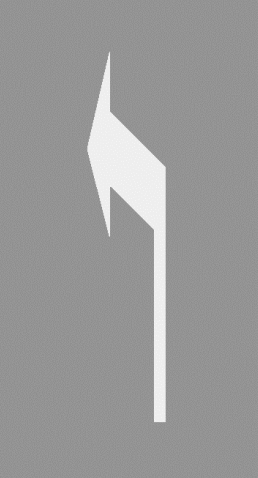
The P-8b - Directional Arrow: Turn road sign may also be known by these alternative names or terms.
The P-8b - Directional Arrow: Turn road sign is part of the Road Markings (P) category, which groups together signs with similar rules and functions.
Understanding how similar Polish road signs like directional arrows are distinguished is key to avoiding errors. Reviewing these comparisons sharpens your sign recognition skills, crucial for successful theory test revision and safe driving.

The P-1 Single Dashed Line: Your guide to safe lane changes and overtaking in Poland.
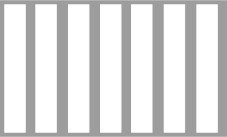
Understand the P-10 'Pedestrian Crossing' Road Sign and Your Obligations

Understand the P-11 Bicycle Crossing Road Sign and Cyclist Priority
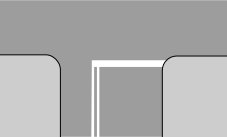
The P-12 Absolute Stop Line: You MUST stop here, no exceptions!
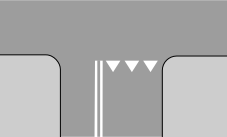
The P-13 'Conditional Stop Line' – Know When to Stop and Yield!
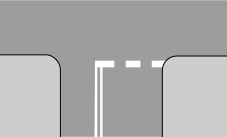
Know When to Stop: The P-14 Conditional Stop Line Explained
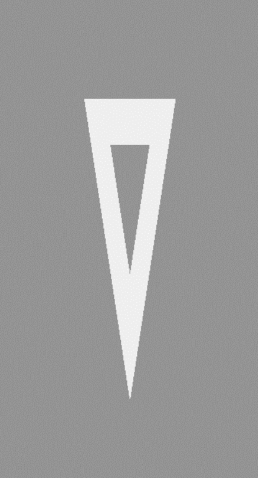
Prepare to yield: Understand the P-15 floor yield triangle road marking.

The P-16 'STOP' road marking means you must stop – even without a vertical sign!
Deepen your understanding of specific road signs by reviewing official Polish traffic rules and associated real-world driving scenarios. These expert-led resources help you bridge the gap between visual recognition and practical exam application.
This article provides a detailed explanation of how Polish traffic signs A-7 ('Ustąp Pierwszeństwa' - Yield), B-20 ('STOP'), and D-1 ('Droga z Pierwszeństwem' - Priority Road) dictate right-of-way at intersections. Understanding the nuances of these signs is a fundamental aspect of the Polish driving theory exam, and mastering them will significantly improve your preparedness for real-world driving scenarios.
Learn the precise regulations for towing trailers in Poland with a Category B driving license. This guide breaks down the differences between the standard B license, the enhanced Code 96, and the full B+E category, focusing on weight limits and when each is necessary. This knowledge is vital for safe driving and for correctly answering exam questions on vehicle combinations.
Mastering Lane Discipline and Priority at Polish Intersections with Arrow Signals
Master Polish Road Markings to Avoid Fines and Drive Confidently
The F-10 sign is a large board placed before an intersection, showing arrows for every available lane. It is vital for lane discipline. A very important rule in Poland: if the leftmost lane arrow allows a left turn, it also permits a U-turn (zawracanie), UNLESS there is a 'No U-turn' (B-23) sign or a directional traffic signal (S-3) that doesn't show a U-turn arrow. This sign helps drivers position themselves correctly well in advance of the junction.
The P-8a arrow is painted on the lane surface to regulate movement at an intersection. If you are in a lane with this arrow, you are legally forbidden from turning left or right. It is used to streamline traffic and prevent collisions that occur when drivers try to turn from a middle lane. Often, these arrows are combined (e.g., straight and right), meaning both directions are allowed from that specific lane.
After reviewing the full list of Polish road signs, explore specific sign categories for in-depth understanding. Challenge your knowledge with practice questions focused on sign recognition and interpretation to solidify your preparation for the driving theory exam.
Browse All Polish Road Signs