
The P-9 Guiding Arrow sign is painted directly onto the road surface and indicates that your current lane is about to end, usually due to road narrowing or a lane terminating. You must merge into the adjacent lane to continue. Look for these arrows as an early warning to check your mirrors, signal your intentions, and prepare for a smooth merge into the traffic flow. In heavy traffic, the zipper merge approach is recommended near the actual merge point.
This P-9 Guiding Arrow sign indicates your current lane is ending, requiring a safe merge into adjacent traffic. Master its meaning for your theory test revision and ensure safe driving on Polish roads by understanding this crucial traffic sign explanation.
The P-9 arrow is a slanted arrow painted on the road surface. It is a critical instruction for merging traffic. It warns that the lane is terminating (e.g., a climbing lane ending or a road narrowing) and that the driver must transition to the next lane. In slow-moving traffic, the 'zipper merge' rule applies at the point where the lane actually ends following these arrows.
Commands drivers to move to the adjacent lane indicated by the arrow because their current lane is ending.
Get clear, practical answers to the most common questions about the P-9 - Guiding Arrow road sign. Learn how the sign works, what rules it represents, and how it affects real driving situations. This FAQ strengthens your understanding and supports accurate decision making for the Polish driving theory exam in Poland.
The P-9 Guiding Arrow is a directional marking on the road surface that instructs you to move into the adjacent lane because your current lane is ending. It's a command, not just a suggestion, to change lanes safely before your lane disappears.
As soon as you see the P-9 arrows, start looking for a safe gap in the lane you intend to merge into. Check your mirrors, signal your intention early, and move smoothly into the continuing lane before your lane physically ends. Avoid sudden or abrupt movements.
The P-9 sign has variations: P-9a points to the left, and P-9b points to the right. Both serve the same purpose: to guide you to merge into the continuing lane by indicating which direction to move.
A common mistake is ignoring the arrows and driving until the lane physically ends, forcing an abrupt merge. Another is merging without checking mirrors or signaling. The theory exam may test your understanding of when to start preparing to merge, not just at the very last second.
Yes, the zipper merge is relevant when traffic is heavy. At the point where the lane actually ends, if traffic is slow, drivers in both the ending lane and the continuing lane should take turns merging, like teeth on a zipper. However, this applies near the merge point itself; the P-9 arrows are the earlier warning to prepare.
It is prohibited to ignore the arrow and continue until the lane ends abruptly, merge without signaling or checking mirrors, or try to overtake other vehicles in the adjacent lane just before your lane runs out. You must prepare to merge.
A clear reference image of the P-9 - Guiding Arrow road sign used in Poland.

The P-9 - Guiding Arrow road sign may also be known by these alternative names or terms.
The P-9 - Guiding Arrow road sign is part of the Road Markings (P) category, which groups together signs with similar rules and functions.
Reviewing related road signs like the Guiding Arrow alongside similar directional or warning signs sharpens your sign recognition skills. This comparative study is essential for effective theory test revision and avoiding confusion on Polish roads.

The P-1 Single Dashed Line: Your guide to safe lane changes and overtaking in Poland.
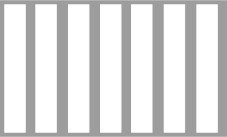
Understand the P-10 'Pedestrian Crossing' Road Sign and Your Obligations

Understand the P-11 Bicycle Crossing Road Sign and Cyclist Priority
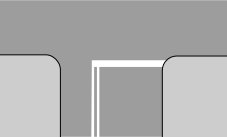
The P-12 Absolute Stop Line: You MUST stop here, no exceptions!
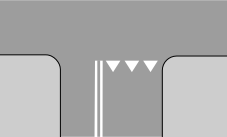
The P-13 'Conditional Stop Line' – Know When to Stop and Yield!
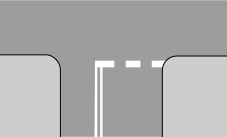
Know When to Stop: The P-14 Conditional Stop Line Explained

Prepare to yield: Understand the P-15 floor yield triangle road marking.

The P-16 'STOP' road marking means you must stop – even without a vertical sign!
Deepen your understanding of specific road signs by reviewing official Polish traffic rules and associated real-world driving scenarios. These expert-led resources help you bridge the gap between visual recognition and practical exam application.
Mastering Lane Discipline and Priority at Polish Intersections with Arrow Signals
Master Polish Crossing Markings for a Safer Drive and Exam Success.
Navigate Polish roads with confidence by understanding critical cyclist priority rules at junctions and crossings. This guide explains your legal obligations as a driver to yield to cyclists, a common area of confusion and potential exam pitfalls. Learn the nuances of right-of-way at intersections and designated cyclist passages to drive safely and pass your theory test.
Every vehicle registered in Poland must have valid third-party liability insurance (OC) at all times, regardless of whether the car is driven or parked in a private garage. This guide clarifies the automated enforcement process managed by the Insurance Guarantee Fund and the substantial financial risks associated with even a single-day lapse in coverage. By mastering these administrative requirements, you will be prepared to handle vehicle ownership duties confidently and avoid avoidable legal penalties.
The R-4c sign is the cycling equivalent of the E-2a. It is a large rectangular board placed at junctions. It lists the names of towns and landmarks and uses arrows to show which branch of the intersection to take. It is designed to be readable from a distance by cyclists, helping them navigate complex rural or forest crossroads where several trails might meet.
The D-10 sign indicates the end of the motorway section. It features the motorway symbol crossed by a red diagonal line. This is a critical point for safety, as drivers who have been traveling at 140 km/h for a long time may suffer from 'speed adaptation'—where 90 km/h feels much slower than it actually is. The sign warns you that the road may now have at-grade intersections, oncoming traffic without a median, and significantly lower speed limits.
After reviewing the full list of Polish road signs, explore specific sign categories for in-depth understanding. Challenge your knowledge with practice questions focused on sign recognition and interpretation to solidify your preparation for the driving theory exam.
Browse All Polish Road Signs