
Learner drivers must be fully familiar with the strict Spanish regulations surrounding the transport of minors to ensure safety and compliance with DGT standards. This article explains the mandatory use of child seats, the importance of correct ISOFIX installation, and the legal consequences of non-compliance, providing the essential knowledge required for your theory exam.
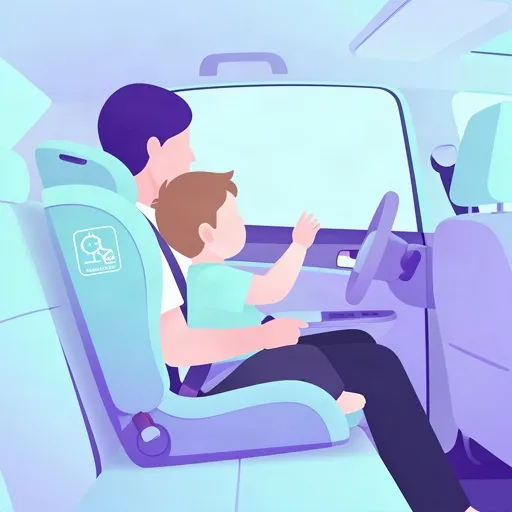
Article content overview
Ensuring the safety of minors during car travel is not only a moral imperative for every driver but a strict legal obligation under Spanish traffic law. The Dirección General de Tráfico (DGT) mandates that all children must be secured using appropriate systems tailored to their physical characteristics. Understanding these regulations is critical for your driving theory exam, as examiners frequently include questions regarding seat positioning, weight and height thresholds, and the consequences of non-compliance.
In Spain, the use of a Child Restraint System (SRI) is mandatory for any minor who is 135 centimeters tall or less. While the law sets this height as the minimum threshold for moving to a standard seat belt, the DGT and safety experts strongly recommend continuing the use of a booster seat or elevated restraint until the child reaches a height of 150 centimeters. Failure to comply with these regulations is considered a serious traffic offense, resulting in a fine of 200 euros and the loss of 4 points from your driving license.
Any device designed to securely hold a child in a vehicle, minimizing the risk of injury during a collision or sudden stop by distributing deceleration forces across the body.
It is important to remember that the age of the child is secondary to their physical measurements. The regulations focus on height and weight to ensure that the seat belt—which is designed for the dimensions of an average adult—does not cause injury by crossing sensitive areas like the neck or abdomen in the event of an impact.
When purchasing a child restraint system, you must ensure that it carries an official homologation label. As of September 2024, only systems homologated under the ECE R129 (i-Size) regulation are permitted for new sales, imports, and commercialization in the European market. While older systems meeting the ECE R44 standard remain legal for use if you already possess them, they are effectively obsolete in terms of retail and professional recommendations.
Always avoid purchasing child seats from non-European online portals. These products often fail to meet the rigorous safety standards required in Spain and pose a significant risk to the minor in the event of an accident.
Proper installation is equally important to the quality of the seat itself. Systems equipped with ISOFIX anchors are highly recommended as they significantly reduce the risk of incorrect installation. When installing a seat, always follow the manufacturer's manual explicitly, ensuring that top tethers or support legs are tensioned correctly to prevent the device from rebounding during a collision.
The safest position for any SRI is in the rear seats of the vehicle, particularly the central rear seat, which provides the best protection against side-impact collisions. Children should travel in a rear-facing position for as long as possible, as this orientation provides superior protection for the head, neck, and spine.
If a child must travel in the front seat due to limited vehicle capacity, you must be hyper-vigilant about airbag status. Never place a rear-facing seat in a front position equipped with an active airbag, as the deployment force can cause fatal injuries to the infant.
A recurring trap in the DGT theory exam involves questions about the placement of children in vehicles. Remember that a medical certificate does not exempt a driver from the obligation to use an SRI. Furthermore, even at low speeds, the deceleration forces in a collision can be lethal for an improperly restrained child. Always ensure that the harness is adjusted snugly; if you can pinch the webbing of the harness between your fingers, it is too loose to be effective.
Article content overview
Explore related topics, search based questions, and concepts that learners often look up when studying Child Restraint Systems (SRI) Spain. These themes reflect real search intent and help you understand how this topic connects to wider driving theory knowledge in Spain.
Find clear and practical answers to common questions learners often have about Child Restraint Systems (SRI) Spain. This section helps explain difficult points, remove confusion, and reinforce the key driving theory concepts that matter for learners in Spain.
In Spain, all children with a height of 135 cm or less must use a homologated child restraint system (SRI) adapted to their weight and size.
Children may only sit in the front seat if they use an approved SRI and either the vehicle has no rear seats, all rear seats are already occupied by other children in SRIs, or it is impossible to install an SRI in the rear seats. If an airbag is present, rear-facing seats require the airbag to be deactivated.
Failure to use an approved child restraint system, or using it incorrectly, is a serious traffic infraction in Spain that results in a €200 fine and the loss of 4 points from the driving licence.
The ECE R129 homologation, also known as i-Size, is the current European standard for child seats. It uses the child's height as the primary criterion for suitability and ensures the seat has passed modern safety tests, including side-impact protection.
Now that you have found specific articles, continue to deepen your understanding by exploring related DGT regulations or other driving theory topics. Strengthen your knowledge of road signs, traffic scenarios, and essential Spanish driving procedures to prepare for your official driving license exam.