
Understanding how to effectively control a severe hemorrhage is a critical component of the Spanish driving theory curriculum. This guide explains the step-by-step methods required by the DGT to stop life-threatening bleeding and highlights the vital legal requirements for handling a tourniquet during an emergency. Following this advice ensures you are ready to respond correctly in a roadside accident scenario and familiar with key safety exam topics.
Article content overview
In the context of the Spanish driving theory curriculum, understanding how to manage traffic accident injuries is not just a safety requirement—it is a mandatory component of the DGT examination. When a road accident occurs, one of the most critical, time-sensitive medical emergencies a driver may face is a severe external hemorrhage. Proper intervention can mean the difference between life and death before emergency medical services arrive on the scene.
The DGT emphasizes a specific hierarchy of intervention when dealing with bleeding victims. You must follow these steps systematically, prioritizing the least invasive but most effective methods first.
Never attempt to remove an object that has impaled a victim, as it may be acting as a plug for the damaged blood vessels. Removing it could trigger a massive, uncontrollable hemorrhage.
When direct pressure on the wound is insufficient, you may need to perform arterial compression. This technique involves pressing the main artery that supplies blood to the bleeding area against the underlying bone. For arm injuries, this involves the humeral artery, while for leg injuries, you target the femoral artery.
If these measures fail, and only in extreme, life-threatening circumstances involving an extremity, the use of a tourniquet is permitted. In the Spanish theory exam, it is vital to remember that a tourniquet is a drastic, final-resort measure.
When applying a tourniquet, it must be placed above the site of the wound—never below. Once applied, it must only be removed by qualified medical personnel at a hospital facility.
Spanish road safety regulations, as detailed in the DGT exam syllabus, require specific documentation when a tourniquet is used. You must note the exact time of application on a piece of paper or directly on the victim's forehead, such as "T 14:30." This information is vital for doctors to assess the risk of tissue damage. Furthermore, the tourniquet must remain visible to emergency responders; never cover it with clothing or bandages.
| Method | Best Used For | Key Requirement |
|---|---|---|
| Direct Pressure | All external wounds | Keep the cloth/dressing in place |
| Arterial Compression | Failed direct pressure | Requires knowledge of pressure points |
| Tourniquet | Life-threatening limb bleeding | Mark time of application clearly |
Internal hemorrhages are particularly treacherous because they are not immediately visible. On the theory exam, you may be asked to identify the signs of internal bleeding, which include a victim appearing pale, feeling cold to the touch, and exhibiting a rapid pulse.
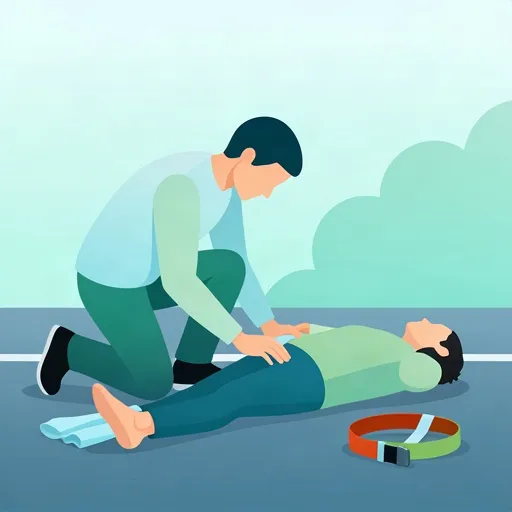
In such cases, you must keep the victim in an "antishock" position, with their head lower than their body and their legs elevated, provided there are no spinal injuries. If the victim becomes unconscious or begins to vomit, always place them in the recovery (defense) position, taking great care to keep their head and neck aligned to avoid worsening potential spinal or vertebral trauma.
A critical medical condition where blood loss occurs inside the body. Signs include cold, pale skin, thirst, and potential loss of consciousness. The victim must be kept warm and in the anti-shock position.
This article teaches the DGT-required hierarchy for controlling severe external bleeding: start with direct pressure using clean dressings, add layers if blood soaks through, then progress to arterial compression at the humeral or femoral points if needed, and finally apply a tourniquet only as a last resort for life-threatening limb bleeding. Critical exam points include never removing impaled objects, recording the tourniquet application time, keeping it visible, and ensuring only hospital personnel remove it. For internal bleeding, recognize signs like cold pale skin and rapid pulse, and position the victim in the anti-shock position while monitoring for loss of consciousness.
A short set of high-value points that capture the most important ideas from this article.
Always attempt direct pressure first using a clean cloth or bandage before considering more invasive measures
If a dressing soaks through, add more layers on top rather than removing the original
Never remove an impaled object as it may be acting as a plug against further blood loss
A tourniquet is a last-resort measure only for life-threatening limb bleeding and must never be removed by anyone except medical personnel at a hospital
When a tourniquet is applied, you must record the exact time of application and keep it visible to emergency responders
For arm bleeding, compress the humeral artery; for leg bleeding, compress the femoral artery against the underlying bone
The tourniquet must always be placed above the wound site, never below
Internal bleeding signs include pale, cold skin, rapid pulse, and potential loss of consciousness
Place internal bleeding victims in the anti-shock position (head lower than body, legs elevated) unless spinal injury is suspected
If a victim becomes unconscious or vomits, place them in the recovery position while maintaining head and neck alignment
Removing a soaked dressing and replacing it, which disrupts clotting and worsens bleeding
Attempting to extract an impaled object, causing massive hemorrhage from the plug effect
Applying a tourniquet below the wound instead of above it
Covering a tourniquet with clothing or bandages, making it invisible to emergency responders
Placing a victim in the anti-shock position when spinal injury cannot be ruled out
Article content overview
A short set of high-value points that capture the most important ideas from this article.
Always attempt direct pressure first using a clean cloth or bandage before considering more invasive measures
If a dressing soaks through, add more layers on top rather than removing the original
Never remove an impaled object as it may be acting as a plug against further blood loss
A tourniquet is a last-resort measure only for life-threatening limb bleeding and must never be removed by anyone except medical personnel at a hospital
When a tourniquet is applied, you must record the exact time of application and keep it visible to emergency responders
For arm bleeding, compress the humeral artery; for leg bleeding, compress the femoral artery against the underlying bone
The tourniquet must always be placed above the wound site, never below
Internal bleeding signs include pale, cold skin, rapid pulse, and potential loss of consciousness
Place internal bleeding victims in the anti-shock position (head lower than body, legs elevated) unless spinal injury is suspected
If a victim becomes unconscious or vomits, place them in the recovery position while maintaining head and neck alignment
Removing a soaked dressing and replacing it, which disrupts clotting and worsens bleeding
Attempting to extract an impaled object, causing massive hemorrhage from the plug effect
Applying a tourniquet below the wound instead of above it
Covering a tourniquet with clothing or bandages, making it invisible to emergency responders
Placing a victim in the anti-shock position when spinal injury cannot be ruled out
Explore related topics, search based questions, and concepts that learners often look up when studying First Aid and Bleeding Control. These themes reflect real search intent and help you understand how this topic connects to wider driving theory knowledge in Spain.
Find clear and practical answers to common questions learners often have about First Aid and Bleeding Control. This section helps explain difficult points, remove confusion, and reinforce the key driving theory concepts that matter for learners in Spain.
The first and most effective step is to apply direct pressure on the wound using a clean cloth, bandage, or sterile gauze. Do not remove the initial dressing if it becomes soaked; simply add more layers on top.
Arterial pressure is used only when direct pressure fails to stop the bleeding. You should apply pressure to the main artery (humeral for arms, femoral for legs) supplying the injury site to block blood flow.
A tourniquet is a last resort, used only for extreme extremity injuries when other methods fail. It must be placed above the wound, tightened until bleeding stops, and the time of application must be written on the victim's forehead. Only medical professionals should remove it.
Look for physical signs such as pale, cold, or clammy skin, a rapid pulse, and intense thirst. Keep the victim lying down in an antishock position with their head lower than their body and legs elevated until professional help arrives.
Now that you have found specific articles, continue to deepen your understanding by exploring related DGT regulations or other driving theory topics. Strengthen your knowledge of road signs, traffic scenarios, and essential Spanish driving procedures to prepare for your official driving license exam.