
Understanding the PAS protocol is a fundamental requirement for every driver under Spanish traffic law. By learning the correct sequence of Proteger, Avisar, and Socorrer, you will be prepared to secure the scene, contact emergency services, and provide safe assistance while avoiding common pitfalls that could endanger yourself or others.
Article content overview
When you are driving in Spain, encountering a road accident is a situation that requires calm, decisive action. As a driver, you are legally and morally obligated to stop and provide assistance, provided that doing so does not create a greater hazard or interfere with professional emergency teams who have already arrived. To ensure safety and consistency, the Dirección General de Tráfico (DGT) mandates the use of the PAS protocol: Proteger (Protect), Avisar (Alert), and Socorrer (Help).
The PAS protocol is the gold standard for road safety in Spain. It is not just a recommendation; it is a fundamental pillar of the Spanish driving theory exam. Many students fail to realize that the order of these actions is strictly hierarchical. Failing to protect the scene before attempting to help a victim is a common exam trap and a dangerous real-world mistake, as it often leads to secondary accidents that can endanger the rescuer and other road users.
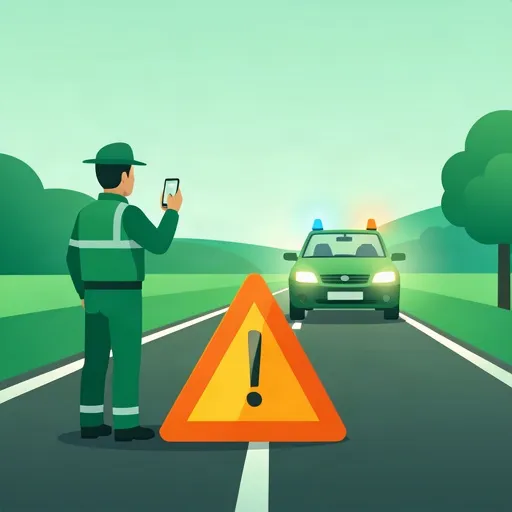
The first priority is always to protect yourself, the victims, and other drivers. Before leaving your vehicle, you must ensure it is safely parked, the engine is turned off, and the parking brake is engaged. In Spain, you are required to wear your reflective vest before exiting the vehicle. If you have a V-16 beacon or emergency triangles, use them correctly to warn approaching traffic of the incident.
Never attempt to move an injured person unless there is an immediate, life-threatening danger, such as a fire or the risk of the vehicle falling. Moving a victim incorrectly can cause irreversible spinal or internal injuries. If you must move someone, treat the body as a rigid block to prevent further trauma.
Once the area is secure, the next step is to alert professional help. In Spain, the universal emergency number is 112. This service is free, accessible from mobile phones even without coverage or credit, and is the primary point of contact for the police, Guardia Civil, firefighters, and medical ambulances.
When you contact 112, you must provide clear and concise information to ensure help arrives as quickly as possible. Essential data includes the exact location of the accident (road name, kilometer marker, or nearby landmarks), the number and condition of the victims, and any additional hazards like fire, trapped occupants, or dangerous goods transport. Do not end the call until the emergency operator explicitly tells you to do so.
The final stage, Socorrer, is where you provide care to the victims. The most important rule here is to act within your capabilities. You are not expected to be a doctor; your role is to maintain the victim in the best possible condition until professional help arrives. This includes talking to the conscious injured to keep them calm, checking for breathing, and stopping major bleeding if possible without moving them.
This is a serious legal offense under the Spanish Penal Code. It refers to the failure of a driver involved in or witnessing an accident to provide or request help for victims, and it carries significant criminal penalties.
In the theory exam, questions often test your judgment on what not to do. For example, you should never give water, food, or medication to an injured person, as this can complicate medical procedures later. Similarly, never remove the helmet from a motorcyclist who has been involved in an accident, as this can cause severe spinal damage. Always focus on maintaining the victim's temperature, as shock can cause a rapid drop in body heat even in warm weather.
The PAS protocol is a mandatory three-step emergency response procedure in Spain covering Proteger (securing the scene by parking safely, wearing a reflective vest, and using warning devices), Avisar (calling 112 with precise location and victim details), and Socorrer (providing basic first aid within your capabilities while waiting for professional help). The strict hierarchical order of these steps is essential for both the driving theory exam and real-world safety. Key legal consequences include omisión del deber de socorro for failing to assist, and specific prohibitions exist against moving victims unnecessarily, removing motorcyclist helmets, or providing food and water to the injured.
A short set of high-value points that capture the most important ideas from this article.
The PAS protocol must always be followed in strict order: Proteger (Protect), then Avisar (Alert), then Socorrer (Help)
In Spain, you must wear your reflective vest before exiting the vehicle and use V-16 beacons or triangles to warn approaching traffic
Call 112 to report the accident, providing exact location, number and condition of victims, and any additional hazards
Never move an injured person unless there is immediate life-threatening danger such as fire or risk of the vehicle falling
Failing to provide or request help to accident victims constitutes a criminal offense called omisión del deber de socorro under Spanish law
The 112 emergency number in Spain works without coverage or credit and connects to police, Guardia Civil, firefighters, and ambulances
When moving a victim is absolutely necessary, treat the body as a rigid block to minimize spinal movement
Do not give water, food, or medication to an injured person as this can complicate later medical treatment
Do not remove a motorcyclist's helmet after an accident unless there is immediate danger requiring CPR
Maintaining the victim's body temperature is important as shock can cause rapid heat loss even in warm conditions
Attempting to help victims before securing the scene, which risks secondary accidents and endangers the rescuer
Moving an injured person without justification, potentially causing irreversible spinal or internal injuries
Failing to provide accurate location information when calling 112, which delays emergency response
Giving water, food, or medication to accident victims, which is prohibited and potentially harmful
Ending the emergency call before the operator confirms all necessary information has been received
Article content overview
A short set of high-value points that capture the most important ideas from this article.
The PAS protocol must always be followed in strict order: Proteger (Protect), then Avisar (Alert), then Socorrer (Help)
In Spain, you must wear your reflective vest before exiting the vehicle and use V-16 beacons or triangles to warn approaching traffic
Call 112 to report the accident, providing exact location, number and condition of victims, and any additional hazards
Never move an injured person unless there is immediate life-threatening danger such as fire or risk of the vehicle falling
Failing to provide or request help to accident victims constitutes a criminal offense called omisión del deber de socorro under Spanish law
The 112 emergency number in Spain works without coverage or credit and connects to police, Guardia Civil, firefighters, and ambulances
When moving a victim is absolutely necessary, treat the body as a rigid block to minimize spinal movement
Do not give water, food, or medication to an injured person as this can complicate later medical treatment
Do not remove a motorcyclist's helmet after an accident unless there is immediate danger requiring CPR
Maintaining the victim's body temperature is important as shock can cause rapid heat loss even in warm conditions
Attempting to help victims before securing the scene, which risks secondary accidents and endangers the rescuer
Moving an injured person without justification, potentially causing irreversible spinal or internal injuries
Failing to provide accurate location information when calling 112, which delays emergency response
Giving water, food, or medication to accident victims, which is prohibited and potentially harmful
Ending the emergency call before the operator confirms all necessary information has been received
Explore related topics, search based questions, and concepts that learners often look up when studying The PAS Protocol Explained. These themes reflect real search intent and help you understand how this topic connects to wider driving theory knowledge in Spain.
Find clear and practical answers to common questions learners often have about The PAS Protocol Explained. This section helps explain difficult points, remove confusion, and reinforce the key driving theory concepts that matter for learners in Spain.
PAS stands for Proteger (Protect), Avisar (Alert), and Socorrer (Help). This is the mandatory sequence of actions for any driver witnessing or involved in a traffic accident in Spain.
Yes, Spanish law mandates that you must stop to provide assistance if you are involved in or witness an accident, provided that help is not already organized and you do not create a further danger to road safety.
Protecting the scene is the first priority to prevent secondary accidents. If you rush to assist a victim without securing the scene first, you risk becoming a victim yourself or causing additional collisions.
No, you should generally not remove a motorcyclist's helmet unless there is an immediate risk of suffocation or it is absolutely necessary to perform life-saving maneuvers, as incorrect removal can cause severe spinal damage.
Now that you have found specific articles, continue to deepen your understanding by exploring related DGT regulations or other driving theory topics. Strengthen your knowledge of road signs, traffic scenarios, and essential Spanish driving procedures to prepare for your official driving license exam.