
The DGT emissions classification system is a critical part of modern Spanish traffic law, designed to manage urban air quality and regulate traffic during high-pollution events. By understanding these labels, you will be prepared for exam questions regarding Low Emission Zones (ZBE) and the legal requirements for vehicle circulation. This guide breaks down how the four environmental categories function and what they mean for your rights and responsibilities as a driver in Spain.
Article content overview
The Spanish traffic authority, the Dirección General de Tráfico (DGT), has implemented a comprehensive system for classifying vehicles based on their environmental impact. For students preparing for the Spanish driving theory exam, understanding these environmental labels is not merely about knowing which sticker goes on which car; it is a fundamental aspect of modern mobility, urban access, and the legal responsibilities of a driver. These classifications are used by municipal authorities to regulate traffic, especially during periods of high pollution, and to manage access to designated Low Emission Zones (ZBE).
The DGT categorizes the vehicle fleet into four distinct groups, ranked by their energy efficiency and exhaust emissions. This system allows for the positive discrimination of cleaner vehicles, granting them advantages in both fiscal matters and urban circulation.
Vehicles that do not meet the minimum requirements for any of these four labels—essentially the 50% most polluting vehicles—do not receive an environmental sticker. These vehicles face the most significant restrictions when entering cities with active Low Emission Zones.
One of the most common topics in the current driving theory curriculum is the implementation of Low Emission Zones, known as ZBEs (Zonas de Bajas Emisiones). These are defined areas within urban centers where access is restricted based on the vehicle's environmental label. The objective is to improve air quality and reduce the health impact of traffic-related emissions.
When you approach a ZBE, you will encounter specific regulatory traffic signs. These signs indicate which vehicles are permitted to enter based on their environmental label. It is a critical examination point to remember that entry requirements are not universal and depend on the specific regulations of the municipality you are driving in.
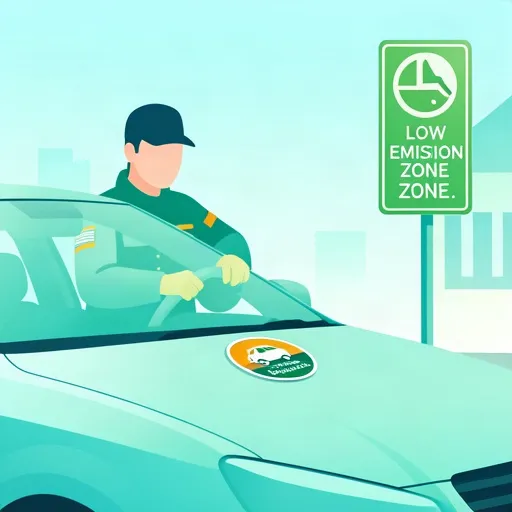
The DGT is very specific regarding how these labels must be displayed to ensure they are visible to authorities and traffic cameras. The rule is straightforward: the sticker must be placed on the interior of the windshield in the lower right corner.
In the case of vehicles that do not have a standard windshield, such as motorcycles, the regulations state that the sticker must be placed in a location where it is clearly visible. Failure to display the label, while not always a moving violation in every jurisdiction, can hinder your ability to prove your vehicle's compliance when entering restricted areas or parking in zones with dynamic pricing linked to emissions.
Exam questions regarding environmental labels often focus on the relationship between a vehicle's engine type and its assigned label, or the consequences of driving into a restricted zone without the required classification. You should be prepared to identify which vehicles qualify as "Zero" or "Eco" and recognize the importance of the labels for mobility benefits, such as utilizing the high-occupancy vehicle (VAO) lane in certain conditions even with a single occupant if you drive a zero-emissions vehicle.
An official DGT label that classifies a vehicle based on its environmental impact, energy efficiency, and compliance with Euro emissions standards, used to regulate access to urban Low Emission Zones (ZBE).
The DGT environmental label system categorizes vehicles into four groups—Zero (Etiqueta 0), ECO, Class C, and Class B—to regulate urban access and manage traffic during high-pollution events. Zero and ECO labels grant mobility benefits and priority access to Low Emission Zones, while unlabelled vehicles face the strictest restrictions. Each label corresponds to specific vehicle technologies and Euro emissions standard compliance levels, determined by registration dates and engine type. Drivers can verify their vehicle's classification through the DGT website, miDGT app, phone (060), or local traffic offices using their license plate. Exam questions typically test the ability to match vehicle types to their correct label and understand ZBE access implications.
A short set of high-value points that capture the most important ideas from this article.
The DGT classifies vehicles into four environmental labels: Zero (Etiqueta 0), ECO, Class C (green), and Class B (yellow), ranked by environmental impact from cleanest to most polluting.
Zero Emissions (Etiqueta 0) applies to battery electric vehicles, range-extended electric vehicles, plug-in hybrids with at least 40 km electric range, and hydrogen fuel cell vehicles.
Low Emission Zones (ZBE) restrict urban access based on environmental labels, but specific entry requirements vary by municipality.
The environmental sticker must be placed on the interior of the windshield in the lower right corner for standard vehicles.
The most polluting 50% of vehicles receive no environmental label and face the harshest restrictions in active Low Emission Zones.
Zero Emissions (Etiqueta 0) = BEVs, REEVs, PHEVs with ≥40 km range, hydrogen vehicles.
ECO label = HEVs, PHEVs with <40 km range, natural gas (CNG/LNG), and LPG vehicles.
Class C (green) = Gasoline cars registered from January 2006, diesel cars from September 2015.
Class B (yellow) = Older combustion vehicles; gasoline from 2001, diesel from 2006.
Label placement rule: interior windshield lower right corner; motorcycles and vehicles without standard windshields require clearly visible alternative placement.
Confusing registration date cutoffs, especially thinking diesel Class C applies from 2001 instead of 2015.
Assuming ZBE entry rules are the same in every Spanish city, when requirements actually depend on each municipality's regulations.
Forgetting that plug-in hybrids (PHEVs) split between Zero and ECO labels based on their minimum 40 km electric range.
Believing all hybrid vehicles automatically qualify for the ECO label without checking their specific type and range.
Incorrectly assuming zero-emission vehicles can always use VAO (high-occupancy vehicle) lanes solo; in Spain this benefit has specific conditions.
Article content overview
A short set of high-value points that capture the most important ideas from this article.
The DGT classifies vehicles into four environmental labels: Zero (Etiqueta 0), ECO, Class C (green), and Class B (yellow), ranked by environmental impact from cleanest to most polluting.
Zero Emissions (Etiqueta 0) applies to battery electric vehicles, range-extended electric vehicles, plug-in hybrids with at least 40 km electric range, and hydrogen fuel cell vehicles.
Low Emission Zones (ZBE) restrict urban access based on environmental labels, but specific entry requirements vary by municipality.
The environmental sticker must be placed on the interior of the windshield in the lower right corner for standard vehicles.
The most polluting 50% of vehicles receive no environmental label and face the harshest restrictions in active Low Emission Zones.
Zero Emissions (Etiqueta 0) = BEVs, REEVs, PHEVs with ≥40 km range, hydrogen vehicles.
ECO label = HEVs, PHEVs with <40 km range, natural gas (CNG/LNG), and LPG vehicles.
Class C (green) = Gasoline cars registered from January 2006, diesel cars from September 2015.
Class B (yellow) = Older combustion vehicles; gasoline from 2001, diesel from 2006.
Label placement rule: interior windshield lower right corner; motorcycles and vehicles without standard windshields require clearly visible alternative placement.
Confusing registration date cutoffs, especially thinking diesel Class C applies from 2001 instead of 2015.
Assuming ZBE entry rules are the same in every Spanish city, when requirements actually depend on each municipality's regulations.
Forgetting that plug-in hybrids (PHEVs) split between Zero and ECO labels based on their minimum 40 km electric range.
Believing all hybrid vehicles automatically qualify for the ECO label without checking their specific type and range.
Incorrectly assuming zero-emission vehicles can always use VAO (high-occupancy vehicle) lanes solo; in Spain this benefit has specific conditions.
Explore related topics, search based questions, and concepts that learners often look up when studying DGT Environmental Labels Guide. These themes reflect real search intent and help you understand how this topic connects to wider driving theory knowledge in Spain.
Find clear and practical answers to common questions learners often have about DGT Environmental Labels Guide. This section helps explain difficult points, remove confusion, and reinforce the key driving theory concepts that matter for learners in Spain.
The four labels are Zero Emissions (Blue), Eco, C (Green), and B (Yellow). They classify vehicles from most to least efficient based on their environmental impact and engine technology.
The sticker must be placed on the bottom right corner of the front windshield. For vehicles without a windshield, such as motorcycles, it must be placed in a visible location.
ZBEs are urban areas where traffic access is restricted based on vehicle emissions to improve air quality, particularly during high pollution episodes. Entry is regulated by the environmental label of the vehicle.
No, vehicles that do not meet the criteria to be considered 'clean' or efficient enough to qualify for a label do not receive one. These vehicles are the most polluting 50% of the fleet and may face the strictest traffic limitations.
Now that you have found specific articles, continue to deepen your understanding by exploring related DGT regulations or other driving theory topics. Strengthen your knowledge of road signs, traffic scenarios, and essential Spanish driving procedures to prepare for your official driving license exam.