
This lesson explores the critical concept of Gross Combination Mass (GCM) for heavy goods vehicles in Switzerland. You will learn how to determine the total permissible weight of your vehicle and trailer, ensuring you comply with Swiss technical regulations and maintain safe driving dynamics.

Lesson content overview
Operating heavy goods vehicles, especially when towing a trailer, introduces complex challenges related to vehicle mass and stability. One of the most critical concepts for professional drivers in the Official Swiss Driving Theory Course for Category C & C1 Goods Vehicles is the Gross Combination Mass (GCM). This limit dictates the maximum total weight of your lorry and its trailer, including all cargo and occupants, ensuring the entire combination can operate safely on public roads. Adhering to the GCM is not just a legal requirement; it is fundamental to preventing accidents, preserving vehicle components, and safeguarding lives.
This lesson will delve into the precise definition of GCM, differentiate it from other critical mass terms, and guide you through the calculations necessary for compliance. We will also explore the severe safety implications of exceeding these limits, from compromised braking to increased wear on vital vehicle systems. Understanding and respecting GCM is a cornerstone of responsible heavy goods vehicle operation.
The Gross Combination Mass (GCM), also known as the permissible maximum total mass of the vehicle combination, represents the absolute maximum weight allowed for a powered vehicle (lorry) combined with its trailer(s), all cargo, and occupants, when fully loaded and ready for movement. This value is a crucial safety parameter, meticulously determined by vehicle manufacturers and regulatory authorities to ensure that the vehicle's engine, transmission, chassis, suspension, and especially the braking systems are capable of safely handling the entire load.
Ignoring or exceeding the GCM can lead to a cascade of dangerous situations. It directly impacts the vehicle's ability to accelerate, climb gradients, and most critically, to brake effectively. The GCM is a legally binding limit, typically found on the vehicle's identification plate. As a professional driver, your responsibility includes knowing this limit and ensuring your loaded combination never surpasses it.
While closely related, it is vital not to confuse Gross Combination Mass (GCM) with Gross Vehicle Mass (GVM). The GVM refers specifically to the maximum permissible total mass of a single vehicle (your lorry alone), including its fuel, passengers, and cargo, but without any trailer attached. Think of GVM as the maximum weight the powered vehicle itself can legally carry.
The GVM ensures that the powered vehicle's own structure, axles, tires, and braking system are not overloaded independently of any trailer. Both GCM and GVM are critical limits that must be respected simultaneously. A lorry could be under its GVM but still contribute to an overloaded combination if the GCM is exceeded.
The maximum permissible total mass of a single powered vehicle (including its fuel, passengers, and cargo) without any trailer attached.
The Maximum Permissible Towing Mass (MPTM) is a derived value that helps in practical loading calculations. It represents the maximum weight that a trailer and its cargo can add to the powered vehicle while keeping the overall combination within the GCM limit. Essentially, MPTM is the difference between the GCM and the GVM of the powered vehicle.
Calculating the MPTM provides a clear guideline for how much a trailer can weigh, including its own tare weight (unladen weight) and its payload (the cargo it carries). This helps drivers avoid overloading the trailer component of their combination, which is just as critical as not overloading the powered vehicle itself.
The difference between the Gross Combination Mass (GCM) and the Gross Vehicle Mass (GVM); it indicates the maximum weight a trailer and its cargo can add to the combination.
Swiss road traffic law is stringent regarding vehicle dimensions and masses to ensure road safety and protect infrastructure. Compliance with these regulations is non-negotiable for professional drivers. Understanding the legal basis provides the 'why' behind the GCM and other mass limits.
In Switzerland, the primary legal framework for road traffic is the Swiss Road Traffic Act (SVG) (Strassenverkehrsgesetz). This act is complemented by various ordinances, including the Ordinance on Technical Requirements for Road Vehicles (VTS) (Verordnung über die technischen Anforderungen an Strassenfahrzeuge), sometimes referred to as StVZO Part 6 for axle loads and Part 22 for braking systems in a broader context. These regulations explicitly define the maximum permissible masses, dimensions, and other technical requirements for vehicles and vehicle combinations.
Article 27 of the Swiss Road Traffic Regulations, for instance, places a direct responsibility on the driver to verify that the vehicle is loaded within the limits of GCM, GVM, and individual axle loads before commencing a journey. Failure to comply can result in substantial fines, vehicle impoundment, and even criminal charges in severe cases, in addition to invalidating insurance coverage.
Drivers of heavy goods vehicles are legally obligated to ensure their combination's total weight does not exceed the Gross Combination Mass (GCM) or any other specified mass limits, including individual axle loads. Non-compliance carries severe penalties and risks.
The definitive source for a vehicle's specific mass limits is its Vehicle Identification Plate, also known as the type plate or data plate. This plate is typically riveted to the vehicle chassis, often visible in the door frame, engine compartment, or on the dashboard. It contains crucial information including:
Drivers must be able to locate and correctly interpret the information on this plate. It is the primary reference for all weight-related decisions and calculations before loading and throughout a journey.
The braking capacity of a vehicle combination is directly tied to its GCM. Heavier combinations require more robust braking power to ensure safe deceleration and stopping distances. Swiss regulations mandate specific braking system requirements based on the GCM of the combination, particularly for trailers.
For example, beyond a certain threshold of trailer mass (often around 7 tonnes, though specific thresholds should be verified), trailers must be equipped with their own independent and functional trailer braking system, typically air brakes. These systems work in conjunction with the powered vehicle's brakes to distribute the braking effort and prevent overloading the lorry's braking components. Relying solely on the powered vehicle's brakes for a heavy combination will quickly lead to brake fade, reduced effectiveness, and a significant safety hazard, especially on long descents.
Accurately calculating and verifying the total mass of your vehicle combination is a critical pre-trip procedure. It requires attention to detail and a systematic approach to ensure compliance with GCM, GVM, and axle load limits.
To ensure your combination remains within its GCM, you need to sum the weight of all components:
Determine the Tare Weight of the Lorry: This is the unladen weight of your powered vehicle, including a full tank of fuel and standard equipment, but no cargo or driver.
Add the Lorry's Payload: This includes the weight of the driver, any passengers, and all cargo carried on the lorry itself. Ensure this does not exceed the lorry's GVM minus its tare weight.
Add the Tare Weight of the Trailer: This is the unladen weight of the trailer itself.
Add the Trailer's Payload: This is the weight of all cargo loaded onto the trailer. Ensure this, combined with the trailer's tare weight, does not exceed the Maximum Permissible Towing Mass (MPTM).
Sum All Components: The total of these four values is your combination's actual operating mass.
Compare to GCM: This calculated total must be equal to or less than the Gross Combination Mass (GCM) specified on your vehicle identification plate.
Example:
Total Combination Mass: (8,000 kg + 9,000 kg) + (3,000 kg + 4,500 kg) = 17,000 kg + 7,500 kg = 24,500 kg. Since 24,500 kg < 26,000 kg (GCM), this combination is compliant in terms of total mass.
Beyond the overall GCM, it is equally critical to manage Axle Load (Achslast). This refers to the load borne by each individual axle within the combination. Every axle on both the powered vehicle and the trailer has a maximum permissible axle load specified on the vehicle identification plate. Overloading a single axle can have severe consequences, even if the overall GCM is respected.
Proper load distribution is key. Cargo must be arranged and secured in such a way that no single axle exceeds its limit. Uneven loading can lead to:
When coupling a trailer, the weight distribution shifts. The coupling point transfers some of the trailer's weight onto the powered vehicle's rear axle (or axles), potentially increasing its load. Always reassess axle loads after coupling and adjust cargo placement if necessary.
A responsible heavy goods vehicle driver always conducts thorough pre-trip checks, and verifying load compliance is paramount. Never assume that a load is within limits based on intuition or past experience.
Know Your Limits: Always have the GVM, GCM, and individual axle load limits readily available, preferably from the vehicle identification plate.
Weigh Your Cargo: Whenever possible, use calibrated scales to weigh the cargo before loading. If exact weights are unknown, use conservative estimates.
Monitor Loading: Oversee the loading process to ensure cargo is distributed evenly and secured properly, minimizing the risk of exceeding axle loads.
Use Public or Commercial Scales: For heavy or complex loads, utilize public weighbridges or commercial truck scales to get an accurate total weight of the combination and often, individual axle weights.
Recalculate for Changes: If any part of the load changes during the journey (e.g., partial deliveries or pickups), reassess the total mass and distribution.
Always factor in the weight of your own body, any passengers, and a full tank of fuel when calculating the lorry's actual operating mass. These "minor" weights add up, especially in smaller vehicles or when approaching limits.
The GCM is not an arbitrary number; it is a critical safety parameter based on extensive engineering and testing. Exceeding this limit has profound and dangerous consequences for vehicle performance, control, and overall road safety.
Perhaps the most immediate and dangerous consequence of exceeding GCM is the severe degradation of braking performance. A heavier vehicle combination requires significantly more energy to slow down and stop.
An overloaded combination becomes inherently less stable and more difficult to control.
Beyond immediate safety, exceeding GCM takes a heavy toll on the vehicle's mechanical components, significantly shortening their lifespan and increasing maintenance costs.
Swiss roads, particularly in mountainous regions, present unique challenges for heavy goods vehicles. GCM compliance is even more critical in these environments.
Despite the clear risks, GCM violations are unfortunately common, often stemming from misunderstandings or deliberate disregard for regulations.
A prevalent mistake is the belief that if individual vehicles (lorry and trailer) are within their respective GVMs, the combination is automatically compliant with GCM. This is incorrect. The GCM is an overriding limit for the entire combination. Another error is overlooking the impact of even small additions of cargo, especially if they push the total mass just over the limit.
Best Practices:
Cargo that is not properly secured can shift during transit, especially under braking, acceleration, or cornering. This dynamic load shift can momentarily or permanently alter axle loads, potentially exceeding limits even if the initial static distribution was compliant. For example, sudden braking can transfer a significant portion of cargo weight forward, heavily loading the powered vehicle's front axles.
Best Practices:
GCM limits are absolute, but the safety implications of approaching or exceeding them are magnified by various external and internal factors.
The GCM assumes a vehicle in good working order. However, real-world conditions vary:
Understanding Gross Combination Mass is not an isolated concept; it forms the foundation for many other critical aspects of heavy goods vehicle operation. It is inherently linked to:
By integrating your knowledge of GCM with these related topics, you develop a comprehensive understanding of heavy goods vehicle dynamics and safe operating procedures.
This lesson covers Gross Combination Mass (GCM), the critical maximum weight limit for vehicle-trailer combinations under Swiss road traffic law. It distinguishes GCM from Gross Vehicle Mass (GVM) and explains the Maximum Permissible Towing Mass (MPTM) calculation, providing a concrete worked example with real values. The content emphasizes that drivers are legally responsible for verifying compliance with all mass limits before driving, and highlights the severe safety consequences of exceeding GCM including brake fade, loss of control, and increased accident risk on Swiss mountain roads. Understanding these concepts is essential for passing the Category C/C1 theory exam and ensuring safe heavy goods vehicle operation.
A short set of high-value points that capture the most important learning from this lesson.
Gross Combination Mass (GCM) is the absolute maximum total weight allowed for a lorry combined with its trailer, all cargo, and occupants when fully loaded
GCM and GVM are separate limits that must both be respected simultaneously; a vehicle can be under GVM but still exceed GCM when towing
The Vehicle Identification Plate is the definitive legal source for a vehicle's specific GCM, GVM, and axle load limits
Exceeding GCM compromises braking effectiveness, vehicle stability, and can cause brake fade, especially dangerous on Swiss mountain descents
Maximum Permissible Towing Mass (MPTM) equals GCM minus GVM and indicates the maximum weight the trailer and its cargo can add to the combination
Explore all units and lessons included in this driving theory course.
MPTM = GCM minus GVM, which gives the maximum trailer weight (tare plus payload) allowed
GVM covers the powered vehicle alone; GCM covers the entire combination; both are legally binding limits found on the vehicle identification plate
Swiss Article 27 places direct legal responsibility on drivers to verify all mass limits before commencing any journey
Every individual axle has its own maximum permissible load independent of the overall GCM; axle overload is a violation even if GCM is respected
Brake fade occurs when overloaded brakes overheat and lose effectiveness, posing extreme danger on long descents
Assuming that if the lorry and trailer are both under their individual GVMs, the combination automatically complies with GCM
Forgetting to include the driver's weight, passengers, and full fuel tank when calculating the lorry's actual operating mass
Overlooking axle load limits while focusing only on total GCM, leading to violations at individual axles
Neglecting dynamic load shifts during transit where cargo movement can temporarily overload specific axles
Using outdated or assumed values instead of physically checking the current limits on the vehicle identification plate
Lesson content overview
A short set of high-value points that capture the most important learning from this lesson.
Gross Combination Mass (GCM) is the absolute maximum total weight allowed for a lorry combined with its trailer, all cargo, and occupants when fully loaded
GCM and GVM are separate limits that must both be respected simultaneously; a vehicle can be under GVM but still exceed GCM when towing
The Vehicle Identification Plate is the definitive legal source for a vehicle's specific GCM, GVM, and axle load limits
Exceeding GCM compromises braking effectiveness, vehicle stability, and can cause brake fade, especially dangerous on Swiss mountain descents
Maximum Permissible Towing Mass (MPTM) equals GCM minus GVM and indicates the maximum weight the trailer and its cargo can add to the combination
Explore all units and lessons included in this driving theory course.
MPTM = GCM minus GVM, which gives the maximum trailer weight (tare plus payload) allowed
GVM covers the powered vehicle alone; GCM covers the entire combination; both are legally binding limits found on the vehicle identification plate
Swiss Article 27 places direct legal responsibility on drivers to verify all mass limits before commencing any journey
Every individual axle has its own maximum permissible load independent of the overall GCM; axle overload is a violation even if GCM is respected
Brake fade occurs when overloaded brakes overheat and lose effectiveness, posing extreme danger on long descents
Assuming that if the lorry and trailer are both under their individual GVMs, the combination automatically complies with GCM
Forgetting to include the driver's weight, passengers, and full fuel tank when calculating the lorry's actual operating mass
Overlooking axle load limits while focusing only on total GCM, leading to violations at individual axles
Neglecting dynamic load shifts during transit where cargo movement can temporarily overload specific axles
Using outdated or assumed values instead of physically checking the current limits on the vehicle identification plate
Explore search topics learners often look for when studying Calculating and Respecting Gross Combination Mass. These topics reflect common questions about road rules, driving situations, safety guidance, and lesson level theory preparation for learners in Switzerland.
Browse additional driving theory lessons that cover connected traffic rules, road signs, and common driving situations related to this topic. Improve your understanding of how different rules interact across everyday traffic scenarios.
Understand the Maximum Permissible Towing Mass (MPTM) for heavy goods vehicles towing trailers in Switzerland. Learn how MPTM relates to Gross Combination Mass (GCM) and Gross Vehicle Mass (GVM) for safe loading and compliance with Swiss road law.

This lesson details the definition of Category B within the Swiss licensing system, focusing on vehicle types, weight capacities, and passenger limits. It clarifies the maximum authorized mass for Category B cars and the specific restrictions on towing trailers. You will learn the legal framework defining which vehicles you may operate and the boundaries of this license category.

This lesson clarifies the essential terminology related to vehicle weight. It defines tare weight (Leergewicht) as the vehicle's empty weight, payload (Nutzlast) as the maximum permissible load it can carry, and gross vehicle mass (Gesamtgewicht) as the total combined weight. Correctly understanding these terms is fundamental for calculating loads and avoiding illegal overloading.

This lesson provides a clear definition of the Swiss heavy goods vehicle license categories. It details the weight limits and vehicle configurations for Category C (lorries over 3.5t) and C1 (lorries from 3.5t to 7.5t). Furthermore, it explains how categories CE and C1E grant the entitlement to tow heavy trailers, forming articulated vehicles or road trains, which is crucial for professional transport operations.

Swiss law strictly regulates the maximum dimensions of commercial vehicles to ensure they can safely navigate the infrastructure. This lesson specifies the standard limits for vehicle height (4.0m), width (2.55m), and length for various lorry and trailer combinations. Adhering to these dimensions is crucial for avoiding collisions with bridges, tunnels, and other structures, and for navigating narrow roads.

Overloading is a serious offence with severe safety and legal ramifications. This lesson details how excess weight drastically increases braking distances, puts extreme stress on tyres leading to blowouts, and negatively affects steering and overall stability. Furthermore, it discusses the substantial fines, potential license withdrawal, and driver liability that result from violating Swiss weight regulations.
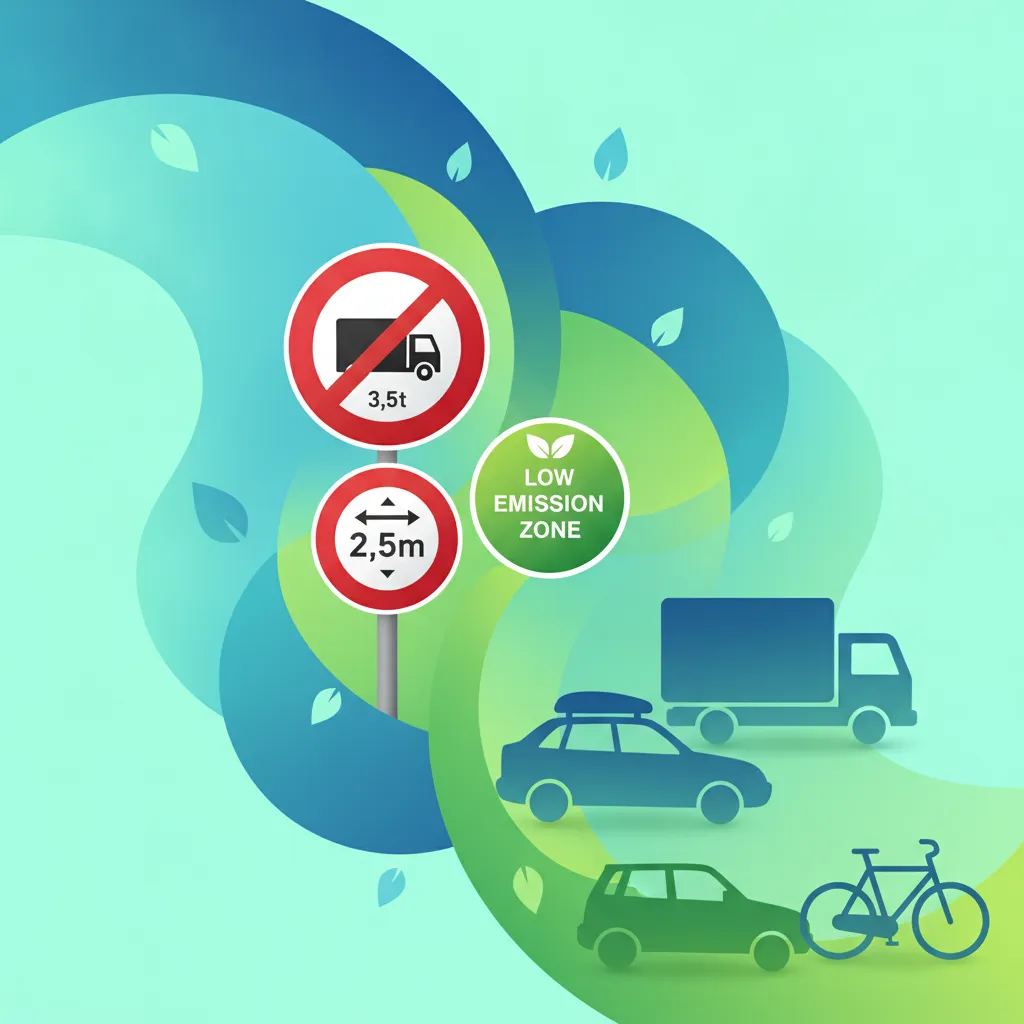
Many urban areas have restrictions to manage traffic and protect infrastructure. This lesson teaches drivers to identify and interpret traffic signs that prohibit access based on gross vehicle weight, axle load, height, or width. It also covers the growing prevalence of environmental or low-emission zones, which may restrict entry for older, more polluting vehicles.

The total weight of a vehicle is supported by its axles, and Swiss regulations set strict limits on the load each axle can bear. This lesson explains how to correctly distribute a load to comply with maximum axle load (Achslast) limits, which is vital for vehicle stability, steering control, and braking efficiency. Incorrect distribution can lead to dangerous handling characteristics and cause significant damage to road surfaces.
Correct load distribution is essential for safe handling and braking. This lesson explains that loads should be placed as low as possible and distributed evenly to maintain a low centre of gravity and comply with axle weight limits. A high or poorly positioned centre of gravity dramatically increases the risk of rollover, especially when cornering or in an emergency manoeuvre.

This lesson defines the common types of trailers used with heavy goods vehicles. It explains the difference between a drawbar trailer (Anhänger), which is towed behind a rigid lorry, and a semitrailer (Sattelanhänger), which is coupled to a tractor unit via a fifth wheel. Understanding these configurations is key to understanding the different handling characteristics of various vehicle combinations.

Transporting loads that are wider, longer, taller, or heavier than standard regulations allow requires special authorization. This lesson explains the concept of exceptional transport and the legal requirement to obtain a special permit from the relevant cantonal authorities. It highlights that such operations require careful route planning, often mandating specific times of travel and sometimes the use of escort vehicles.
Explore the critical concept of axle loads (Achslast) and their distribution in heavy goods vehicles. Learn how respecting these limits is essential for maintaining vehicle stability and preventing dangerous situations on Swiss roads.
The total weight of a vehicle is supported by its axles, and Swiss regulations set strict limits on the load each axle can bear. This lesson explains how to correctly distribute a load to comply with maximum axle load (Achslast) limits, which is vital for vehicle stability, steering control, and braking efficiency. Incorrect distribution can lead to dangerous handling characteristics and cause significant damage to road surfaces.
Correct load distribution is essential for safe handling and braking. This lesson explains that loads should be placed as low as possible and distributed evenly to maintain a low centre of gravity and comply with axle weight limits. A high or poorly positioned centre of gravity dramatically increases the risk of rollover, especially when cornering or in an emergency manoeuvre.
Overloading is a serious offence with severe safety and legal ramifications. This lesson details how excess weight drastically increases braking distances, puts extreme stress on tyres leading to blowouts, and negatively affects steering and overall stability. Furthermore, it discusses the substantial fines, potential license withdrawal, and driver liability that result from violating Swiss weight regulations.

Heavy vehicles, especially those with a high centre ofgravity, are susceptible to rolling over. This lesson examines the primary causes, including excessive speed on bends or roundabouts, sudden steering manoeuvres, and the 'sloshing' effect of liquid loads in tankers. It reinforces that maintaining a sensible speed and driving smoothly are the best ways to mitigate this serious risk.
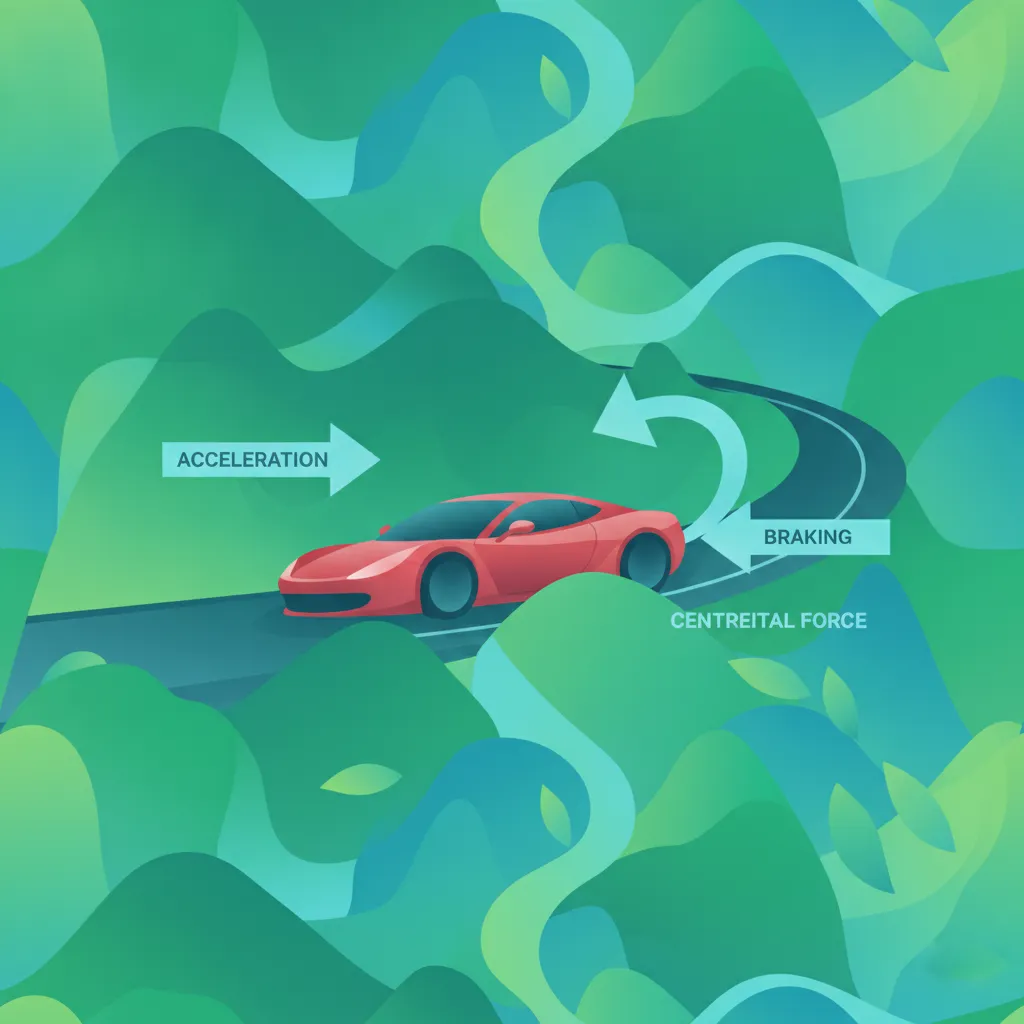
A load is not static; it is subjected to significant forces during transport. This lesson explains how acceleration, braking (deceleration), and cornering create powerful inertial forces that try to move the cargo. Load securing systems must be strong enough to counteract these forces to prevent the load from sliding forward during braking, backward during acceleration, or sideways when turning.

While others may have loaded the vehicle, the driver holds the final legal responsibility for the security of the load once on the public highway. This lesson clarifies this crucial point of law, explaining that the driver must inspect the load and its securing arrangements before departure and re-check them during the journey. The consequences of a load shifting or falling can be catastrophic and result in severe legal penalties for the driver.
Swiss law strictly regulates the maximum dimensions of commercial vehicles to ensure they can safely navigate the infrastructure. This lesson specifies the standard limits for vehicle height (4.0m), width (2.55m), and length for various lorry and trailer combinations. Adhering to these dimensions is crucial for avoiding collisions with bridges, tunnels, and other structures, and for navigating narrow roads.

The suspension system connects the vehicle's axles to its frame, supporting the massive weight and absorbing shocks from the road surface. This lesson describes the two common types: traditional leaf springs and modern air suspension. It explains how a well-maintained suspension is crucial for vehicle stability, proper handling, braking effectiveness, and preventing damage to the load and the vehicle itself.
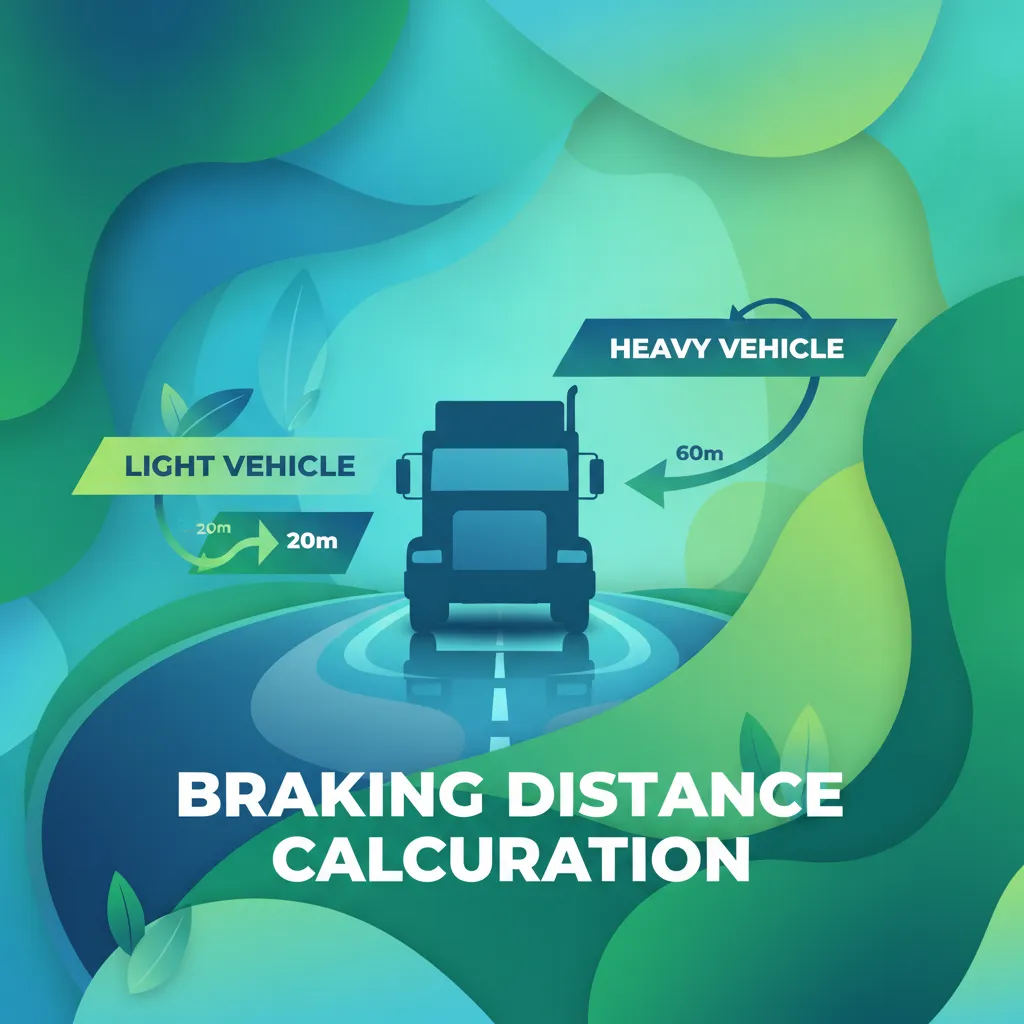
The immense mass of a loaded truck means its braking distance is far greater than that of a car. This lesson breaks down total stopping distance into reaction distance and braking distance, explaining how speed, weight, and road conditions have an exponential effect. It reinforces the necessity of maintaining a significantly larger following distance to ensure enough space to stop safely in an emergency.
Find clear answers to common questions learners have about Calculating and Respecting Gross Combination Mass. Learn how the lesson is structured, which driving theory objectives it supports, and how it fits into the overall learning path of units and curriculum progression in Switzerland. These explanations help you understand key concepts, lesson flow, and exam focused study goals.
Exceeding the GCM puts excessive strain on your vehicle's engine, transmission, and braking system. In Switzerland, this is not only illegal and subject to heavy fines, but it significantly increases your braking distance and rollover risk, especially on mountain passes.
The maximum permissible GCM is typically found on the vehicle's identification plate or in the vehicle's registration document (Fahrzeugausweis). Always cross-reference this with the trailer's data to ensure you do not exceed the lowest common denominator.
The legal GCM limit remains constant regardless of the road type. However, your management of that mass becomes more critical on mountain roads, where gravity significantly impacts your ability to control the vehicle's momentum during descents.
Yes. Gross Vehicle Mass (GVM) refers to the maximum weight of the individual lorry alone, while Gross Combination Mass (GCM) refers to the combined weight of the lorry plus its towed trailer. You must respect both limits independently.
Pinpoint specific Swiss traffic rules, road signs, or driving situations you need to master. Use the practice search to start a focused revision session now and build confidence for your official driving theory exam.