
This lesson maps out the significant blind spots inherent in operating large goods vehicles, covering areas directly in front, behind, and along both sides of your lorry. Understanding these no-zones is vital for safely navigating complex urban environments and performing lane changes as a professional driver.
Lesson content overview
Driving heavy goods vehicles (HGVs) in Switzerland, whether for Category C or C1, demands a profound understanding of their unique challenges, especially concerning blind spots. Due to their immense size, elevated cab position, and specific mirror systems, trucks inherently possess significant areas around them that are entirely hidden from the driver's view. These areas, often called "no-zones," pose substantial risks to other road users, particularly cyclists, motorcyclists, and pedestrians, as well as smaller vehicles. This lesson provides an exhaustive examination of these critical blind spots and outlines comprehensive strategies for their effective identification and management, ensuring safer operation of heavy vehicles on Swiss roads.
Heavy goods vehicles present a unique challenge regarding driver visibility. Unlike passenger cars, the sheer dimensions of trucks create expansive areas where other road users can become completely obscured. These "no-zones" are a primary concern for professional drivers, requiring constant vigilance and a proactive approach to safety.
The presence of blind spots in heavy vehicles is a direct consequence of their design and operational characteristics. The high cab position, while offering a commanding view of distant traffic, severely obstructs the driver's direct line of sight to the immediate front. Similarly, the long chassis and cargo area, often coupled with trailers, block visibility to the rear and extend vast sections along both sides that mirrors alone cannot fully cover. This complex interplay of vehicle length, width, and driver's vantage point necessitates a robust understanding of where these hidden zones lie.
Swiss traffic regulations place a high degree of responsibility on HGV drivers to account for their vehicle's blind spots. The law mandates systematic checks before any lateral movement, such as changing lanes or turning. This obligation extends beyond simple mirror checks to include active measures that anticipate and confirm the absence of other road users in these invisible areas. Professional drivers are expected to recognize that smaller vehicles, cyclists, and pedestrians are especially vulnerable and often invisible within these no-zones, demanding extra caution.
Heavy goods vehicles have several extensive blind spots, each presenting distinct challenges. Understanding the exact location and typical dimensions of these no-zones is the first step towards managing them effectively.
The front blind spot is the area directly in front of the truck's cab that the driver cannot see, even from their elevated position. This zone can extend approximately 5 to 7 metres forward from the front bumper. It is particularly dangerous at low speeds, during acceleration from a stop, or when turning.
A stationary front blind spot exists where vehicles or pedestrians are directly ahead and below the driver's line of sight. The dynamic front blind spot, on the other hand, refers to moving traffic that might enter this zone from behind the truck and become obscured as the truck accelerates. A common scenario involves a cyclist crossing directly in front of a truck at an intersection, remaining invisible to the driver until it is too late to react safely. Drivers must always ensure the path ahead is clear before moving forward.
The rear blind spot encompasses the area directly behind the truck, which is obscured by the cargo area, bodywork, or any attached trailer. This zone can extend roughly 8 to 12 metres behind the vehicle, making it challenging to detect smaller vehicles, motorcycles, or pedestrians travelling directly behind.
For a tractor-trailer combination, the trailer itself significantly contributes to this blind spot, creating a distinct "trailer-only blind spot." The height and distribution of cargo also influence visibility, with high loads potentially obstructing parts of the rear view. Relying solely on a single rearview mirror is insufficient, as it only captures a fraction of this extensive area. Drivers must use all available mirrors, and if equipped, rear-view cameras and sensors, before slowing, stopping, or reversing.
The side blind spots, often referred to as lateral no-zones, are long, narrow strips along the length of the vehicle's sides that are not adequately covered by standard wing mirrors. These zones typically stretch from the front doors all the way to the rear wheels. They are particularly hazardous during lane changes, merging, and turning maneuvers.
This blind spot is located immediately to the left of the driver's side, beyond the coverage of the left wing mirror. It is a frequent area for collisions with smaller vehicles or cyclists attempting to overtake or travel alongside the truck, particularly in urban environments or during left-hand turns.
The far-side blind spot, on the passenger side (right-hand side in Switzerland), is often larger and more perilous due to the driver's distance from it and reduced direct visibility. Cyclists or motorcyclists attempting to overtake on the right, or vehicles merging from the right, can easily become hidden here. This is especially critical before making right-hand turns or changing lanes to the right.
Effectively managing blind spots requires more than just awareness; it demands active strategies and consistent practice. Professional drivers must adopt a systematic approach to ensure these no-zones are clear before any maneuver.
Proper mirror adjustment is foundational to minimizing blind spots. Heavy vehicles are equipped with multiple mirrors, including an interior rear-view mirror (if applicable), and multiple external wing mirrors (main, wide-angle, and sometimes kerb mirrors). Each must be set correctly to maximize the field of view.
Adjust the interior rear-view mirror (if present) to provide a clear view directly behind the vehicle's cabin or through the rear window of the cargo area, if accessible.
Set the main external wing mirrors (left and right) so that you can just barely see the side of your own vehicle in the innermost edge of the mirror. This provides the widest possible view of the lanes beside and behind you.
Adjust wide-angle mirrors to cover the blind spot areas immediately adjacent to the side of your vehicle and further out. These mirrors typically have a curved surface to show a broader, albeit distorted, view.
If equipped, adjust kerb mirrors (usually on the passenger side) to provide a clear view of the kerb and the area immediately around the front and rear wheels on that side, especially useful for tight turns and maneuvering.
Always re-adjust mirrors after attaching or detaching a trailer, changing loads, or when a new driver takes over the vehicle, as the vehicle's dimensions and dynamics change.
Regularly clean all mirrors, especially in adverse weather conditions, to maintain optimal visibility. Dirty or frosted mirrors severely compromise your ability to detect hazards.
Even with perfectly adjusted mirrors, there will always be areas that remain hidden. This is where the "over-the-shoulder check" becomes indispensable. This involves a physical head turn by the driver to visually sweep the blind spots not covered by mirrors.
A mandatory physical head turn by the driver to directly observe areas adjacent to the vehicle that are outside the field of view of all mirrors. It is crucial before any lateral movement.
This check is mandatory immediately before any lane change, merging maneuver, or turning, especially in congested traffic or urban environments. A quick glance is insufficient; a full, deliberate head turn is required to accurately perceive any hidden vehicles, cyclists, or pedestrians. Failing to perform a thorough over-the-shoulder check is a common cause of collisions involving HGVs.
In situations where the driver's visibility is severely limited, such as during reversing, positioning in tight loading bays, or maneuvering in depots, a trained assistant known as a banksman or signaller is crucial.
A trained individual who assists the heavy goods vehicle driver by providing clear visual and/or audible signals, especially during complex or low-visibility maneuvers like reversing, to ensure safety and prevent collisions.
The banksman acts as the driver's "eyes" in the blind zones, guiding the vehicle and alerting the driver to obstacles, other vehicles, or pedestrians. Swiss occupational safety regulations often mandate the use of a banksman in such restricted environments. The driver and banksman must establish clear communication protocols before initiating any maneuver, ensuring mutual understanding of signals.
Swiss road traffic law is explicit about a heavy goods vehicle driver's responsibilities concerning blind spots. Adherence to these regulations is not just a legal requirement but a fundamental aspect of professional driving safety.
The Swiss Road Traffic Act (SVG), particularly concerning the obligation to yield (Art. 4), implies that drivers must account for their blind spots and yield to other road users who may be hidden within them. This principle underpins the heightened responsibility of HGV drivers.
Furthermore, the Ordinance on Heavy Vehicle Dimensions (V1/1995) (Art. 15) specifies mirror requirements for heavy vehicles. It mandates that Category C and C1 vehicles, including combinations with trailers, must be equipped with an interior rear-view mirror and two external wing mirrors that provide sufficient field of view (e.g., covering at least 120° each for main mirrors). These requirements aim to ensure drivers have adequate visual access to critical blind zones. Drivers must adjust these mirrors correctly to meet the intended coverage.
The Swiss Road Traffic Regulations (Art. 12) outline precise obligations for lane changes. Before changing lanes, a driver must:
These steps are legally mandatory and are designed to prevent collisions, especially with smaller vehicles that might be hidden.
Chapter 5 of the Swiss Occupational Safety Regulation specifies situations where a trained banksman must assist the driver. This is particularly relevant when reversing or maneuvering in confined spaces such as loading bays, depots, or construction sites where the driver's direct and mirror-aided view is severely restricted. This regulation underscores the critical importance of mitigating blind spot risks in challenging environments.
The Swiss Road Traffic Ordinance (Art. 2) mandates that drivers adapt their speed to prevailing road, traffic, visibility, and vehicle handling characteristics. This rule is especially pertinent to blind spot management. Drivers must reduce speed and increase following distances when approaching intersections, merge points, or in any situation where visibility into blind zones is compromised. This allows for increased reaction time to hazards that may suddenly emerge from a blind spot.
Even experienced HGV drivers can make errors related to blind spots. Awareness of these common pitfalls and adopting correct habits is crucial for continuous safety.
Inadequate Over-the-Shoulder Check:
Assuming Rear-View Mirror Provides Full Rear Coverage:
Failing to Adjust Mirrors After Attaching a Trailer:
Changing Lanes Too Quickly Near Intersections:
Merging onto a Motorway Without Accounting for the Front Blind Spot:
Relying Solely on Advanced Driver-Assistance Systems (ADAS):
Blind spots are not static; their effective management requires considering dynamic factors such as environmental conditions, road type, and the vehicle's state.
Always assume that a smaller road user might be present in your blind spot, even if you have checked thoroughly. A moment's inattention can have severe consequences.
Applying blind spot management principles in various driving situations is critical for developing safe habits.
Setting: You are driving a Category C truck through a busy Swiss city intersection in daylight with moderate traffic. The traffic light ahead turns green. Decision Point: You need to make a left turn onto a side street. Correct Behavior: Activate your left turn signal well in advance. Check your left wing mirror for approaching traffic or cyclists. Perform a thorough over-the-shoulder glance to your left to confirm no cyclists or motorcyclists are in your near-side blind spot. Once clear, smoothly execute the turn, being mindful of the vehicle's off-tracking and maintaining a safe distance from the kerb and any vulnerable road users. Incorrect Behavior: Activate the signal and glance only at your left wing mirror. Neglect the over-the-shoulder check, assuming the mirror provides sufficient coverage. Begin the turn and narrowly miss or collide with a cyclist who was riding alongside your vehicle in the blind spot.
Setting: You are driving a Category C1 truck on a dual-carriageway at 80 km/h under sunny conditions. Decision Point: You need to change lanes to the left to overtake a slower vehicle. Correct Behavior: Activate your left turn signal. Check your left wing mirror to observe the traffic flow in the target lane. Critically, perform a full over-the-shoulder check to your left to ensure no vehicle, especially a faster-moving motorcycle or car, is hidden in your blind spot. Once the lane is confirmed clear and a safe gap exists, smoothly steer into the left lane while maintaining your speed. Incorrect Behavior: Activate the signal and only glance at your left wing mirror. Begin to change lanes without a proper over-the-shoulder check. A fast-approaching motorcyclist, hidden in your blind spot, is suddenly in your path, forcing an abrupt evasive maneuver or causing a collision.
Setting: You are driving a heavy goods vehicle and are on a slip road, preparing to merge onto a busy Swiss motorway during a light rain shower, reducing visibility. Decision Point: Accelerating to merge safely with motorway traffic. Correct Behavior: Adjust your mirrors for the wet conditions and slightly increase your following distance on the slip road. Check your interior mirror and, if equipped, your rear-view camera, for any vehicles behind that might merge quickly. Accelerate smoothly to match the speed of motorway traffic. Pay close attention to your extensive front blind spot, using mirrors and scanning the road ahead to ensure no vehicles are hidden as you approach the main carriageway. Merge only when a clear and safe gap is available, being highly aware of vehicles that may be in your side blind spots. Incorrect Behavior: Accelerate without sufficient mirror or blind spot checks, assuming other drivers will yield. Merge into a gap that quickly closes, or cut off another vehicle that was in your front or side blind spot, leading to a dangerous braking situation or collision.
Setting: You are reversing a Category C truck with a semi-trailer into a narrow loading dock at a depot, where other forklifts and personnel are present. Decision Point: Aligning the trailer with the loading bay. Correct Behavior: Before starting, confirm clear communication with your trained banksman. Use your rearview camera (if available) in conjunction with your mirrors. Follow the banksman's clear signals (e.g., "stop," "go," "turn left/right"). Reverse slowly and cautiously, performing constant mirror and occasional over-the-shoulder checks (if possible) while relying heavily on the banksman's guidance for all blind zones. Stop immediately if you lose sight of the banksman. Incorrect Behavior: Attempt to reverse into the loading dock without banksman assistance, relying solely on mirrors and a camera. Misjudge the trailer's position or fail to spot an obstacle or another worker due to severe blind spots, resulting in damage or injury.
Setting: You are driving a Category C truck in a residential area during daylight, approaching a pedestrian crossing where people are waiting to cross. Decision Point: Stopping at a red pedestrian signal. Correct Behavior: Observe the traffic flow ahead and behind. Before braking, check your interior and wing mirrors for any cyclists or motorcyclists who might be attempting to overtake you or are closely following. Brake smoothly and progressively, ensuring your vehicle stops well before the crossing line. Remain aware of your side blind spots, as pedestrians might start to cross before the signal changes or cyclists might approach from the sides. Incorrect Behavior: Brake abruptly without checking your rear blind zone. A cyclist approaching from directly behind, hidden by your truck's cargo area, is unable to react in time and rear-ends your vehicle. Alternatively, failing to notice a pedestrian stepping out from your side blind spot near the crossing.
Effective blind spot management is an ongoing process that requires constant attention and adaptation. Professional drivers of Category C and C1 vehicles must internalize these principles to ensure maximum safety for themselves and all other road users.
This lesson addresses the critical challenge of blind spot management for Category C and C1 drivers in Switzerland, where HGVs create extensive no-zones due to their size and design. Drivers must understand the specific dimensions of front, rear, and lateral blind spots and recognize that vulnerable road users—cyclists, pedestrians, and motorcyclists—are particularly at risk. Effective management combines properly adjusted mirrors (interior, main wing, wide-angle, and kerb mirrors), mandatory physical over-the-shoulder checks before any lateral maneuver, and appropriate use of a trained banksman in confined spaces. Swiss regulations under the Road Traffic Act (SVG) and Ordinance V1/1995 mandate systematic checks and signaling, with drivers bearing heightened responsibility to account for hidden road users. Dynamic factors including weather, road type, load distribution, and trailer coupling continuously affect blind spot visibility, requiring adaptive driving behavior.
A short set of high-value points that capture the most important learning from this lesson.
Heavy goods vehicles have three primary blind spot zones: front (5-7m), rear (8-12m), and extensive lateral no-zones along both sides that extend from the cab to the rear wheels.
Proper mirror adjustment is foundational—set main wing mirrors to show just the edge of your vehicle, use wide-angle mirrors for adjacent blind zones, and always re-adjust after attaching trailers.
Over-the-shoulder checks are mandatory and non-negotiable; mirrors alone cannot cover every angle, and a deliberate head turn is required before any lateral movement.
Swiss law mandates systematic blind spot checks and signaling before lane changes or turns, with heightened responsibility to yield to road users who may be hidden in no-zones.
Dynamic conditions—weather, road type, load, and trailer coupling—continuously alter blind spot dimensions, requiring adaptive observation strategies.
Explore all units and lessons included in this driving theory course.
Near-side blind spot (driver's left in Switzerland) is a frequent collision zone for cyclists overtaking or traveling alongside during left-hand turns.
Attaching a trailer drastically extends rear blind spots and changes vehicle geometry, requiring immediate mirror re-adjustment and awareness of off-tracking during turns.
A banksman is legally required or highly recommended in confined spaces (loading bays, depots) where driver visibility is severely restricted during reversing.
Mirror checks alone are insufficient; Swiss Road Traffic Regulations (Art. 12) require three steps: signal, check mirrors, perform blind spot check.
Always assume smaller vehicles, cyclists, and pedestrians could be present in your blind spot even after thorough checking—vulnerable road users are most at risk.
Relying solely on wing mirror checks without performing a full over-the-shoulder glance, assuming mirrors provide complete coverage of lateral blind spots.
Failing to re-adjust mirrors after coupling or uncoupling a trailer, leaving the driver with incorrect blind spot geometry for the new vehicle configuration.
Changing lanes too quickly near intersections where cyclists and motorcyclists may be hidden in side blind spots and have insufficient time to react.
Assuming the rear-view mirror shows full rear coverage; the cargo area blocks most of the rear, creating an extensive hidden zone behind the truck.
Over-relying on ADAS blind spot detection systems as a substitute for visual checks, forgetting that weather conditions, sensor obstructions, or system failures can compromise these aids.
Lesson content overview
A short set of high-value points that capture the most important learning from this lesson.
Heavy goods vehicles have three primary blind spot zones: front (5-7m), rear (8-12m), and extensive lateral no-zones along both sides that extend from the cab to the rear wheels.
Proper mirror adjustment is foundational—set main wing mirrors to show just the edge of your vehicle, use wide-angle mirrors for adjacent blind zones, and always re-adjust after attaching trailers.
Over-the-shoulder checks are mandatory and non-negotiable; mirrors alone cannot cover every angle, and a deliberate head turn is required before any lateral movement.
Swiss law mandates systematic blind spot checks and signaling before lane changes or turns, with heightened responsibility to yield to road users who may be hidden in no-zones.
Dynamic conditions—weather, road type, load, and trailer coupling—continuously alter blind spot dimensions, requiring adaptive observation strategies.
Explore all units and lessons included in this driving theory course.
Near-side blind spot (driver's left in Switzerland) is a frequent collision zone for cyclists overtaking or traveling alongside during left-hand turns.
Attaching a trailer drastically extends rear blind spots and changes vehicle geometry, requiring immediate mirror re-adjustment and awareness of off-tracking during turns.
A banksman is legally required or highly recommended in confined spaces (loading bays, depots) where driver visibility is severely restricted during reversing.
Mirror checks alone are insufficient; Swiss Road Traffic Regulations (Art. 12) require three steps: signal, check mirrors, perform blind spot check.
Always assume smaller vehicles, cyclists, and pedestrians could be present in your blind spot even after thorough checking—vulnerable road users are most at risk.
Relying solely on wing mirror checks without performing a full over-the-shoulder glance, assuming mirrors provide complete coverage of lateral blind spots.
Failing to re-adjust mirrors after coupling or uncoupling a trailer, leaving the driver with incorrect blind spot geometry for the new vehicle configuration.
Changing lanes too quickly near intersections where cyclists and motorcyclists may be hidden in side blind spots and have insufficient time to react.
Assuming the rear-view mirror shows full rear coverage; the cargo area blocks most of the rear, creating an extensive hidden zone behind the truck.
Over-relying on ADAS blind spot detection systems as a substitute for visual checks, forgetting that weather conditions, sensor obstructions, or system failures can compromise these aids.
Explore search topics learners often look for when studying Identifying and Managing Extensive Blind Spots. These topics reflect common questions about road rules, driving situations, safety guidance, and lesson level theory preparation for learners in Switzerland.
Browse additional driving theory lessons that cover connected traffic rules, road signs, and common driving situations related to this topic. Improve your understanding of how different rules interact across everyday traffic scenarios.
Learn the critical theory behind adjusting multiple mirrors on HGVs and systematically managing extensive blind spots. Essential knowledge for safe driving and passing the Swiss Category C theory exam, focusing on driver responsibility and observation techniques.

A lorry is equipped with multiple mirrors (up to six) to cover different fields of view. This lesson explains the function of each type: the main mirrors, wide-angle mirrors, and close-proximity (kerb and front) mirrors. It stresses the importance of adjusting them properly before every journey and developing a routine of constantly scanning all mirrors to maintain situational awareness.

This lesson covers the systematic use of rearview and side mirrors, combined with head checks, to maintain full awareness of surrounding traffic. It emphasizes frequent observation to detect vehicles in blind spots, especially during lane changes and turns. The content also details the proper timing for head checks and the role of scanning techniques in preventing collisions.

Proper visibility is paramount for the safety of large vehicles, especially at night or in poor weather. This lesson covers the full range of required lights, including headlights, indicators, brake lights, and side and rear marker lights. It also explains the function of reflectors and the mandatory high-visibility conspicuity markings that outline the vehicle's shape to other drivers.

Buses and coaches have significant blind spots to the front, sides, and rear. This lesson maps out these 'no-zones' and teaches a continuous and active scanning process using all available mirrors and direct vision. The goal is to minimize the time any other road user spends undetected in a blind spot.
Passenger vehicles are equipped with multiple mirrors, each designed for a specific purpose. This lesson explains how to correctly use standard, wide-angle, and kerb-side mirrors to build a complete picture of the surroundings. It also covers how modern camera systems supplement, but do not replace, the fundamental skill of effective mirror use.

Turning a long vehicle requires careful planning and execution. This lesson covers the correct procedure: approach, observation, signalling, and positioning the vehicle correctly to allow for the trailer's off-tracking without mounting the kerb. It also highlights the need for constant mirror checks throughout the turn to monitor for cyclists or other vulnerable road users who may enter the danger zone.

Being seen and being able to see are critical for safety. This lesson covers the systematic check of all exterior lights, including headlights, brake lights, and indicators. It also emphasizes the importance of ensuring all mirrors and camera lenses are clean, undamaged, and properly adjusted for maximum visibility.

Rural roads present challenges like narrow lanes, poor surfaces, sharp bends, and limited visibility. This lesson teaches drivers how to position their large vehicle to maximize space and visibility, anticipate oncoming traffic at blind corners, and be aware of specific rural hazards. These hazards include slow-moving agricultural vehicles, animals on the road, and concealed farm entrances.

Motorway driving requires constant concentration due to high speeds. This lesson emphasizes the importance of staying in the right-hand lane unless overtaking and the specific restrictions on lorry overtaking in Switzerland. It reinforces the need for a following distance of at least four seconds to compensate for the vehicle's long stopping distance and provides guidance on safely merging and exiting.

This lesson focuses on safe reversing techniques, emphasizing the use of mirrors, rearview cameras, and checking rear visibility. You will learn to control reversing speed and safely reverse around corners or in narrow spaces. The content also outlines the necessary safety checks to perform before and during any reversing maneuver to prevent accidents.
Understand the dangerous 'no-zones' around heavy goods vehicles and the specific risks they pose to cyclists and pedestrians. Essential driving theory for Category C in Switzerland, focusing on defensive driving and anticipating hidden road users.

Pedestrians, cyclists, motorcyclists, and e-scooter riders are extremely vulnerable in any interaction with a heavy vehicle. This lesson instills a defensive mindset, teaching drivers to be hyper-aware of VRUs, especially near junctions, crossings, and cycle lanes. It focuses on anticipation and giving VRUs extra space, as they can be unpredictable and are often hidden in blind spots.

This lesson focuses on general driving safety in areas with a high concentration of children. It stresses the importance of significantly reducing speed, being prepared for unexpected events, and scanning for children between parked cars. The driver must exhibit maximum vigilance in these high-risk environments at all times.

This lesson explores the specific considerations for cyclists and pedestrians, who are among the most vulnerable road users. It covers the proper use of bicycle lanes, the minimum safe overtaking distance for cyclists, and the legal requirements for yielding at pedestrian crossings. The content reinforces the need for heightened vigilance around these users.

Urban driving requires heightened awareness and careful planning. This lesson covers the challenges of narrow streets, heavy traffic, and the need to identify designated loading and unloading zones. It emphasizes the importance of planning routes in advance to account for time-based access restrictions and to avoid unsuitable roads.

Heavy goods vehicles are fitted with specific safety structures to mitigate the severity of collisions with smaller vehicles and vulnerable road users. This lesson explains the function of the rear underrun bar, which prevents cars from going underneath the truck in a rear-end collision. It also covers side guards, which are designed to stop cyclists and pedestrians from falling under the vehicle's wheels during a side impact.

The left-hand turn (in Switzerland) is a moment of high risk, as a cyclist can easily be hidden in the vehicle's nearside blind spot. This lesson provides a detailed analysis of this scenario, mandating a slow approach and meticulous, repeated mirror checks before and during the turn. It emphasizes that the driver must assume a cyclist could be there, even if one isn't immediately visible.
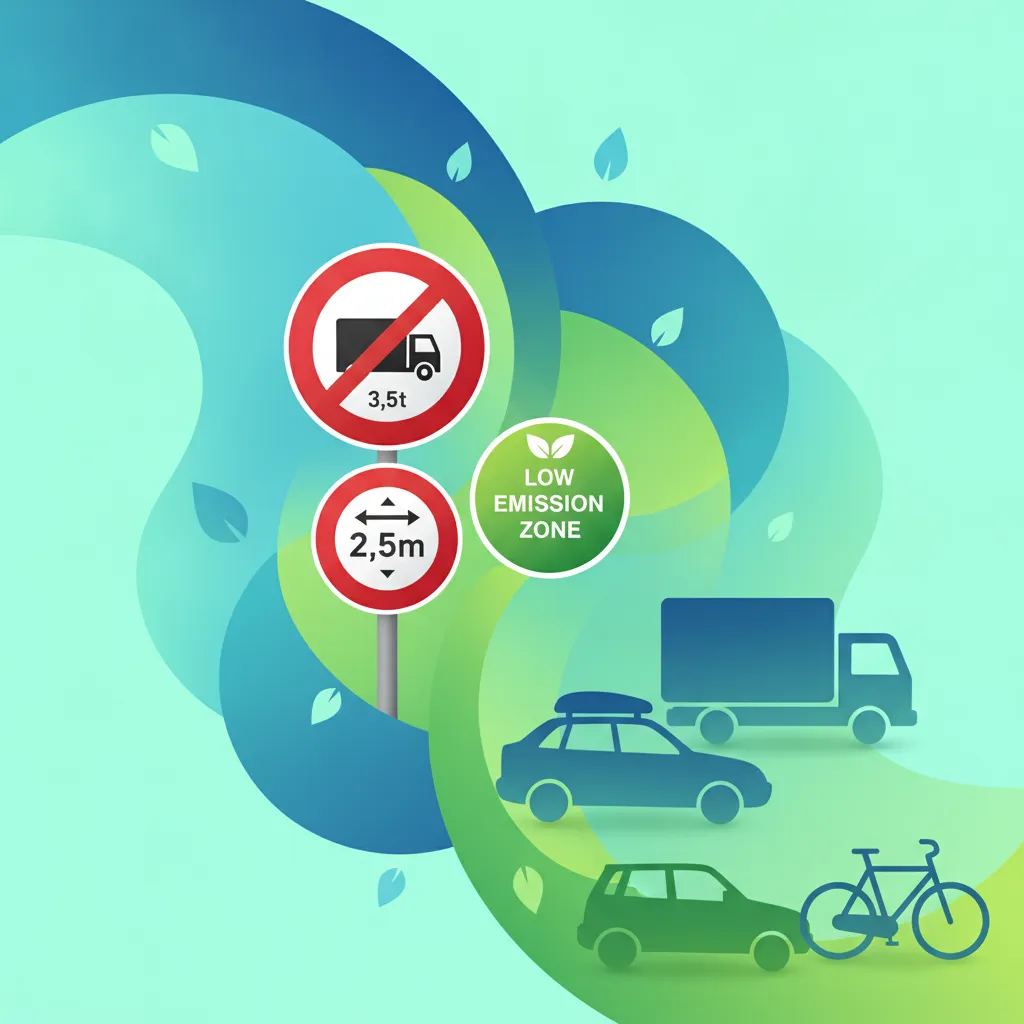
Many urban areas have restrictions to manage traffic and protect infrastructure. This lesson teaches drivers to identify and interpret traffic signs that prohibit access based on gross vehicle weight, axle load, height, or width. It also covers the growing prevalence of environmental or low-emission zones, which may restrict entry for older, more polluting vehicles.

This lesson trains drivers to look beyond other vehicles and actively search for pedestrians, cyclists, and motorcyclists, especially those who may be distracted or unaware. It covers common behavioral patterns of different VRU groups. The goal is to see potential hazards developing early and create time and space to react safely.
Motorway driving requires constant concentration due to high speeds. This lesson emphasizes the importance of staying in the right-hand lane unless overtaking and the specific restrictions on lorry overtaking in Switzerland. It reinforces the need for a following distance of at least four seconds to compensate for the vehicle's long stopping distance and provides guidance on safely merging and exiting.
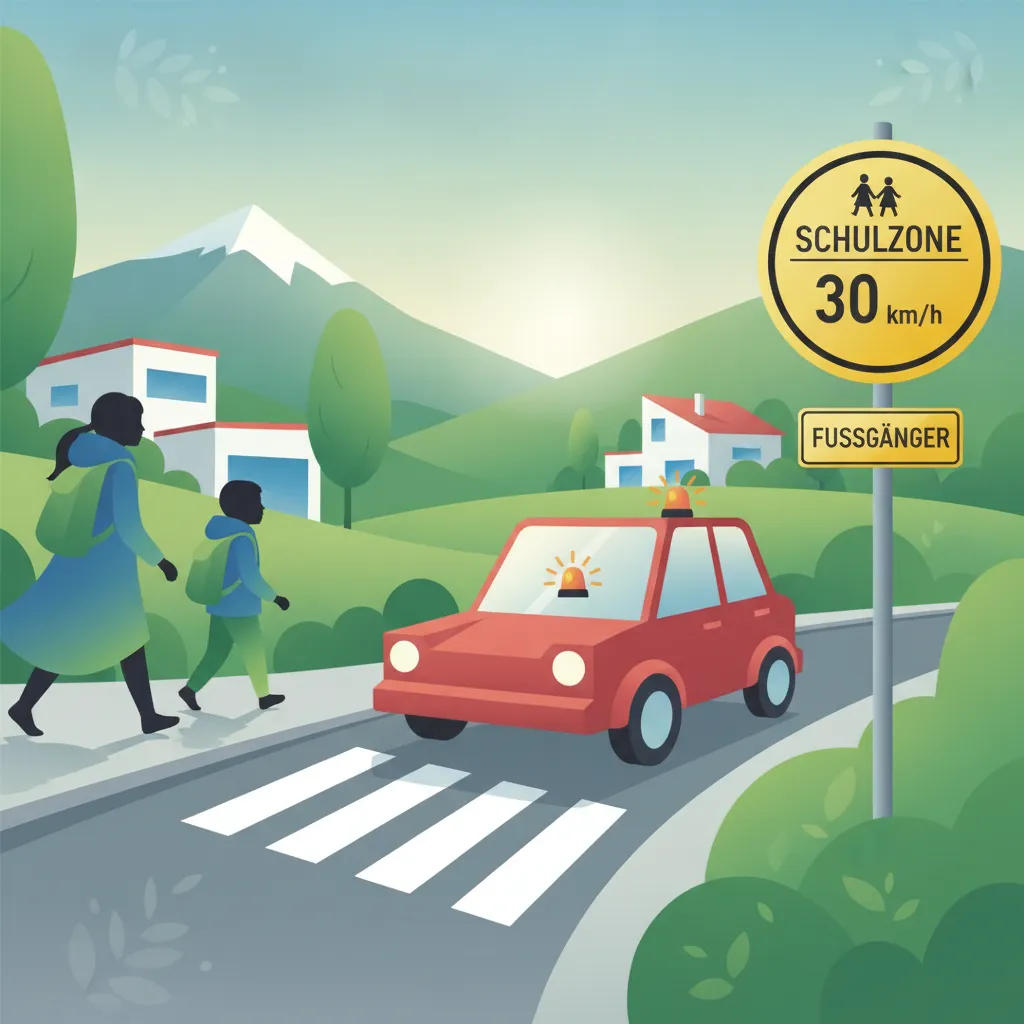
This lesson focuses on school zones, where special speed limits and cautionary measures are required. You will learn to recognize school zone signs, understand reduced speed limits, and be aware of designated child crossing zones. The content also emphasizes the need for heightened vigilance when school buses stop for students to ensure child safety.
Find clear answers to common questions learners have about Identifying and Managing Extensive Blind Spots. Learn how the lesson is structured, which driving theory objectives it supports, and how it fits into the overall learning path of units and curriculum progression in Switzerland. These explanations help you understand key concepts, lesson flow, and exam focused study goals.
Because of the height and length of heavy vehicles, standard mirrors leave large areas, known as 'no-zones', completely hidden from view. You must use a combination of wide-angle, close-proximity, and front mirrors to cover these critical gaps.
The exam often uses images or videos where you must identify if a cyclist or pedestrian is currently in a blind spot. You will be tested on your ability to recognize these hazards before initiating a turn or lane change.
Yes, Swiss regulations require specific mirror types (front, kerb, and wide-angle) on lorries to minimize these areas. This lesson teaches you how to ensure these are adjusted correctly before starting your journey.
The biggest risk is the 'left-hook' or 'right-hook' conflict with cyclists when turning at a junction. Because the cyclist may be positioned in a blind spot alongside the trailer, you must use your mirrors and shoulder checks extensively before steering.
Pinpoint specific Swiss traffic rules, road signs, or driving situations you need to master. Use the practice search to start a focused revision session now and build confidence for your official driving theory exam.