
This lesson details the critical, legally mandated actions you must take if involved in a road traffic accident while operating a heavy vehicle. You will learn the priority sequence of securing a scene, alerting emergency services, and managing your professional responsibilities under Swiss law.
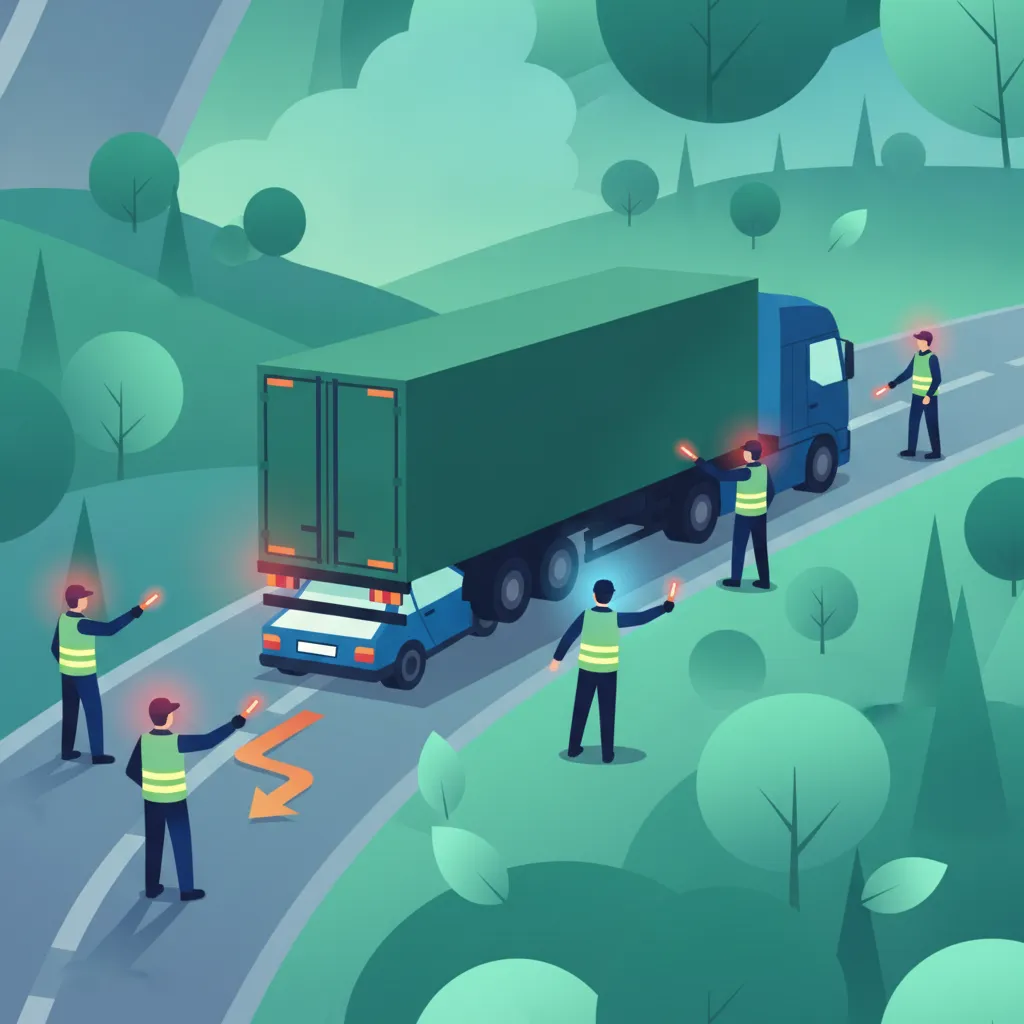
Lesson content overview
Driving a heavy goods vehicle (Category C or C1) comes with significant responsibility, especially when involved in a road traffic accident. Due to their immense mass, length, and potential to carry hazardous loads, heavy vehicles pose unique challenges in collision scenarios. Effective, immediate, and structured action is paramount to protect lives, prevent secondary accidents, and ensure legal compliance. This lesson outlines the critical steps required for heavy vehicle drivers in Switzerland following an accident.
Proper accident management for heavy vehicles builds on fundamental road safety principles but demands heightened awareness and specific protocols. Understanding these procedures is not only a legal obligation but a moral one, designed to mitigate harm to occupants, other road users, and the environment.
The moments immediately following a road accident involving a heavy vehicle are critical. Your primary objectives are to ensure your own safety, the safety of your passengers, and to prevent any further danger to other road users. This systematic approach is universally recognized and begins with a swift assessment of the situation.
As soon as an impact occurs or you become aware of an accident, your first mandatory step is to stop your vehicle safely. Do not drive away, even if you believe the damage is minor or you were not at fault. Once stopped, you must immediately activate your hazard warning lights to signal to other traffic that your vehicle is stationary and potentially obstructing the road.
Stop Immediately: Bring your vehicle to a controlled stop at the scene of the accident.
Activate Hazard Warning Lights: Switch on your hazard lights (all indicators flashing simultaneously) to alert approaching traffic.
Assess for Danger: Before exiting the vehicle, quickly scan your surroundings for immediate hazards. Look for fire, smoke, spilled fuel or cargo, broken parts on the road, or fast-approaching traffic.
Put on a Reflective Vest: If it's safe to exit your vehicle, put on a high-visibility reflective vest (Warnweste / gilet de sécurité) before opening the door. This ensures you are clearly seen by other road users, especially in poor visibility conditions.
Exit Safely: If possible and safe, exit your vehicle on the side away from active traffic.
Heavy goods vehicles, by their very nature, introduce amplified risks into an accident scenario. Their mass means greater destructive force in a collision and longer stopping distances, increasing the potential for multiple vehicle impacts. The loads they carry can shift, spill, or even ignite, creating secondary hazards like road obstruction, environmental contamination, or fire.
Furthermore, a stationary heavy vehicle, especially on a motorway or at night, presents a significant obstacle. Its size can obscure the view for other drivers, leading to further collisions if the scene is not adequately secured. Recognizing these enhanced risks underpins all subsequent actions.
After assessing the immediate dangers, your next priority is to make the accident scene safe for everyone involved and for approaching traffic. This involves deploying warning devices and ensuring your heavy vehicle cannot move unintentionally.
Your hazard warning lights are crucial for immediate notification. They provide a clear visual signal that your vehicle is not moving normally and requires caution from other drivers. These should be activated as soon as your vehicle comes to a stop after an incident. Leaving them off, especially in low light or adverse weather, significantly increases the risk of another vehicle colliding with yours.
Hazard lights are designed for temporary stops in hazardous situations. They do not replace the need for warning triangles.
Warning triangles (Pannendreieck / triangle de panne) are essential for alerting oncoming traffic to an obstruction ahead. Their reflective properties make them visible even at night or in poor weather. The distance at which you place the triangle is critical and varies based on the road type to give other drivers enough time to react.
Motorways (Autobahnen / autoroutes): Place the warning triangle approximately 150 metres behind your heavy vehicle. This considerable distance accounts for higher speeds and longer reaction times needed on motorways.
Other Roads: On urban streets, rural roads, or any road type other than a motorway, the warning triangle should be placed about 50 metres behind your vehicle. In urban areas, if space is constrained, it may be placed closer, but ensure maximum visibility.
Always walk facing oncoming traffic when placing the triangle, wearing your reflective vest, and keeping an eye on your surroundings.
Wearing a high-visibility reflective vest is mandatory whenever you leave your vehicle on the road after an accident or breakdown. This simple garment significantly enhances your visibility to other drivers, reducing the risk of you being struck by passing traffic. Always keep one readily accessible in your heavy vehicle.
Never attempt to place a warning triangle or assist at an accident scene without first putting on a reflective vest. Your personal safety is paramount.
A heavy vehicle, especially on an incline or if damaged, can roll or drift if not properly secured. After an accident, ensure your vehicle is completely immobilized.
Engage Parking Brake: Always apply the parking brake firmly.
Select Lowest Gear (Manual) or Park (Automatic): If your vehicle has a manual gearbox, engage the lowest gear. For automatic transmissions, select "P" (Park).
Use Chocking Devices: If available and safe to do so, place wheel chocks (Hemmschuhe / cales de roue) under the wheels, especially if you are on a slope. This provides an additional layer of security against unintentional movement.
Switch Off Engine: Turn off the engine to reduce fire risk and prevent unintended vehicle functions.
During your initial danger assessment, you might identify immediate threats beyond traffic. These require specific, rapid responses:
Materials or items with hazardous properties which, if not properly controlled, present a potential hazard to human health and safety, infrastructure, or their means of transport. In Switzerland, their transport is governed by specific regulations.
Once the immediate scene is secured and initial dangers are assessed, contacting the emergency services is your next critical step. In Switzerland, as across much of Europe, the universal emergency number is 112.
You are legally obliged to contact emergency services (police, fire, ambulance) immediately via 112 if:
When you call 112, remain calm and provide concise, accurate information. The dispatcher needs specific details to send the appropriate emergency teams.
Exact Location: Give the most precise location possible. This includes the road name (e.g., A1 motorway, main road number), direction of travel, kilometre markers if available, and any nearby landmarks (exits, tunnels, towns).
Nature of the Accident: Briefly describe what happened (e.g., "rear-end collision," "vehicle overturned," "truck hit a barrier").
Number of Injured Persons: State how many people appear to be injured and, if you can assess safely, the severity of their injuries (e.g., "one person trapped," "several walking wounded").
Type of Vehicles Involved: Specify that a "heavy goods vehicle" or "semi-trailer" is involved, and mention other vehicle types if known (e.g., "car," "motorcycle").
Presence of Dangerous Goods: If your heavy vehicle or another involved vehicle is carrying dangerous goods, state this clearly and provide any UN numbers or hazard placards visible.
Fire or Other Hazards: Report any fire, smoke, fuel spills, or other significant dangers you have identified.
Do not hang up until the dispatcher tells you to do so; they may have further questions or instructions.
After contacting emergency services, your focus may shift to assisting injured parties. Your role in providing first aid is important but strictly limited by your training and legal obligations.
In Switzerland, there is a legal duty to render assistance to injured persons. However, this does not mean you are expected to perform advanced medical procedures without training. Your primary obligation, if untrained, is to ensure professional help is called and to provide basic comfort and safety to the injured until paramedics arrive.
You are not legally obligated to perform first aid if you do not possess appropriate training. However, you are legally obliged to notify emergency services of any injuries and to ensure the injured person is not exposed to further danger.
If you possess valid first aid training, you are expected to provide assistance within the scope of your knowledge. This might include:
Always prioritize your own safety. Do not put yourself in danger to assist others.
Beyond ensuring safety and calling for help, you have clear legal obligations following an accident involving your heavy vehicle. These steps are crucial for determining liability, processing insurance claims, and complying with Swiss Road Traffic Regulations.
The Swiss Road Traffic Act (Strassenverkehrsgesetz, SVG / Loi sur la circulation routière, LCR) mandates that any driver involved in an accident must stop immediately. You must remain at the scene until all necessary information has been exchanged with other parties involved. Leaving the scene of an accident without exchanging information is a serious criminal offense, often referred to as a "hit-and-run" (Fahrerflucht / délit de fuite), carrying severe penalties including fines, license suspension, and even imprisonment.
It is crucial to exchange comprehensive information with all other drivers or parties involved in the accident. This data forms the basis for insurance claims and any subsequent investigations. Be polite and cooperative, but avoid arguments about fault.
Your Full Name and Address
Your Vehicle Registration Number (Kontrollschild / numéro d'immatriculation)
Your Insurance Company Details and Policy Number
Your Driver's License Number
Your Vehicle Identification Number (VIN) / Chassis Number (Fahrgestellnummer / numéro de châssis)
You should also gather the same information from the other parties. If any party refuses to provide information or seems uncooperative, note this and report it to the police when they arrive. Take photos of the accident scene, vehicle positions, and damage if it is safe to do so and does not hinder emergency services.
For accidents involving injuries, fatalities, or significant material damage (generally exceeding 1,200 CHF per vehicle), you are typically required to complete an official accident report form. In Switzerland, a common form for insurance purposes and initial reporting is referred to as "Formular 2" (or "Constat amiable d'accident" in French-speaking regions).
This form records the details of the accident, including date, time, location, parties involved, vehicle details, insurance information, and a diagram of the accident scene. Completing it accurately helps authorities and insurance companies reconstruct the event. If the police are present, they will often guide this process or complete their own official report.
The core principles of accident management remain constant, but specific actions may need adjustment based on the surrounding environment and conditions.
Adverse weather or low visibility significantly compounds the dangers at an accident scene.
Different road environments present unique challenges.
If your heavy vehicle is transporting dangerous goods and an accident results in a spill, leak, or fire involving these materials, specific, enhanced protocols apply.
The dynamics of a heavy load or a detached trailer add complexity.
Failing to follow the correct procedures after a heavy vehicle accident can have severe repercussions.
By adhering strictly to the established protocols, heavy vehicle drivers uphold their professional responsibility and contribute significantly to road safety and effective emergency management.
Understanding the procedures for managing a road accident involving a heavy vehicle is fundamental for all Category C and C1 goods vehicle drivers in Switzerland. This knowledge, combined with practical training, empowers you to act decisively and correctly when faced with an emergency.
This lesson covers the legally mandated procedures for heavy vehicle drivers in Switzerland when involved in a road accident. The priority sequence is clear: secure your own safety, make the scene safe for others by deploying hazard lights and warning triangles at specified distances, call emergency services via 112 with precise information, and render assistance within your training limits. Drivers must stop immediately, exchange specific personal and vehicle details with all parties, and complete Formular 2 for accidents involving injuries or material damage exceeding 1,200 CHF. Failure to comply can result in hit-and-run charges, increased liability for secondary collisions, and insurance complications.
A short set of high-value points that capture the most important learning from this lesson.
Safety takes priority: secure your own safety first, then protect the scene from further hazards before providing any assistance.
Warning triangle placement is legally defined: 150 metres on motorways and 50 metres on all other roads in Switzerland.
The 112 emergency number is mandatory for reporting any injury, traffic obstruction, dangerous goods involvement, or material damage exceeding 1,200 CHF.
Leaving the scene of an accident without exchanging required information constitutes hit-and-run (Fahrerflucht), a serious criminal offence.
Heavy vehicle drivers must use hazard lights immediately, wear a reflective vest before exiting, engage the parking brake, and select a low gear or Park to immobilize the vehicle.
Explore all units and lessons included in this driving theory course.
Always activate hazard lights first, then put on your reflective vest, then place warning triangles facing oncoming traffic while walking on the road side.
When calling 112, report exact location, accident type, number of injured persons, vehicle types including heavy goods vehicle, and any dangerous goods with UN numbers.
The mandatory information to exchange includes full name and address, vehicle registration, insurance details, driver's license number, and VIN/chassis number.
If carrying dangerous goods and involved in an accident, maintain a safe distance, do not attempt cleanup, and clearly state the UN number and hazard class when calling emergency services.
Without first aid training you are legally required to call emergency services and protect the injured from further danger, but not to perform medical procedures.
Placing warning triangles at incorrect distances or in the wrong direction, reducing reaction time for approaching drivers.
Leaving the accident scene prematurely or failing to exchange all required information with other parties involved.
Exiting the vehicle without first activating hazard lights or putting on a reflective vest, creating personal safety risks.
Forgetting to immobilize the heavy vehicle properly by not engaging the parking brake or selecting Park/low gear, especially on slopes.
Failing to notify emergency services when material damage exceeds the 1,200 CHF threshold, even if there are no injuries.
Lesson content overview
A short set of high-value points that capture the most important learning from this lesson.
Safety takes priority: secure your own safety first, then protect the scene from further hazards before providing any assistance.
Warning triangle placement is legally defined: 150 metres on motorways and 50 metres on all other roads in Switzerland.
The 112 emergency number is mandatory for reporting any injury, traffic obstruction, dangerous goods involvement, or material damage exceeding 1,200 CHF.
Leaving the scene of an accident without exchanging required information constitutes hit-and-run (Fahrerflucht), a serious criminal offence.
Heavy vehicle drivers must use hazard lights immediately, wear a reflective vest before exiting, engage the parking brake, and select a low gear or Park to immobilize the vehicle.
Explore all units and lessons included in this driving theory course.
Always activate hazard lights first, then put on your reflective vest, then place warning triangles facing oncoming traffic while walking on the road side.
When calling 112, report exact location, accident type, number of injured persons, vehicle types including heavy goods vehicle, and any dangerous goods with UN numbers.
The mandatory information to exchange includes full name and address, vehicle registration, insurance details, driver's license number, and VIN/chassis number.
If carrying dangerous goods and involved in an accident, maintain a safe distance, do not attempt cleanup, and clearly state the UN number and hazard class when calling emergency services.
Without first aid training you are legally required to call emergency services and protect the injured from further danger, but not to perform medical procedures.
Placing warning triangles at incorrect distances or in the wrong direction, reducing reaction time for approaching drivers.
Leaving the accident scene prematurely or failing to exchange all required information with other parties involved.
Exiting the vehicle without first activating hazard lights or putting on a reflective vest, creating personal safety risks.
Forgetting to immobilize the heavy vehicle properly by not engaging the parking brake or selecting Park/low gear, especially on slopes.
Failing to notify emergency services when material damage exceeds the 1,200 CHF threshold, even if there are no injuries.
Explore search topics learners often look for when studying Actions at a Road Accident Involving a Heavy Vehicle. These topics reflect common questions about road rules, driving situations, safety guidance, and lesson level theory preparation for learners in Switzerland.
Browse additional driving theory lessons that cover connected traffic rules, road signs, and common driving situations related to this topic. Improve your understanding of how different rules interact across everyday traffic scenarios.
Understand your mandatory legal responsibilities after a road traffic accident involving a heavy vehicle in Switzerland. This includes stopping, exchanging information, and reporting procedures to comply with Swiss law for Category C and C1 drivers.
The driver is legally responsible for the roadworthiness of their vehicle at the start of and during every journey. This lesson outlines the formal process for reporting any identified defects to the transport manager or maintenance staff. It stresses the critical rule that a vehicle with a known safety-critical defect must not be driven until it has been professionally repaired and declared safe.
This lesson clarifies the legal requirements for reporting traffic incidents in Switzerland. It provides guidance on how to interact with police and emergency personnel, providing clear and accurate information. Understanding these procedures helps ensure the incident is documented correctly for legal and insurance purposes.
This lesson outlines the mandatory documentation required during any professional transport journey in Switzerland. Drivers must be able to present the vehicle registration document ('Fahrzeugausweis'), their valid driving license, and the OACP qualification card upon request. It also touches upon transport-specific documents like consignment notes, which are crucial for legal compliance during roadside inspections by authorities.

Operating a heavy goods vehicle involves a significant responsibility for the safety of all road users. This lesson emphasizes the professional driver's enhanced duty of care due to the vehicle's size, mass, and potential impact in a collision. It covers the importance of a professional attitude, constant vigilance, and adherence to all traffic regulations to prevent incidents and maintain a high standard of road safety.
This lesson emphasizes the broad responsibilities of holding a driver's licence in Switzerland, including adherence to traffic laws and maintaining vehicle roadworthiness. It covers legal obligations related to insurance, registration, and reporting accidents, as well as the consequences of violations. The content reinforces the duty of care drivers owe to all other road users.
For professional drivers, traffic violations can have career-altering consequences beyond standard fines. This lesson details the heightened penalties for infringements such as speeding, overloading, insecure loads, and violations of driving time regulations. It outlines the process of warnings, license suspension or withdrawal, and potential criminal liability, emphasizing the importance of strict legal compliance in the transport industry.
This lesson outlines the legal repercussions for breaking traffic laws in Switzerland. It details the system of fines and administrative measures, including the potential for license withdrawal for serious offenses. The content also explains a rider's legal duties after being involved in an accident, including reporting and insurance obligations.

Losing part of a load on the road creates an immediate and serious hazard for other drivers. This lesson outlines the driver's responsibilities: stop in a safe place, assess the situation from a safe distance, and immediately alert the police. The driver's primary role is to warn other road users and not to attempt to retrieve the load from a live carriageway.

While others may have loaded the vehicle, the driver holds the final legal responsibility for the security of the load once on the public highway. This lesson clarifies this crucial point of law, explaining that the driver must inspect the load and its securing arrangements before departure and re-check them during the journey. The consequences of a load shifting or falling can be catastrophic and result in severe legal penalties for the driver.
Overloading is a serious offence with severe safety and legal ramifications. This lesson details how excess weight drastically increases braking distances, puts extreme stress on tyres leading to blowouts, and negatively affects steering and overall stability. Furthermore, it discusses the substantial fines, potential license withdrawal, and driver liability that result from violating Swiss weight regulations.
Learn how to effectively secure an accident scene involving a heavy vehicle, manage immediate hazards such as dangerous goods or fire, and clearly communicate critical information to emergency services like 112 in Switzerland.
After stopping for an emergency, making the scene safe is the top priority. This lesson details the procedure: activate hazard warning lights, put on high-visibility clothing before exiting the cab, and place the warning triangle at the correct distance behind the vehicle (at least 100m on motorways). This warns approaching traffic and creates a safer environment for the driver and emergency responders.
Losing part of a load on the road creates an immediate and serious hazard for other drivers. This lesson outlines the driver's responsibilities: stop in a safe place, assess the situation from a safe distance, and immediately alert the police. The driver's primary role is to warn other road users and not to attempt to retrieve the load from a live carriageway.
This lesson covers the immediate actions to take following a collision. The priorities are to prevent further incidents by securing the scene, to assess the situation for injuries, and to alert the emergency services. You will learn the correct procedures for making the area safe for yourself, your passengers, and other road users.
Find clear answers to common questions learners have about Actions at a Road Accident Involving a Heavy Vehicle. Learn how the lesson is structured, which driving theory objectives it supports, and how it fits into the overall learning path of units and curriculum progression in Switzerland. These explanations help you understand key concepts, lesson flow, and exam focused study goals.
Yes. Under Swiss law, every driver involved in an accident, regardless of the severity, must stop and remain at the scene to exchange information. Leaving the scene without doing so is considered a hit-and-run, which carries severe legal consequences for professional drivers.
Your first priority is to secure the site to prevent further incidents. This includes switching on your hazard lights, setting up a warning triangle at a sufficient distance, and ensuring your own safety before attempting to check on others.
While the fundamental duty to assist and report is the same, as a professional Category C or C1 driver, you are expected to demonstrate higher levels of awareness, especially regarding the potential for hazardous loads or the greater danger your vehicle poses to others in a crash.
You are legally required to provide assistance that is reasonable and safe. This primarily means calling 112 and providing accurate location details; you are not expected to perform medical procedures, but you must not leave the scene if your presence is needed to assist.
Pinpoint specific Swiss traffic rules, road signs, or driving situations you need to master. Use the practice search to start a focused revision session now and build confidence for your official driving theory exam.