
This lesson details the critical safety requirements for securing loads and protecting passengers within your vehicle. It is a vital part of your preparation for the Belgian Category B theoretical exam, focusing on how cargo weight and passenger safety equipment directly influence vehicle stability and legal compliance on the road.
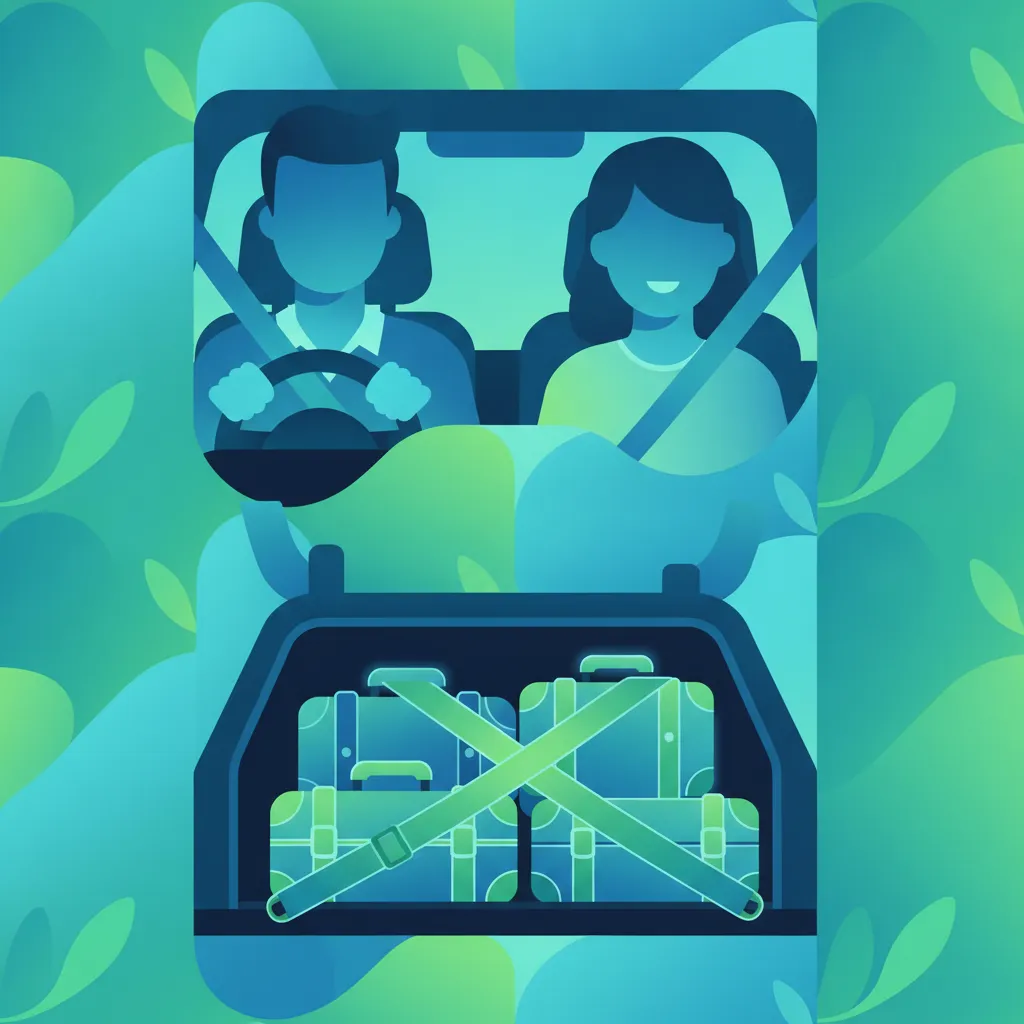
Lesson content overview
Driving a vehicle safely on Belgian roads involves more than just understanding traffic rules and signs; it also requires a thorough grasp of how your vehicle's load and passengers affect its performance and stability. This lesson delves into the critical aspects of securing loads and ensuring the safety of all occupants, fundamental knowledge for any driver pursuing their Belgian Category B Driving Licence. Proper load securement prevents cargo from becoming a hazard, while correct use of seatbelts and child restraint systems safeguards lives in the event of an accident.
The way weight is distributed within your vehicle significantly impacts its handling, braking, and overall stability. An improperly loaded vehicle can become unpredictable, increasing the risk of accidents.
Load distribution refers to how the total weight of your vehicle, including its occupants and cargo, is spread out. Every vehicle is designed with an optimal centre of gravity, which is the point where the entire mass of the vehicle is balanced. When you add weight, especially in significant amounts or in high positions, this centre of gravity shifts.
For safe driving, it's ideal to keep the vehicle's centre of gravity as low and as central as possible. This arrangement helps maintain stability, especially during turns, braking, or sudden manoeuvres. Imagine trying to balance a heavy box: it's much easier to keep it stable when held low to the ground than when held high above your head. The same principle applies to your vehicle.
An uneven or excessive load can severely compromise your vehicle's driving characteristics:
While specific rules might vary, the overarching principle in Belgium, as in most places, is that loads must be safely distributed and secured to prevent them from affecting the driver's control or causing danger to other road users. This includes not exceeding the vehicle's maximum permissible load limits, which are discussed in detail later. Failure to comply can result in fines and legal consequences.
Securing cargo is not just about preventing items from shifting around; it's about protecting lives. Unsecured items, even small ones, can become deadly projectiles in a collision or during sudden braking.
The primary reason to secure loads is to prevent them from moving. During normal driving, sudden acceleration, braking, or turns can cause unsecured items to slide, roll, or even fly around the cabin or cargo area.
Effective load securement utilizes various tools and techniques:
Many drivers underestimate the forces involved in even a moderate collision or sudden stop, leading to common mistakes:
Seatbelts are arguably the most critical safety feature in a vehicle. Their correct use is mandatory for all occupants in Belgium and significantly reduces the risk of serious injury or fatality in a collision.
Seatbelts are designed to work with your vehicle's other safety features, such as airbags, to keep you safe. In a crash, a seatbelt:
Most modern vehicles are equipped with three-point seatbelts, which consist of a lap belt and a shoulder belt. These are highly effective when used correctly:
In Belgium, it is mandatory for all occupants of a vehicle to wear a seatbelt if one is fitted, regardless of whether they are in the front or rear seats. This rule applies at all times while the vehicle is in motion. There are very limited exceptions, typically for specific professions under specific circumstances (e.g., taxi drivers during certain periods, delivery drivers making frequent stops), but for the average driver and passenger, the rule is absolute.
Children, due to their developing bodies and different proportions, cannot be safely restrained by adult seatbelts alone. They require specialized Child Restraint Systems (CRS), commonly known as car seats, to provide adequate protection.
A child's body is more fragile than an adult's, particularly their head, neck, and spine. An adult seatbelt is designed for an adult body frame and musculature. For a child:
Child restraint systems are categorised based on a child's weight, height, and sometimes age, ensuring they provide the best fit and protection. It is crucial to use the correct type of CRS for your child.
Generally, CRS categories include:
Rear-Facing Child Seats (Group 0/0+):
Forward-Facing Child Seats (Group 1):
Booster Seats (Group 2/3):
Even the best CRS cannot protect a child if it's not installed correctly. Common mistakes include:
Read both the car seat manual and your vehicle's owner's manual for specific instructions.
Choose the correct installation method: using the vehicle's seatbelts or ISOFIX/LATCH attachments (if available and compatible).
Ensure the car seat is tightly secured and does not move excessively.
Route the harness correctly and ensure it is snug against the child, without twists.
Confirm the buckle is properly fastened and the chest clip is at armpit level.
Every vehicle has specific limits on how much weight it can safely carry. Exceeding these limits, known as overloading, is illegal and profoundly compromises vehicle safety.
You can find your vehicle's GVWR and other weight specifications on a sticker usually located on the driver's side door jamb, in the glove compartment, or in the owner's manual.
Exceeding your vehicle's load capacity has multiple dangerous consequences:
The easiest way to check your vehicle's load limits is to consult the label on the driver's door pillar or your vehicle's owner's manual. These sources will provide the Gross Vehicle Weight Rating (GVWR) and often the maximum axle weights. If you are unsure, consider weighing your vehicle at a public weighbridge when fully loaded to ensure compliance.
Compliance with Belgian traffic laws regarding load securement and passenger safety is non-negotiable. These regulations are designed to protect everyone on the road.
Violations of these regulations can lead to various penalties, including:
Let's look at some real-world scenarios to consolidate understanding:
Scenario 1: Moving House with Loose Items
Scenario 2: Driving with a Young Child
Scenario 3: Holiday Trip with Extensive Luggage
Load securement and passenger safety are fundamental aspects of responsible driving. By understanding the principles of load distribution, diligently securing all cargo, correctly using seatbelts, and ensuring children are in appropriate restraint systems, you significantly reduce the risk of accidents and the severity of injuries. Adhering to vehicle load limits and Belgian regulations is not just about avoiding fines; it's about safeguarding yourself, your passengers, and all other road users. Always make safety your top priority before every journey.
This lesson covers the critical safety requirements for securing loads and protecting passengers on Belgian roads. You must understand how improper load distribution affects braking, steering, and stability, and always keep heavy cargo low and central. All occupants must wear seatbelts, and children under 1.35 m require an age-appropriate child restraint system. The lesson also explains vehicle load capacity limits (GVWR and payload) and the legal penalties for non-compliance, including fines and potential insurance issues.
A short set of high-value points that capture the most important learning from this lesson.
Load distribution directly affects vehicle handling, braking distance, and stability; keep the centre of gravity low and central for safe driving
All loads must be properly secured with appropriate equipment (straps, nets, barriers) to prevent items from becoming dangerous projectiles during sudden stops
Seatbelt use is mandatory for ALL occupants in Belgium, front and rear, whenever seatbelts are fitted in the vehicle
Children under 1.35 metres (135 cm) must always use an approved child restraint system matched to their weight and height
Never exceed your vehicle's Gross Vehicle Weight Rating (GVWR) - check the label on the driver's door jamb or owner's manual
Explore all units and lessons included in this driving theory course.
Rear-facing child seats are for infants up to ~13 kg; forward-facing seats for children 9-18 kg; booster seats for children 15-36 kg until they reach 1.35 m
The lap belt must sit low across hips (not stomach), and the shoulder belt must cross the chest away from the neck - never tuck it under your arm or behind your back
A properly installed child restraint system should not move more than 2-3 cm at the belt path when pulled
Payload equals GVWR minus curb weight - this is the maximum combined weight of passengers and cargo you can carry
Payload must never exceed the manufacturer's specified GVWR or individual axle load limits
Assuming a closed boot or tailgate alone will hold items - these offer minimal resistance in a sudden stop or collision
Moving a child to a booster seat or adult seatbelt before they have outgrown their current restraint based on height or weight limits
Placing heavy items high in the vehicle or on a roof rack, which raises the centre of gravity and increases rollover risk
Neglecting to re-check cargo securement after the first few kilometres as loads can settle and straps can loosen
Installing a rear-facing child seat in the front passenger seat without first deactivating the airbag - this can be fatal to an infant
Lesson content overview
A short set of high-value points that capture the most important learning from this lesson.
Load distribution directly affects vehicle handling, braking distance, and stability; keep the centre of gravity low and central for safe driving
All loads must be properly secured with appropriate equipment (straps, nets, barriers) to prevent items from becoming dangerous projectiles during sudden stops
Seatbelt use is mandatory for ALL occupants in Belgium, front and rear, whenever seatbelts are fitted in the vehicle
Children under 1.35 metres (135 cm) must always use an approved child restraint system matched to their weight and height
Never exceed your vehicle's Gross Vehicle Weight Rating (GVWR) - check the label on the driver's door jamb or owner's manual
Explore all units and lessons included in this driving theory course.
Rear-facing child seats are for infants up to ~13 kg; forward-facing seats for children 9-18 kg; booster seats for children 15-36 kg until they reach 1.35 m
The lap belt must sit low across hips (not stomach), and the shoulder belt must cross the chest away from the neck - never tuck it under your arm or behind your back
A properly installed child restraint system should not move more than 2-3 cm at the belt path when pulled
Payload equals GVWR minus curb weight - this is the maximum combined weight of passengers and cargo you can carry
Payload must never exceed the manufacturer's specified GVWR or individual axle load limits
Assuming a closed boot or tailgate alone will hold items - these offer minimal resistance in a sudden stop or collision
Moving a child to a booster seat or adult seatbelt before they have outgrown their current restraint based on height or weight limits
Placing heavy items high in the vehicle or on a roof rack, which raises the centre of gravity and increases rollover risk
Neglecting to re-check cargo securement after the first few kilometres as loads can settle and straps can loosen
Installing a rear-facing child seat in the front passenger seat without first deactivating the airbag - this can be fatal to an infant
Explore search topics learners often look for when studying Load Securement and Passenger Safety. These topics reflect common questions about road rules, driving situations, safety guidance, and lesson level theory preparation for learners in Belgium.
Browse additional driving theory lessons that cover connected traffic rules, road signs, and common driving situations related to this topic. Improve your understanding of how different rules interact across everyday traffic scenarios.
Learn how improper load distribution and exceeding vehicle weight limits impact handling, braking distance, and overall stability. Essential driving theory for safe vehicle operation in Belgium.

This lesson explores the concept of tire grip, or traction, and its importance for vehicle stability and control. It explains how different road surfaces, such as wet asphalt, gravel, or oily patches, can reduce grip and increase the risk of skidding. The content also highlights the role of correct tire pressure in maintaining optimal contact with the road, helping riders avoid a loss of traction.
This lesson details the spectrum of obligations that apply to drivers, from basic compliance with traffic signs to responsibilities like vehicle upkeep and accident reporting. Learners will understand the importance of maintaining a vehicle in a roadworthy condition. It also covers the legal expectations for safe driving practices, including the use of safety equipment.

This lesson focuses on driving safely in adverse weather like rain, fog, and low sun glare, which affects road friction and visibility. It provides guidelines on speed adaptation, maintaining a safe following distance, and the proper use of vehicle equipment like lights and wipers. Learners will understand how to reduce risks like hydroplaning and skidding.
The focus of this lesson is on maintaining proper lane discipline, especially on motorways and other high-speed roads. Learners will explore the rules for changing lanes, overtaking, and positioning in the correct lane based on speed and traffic flow. Emphasis is placed on safe merging techniques and adherence to all lane markings for fluid traffic movement.
In this lesson, learners will explore the concept of a safe following distance, primarily through the application of the two-second rule. It also breaks down the components of total stopping distance: perception-reaction time and braking distance. Learners will understand how to adjust these distances based on their speed, vehicle, and current road conditions.
This lesson covers the principles of effective braking, distinguishing between controlled, progressive braking and emergency braking techniques. It breaks down the total stopping distance into reaction distance and braking distance, explaining how speed and road surface conditions dramatically affect the latter. Learners will understand how to use both front and rear brakes correctly to stop quickly and safely without losing control.

This lesson emphasizes the importance of regular vehicle maintenance and simple pre-drive inspections. Learners will understand how to check tyre pressure and tread depth, brake responsiveness, essential fluid levels, and the function of all lights. Performing these checks ensures vehicle reliability and contributes significantly to safety on the road.
This lesson details the proper use of all vehicle lights and signaling devices. It explains when to use low and high beams, fog lights, hazard lights, and turn signals to communicate effectively with other road users. Correct lighting usage improves visibility and safety, especially in adverse weather conditions and during hours of darkness.
This lesson covers the specific challenges of driving on motorways, rural roads, and navigating roadworks. Learners will review lane discipline on high-speed roads and identify hazards common to rural roads, such as sharp bends and wildlife. It also explains the importance of adjusting speed and following temporary signage in construction zones.
This lesson focuses on the critical skill of managing traction by understanding how tyres interact with different road surfaces. It teaches you to identify and react to low-grip surfaces such as wet roads, gravel, painted markings, and manhole covers. You will learn how to adjust your speed, braking, and cornering to prevent loss of traction and maintain control.
Understand the legal requirements for securing cargo and ensuring passenger safety in vehicles according to Belgian traffic law. Covers seatbelts, child restraints, and cargo limitations for your driving theory.
This lesson details the spectrum of obligations that apply to drivers, from basic compliance with traffic signs to responsibilities like vehicle upkeep and accident reporting. Learners will understand the importance of maintaining a vehicle in a roadworthy condition. It also covers the legal expectations for safe driving practices, including the use of safety equipment.
Overtaking safely is a critical driving skill. This lesson explains where and how overtaking is permitted in Belgium, the importance of correct signaling, and maintaining a sufficient speed differential. Learners will understand the rules for passing on motorways and single-carriageway roads, and how to identify zones where overtaking is prohibited.
This lesson details the proper use of all vehicle lights and signaling devices. It explains when to use low and high beams, fog lights, hazard lights, and turn signals to communicate effectively with other road users. Correct lighting usage improves visibility and safety, especially in adverse weather conditions and during hours of darkness.

This lesson focuses on the rules governing pedestrian crossings, including marked zebra crossings and signal-controlled crossings. Special attention is given to school zones and residential areas where pedestrian activity is high. Learners will understand how to recognize and respect pedestrian priority in various crossing scenarios to ensure their safety.
The focus of this lesson is on maintaining proper lane discipline, especially on motorways and other high-speed roads. Learners will explore the rules for changing lanes, overtaking, and positioning in the correct lane based on speed and traffic flow. Emphasis is placed on safe merging techniques and adherence to all lane markings for fluid traffic movement.
This lesson focuses on the legal duties and responsibilities that an AM vehicle operator must uphold on Belgian roads. It covers critical rules such as adhering to speed limits, correctly applying right-of-way principles, and following regulations for overtaking other vehicles. The lesson also explains the system of fines and penalty points for traffic violations, emphasizing the legal consequences of non-compliance to foster responsible driving habits.
This lesson covers the specific challenges of driving on motorways, rural roads, and navigating roadworks. Learners will review lane discipline on high-speed roads and identify hazards common to rural roads, such as sharp bends and wildlife. It also explains the importance of adjusting speed and following temporary signage in construction zones.
In this lesson, learners will explore the concept of a safe following distance, primarily through the application of the two-second rule. It also breaks down the components of total stopping distance: perception-reaction time and braking distance. Learners will understand how to adjust these distances based on their speed, vehicle, and current road conditions.
This lesson examines the interactions between private vehicles and public transport, focusing on buses and trams. Learners will understand the priority rules for these vehicles, recognizing dedicated lanes and stopping positions. Special considerations for motorcyclists, school buses, and other vulnerable users are also discussed to ensure safe coexistence.
This lesson emphasizes the importance of regular vehicle maintenance and simple pre-drive inspections. Learners will understand how to check tyre pressure and tread depth, brake responsiveness, essential fluid levels, and the function of all lights. Performing these checks ensures vehicle reliability and contributes significantly to safety on the road.
Find clear answers to common questions learners have about Load Securement and Passenger Safety. Learn how the lesson is structured, which driving theory objectives it supports, and how it fits into the overall learning path of units and curriculum progression in Belgium. These explanations help you understand key concepts, lesson flow, and exam focused study goals.
Uneven weight distribution significantly affects your vehicle's handling, making it harder to steer, increasing braking distances, and raising the risk of instability during sudden maneuvers or cornering, which is a common focus in exam scenarios.
Yes, children shorter than 1.35 meters must be secured in an approved child restraint system adapted to their height and weight. Following these rules is mandatory and frequently tested as part of passenger safety.
Yes, transporting an unsecured load that could shift or fall is a violation of Belgian traffic law. It creates a serious hazard for you and other road users, and you will be penalized if caught by police.
Yes, the driver and all passengers must wear seatbelts if the vehicle is equipped with them. It is the driver's responsibility to ensure that all occupants, especially children, are properly restrained before driving.
Ready to focus your Belgian driving theory revision? Utilize our powerful search tool to pinpoint exact topics, road signs, or difficulty levels. Engage with practice questions that directly address your learning needs and solidify your understanding of Belgian traffic laws for your upcoming exam.