
This lesson guides you through essential techniques for navigating challenging Danish weather conditions, including heavy rain, strong wind, and low visibility. Understanding how to adapt your speed and vehicle settings is a critical component of your Category B theory test. You will learn the correct use of lights and defensive strategies to ensure safety in diverse road environments.

Lesson content overview
Driving in Denmark requires drivers to be prepared for a variety of weather conditions, from heavy rain and strong winds to dense fog and the long hours of darkness in winter. As a part of your Danish Driving License Theory Course: Category B Preparation, this lesson will equip you with the essential knowledge and skills to navigate these challenging situations safely and confidently. Understanding how adverse weather affects your vehicle and your ability to perceive hazards is fundamental to reducing accident risk and becoming a responsible driver.
Adverse weather conditions significantly alter the driving environment, demanding heightened awareness and proactive adjustments from drivers. The core principle of safe driving under these circumstances is adapting your speed and increasing your following distance to compensate for reduced visibility and traction. This lesson focuses on the specific challenges posed by rain, wind, darkness, and fog, explaining the risks and outlining the necessary precautions.
Weather conditions can compromise the physical limits of your vehicle and your own perceptual abilities. Rain reduces tire grip, making braking and steering less effective. Strong winds can destabilize your vehicle, especially larger ones or those with trailers. Darkness and fog severely limit your vision, making it harder to spot obstacles, pedestrians, or other vehicles in time. By understanding these impacts, you can take appropriate measures to mitigate risks, ensuring not only your safety but also that of other road users.
Regardless of the specific adverse condition, certain fundamental principles apply universally to maintain safety on the road. These principles revolve around giving yourself more time and space to react, as well as making sure your vehicle is as visible as possible.
Reducing your speed is arguably the most critical adjustment in adverse weather. Higher speeds demand longer stopping distances, and reduced traction from wet or icy roads directly extends these distances. In poor visibility, a slower speed allows you more time to identify hazards and react appropriately, whether it's braking, steering, or adjusting your position. There is no fixed speed limit for bad weather; instead, you must drive at a speed that is safe for the prevailing conditions, even if it is significantly below the posted limit.
The space between your vehicle and the one ahead, known as the following distance, becomes even more crucial in adverse conditions. Reduced visibility means less time to see brake lights, and diminished traction means it takes longer to stop. Increasing your following distance provides a crucial buffer, allowing ample time to react to sudden stops or movements by the vehicle in front, and preventing potential rear-end collisions. A general rule of thumb is to increase your usual following distance by at least double, or even more, depending on the severity of the conditions.
Proper use of your vehicle's lights is essential for both seeing and being seen. In darkness, rain, or fog, standard daytime running lights (DRLs) are often insufficient to illuminate the road ahead or make your vehicle adequately visible from the rear. Knowing when to switch to dipped beams, activate fog lights, or use high beams (and when not to) is a vital skill. Incorrect lighting can dazzle other drivers, reduce your own visibility, or even lead to legal penalties under Danish traffic laws.
Rain is a common occurrence in Denmark and can quickly make roads slippery and hazardous. Understanding the risks, especially aquaplaning, is crucial for safe driving.
A dangerous condition where a layer of water builds up between a vehicle's tires and the road surface, causing a loss of traction and control over steering and braking.
Aquaplaning, also known as hydroplaning, occurs when your tires lose contact with the road surface due to a film of water. Instead of gripping the asphalt, the tires essentially float on the water, making it impossible to steer or brake effectively. This can happen in heavy rain, especially when water accumulates on the road, or if your tires are worn.
At moderate speeds, aquaplaning might cause a slight wobble or loss of steering precision. At higher speeds, or in very deep water, the loss of control can be sudden and complete, leading to dangerous skids or uncontrolled drifts.
Prevention is key when it comes to aquaplaning. The primary preventive measure is to reduce your speed significantly when driving in heavy rain or on roads with standing water. Slower speeds allow the tire tread more time to displace water, maintaining contact with the road.
When driving in rain, avoid sudden braking or steering movements. Gentle inputs are less likely to break traction. If you feel your vehicle start to aquaplane, ease off the accelerator, keep the steering wheel pointed straight, and avoid braking until your tires regain contact with the road.
Maintaining an increased following distance also gives you more time to react if the vehicle ahead encounters standing water or brakes suddenly. Be particularly cautious when driving through puddles, as their depth can be deceptive, and a sudden splash can momentarily obscure your vision or affect your vehicle's stability.
The condition of your tires plays a significant role in preventing aquaplaning. Tires with adequate tread depth are designed to channel water away from the contact patch between the tire and the road. If your tires are worn, their ability to displace water is severely compromised, greatly increasing the risk of aquaplaning even in moderate rain. Regularly check your tire tread depth; the minimum legal requirement in Denmark is 1.6 mm, but greater depths provide better performance in wet conditions.
Strong winds, particularly crosswinds (winds blowing perpendicular to your direction of travel), can significantly affect your vehicle's stability and control, especially on exposed roads like bridges, causeways, or open fields.
Crosswinds can exert considerable force on the side of your vehicle, potentially pushing it sideways. This effect is more pronounced for:
A sudden gust of wind can cause your vehicle to drift unexpectedly into an adjacent lane or towards the shoulder, requiring immediate steering correction. This can be particularly dangerous if you are close to other vehicles or driving at high speed.
To manage strong crosswinds:
Driving after sunset, before sunrise, or during twilight hours presents distinct challenges due to significantly reduced visibility. Even with headlights, human eyes perceive less depth, contrast, and color in low light.
In darkness, your ability to spot hazards, road markings, and other road users is severely diminished. Pedestrians, cyclists, and animals can be particularly difficult to see, especially if they are wearing dark clothing or lack proper reflective gear. Glare from oncoming headlights can temporarily blind you, further reducing your reaction time. Roads that are familiar during the day can become disorienting at night.
Proper headlight usage is paramount:
Avoid looking directly into oncoming headlights; instead, focus your gaze slightly to the right edge of your lane to maintain your night vision.
Fog is one of the most challenging weather conditions for drivers because it drastically reduces visibility, sometimes to only a few meters. Driving in fog requires extreme caution and specific lighting adjustments.
Dense fog makes it very difficult to judge distances, speeds, and the position of other vehicles. The moisture in the air refracts light, making high beams ineffective and potentially causing severe glare that reflects back at you, worsening visibility. Road markings can disappear, and hazards can emerge suddenly from the gloom. Driving too fast in fog is extremely dangerous, as you may not have enough time to react to an obstacle.
Specialized lights, usually mounted low on the front and sometimes the rear of a vehicle, designed to cut through fog and illuminate the road directly ahead without causing excessive glare.
In Denmark, fog lights (tågelys) should only be used when visibility is significantly reduced due to fog, heavy rain, or snow. The rule of thumb for visibility is often considered to be less than 50 meters, but it's ultimately about judgment of serious reduction.
Never use high beam headlights in fog. They will reflect off the fog droplets, creating a "wall of light" that reduces your visibility even further.
When driving in fog:
Understanding the purpose and correct application of each lighting system on your vehicle is vital for safety, particularly in adverse conditions.
Compliance with Danish traffic laws is essential. The regulations emphasize adapting to conditions and using appropriate vehicle features.
While there are no specific speed limits exclusively for rain or fog, Danish traffic law mandates that drivers must always adapt their speed to the prevailing road, traffic, and weather conditions. Failure to reduce speed in adverse weather to a safe level, leading to an accident or hazardous situation, is a serious traffic violation. Similarly, maintaining an insufficient following distance under hazardous conditions can result in penalties, as it contravenes the duty to drive safely and considerately.
Danish law specifies a minimum legal tread depth of 1.6 mm for tires. However, for safe driving in wet conditions, a significantly greater tread depth is recommended. Worn tires (close to the legal limit) are far more prone to aquaplaning and have extended braking distances on wet roads. Regular tire maintenance, including checking tread depth and pressure, is not just a legal obligation but a crucial safety measure.
Many accidents in adverse weather stem from common errors. Being aware of these can help you avoid them.
Driving in rain, wind, darkness, or fog demands a proactive and adaptive approach. The key takeaways for safe driving in adverse weather conditions for your Danish Category B license are:
By consistently applying these principles, you will significantly enhance your safety and the safety of others on the road, regardless of the weather.
Driving in adverse weather requires adapting speed and following distance to current conditions, with no fixed weather-specific speed limits—only what is safe for the circumstances. Rain creates aquaplaning risk when tires lose road contact; prevention through speed reduction and maintaining adequate tire tread depth is essential. Fog and darkness demand correct headlight selection: dipped beams are mandatory from sunset to sunrise and in reduced visibility, while fog lights should only be used when visibility falls below approximately 50 meters and high beams must never be used in fog. Strong crosswinds particularly threaten high-profile vehicles and those with trailers, requiring reduced speed and firm steering corrections on exposed roads. Danish regulations mandate dipped beams in low visibility, high beams dimmed within 200 meters of oncoming traffic, and minimum 1.6mm tire tread depth, with worn tires significantly elevating aquaplaning risk.
A short set of high-value points that capture the most important learning from this lesson.
Always reduce speed and increase following distance in adverse weather to compensate for reduced traction and longer stopping distances
Aquaplaning occurs when tires float on water; ease off the accelerator and keep steering straight until traction returns
Fog lights (tågelys) should only be used when visibility is seriously impaired and must be switched off once conditions improve
Crosswinds pose the greatest risk to high-profile vehicles, trailers, and lightweight cars on exposed roads like bridges
Daytime running lights are insufficient in poor visibility; dipped beam headlights must be manually activated in heavy rain, fog, or tunnels
Explore all units and lessons included in this driving theory course.
Danish law requires dipped beams (nærlys) from sunset to sunrise and in all tunnels
Minimum legal tire tread depth in Denmark is 1.6mm, but greater depth provides significantly better wet road performance
High beams must be dimmed to dipped beams when an oncoming vehicle is within approximately 200 meters
Never use high beam headlights in fog—they reflect off moisture droplets and create a wall of light that worsens visibility
Worn tires close to the 1.6mm limit greatly increase the risk of aquaplaning even in moderate rain
Relying on daytime running lights alone in heavy rain, fog, or tunnels instead of switching to dipped beams
Using high beam headlights in fog, which causes severe glare and reduces visibility instead of improving it
Failing to reduce speed appropriately for conditions, treating posted speed limits as safe regardless of weather
Not increasing following distance sufficiently in wet or foggy conditions, leading to inadequate reaction time
Underestimating crosswind effects when exiting sheltered areas or passing large vehicles
Lesson content overview
A short set of high-value points that capture the most important learning from this lesson.
Always reduce speed and increase following distance in adverse weather to compensate for reduced traction and longer stopping distances
Aquaplaning occurs when tires float on water; ease off the accelerator and keep steering straight until traction returns
Fog lights (tågelys) should only be used when visibility is seriously impaired and must be switched off once conditions improve
Crosswinds pose the greatest risk to high-profile vehicles, trailers, and lightweight cars on exposed roads like bridges
Daytime running lights are insufficient in poor visibility; dipped beam headlights must be manually activated in heavy rain, fog, or tunnels
Explore all units and lessons included in this driving theory course.
Danish law requires dipped beams (nærlys) from sunset to sunrise and in all tunnels
Minimum legal tire tread depth in Denmark is 1.6mm, but greater depth provides significantly better wet road performance
High beams must be dimmed to dipped beams when an oncoming vehicle is within approximately 200 meters
Never use high beam headlights in fog—they reflect off moisture droplets and create a wall of light that worsens visibility
Worn tires close to the 1.6mm limit greatly increase the risk of aquaplaning even in moderate rain
Relying on daytime running lights alone in heavy rain, fog, or tunnels instead of switching to dipped beams
Using high beam headlights in fog, which causes severe glare and reduces visibility instead of improving it
Failing to reduce speed appropriately for conditions, treating posted speed limits as safe regardless of weather
Not increasing following distance sufficiently in wet or foggy conditions, leading to inadequate reaction time
Underestimating crosswind effects when exiting sheltered areas or passing large vehicles
Explore search topics learners often look for when studying Weather Conditions: Rain, Wind, Darkness, and Fog. These topics reflect common questions about road rules, driving situations, safety guidance, and lesson level theory preparation for learners in Denmark.
Browse additional driving theory lessons that cover connected traffic rules, road signs, and common driving situations related to this topic. Improve your understanding of how different rules interact across everyday traffic scenarios.
Understand the specific hazards of driving in adverse weather conditions like heavy rain, strong winds, fog, and darkness. Learn how these conditions affect vehicle control, visibility, and road safety according to Danish traffic law.
This lesson explains how to adjust driving techniques for adverse conditions. It covers the effects of rain, snow, ice, and fog on tire grip and visibility, emphasizing the need to increase following distances and reduce speed. The content also details the correct use of lights for night driving and in poor weather to ensure the bus is visible to others.
This lesson focuses on techniques for riding when visibility and traction are compromised by weather. It explains how to adjust speed, increase following distance, and use lights to see and be seen in rain or fog. Understanding the risk of hydroplaning and making smooth control inputs are key takeaways.
This lesson provides a comprehensive overview of a vehicle's lighting systems and their proper use. It covers the functions of low and high beams, fog lights, and all signal lights, emphasizing their importance for visibility and communication with other drivers. The material explains the legal requirements for using lights in various conditions, including daytime, darkness, and adverse weather, as specified by Danish regulations.
This lesson addresses the combined challenges of navigating narrow rural roads and driving in adverse weather. It explains how to adapt speed and braking techniques for conditions like heavy rain, fog, or ice, which are common on rural routes. The content also integrates these factors into route planning, teaching drivers how to select the safest and most appropriate path while avoiding local weight or height restrictions.
This lesson details how to adapt riding techniques for rain and wind. It explains how wet surfaces reduce tyre grip and increase braking distances, requiring smoother control inputs and lower speeds. The content also provides strategies for managing the force of strong crosswinds on a small vehicle.

This lesson prepares riders for the specific hazards of rural roads, which often have less visibility and more unpredictable surfaces. It covers strategies for approaching blind curves, safely passing agricultural machinery, and being vigilant for animals on the road. Adjusting speed to match visibility is a core principle.

This lesson teaches you to identify warning signs that alert drivers to upcoming hazards and changing road conditions. It covers common signs such as sharp curves, school zones, animal crossings, and temporary conditions like roadworks or slippery surfaces. Understanding these signs is crucial for anticipating risks and adjusting your driving to ensure safety on all types of Danish roads.

This lesson covers the core principles of defensive driving in an urban context. It teaches drivers how to anticipate the actions of other road users, maintain safe following distances in dense traffic, and navigate complex intersections with multiple signals. The content emphasizes heightened awareness of pedestrians, cyclists, and unexpected events common in Danish city environments.
This lesson introduces the essential principles of defensive driving, shifting the focus from reacting to hazards to proactively anticipating them. You will learn techniques for systematic scanning of the driving environment, maintaining a safety cushion around your vehicle, and identifying potential risks before they develop. These proactive strategies are fundamental to becoming a safer, more confident driver.

This lesson teaches the importance of adapting your speed to prevailing conditions, rather than simply adhering to the posted limit. It explains how factors like traffic density, road surface quality, visibility, and adverse weather should influence your speed choice. Developing this risk-aware approach is crucial for maintaining vehicle control and ensuring safety in all driving environments.
Master the proper use of headlights, fog lights, and other vehicle lighting systems for driving in rain, fog, darkness, and snow. Learn Danish regulations for visibility and how to ensure you can see and be seen.
This lesson provides a comprehensive overview of a vehicle's lighting systems and their proper use. It covers the functions of low and high beams, fog lights, and all signal lights, emphasizing their importance for visibility and communication with other drivers. The material explains the legal requirements for using lights in various conditions, including daytime, darkness, and adverse weather, as specified by Danish regulations.
Properly functioning lighting and signaling systems are fundamental for safe communication on the road. This lesson details the purpose and correct use of all exterior lights, including headlights, brake lights, turn signals, and hazard lights, according to Danish law. It emphasizes the driver's responsibility to ensure these systems are clean and operational to maintain visibility and clearly signal maneuvers to other road users.

This lesson explains the critical importance of being visible to other road users. It details the proper use of headlights and daytime running lights as required by Danish law. The content also covers the effectiveness of wearing reflective clothing and ensuring the vehicle's reflectors are clean and functional.
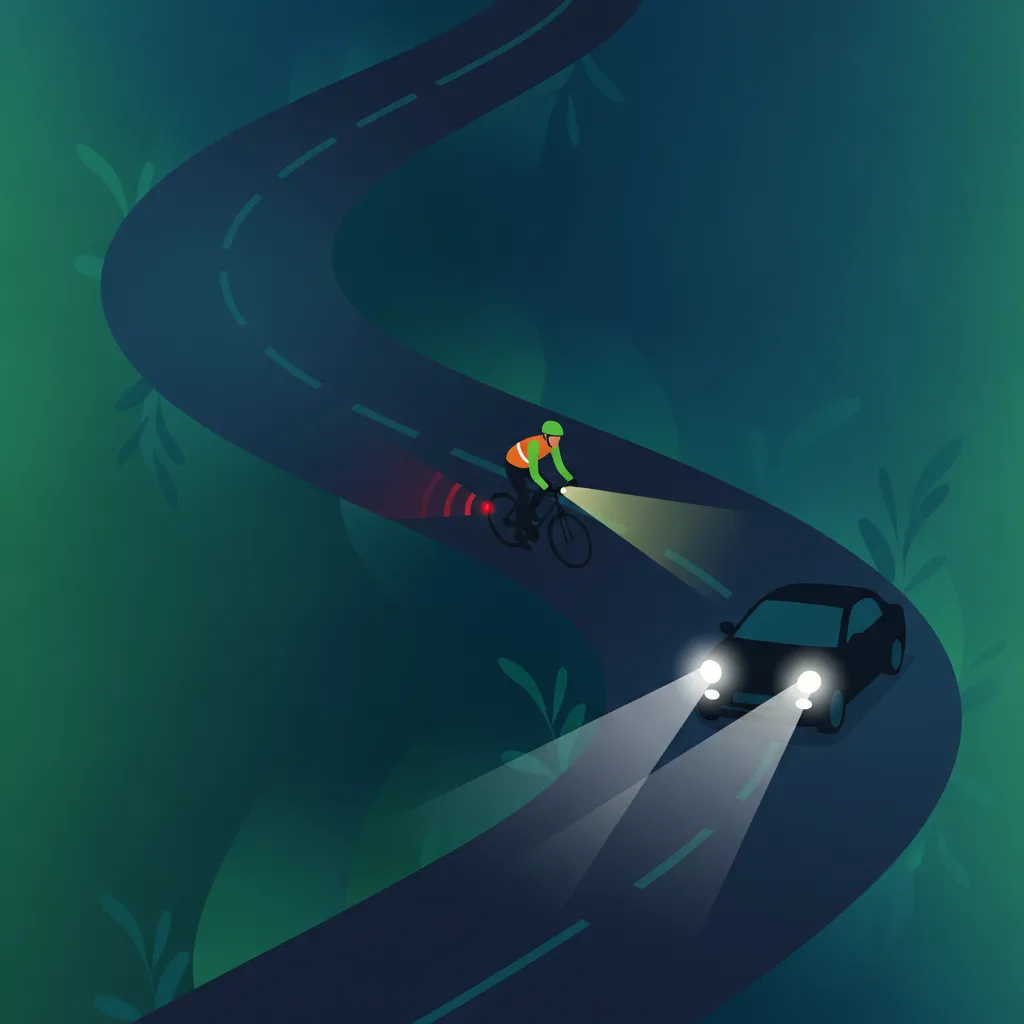
This lesson focuses on the specific challenges of riding in darkness. It explains the legal requirements and proper use of high and low beam headlights to see and be seen. The importance of wearing reflective clothing and ensuring all vehicle lights and reflectors are functioning is strongly emphasized.

This lesson provides strategies for safe riding after dark, when visibility is significantly reduced. It explains how to use high and low beams effectively, avoid being dazzled by other vehicles' lights, and look for road markings to guide your path. The importance of wearing reflective clothing to be seen is strongly emphasized.
This lesson details the meaning and application of various road surface markings, including lane dividers, solid and broken lines, and directional arrows. You will also learn to interpret the full sequence of traffic light signals, including the specific rules for the amber (yellow) light phase. A proper understanding of these systems is vital for maintaining correct lane discipline and adhering to traffic controls.
This lesson covers the correct techniques for various turning manoeuvres, including how to signal, position your vehicle, and judge gaps in traffic. It also details the legal and safety protocols for overtaking, emphasizing the importance of assessing speed, distance, and oncoming traffic. A thorough understanding of these procedures is crucial for navigating intersections and two-lane roads safely.
This lesson focuses on techniques for riding when visibility and traction are compromised by weather. It explains how to adjust speed, increase following distance, and use lights to see and be seen in rain or fog. Understanding the risk of hydroplaning and making smooth control inputs are key takeaways.
Find clear answers to common questions learners have about Weather Conditions: Rain, Wind, Darkness, and Fog. Learn how the lesson is structured, which driving theory objectives it supports, and how it fits into the overall learning path of units and curriculum progression in Denmark. These explanations help you understand key concepts, lesson flow, and exam focused study goals.
You must use fog lights when visibility is significantly reduced due to heavy fog or falling snow. It is important to remember that these lights are powerful and can dazzle other drivers; therefore, they must be switched off immediately when conditions improve.
Because wet roads drastically increase your stopping distance and the risk of losing control through aquaplaning. The test emphasizes this to ensure you understand that simply staying within the speed limit is not enough; you must also adapt to the grip level of the road surface.
While there is no single law for every bridge, Danish theory questions often highlight the danger of crosswinds on high structures. You should always be prepared to steer against the wind and reduce your speed to maintain control of the vehicle.
Yes, you will likely encounter questions about using high-beam vs. low-beam headlights in rural or dark conditions. The main rule is to use high beams to maximize visibility but switch to low beams when approaching or following other road users to avoid blinding them.
Use our powerful search tool to pinpoint specific Danish driving theory topics, road signs, or traffic situations you need to review. Start exploring relevant practice sets now to reinforce your knowledge and build confidence for your upcoming driving licence exam.