
Welcome to the final lesson of your Spanish Category AM (Moped) Theory preparation! This unit focuses on the critical importance of understanding the DGT's penalty system. We'll break down traffic infractions, the associated fines, and how the demerit points system works, ensuring you know the consequences of violations and how to keep your license valid.

Lesson content overview
Navigating the roads safely and legally in Spain as an AM category moped rider requires a clear understanding of the traffic penalty system. This comprehensive lesson details the Spanish framework, which uniquely combines monetary fines with a demerit points system linked to your driving licence. Knowing how this system operates is crucial not only for avoiding infractions but also for appreciating the long-term implications of traffic violations, which can ultimately lead to the suspension of your licence.
The Spanish driving licence points system, overseen by the Dirección General de Tráfico (DGT), applies uniformly across all vehicle categories, including AM mopeds and light scooters. Its primary goal is to deter unsafe driving practices and promote responsible road behaviour through both immediate financial consequences and the sustained threat of losing driving privileges. By understanding the categories of infractions, their associated fines and point deductions, and the pathways for point recovery, AM riders can ensure they maintain a valid licence and contribute to road safety.
Spain employs a sophisticated dual-penalty system designed to address traffic violations comprehensively. This system involves two main components: monetary fines (sanciones económicas) and a demerit points system (sistema de puntos) directly linked to your driving licence. The purpose is twofold: to provide immediate financial disincentive for infractions and to encourage continuous safe driving habits by threatening the loss of driving privileges.
The underlying logic of this system is based on behavioural deterrence and safety incentives. Financial penalties serve as a deterrent for occasional lapses, while the points system targets repeat offenders by imposing more severe consequences, including licence suspension. Each point on your licence represents a "credit" for safe driving, and the accumulation of lost points reflects a driver's increasing risk profile. This unified approach simplifies enforcement and ensures proportional punishment across different vehicle types, including AM mopeds.
At the core of the Spanish penalty system is the points balance. Every new driver, upon obtaining their first licence, starts with a specific number of points. These points are not merely an administrative detail; they represent your privilege to drive.
Upon receiving your AM licence, or any driving licence in Spain, you will start with an initial balance of 12 points. These points serve as a baseline safety buffer, representing your "credit" for safe and responsible driving. The goal of every driver is to maintain this balance by adhering to traffic regulations.
Remember that your initial 12 points are a valuable asset. Each traffic infraction that carries a points deduction will directly reduce this balance, bringing you closer to licence suspension.
Traffic infractions in Spain are not all treated equally. They are carefully categorised into three levels of severity: Minor (leves), Serious (graves), and Very Serious (muy graves). This classification is critical because it dictates the severity of the penalty, including both the monetary fine and the number of points deducted from your licence. The categorisation is based on the risk level associated with the offence and its potential impact on road safety.
The Reglamento General de Circulación (RGC), the official Spanish road traffic code, outlines these categories and their specific point values. Understanding these classifications helps AM riders anticipate the consequences of various violations.
Minor infractions are considered low-risk behaviours that, while still violations, generally pose less immediate danger to road safety. These typically result in smaller monetary fines and a lower number of points deducted.
Examples of minor infractions relevant to AM moped riders might include minor parking violations, some less severe speed limit excesses, or other minor administrative oversights. While these offences typically carry a fine of around €100, some minor infractions may still result in a point deduction, often around 2 points. It is a common misunderstanding to assume that all minor violations are free of point deductions; always verify the specific details of any sanction received.
Serious infractions involve moderate-risk behaviours that have a more significant potential to endanger road users. These offences carry substantially higher fines and more significant point deductions. For AM moped riders, serious infractions often relate to crucial safety equipment, speed, or basic traffic rules.
Examples include exceeding speed limits by more than 20 km/h, riding without proper insurance (although this often has broader implications), or certain instances of improper overtaking. Serious infractions typically result in fines ranging from €200 to €500. The point deductions for serious infractions are generally between 4 and 5 points. These deductions can quickly deplete your initial point balance, making it critical to avoid such violations.
Very Serious infractions represent the highest level of traffic violation, involving high-risk behaviours that pose an immediate and severe danger to public safety. These offences incur the largest monetary fines and the maximum point deductions, often leading directly to licence suspension.
For AM moped riders, very serious infractions include critical violations such as driving under the influence of alcohol or drugs, reckless driving, or significantly exceeding speed limits (e.g., travelling over 30 km/h above the limit). Fines for very serious infractions can range from €1,000 to €2,000, and these violations typically result in a deduction of 6 points. A single very serious infraction can instantly reduce a driver's point balance by half or more, potentially triggering a licence suspension if the remaining points are insufficient.
In addition to point deductions, every traffic infraction in Spain comes with a monetary fine. These fines are scaled according to the severity of the infraction, aligning with the Minor, Serious, and Very Serious categories.
The standard fine (multa) for an infraction is set according to its severity. However, the Spanish system encourages prompt payment by offering a significant discount. If a fine is paid within a specified timeframe, typically 20 days from the date of notification, the driver is eligible for a 50% reduction on the standard fine amount. This reduction applies to most fines, but it's essential to confirm the specific terms on the notification itself.
For example, a €300 fine for a serious infraction could be reduced to €150 if paid within the 20-day discount period. This provision provides an immediate financial incentive for riders to settle their penalties quickly.
Conversely, failing to pay a fine within the initial 20-day discount period (and subsequently within the standard payment period, usually 45 days) can lead to a significant increase in the amount due. After the initial discount period expires, the fine reverts to its full standard amount. If payment is delayed further, beyond the standard payment period, the fine can incur a surcharge, often increasing the original amount by 100% or more due to administrative fees and late payment penalties. This means a €200 fine could potentially escalate to €400 or more if payment is significantly delayed.
Your points balance is the current number of points you have remaining on your AM licence. This balance is dynamic, starting at 12 points and decreasing with each point-deducting infraction. It is a critical indicator of your driving record and your continued eligibility to drive.
Riders must actively monitor their points balance, as reaching zero points triggers an automatic licence suspension. Unlike some systems where points might "reset" annually, in Spain, points are only recovered through specific mechanisms, which we will discuss shortly. Your licence status is directly tied to this balance, making it a primary concern for all drivers.
The most severe consequence of accumulating traffic violations is the suspension of your driving licence. This occurs automatically when your points balance drops to zero. Licence suspension means you are legally prohibited from operating any motor vehicle for a specified period.
When your AM licence is suspended due to a zero-point balance, there is a mandatory suspension period. For the first suspension, this period is generally a minimum of 3 months. During this time, you cannot legally ride your moped or any other vehicle. Attempting to drive during a suspension period is a serious criminal offence with severe legal ramifications.
For repeat offenders, or in cases of particularly grave infractions, the suspension period can be extended, potentially up to 6 months. Reinstating your licence after suspension is not automatic upon the period's expiry; it requires specific actions, including participation in a recovery course.
The Spanish points system is designed not just to punish but also to rehabilitate. There are pathways for drivers to recover lost points and regain their full driving privileges after a period of safe conduct or through specific educational courses.
For drivers who have lost points but have not yet reached zero, the system offers an automatic recovery mechanism. If a driver goes a continuous period of two years without committing any point-deducting infractions, their points balance will automatically be restored to the initial 12 points. This period encourages sustained safe driving habits.
For drivers who have lost their entire points balance and had their licence suspended, the clean driving period required for automatic point restoration is longer. After completing the mandatory recovery course and having their licence reinstated, they will start with a reduced number of points (usually 8) and must complete a period of three years of clean driving to return to 12 points.
For drivers whose licences have been suspended due to reaching zero points, point recovery is not automatic. They are required to complete a specific educational programme known as the Curso de Recuperación del Permiso por Pérdida de Puntos (Licence Recovery Course for Point Loss).
This course is mandatory for licence reinstatement and typically consists of 12 hours of instruction. It covers various topics related to road safety, traffic regulations, and responsible driving behaviour. Upon successful completion of this course and the fulfilment of the suspension period, the driver's licence will be reinstated, and their points balance will be restored, usually to 8 points. There are also sensitisation and re-education courses for partial point recovery (Curso de Recuperación Parcial de Puntos), which can be taken voluntarily to recover up to 6 points without having lost the entire balance.
The legal foundation for the Spanish traffic penalty system is primarily laid out in the Reglamento General de Circulación (RGC), the general road traffic code. This comprehensive document details all rules and regulations governing road users in Spain, including AM licence holders.
Several articles within the RGC are particularly relevant to understanding penalties:
Understanding these articles allows riders to consult the authoritative source for any specific rule or penalty.
To provide a practical understanding, let's examine common scenarios involving AM moped riders and their associated penalties in Spain:
Speeding in an Urban Area:
Failure to Wear an Approved Helmet:
Riding Under the Influence of Alcohol (DUI):
Using a Handheld Mobile Phone While Riding:
Riding a Moped with an Unauthorised Passenger:
Ignoring a Stop Sign or Red Traffic Light:
The Spanish penalty, fine, and points system is not merely a mechanism for punishment; it is a fundamental tool for promoting road safety and shaping driver behaviour. Its design incorporates several key insights:
Ultimately, by understanding and respecting the penalty system, AM moped riders not only protect their driving privileges but also contribute significantly to creating safer roads for everyone in Spain. Compliance leads to continued mobility, reduced accident risk, and avoidance of significant financial and legal burdens.
The Spanish traffic penalty system for AM moped riders combines fines with a points-based demerit system overseen by the DGT. Drivers start with 12 points, which decrease with each infraction based on severity—minor infractions deduct around 2 points, serious infractions 4-5 points, and very serious infractions 6 points. Reaching zero points triggers licence suspension for a minimum of 3 months, with reinstatement requiring a 12-hour mandatory recovery course. Paying fines within 20 days offers a 50% discount, while delayed payment can double the original amount. Points are recovered automatically after 2 years of clean driving (or 3 years after suspension), encouraging sustained safe driving habits.
A short set of high-value points that capture the most important learning from this lesson.
Spain uses a dual penalty system combining monetary fines with a demerit points system directly linked to your driving licence.
Traffic infractions are classified into three severity levels: Minor (2 points), Serious (4-5 points), and Very Serious (6 points), each with proportional fines.
Your licence starts with 12 points; reaching zero triggers automatic licence suspension for a minimum of 3 months.
Points are recovered automatically after 2 years of clean driving, or after completing a 12-hour mandatory recovery course if your licence was suspended.
Paying fines within 20 days grants a 50% discount, but delayed payment can double the original amount.
Explore all units and lessons included in this driving theory course.
New drivers start with 12 points, not an unlimited licence.
After licence suspension, reinstatement requires completing a recovery course and results in only 8 points restored.
Very serious infractions like DUI, running red lights, or handheld phone use deduct 6 points and carry €1,000-2,000 fines.
Speed violations exceeding 20 km/h above the limit are serious infractions for AM riders (max 45 km/h).
RGC Articles 38-43 define infraction categories and point values; Article 94 governs licence suspension.
Assuming minor infractions only carry fines with no point deduction—some minor violations still cost 2 points.
Missing the 20-day early payment window, causing a fine to increase from the discounted amount to full price or more.
Believing points reset annually—Spanish points only recover through the 2-year clean driving period or a recovery course.
Confusing the 45-day standard payment period with the 20-day discount period for reduced fines.
Thinking a first licence automatically comes with a full 12 points—new drivers who pass a recovery course after suspension only get 8 points back.
Lesson content overview
A short set of high-value points that capture the most important learning from this lesson.
Spain uses a dual penalty system combining monetary fines with a demerit points system directly linked to your driving licence.
Traffic infractions are classified into three severity levels: Minor (2 points), Serious (4-5 points), and Very Serious (6 points), each with proportional fines.
Your licence starts with 12 points; reaching zero triggers automatic licence suspension for a minimum of 3 months.
Points are recovered automatically after 2 years of clean driving, or after completing a 12-hour mandatory recovery course if your licence was suspended.
Paying fines within 20 days grants a 50% discount, but delayed payment can double the original amount.
Explore all units and lessons included in this driving theory course.
New drivers start with 12 points, not an unlimited licence.
After licence suspension, reinstatement requires completing a recovery course and results in only 8 points restored.
Very serious infractions like DUI, running red lights, or handheld phone use deduct 6 points and carry €1,000-2,000 fines.
Speed violations exceeding 20 km/h above the limit are serious infractions for AM riders (max 45 km/h).
RGC Articles 38-43 define infraction categories and point values; Article 94 governs licence suspension.
Assuming minor infractions only carry fines with no point deduction—some minor violations still cost 2 points.
Missing the 20-day early payment window, causing a fine to increase from the discounted amount to full price or more.
Believing points reset annually—Spanish points only recover through the 2-year clean driving period or a recovery course.
Confusing the 45-day standard payment period with the 20-day discount period for reduced fines.
Thinking a first licence automatically comes with a full 12 points—new drivers who pass a recovery course after suspension only get 8 points back.
Explore search topics learners often look for when studying Penalties, Fines, and Points System. These topics reflect common questions about road rules, driving situations, safety guidance, and lesson level theory preparation for learners in Spain.
Browse additional driving theory lessons that cover connected traffic rules, road signs, and common driving situations related to this topic. Improve your understanding of how different rules interact across everyday traffic scenarios.
Understand the Spanish demerit points system and how traffic infractions lead to fines and potential licence suspension. Essential knowledge for AM category riders to maintain their driving privileges in Spain.

This lesson details the specific prerequisites for obtaining an AM licence, starting with the minimum age of fifteen and the mandatory medical fitness certificate. It guides learners through the administrative process at the DGT, including required identification, proof of residence, and parental consent for minors. The content explains the role of driving schools and the necessary steps for exam registration, ensuring a clear understanding of the entire application procedure.
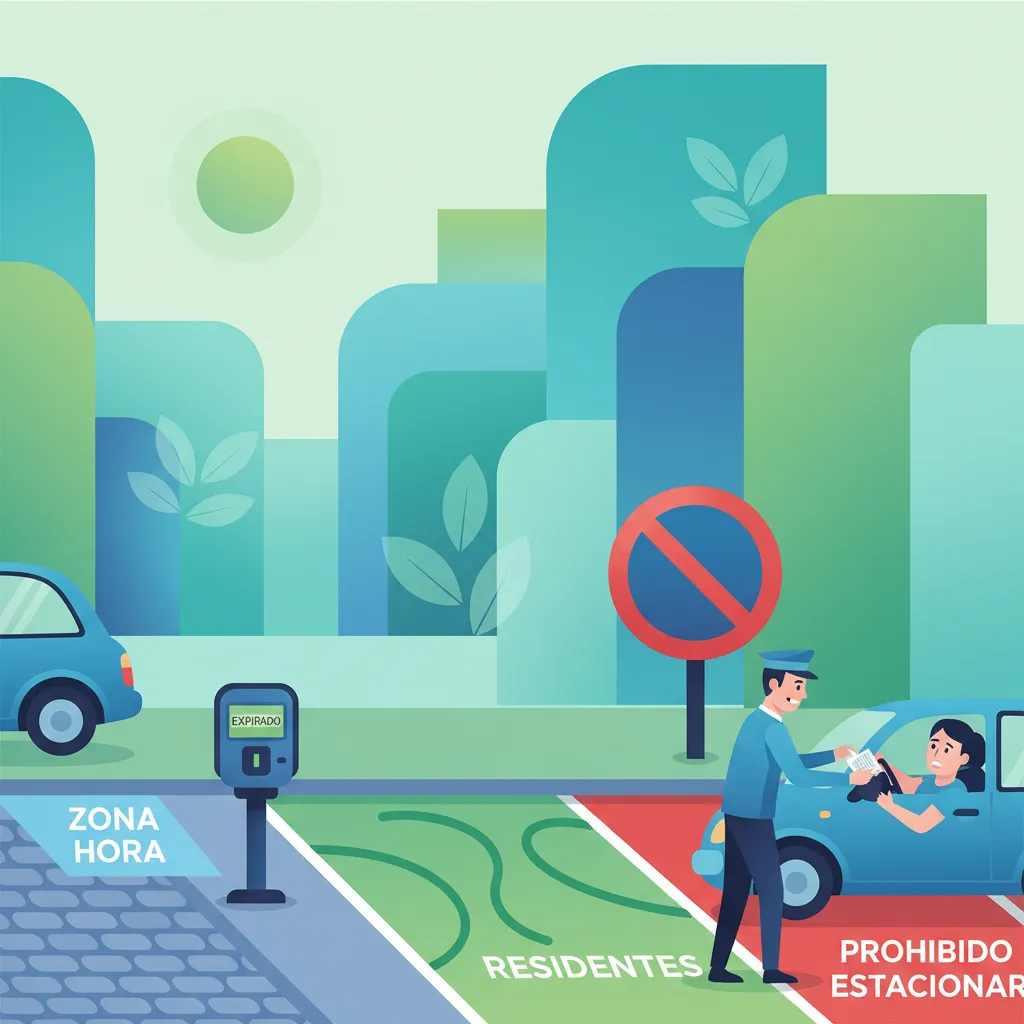
This lesson outlines the legal framework surrounding parking regulations in Spain, including the identification of regulated zones (e.g., ORA/SER), no-parking areas, and disabled parking spaces. It explains DGT signage interpretation and how improper parking can affect traffic flow and result in penalties. Learners will understand the regulatory environment to comply with parking laws and avoid fines.
This lesson examines the Spanish points system, detailing how traffic infractions are classified and the corresponding points assigned for each violation. It explains the progressive nature of point accumulation, the thresholds that can lead to licence revocation, and the mechanisms for point recovery. Learners will understand the importance of maintaining a clean driving record to avoid severe legal consequences.
This lesson introduces the visual language of road markings, focusing on the distinction between solid and broken lines and what they permit regarding lane changes and overtaking. It explains the meaning of directional arrows painted on the road surface, which guide drivers into the correct lane for their intended maneuver. Understanding these markings is crucial for maintaining proper lane discipline and navigating complex intersections and multi-lane roads.
This lesson explains each phase of a Spanish traffic light, detailing the specific action required for red, amber, and green signals. It clarifies the meaning of a flashing amber light, which indicates yielding to other traffic or pedestrians, and the red-amber combination. Understanding these signals is fundamental for safely navigating controlled intersections and ensuring compliance with traffic flow rules established by the DGT.
This lesson focuses on the strict limits for alcohol consumption while driving, expressed as blood alcohol concentration (BAC) thresholds specific to Spain. It explains how breathalyzer tests are administered, the legal consequences of exceeding the limits, and associated penalties like fines and licence suspension. The lesson also addresses drug-impaired driving, describing detection methods and the legal ramifications for both recreational and prescription substances.
This lesson provides a clear and serious overview of the laws concerning driving under the influence of alcohol or drugs. It specifies the legal blood alcohol concentration (BAC) limits for moped riders and explains the zero-tolerance policy for illicit substances. The content details the severe consequences of impairment, which include heavy fines, license suspension, and potential criminal charges, reinforcing the absolute necessity of riding sober.

This lesson defines the minimum legal ages for driving categories B and BE and explains the importance of medical fitness for safe vehicle operation. It covers the specific health criteria set by the DGT, such as visual acuity, hearing capacity, and other physical capabilities. The content also outlines the distinctions between the two categories, focusing on the legal permissions and requirements for each.
Learn the Spanish DGT procedures for automatic point recovery and mandatory recovery courses after licence suspension. Essential information for AM category riders aiming to regain their driving privileges.
This lesson examines the Spanish points system, detailing how traffic infractions are classified and the corresponding points assigned for each violation. It explains the progressive nature of point accumulation, the thresholds that can lead to licence revocation, and the mechanisms for point recovery. Learners will understand the importance of maintaining a clean driving record to avoid severe legal consequences.
This lesson focuses on the strict limits for alcohol consumption while driving, expressed as blood alcohol concentration (BAC) thresholds specific to Spain. It explains how breathalyzer tests are administered, the legal consequences of exceeding the limits, and associated penalties like fines and licence suspension. The lesson also addresses drug-impaired driving, describing detection methods and the legal ramifications for both recreational and prescription substances.

In this lesson, the structure and administration of the driving licence examinations are explained, covering both the theory and practical components. It details the format of the multiple-choice theory test, the pass criteria, and the process of registering for examinations through the DGT platform. The content also discusses test locations, scheduling, and the issuance of certification upon successful completion.

This lesson examines the specific documents needed to start the Spanish license acquisition process, including personal identification, proof of residence, and a valid medical certificate (psicotécnico). It outlines the official DGT application form, associated fees, and the sequential steps for successful registration. The content also clarifies the age thresholds for categories B and BE and the conditions for license renewal.
This lesson provides a clear and serious overview of the laws concerning driving under the influence of alcohol or drugs. It specifies the legal blood alcohol concentration (BAC) limits for moped riders and explains the zero-tolerance policy for illicit substances. The content details the severe consequences of impairment, which include heavy fines, license suspension, and potential criminal charges, reinforcing the absolute necessity of riding sober.
This lesson addresses the specific challenges posed by rain and fog, focusing on reduced visibility and loss of traction. It explains the proper use of windshield wipers and fog lights, and the need to adjust speed and increase following distance. The content covers how to prevent and react to hydroplaning (aquaplaning) to maintain vehicle control.

This lesson provides guidance on responding to a road accident, following the 'Protect, Alert, Assist' protocol. It details the steps for securing the scene, notifying emergency services, and providing basic aid if necessary. The content covers the legal responsibilities of the driver, including completing an accident report form (parte amistoso) and exchanging insurance information.
Find clear answers to common questions learners have about Penalties, Fines, and Points System. Learn how the lesson is structured, which driving theory objectives it supports, and how it fits into the overall learning path of units and curriculum progression in Spain. These explanations help you understand key concepts, lesson flow, and exam focused study goals.
In Spain, traffic infractions for all vehicles, including mopeds, are classified into three main categories: minor, serious, and very serious. Minor infractions typically involve lesser violations and carry fines and fewer points deducted. Serious infractions have higher fines and more significant point deductions. Very serious infractions are the most severe and can result in substantial fines, significant loss of points, and potential license suspension.
The exact number of points deducted for a serious infraction can vary depending on the specific violation. However, serious infractions generally lead to a deduction of 6 points from your license. For a new driver, or if their initial balance is low, this can be a significant impact. Always refer to the official DGT guidelines for precise details on specific violations.
If you accumulate too many penalty points, your AM category license can be suspended or revoked by the DGT. For new drivers, the threshold is generally lower. Accumulating points means you have repeatedly committed infractions, indicating a risk to road safety. It's essential to drive responsibly to maintain your license.
While the fundamental principles of the penalty system (fines and points) are the same for mopeds as for other vehicles, the specific infractions and associated penalties may differ based on the vehicle's classification and typical usage. For instance, certain safety equipment violations or speed limit differences specific to mopeds will have their own penalties.
Lost penalty points can be recovered over time. If you do not commit any new infractions, you will automatically recover a certain number of points after a period of two or three years, depending on the severity of the original violation and whether you are a new or established driver. You can also take specific courses approved by the DGT to recover some points earlier.
Use our powerful search functionality to pinpoint specific Spanish DGT driving theory practice sets. Filter by road sign categories, traffic law topics, or question difficulty to build custom study sessions and reinforce your knowledge precisely where it matters for your official exam.