
This lesson provides a comprehensive overview of the Spanish DGT driving licence examination process for Categories B and BE. You will learn about the structure of both the theory and practical tests, understanding the format, pass criteria, and administrative steps involved, from registration through to receiving your license. This knowledge is crucial for confidently navigating the official DGT procedures and successfully earning your Spanish driving licence.

Lesson content overview
Embarking on the journey to obtain a Spanish driving licence for categories B and BE involves a structured examination process administered by the Dirección General de Tráfico (DGT). This comprehensive lesson will guide you through the intricacies of the DGT's administrative procedures, detailing both the theoretical and practical components required to successfully pass your driving tests in Spain. Understanding these steps is crucial for a smooth and efficient path to becoming a licensed driver.
The DGT's examination system is meticulously designed to ensure all new drivers possess both the essential knowledge of traffic regulations and the practical competence to drive safely on Spanish roads. This lesson forms a vital part of your Complete Spanish Driving License Theory Course for Categories B & BE (DGT), connecting directly with your foundational knowledge of traffic law and preparing you for the practical application of vehicle controls.
The Dirección General de Tráfico (DGT) stands as the central authority for managing all aspects of driving licences in Spain, from issuing permits to overseeing road safety and traffic regulations. Its role ensures a standardized and legally robust process for obtaining driving qualifications across the entire nation. This centralized system is fundamental to maintaining high safety standards and adhering to both national and European Union directives, such as EU Directive 2006/126/EC.
All official theory and practical driving tests are administered either directly by DGT officials or through accredited driving schools, known as Autoescuelas. This guarantees that all candidates are assessed against the same rigorous criteria, promoting fairness and consistency. Centralized record-keeping further streamlines administrative processes, allowing for efficient tracking of candidate progress and licence issuance.
The Spanish driving licence examination is fundamentally a two-stage assessment, separating the evaluation of theoretical knowledge from practical driving skills. This approach allows for a distinct focus on each critical aspect of driving competence. Both stages must be successfully completed to obtain your licence, though failure in one stage does not automatically invalidate a pass in the other, except for specific validity periods.
The initial stage assesses your understanding of road rules, signs, and safe driving principles through a multiple-choice theory test. Following a successful theory examination, candidates proceed to the practical driving test, where their ability to control a vehicle, apply traffic laws, and make safe decisions on the road is evaluated. This sequential process ensures a comprehensive assessment of a driver's readiness.
The DGT theory test is a critical first step, designed to evaluate your cognitive knowledge of Spanish traffic regulations. It consists of 30 multiple-choice questions, each offering three possible answers, only one of which is correct. These questions are drawn from a vast pool of over 1000 potential questions, ensuring a broad assessment of your theoretical understanding.
To pass the theory test, you must achieve a minimum score of 27 correct answers out of 30, which equates to 90%. Each incorrect answer reduces your score by one point. Candidates are typically given 30 minutes to complete the exam. While the standard test is for all applicants, a "remedial test" follows the same format for those who have previously failed. It is a common misunderstanding that a perfect score is required; achieving 27 correct answers is sufficient to pass.
Familiarize yourself with the extensive question pool available through practice materials. Understanding the underlying logic of traffic rules rather than memorizing answers will serve you better.
Once the theory test is passed, the focus shifts to the practical driving assessment. This test, conducted by an official DGT examiner, assesses your ability to safely operate a vehicle and apply traffic rules in real-world driving conditions. For category B, the test includes mandatory manoeuvres such as reverse parking, hill starts, and a road-driving segment. For the BE category, which allows for towing heavier trailers, the practical test is extended to include specific trailer handling manoeuvres.
The examiner will evaluate your vehicle control, adherence to all traffic regulations, and your decision-making abilities, especially concerning hazard perception and defensive driving. It's important not to assume a pass after a short road segment; the examiner has discretion to add further manoeuvres if needed. Proficiency in areas covered in lessons like "Vehicle Basics & Controls" and "Hazard Perception & Defensive Driving" will be directly assessed during this stage.
Registering for your DGT theory and practical tests is a mandatory step managed through the Cita Previa system. This appointment system, crucial for capacity planning and candidate data recording, ensures an organized and efficient examination process. It is essential to understand that theory and practical tests require separate bookings.
The primary method for booking your DGT examinations is through the official DGT website (sede.dgt.gob.es). This online portal allows you to select the type of test, choose your preferred test location, and pick an available date and time slot. The system validates your eligibility and ensures all prerequisites are met before confirming the appointment.
Alternatively, for those who prefer or require assistance, bookings can also be made via the DGT call centre. Incorrect or incomplete data during the registration process can lead to delays or even cancellation of your appointment, so accuracy is paramount. It is crucial to remember that each test—theory and practical—requires its own distinct booking through the Cita Previa system.
Visit the official DGT website (sede.dgt.gob.es) and navigate to the 'Cita Previa' section.
Select the type of exam you wish to book (e.g., 'Examen Teórico' for theory, 'Examen Práctico' for practical).
Choose your preferred DGT test centre and review the available dates and times.
Fill in your personal details accurately, ensuring they match your identification documents.
Confirm your booking and note down the appointment details and reference number.
On the day of your theory and practical tests, presenting the correct and valid documentation is absolutely mandatory. This typically includes a valid form of identification, such as your NIE (Número de Identificación de Extranjero) or DNI (Documento Nacional de Identidad), and proof of residence. These documents are crucial for identity verification and preventing fraud.
For certain licence categories, particularly for category BE, or if you have known medical conditions, a valid medical certificate will also be required. This certificate ensures that you meet the necessary physical and mental fitness standards to safely operate the vehicle type you are applying for. Failure to present any required documentation will result in being denied entry to the exam, necessitating a reschedule.
DGT driving examinations are conducted at authorized centres across Spain, which include DGT offices and various accredited Autoescuelas (driving schools). These locations are strategically distributed to serve candidates throughout both urban and rural areas. The availability of test slots and the specific types of tests offered can vary significantly between centres.
Urban centres, typically located in larger cities, generally have higher capacity and may offer a wider range of test dates. Rural centres, while convenient for local residents, might have more limited weekly slots. It is important to note that not all centres are equipped to administer specialized tests, such as those for category BE, which require specific facilities and vehicles for trailer handling. When booking, always confirm that the chosen centre can accommodate your specific licence category.
Obtaining your Spanish driving licence involves several associated fees that must be paid before your scheduled examination dates. These fees cover the administrative costs of processing your application and conducting the tests. It is critical to settle all required payments in advance, as unpaid fees will lead to the cancellation of your appointment.
The theory exam typically incurs a standard fee. Practical exam fees can vary by region and licence category. Should you fail an examination and need to retake it, an additional re-examination fee will be applicable. It's a common misconception that fees are refundable after a failed attempt; they are generally non-refundable. All fees are subject to IVA (Impuesto sobre el Valor Añadido), or Value-Added Tax, which is usually included in the stated amount.
Upon successfully passing both the theory and practical components of your driving examination, the DGT will process your licence issuance. This process culminates in both a digital transcript and a physical licence card, providing official proof of your legal driving capability in Spain.
A digital transcript of your successful examination results will be recorded in the DGT’s system, often accessible through the "Mi DGT" application. This digital record serves as legal proof that you have passed and are authorized to drive, even before the physical card arrives. The physical licence card will be mailed to your registered address after a processing period, typically ranging from 15 to 30 days. The licence officially becomes legally effective on the date indicated in your digital record.
You do not need to wait for the physical card to arrive to legally drive in Spain once your digital record shows a successful pass. The "Mi DGT" app provides valid digital proof for police checks.
Adhering to specific DGT regulations and rules is paramount throughout the entire licensing process. These rules are designed to ensure the safety of all road users and the integrity of the examination system. Understanding them will help you avoid common administrative pitfalls and ensure a smooth progression towards your licence.
To apply for a category B driving licence in Spain, candidates must be at least 18 years old. This age requirement is legally mandated to ensure a sufficient level of maturity and legal capacity for drivers. For certain categories, particularly BE, and for all candidates with specific medical conditions, a valid medical certificate is required. This certificate assesses your physical and mental fitness to safely operate a vehicle, especially larger vehicles or those towing trailers.
A crucial regulation to remember is the validity period of your DGT theory test results. Once you pass the theory examination, the results are valid for a period of 12 months. Within this timeframe, you must successfully pass your practical driving test. If the 12-month period expires before you pass the practical test, you will be required to retake and pass the theory exam again before being allowed to attempt the practical test. This rule ensures that your theoretical knowledge remains current and relevant.
The category BE driving licence, which permits the towing of trailers with a Gross Vehicle Weight (GVW) exceeding 750 kg (within specified limits), has additional specific requirements for its practical test. It is mandatory for candidates to perform all required manoeuvres, including reverse parking, with a trailer properly attached to the towing vehicle. Furthermore, the trailer must be loaded within its permitted maximum permissible mass (Masa Onerosa Total or MOT) during the test. Attempting the BE practical test without a trailer or with an improperly loaded one will result in immediate failure. This rigorous assessment ensures competence in the complex dynamics of towing.
Navigating the DGT examination process can present several challenges if candidates are not fully aware of the rules and procedures. Being prepared for common pitfalls can save you time, money, and frustration.
While much of the examination process is controlled, certain external factors can influence your test day experience. Being aware of these conditional variations allows for better preparation and adaptation.
Successfully navigating the DGT examination process for your Spanish driving licence requires diligence, preparation, and a thorough understanding of the administrative and practical requirements. From the initial registration through the Cita Previa system to the final issuance of your digital and physical licence, each step is designed to assess your competence and ensure road safety. By understanding the theory and practical test structures, adhering to documentation rules, and being aware of potential pitfalls and external factors, you can significantly enhance your chances of a smooth and successful journey to becoming a licensed driver in Spain.
This lesson explains the complete DGT examination process for Spanish driving licences Categories B and BE, covering both theory and practical assessments. The theory test consists of 30 multiple-choice questions with a 90% pass requirement (27/30 correct), valid for 12 months. The practical test evaluates vehicle control, traffic rule application, and mandatory manoeuvres, with BE requiring specific trailer handling. Key administrative steps include registering through the Cita Previa system, preparing required documentation (NIE/DNI, medical certificate), and paying fees in advance. Understanding common pitfalls such as late arrival, missing documents, and incorrect booking procedures will help candidates avoid unnecessary delays and expenses.
A short set of high-value points that capture the most important learning from this lesson.
The DGT theory test requires 27 correct answers out of 30 (90% pass mark), not a perfect score
Theory test results remain valid for 12 months; you must pass the practical test within this period or retake the theory
Separate Cita Previa bookings are required for theory and practical tests through sede.dgt.gob.es
For Category BE, the practical test must be taken with a properly loaded trailer within its Masa Onerosa Total (MOT)
Your digital transcript in 'Mi DGT' serves as legal proof of driving capability before the physical licence card arrives
Explore all units and lessons included in this driving theory course.
Booking through Cita Previa is mandatory for all DGT tests; theory and practical require separate appointments
Valid NIE/DNI, proof of residence, and medical certificate (where applicable) are required on test day
Category BE candidates must perform all manoeuvres with a trailer attached and properly loaded
Late arrival typically results in automatic cancellation and fee loss
Fees are non-refundable after a failed attempt and must be paid before the exam date
Arriving late to the test centre, even by a few minutes, leads to automatic cancellation and lost fees
Forgetting required documentation such as ID, proof of residence, or medical certificate
Attempting to book theory and practical tests as a single appointment through Cita Previa
Trying to take the BE practical test without a trailer attached or with an improperly loaded trailer
Failing to cancel an existing appointment before booking a new one at a different location
Lesson content overview
A short set of high-value points that capture the most important learning from this lesson.
The DGT theory test requires 27 correct answers out of 30 (90% pass mark), not a perfect score
Theory test results remain valid for 12 months; you must pass the practical test within this period or retake the theory
Separate Cita Previa bookings are required for theory and practical tests through sede.dgt.gob.es
For Category BE, the practical test must be taken with a properly loaded trailer within its Masa Onerosa Total (MOT)
Your digital transcript in 'Mi DGT' serves as legal proof of driving capability before the physical licence card arrives
Explore all units and lessons included in this driving theory course.
Booking through Cita Previa is mandatory for all DGT tests; theory and practical require separate appointments
Valid NIE/DNI, proof of residence, and medical certificate (where applicable) are required on test day
Category BE candidates must perform all manoeuvres with a trailer attached and properly loaded
Late arrival typically results in automatic cancellation and fee loss
Fees are non-refundable after a failed attempt and must be paid before the exam date
Arriving late to the test centre, even by a few minutes, leads to automatic cancellation and lost fees
Forgetting required documentation such as ID, proof of residence, or medical certificate
Attempting to book theory and practical tests as a single appointment through Cita Previa
Trying to take the BE practical test without a trailer attached or with an improperly loaded trailer
Failing to cancel an existing appointment before booking a new one at a different location
Explore search topics learners often look for when studying Examination Process and DGT Administration. These topics reflect common questions about road rules, driving situations, safety guidance, and lesson level theory preparation for learners in Spain.
Browse additional driving theory lessons that cover connected traffic rules, road signs, and common driving situations related to this topic. Improve your understanding of how different rules interact across everyday traffic scenarios.
Understand the structure of Spanish driving licence exams administered by the DGT. This lesson covers theory and practical test formats, registration procedures via Cita Previa, and pass criteria for categories B and BE.
This lesson breaks down the structure of the DGT theoretical exam for motorcycles, describing the number of multiple-choice questions and the required passing score. It provides study strategies such as revision schedules and the use of official question banks to improve recall. Learners are also advised on managing time allocation per question to align with DGT’s scoring algorithm.

This lesson examines the specific documents needed to start the Spanish license acquisition process, including personal identification, proof of residence, and a valid medical certificate (psicotécnico). It outlines the official DGT application form, associated fees, and the sequential steps for successful registration. The content also clarifies the age thresholds for categories B and BE and the conditions for license renewal.
This lesson covers the essential techniques for perpendicular parking (reversing into a bay) and executing a three-point turn. It details the approach, turning points, and use of mirrors and observation to ensure proper vehicle positioning. Learners will understand how to assess the required space and comply with DGT regulations for these common maneuvers.
This lesson explains the fundamental DGT regulations that govern public transport services, including requirements for operational permits and route authorizations. It covers the mandatory schedules for vehicle inspections, standards for emissions, and the legal importance of adhering to timetables and service quality. Learners will also understand the nature of regulatory audits and compliance checks that operators must undergo.

This lesson provides a detailed breakdown of the D and D1 license categories, defining the vehicle dimensions and passenger capacities for each. It explains the DGT's eligibility requirements, including minimum age, medical certification, and mandatory psychological assessments for professional drivers. Learners will understand the complete procedural path to obtaining a professional bus or coach license in Spain.

This lesson focuses on the comprehensive understanding of traffic light signals and their timing sequences. It defines the meanings of steady red, amber, and green lights, as well as flashing amber and arrow signals. The content also covers pedestrian and cyclist phases, describing the actions drivers must take during each signal change to maintain safety and compliance.

This lesson outlines the proper use and legal requirements of vehicle lighting and mirror systems. It covers headlamps, fog lights, turn signals, and brake lights, clarifying when each must be used according to DGT regulations. The lesson also explains the correct adjustment of rearview and side mirrors and strategies for effective blind-spot monitoring.
In this lesson, drivers learn how to identify risk zones where potential hazards are likely to develop. The content explains the use of proactive observation and scanning techniques to detect evolving dangers in the driving environment. Learners will practice anticipating the actions of other road users based on traffic patterns and context, adjusting their speed and position accordingly.
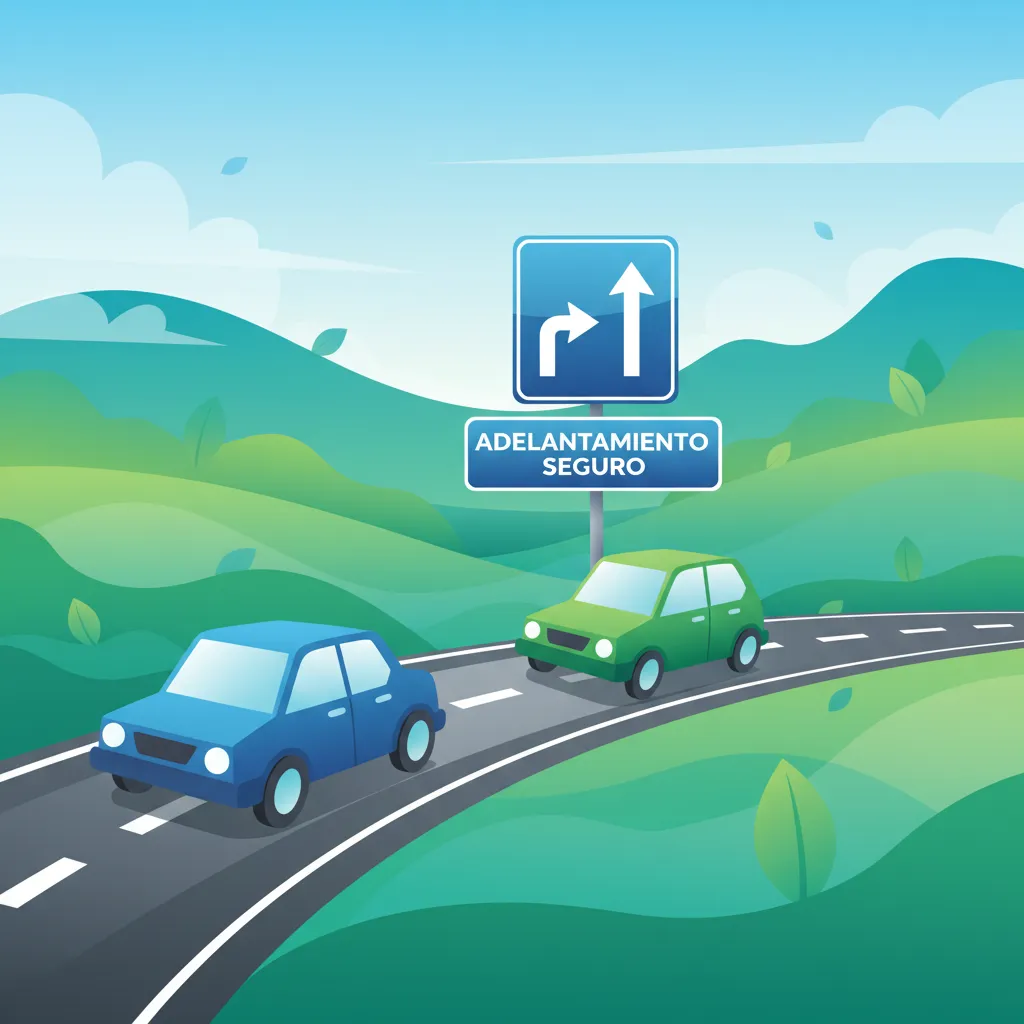
This lesson covers the legal overtaking procedures applicable on different road types, focusing on identifying safe passing zones and executing maneuvers correctly. Learners will be taught how to maintain adequate safety distances before, during, and after overtaking. The content includes DGT regulations for overtaking, appropriate signaling, and visibility checks to ensure safe completion of the maneuver.
Learn about the key regulations for DGT driving tests in Spain, including the validity of theory test results (12 months), specific requirements for category BE, and common pitfalls to avoid during the examination process.
This lesson addresses the specific challenges posed by rain and fog, focusing on reduced visibility and loss of traction. It explains the proper use of windshield wipers and fog lights, and the need to adjust speed and increase following distance. The content covers how to prevent and react to hydroplaning (aquaplaning) to maintain vehicle control.
This lesson outlines the proper use and legal requirements of vehicle lighting and mirror systems. It covers headlamps, fog lights, turn signals, and brake lights, clarifying when each must be used according to DGT regulations. The lesson also explains the correct adjustment of rearview and side mirrors and strategies for effective blind-spot monitoring.
This lesson breaks down the structure of the DGT theoretical exam for motorcycles, describing the number of multiple-choice questions and the required passing score. It provides study strategies such as revision schedules and the use of official question banks to improve recall. Learners are also advised on managing time allocation per question to align with DGT’s scoring algorithm.
This lesson covers the legal overtaking procedures applicable on different road types, focusing on identifying safe passing zones and executing maneuvers correctly. Learners will be taught how to maintain adequate safety distances before, during, and after overtaking. The content includes DGT regulations for overtaking, appropriate signaling, and visibility checks to ensure safe completion of the maneuver.
This lesson covers the essential techniques for perpendicular parking (reversing into a bay) and executing a three-point turn. It details the approach, turning points, and use of mirrors and observation to ensure proper vehicle positioning. Learners will understand how to assess the required space and comply with DGT regulations for these common maneuvers.

This lesson provides a detailed examination of the components that determine a vehicle’s stopping distance: perception time, reaction time, and braking distance. It outlines how to calculate safe stopping distances under various speeds and road conditions like wet or dry surfaces. Learners will be equipped to compute appropriate safety margins and understand the physics of emergency braking.
This lesson covers how environmental conditions such as rain, fog, and darkness affect driving safety. It instructs drivers on adjusting speed, using appropriate lighting, and increasing following distance to compensate for reduced visibility and traction. The lesson incorporates DGT safety recommendations for handling adverse weather to mitigate risk and maintain control.
Find clear answers to common questions learners have about Examination Process and DGT Administration. Learn how the lesson is structured, which driving theory objectives it supports, and how it fits into the overall learning path of units and curriculum progression in Spain. These explanations help you understand key concepts, lesson flow, and exam focused study goals.
The Spanish DGT theory test for Category B consists of 30 multiple-choice questions. To pass, you must answer at least 27 questions correctly, meaning you can make a maximum of 3 errors. The BE category exam has specific additional questions that follow similar passing criteria for their section.
To register for the DGT driving exam, you typically need your valid NIE/TIE, a medical fitness report (reconocimiento médico), two passport-sized photos, and proof of payment of the DGT fees. Your driving school usually assists with the online registration process for Category B & BE exams.
Yes, the Spanish DGT theory test can be taken in several languages, including English, Spanish, French, and German. You will need to specify your preferred language when you register for the exam, ensuring you choose the language you are most comfortable with for the Category B & BE exams.
If you fail the DGT theory or practical test, you generally have opportunities to retake it. Your initial DGT fee covers two attempts. If you fail twice, you'll need to pay the fee again to get another two attempts. There are usually no long waiting periods for retakes, though this can vary by DGT office.
Once you pass the Spanish DGT theory test for Category B or BE, your pass is valid for two years. Within this two-year period, you must successfully pass your practical driving test. If you don't, you will need to retake the theory exam.
Use our powerful search functionality to pinpoint specific Spanish DGT driving theory practice sets. Filter by road sign categories, traffic law topics, or question difficulty to build custom study sessions and reinforce your knowledge precisely where it matters for your official exam.