
Welcome to the lesson on the Points System and Infractions, a critical component of the Spanish driving license theory for categories B and BE. Understanding how the DGT manages traffic violations and assigns points is essential not only for passing your theory exam but also for maintaining a safe and legal driving record. This lesson builds upon the foundational legal requirements covered in Unit 1 and prepares you for understanding the consequences of specific traffic rule breaches.
Lesson content overview
Welcome to this comprehensive lesson, part of your Complete Spanish Driving License Theory Course for Categories B & BE (DGT). Navigating Spain's roads requires not only an understanding of traffic rules but also a clear grasp of the country's driver's licence points system. This system is a crucial mechanism designed to promote road safety by linking specific traffic infractions to demerit points. Every driver, whether new or experienced, must understand how points are allocated, deducted, and recovered to maintain a valid licence and avoid severe legal consequences.
This lesson will detail the framework of the Spanish points system, classify various traffic infractions based on their severity, and explain the procedures for licence suspension and point recovery. By understanding these principles, you will be better equipped to make responsible decisions on the road and contribute to a safer driving environment for everyone.
The Spanish points system serves as a quantitative penalty mechanism directly tied to a driver's licence. Its primary objective is to enhance road safety by discouraging repeat offences and encouraging responsible driving habits. Unlike a simple fine, point deductions directly affect your privilege to drive, making them a significant deterrent against dangerous behaviour.
This system operates on a clear, progressive structure: drivers start with a set number of points, and points are deducted for specific traffic violations. The severity of the infraction directly correlates with the number of points lost, ensuring that the penalty aligns with the risk posed to public safety. This systematic approach aims to rehabilitate drivers who commit minor infractions while providing clear consequences for more serious or repeated violations.
When you receive your first Spanish driving licence, whether for Category B (cars) or BE (cars with trailers), you automatically start with an initial allocation of 12 points. This baseline serves as a clean record and is the maximum number of points a standard experienced driver can hold. For newly qualified drivers, the system often includes a probationary period, during which the initial point allocation might differ slightly, or the thresholds for consequences might be more stringent.
Newly Licensed Drivers (Novatos): While the standard is 12 points, some new drivers may initially be allocated 8 points for a probationary period (typically 3 years). After this period, if no serious infractions have occurred, the points will increase to 12. Always verify the specific rules applicable to your individual licence status.
This initial allocation ensures that every driver begins with a clear understanding of their standing within the system. Any infraction from this point onward will result in a reduction of these initial points, progressively moving the driver closer to potential licence suspension if multiple or severe violations occur.
Traffic infractions in Spain are systematically categorised based on their severity and the risk they pose to road safety. This classification determines not only the monetary fine but also the number of points deducted from your licence. Understanding these categories is crucial for anticipating the consequences of various driving errors.
The Dirección General de Tráfico (DGT) maintains an official table that links each specific traffic violation to a corresponding number of points, ranging from 0 to 6 points per infraction. This framework ensures consistency in penalties across the country.
To illustrate, let's look at some frequent violations:
Always remember that most point-deducting infractions also carry a monetary fine. These fines can range from tens to hundreds of euros, depending on the severity of the violation.
The points system is designed to provide clear and progressive consequences for drivers who accumulate infractions. The most severe consequence is the temporary or permanent loss of your driving privileges through licence suspension or revocation.
The critical threshold in the Spanish points system is 0 points. If a driver's accumulated point deductions lead to a total of zero points, their driving licence is automatically suspended. This is not an immediate, on-the-spot suspension, but rather a legal procedure initiated by the DGT.
Notification: The DGT (Dirección General de Tráfico) will officially notify the driver of the licence suspension. This notification will specify the start date and duration of the suspension.
Suspension Period: The standard suspension period for reaching 0 points is 6 months. During this time, the driver must not drive any vehicle for which their licence was suspended. Driving with a suspended licence is a serious offence, carrying significant legal penalties, including further fines, extended suspension, and even imprisonment.
Mandatory Course and Exam: To regain their driving licence after the suspension period, the driver is legally required to complete a road safety awareness and re-education course (curso de sensibilización y reeducación vial). Following this course, they must pass a theoretical examination administered by the DGT. This exam tests their knowledge of traffic rules and road safety principles.
Licence Reinstatement: Only after successfully completing the course and passing the theoretical exam can the licence be reinstated, typically with an initial allocation of 8 points.
While reaching 0 points is the primary cause for suspension, there are other scenarios:
Monitoring your points balance regularly is crucial. The DGT provides online services where drivers can check their current point total. Being proactive allows you to adjust your driving behaviour before reaching critical thresholds.
The purpose of these suspension mechanics is clear: to protect public safety by removing unsafe drivers from the road. The implications for suspended drivers can be significant, affecting their ability to commute, work (if driving is job-related), and potentially increasing insurance premiums in the long term.
The Spanish points system isn't solely about punishment; it also incorporates a mechanism for drivers to regain lost points through good behaviour. This Point Recovery System (Recuperación de Puntos) encourages sustained safe driving practices.
The primary method for point recovery is consistent safe driving over time:
While the recovery system offers a pathway back to a full licence, there are important caveats:
The rationale behind this system is to not only penalise past mistakes but also to incentivise and reward a sustained commitment to safe driving. It provides a chance for drivers to rebuild their record, but it also ensures that those who commit the most egregious violations face more stringent requirements for reinstatement.
The Spanish points system is just one part of a broader framework of traffic law enforcement. Infractions often trigger multiple consequences simultaneously, and drivers must be aware that a single violation can lead to a combination of penalties.
It is essential for drivers to understand that the consequences of a traffic violation extend beyond just the immediate point loss. A single act of unsafe driving can have a cascading effect, impacting finances, legal standing, and future driving privileges.
The Spanish points system operates under a robust legal framework, primarily governed by the Reglamento General de Conductores (RGC) and the Reglamento de Circulación. These regulations define the rules, point values, and procedures that drivers and authorities must follow.
These rules are not merely guidelines; they are legally binding and form the backbone of road safety enforcement in Spain. Drivers in the Spanish Driving License Theory Course for Categories B & BE (DGT) must familiarise themselves with these regulations to ensure full compliance.
Navigating the points system can sometimes lead to misunderstandings. Addressing these common pitfalls is essential for all drivers.
Let's consider practical examples to illustrate how the points system works:
Scenario 1: Urban Speeding
Scenario 2: Mobile Phone Usage
Scenario 3: Accumulating Infractions and Suspension
Scenario 4: Point Recovery in Action
These scenarios highlight the tangible impact of the points system on a driver's privileges and the importance of continuous responsible behaviour.
The application of the points system is not always static; certain contextual variations can influence the severity of an infraction or the associated point deduction. These factors relate to environmental conditions, road types, vehicle characteristics, and the presence of vulnerable road users.
Understanding these contextual variations is part of defensive driving and encourages drivers to adapt their behaviour not just to the static rules, but also to the dynamic conditions of the road environment.
The Spanish points system is a cornerstone of road safety legislation in Spain, designed to ensure that all drivers holding a licence for categories B and BE operate their vehicles responsibly. From the initial allocation of 12 points to the structured deductions for infractions and the mechanisms for point recovery, the system provides a clear framework for driver accountability.
Understanding how points are lost for minor, serious, and very serious violations, the severe implications of licence suspension, and the pathways to regain points through good behaviour and re-education courses, is not merely about avoiding penalties. It's about cultivating a mindset of continuous safety and adherence to traffic laws. As you progress through your Spanish Driving License Theory Course, remember that maintaining a clean driving record is paramount for your safety, the safety of others, and your continued privilege to drive in Spain.
The Spanish driving points system starts new drivers with 12 points (or 8 during a 3-year probationary period) and deducts points based on infraction severity, ranging from 0 points for minor administrative fines to 6 points for dangerous conduct like DUI or reckless driving. Drivers can recover 2 points automatically after 6 months without new infractions, or up to 4 points by completing a voluntary 12-hour road safety course, subject to maximum recovery limits. Reaching zero points triggers a 6-month license suspension requiring a mandatory re-education course and theoretical exam, with reinstated licenses starting at 8 points. Contextual factors like road type, weather conditions, and the presence of vulnerable road users can influence penalty severity, and extremely serious offences like DUI require a medical-psychological assessment before license reinstatement.
A short set of high-value points that capture the most important learning from this lesson.
New drivers start with 12 points (or 8 during a 3-year probationary period), and points are deducted from 0-6 depending on infraction severity.
Infractions are classified into six tiers: 0 points (minor fines), 1 point (very minor), 2 points (seatbelt/child restraint), 3 points (mobile phone), 4 points (red light/speeding 31-40 km/h over), and 6 points (DUI/reckless driving).
License suspension occurs automatically when points reach zero, resulting in a 6-month driving ban requiring a mandatory re-education course and theoretical exam for reinstatement.
Points are recovered automatically at 2 points per 6-month period of clean driving, or up to 4 points can be recovered by completing a voluntary 12-hour road safety course.
Severe infractions like DUI or reckless driving causing injury cannot be recovered through standard clean driving; they require a mandatory medical-psychological assessment before license reinstatement.
Explore all units and lessons included in this driving theory course.
The 6-point threshold is reserved for the most dangerous offences: driving under the influence of alcohol/drugs, reckless driving causing injury, and speeding more than 50 km/h over the limit.
Drivers starting with 8 probationary points can only recover up to 12 points total through good behaviour (6 points maximum within any 3-year period), while those starting with 12 can recover to the full 12.
Mobile phone usage deducts 3 points even when stationary at a traffic light if the engine is running and you are in control of the vehicle.
After license suspension at zero points, reinstatement typically grants only 8 points, not the full 12.
Speeding penalties escalate with severity: 21-30 km/h over the limit costs 3 points, 31-40 km/h costs 4 points, and exceeding by more than 50 km/h costs 6 points.
Assuming all speeding offences result in 6 points; only extreme excess (over 50 km/h) triggers maximum penalty.
Believing hands-free phone use is always exempt; holding or interacting with a mounted phone causing distraction still results in 3-point deduction.
Thinking points transfer separately to each licence category; the Spanish system applies points to the driver across all categories held.
Expecting automatic point recovery after only one month without infractions; the required clean driving period is always 6 consecutive months.
Assuming points are restored indefinitely through good behaviour; there is a maximum recovery limit of 6 points within any 3-year period.
Lesson content overview
A short set of high-value points that capture the most important learning from this lesson.
New drivers start with 12 points (or 8 during a 3-year probationary period), and points are deducted from 0-6 depending on infraction severity.
Infractions are classified into six tiers: 0 points (minor fines), 1 point (very minor), 2 points (seatbelt/child restraint), 3 points (mobile phone), 4 points (red light/speeding 31-40 km/h over), and 6 points (DUI/reckless driving).
License suspension occurs automatically when points reach zero, resulting in a 6-month driving ban requiring a mandatory re-education course and theoretical exam for reinstatement.
Points are recovered automatically at 2 points per 6-month period of clean driving, or up to 4 points can be recovered by completing a voluntary 12-hour road safety course.
Severe infractions like DUI or reckless driving causing injury cannot be recovered through standard clean driving; they require a mandatory medical-psychological assessment before license reinstatement.
Explore all units and lessons included in this driving theory course.
The 6-point threshold is reserved for the most dangerous offences: driving under the influence of alcohol/drugs, reckless driving causing injury, and speeding more than 50 km/h over the limit.
Drivers starting with 8 probationary points can only recover up to 12 points total through good behaviour (6 points maximum within any 3-year period), while those starting with 12 can recover to the full 12.
Mobile phone usage deducts 3 points even when stationary at a traffic light if the engine is running and you are in control of the vehicle.
After license suspension at zero points, reinstatement typically grants only 8 points, not the full 12.
Speeding penalties escalate with severity: 21-30 km/h over the limit costs 3 points, 31-40 km/h costs 4 points, and exceeding by more than 50 km/h costs 6 points.
Assuming all speeding offences result in 6 points; only extreme excess (over 50 km/h) triggers maximum penalty.
Believing hands-free phone use is always exempt; holding or interacting with a mounted phone causing distraction still results in 3-point deduction.
Thinking points transfer separately to each licence category; the Spanish system applies points to the driver across all categories held.
Expecting automatic point recovery after only one month without infractions; the required clean driving period is always 6 consecutive months.
Assuming points are restored indefinitely through good behaviour; there is a maximum recovery limit of 6 points within any 3-year period.
Explore search topics learners often look for when studying Points System and Infractions. These topics reflect common questions about road rules, driving situations, safety guidance, and lesson level theory preparation for learners in Spain.
Browse additional driving theory lessons that cover connected traffic rules, road signs, and common driving situations related to this topic. Improve your understanding of how different rules interact across everyday traffic scenarios.
Understand the Spanish points system rules for recovery. Learn about automatic point regaining and voluntary road safety courses to restore lost points on your DGT driving licence.

This lesson explains the Spanish traffic penalty system, which combines fines with a demerit points system linked to the driving license. It outlines the different categories of infractions (minor, serious, very serious) and their corresponding penalties in terms of fines and points lost. Understanding this system is essential for riders to appreciate the long-term consequences of traffic violations, which can ultimately lead to the suspension of their license.

This lesson examines the specific documents needed to start the Spanish license acquisition process, including personal identification, proof of residence, and a valid medical certificate (psicotécnico). It outlines the official DGT application form, associated fees, and the sequential steps for successful registration. The content also clarifies the age thresholds for categories B and BE and the conditions for license renewal.
Learn how traffic infractions are classified in Spain and the corresponding point deductions and fines. Understand severe violations and consequences for your driving licence.
This lesson explains the Spanish traffic penalty system, which combines fines with a demerit points system linked to the driving license. It outlines the different categories of infractions (minor, serious, very serious) and their corresponding penalties in terms of fines and points lost. Understanding this system is essential for riders to appreciate the long-term consequences of traffic violations, which can ultimately lead to the suspension of their license.
This lesson explains the designated functions of different parts of a highway system. It covers the legal and appropriate use of carriageways, the specific emergency-only use of the hard shoulder (arcén), and the purpose of service roads. The content clarifies DGT regulations for each, ensuring drivers know where they can and cannot drive or stop.
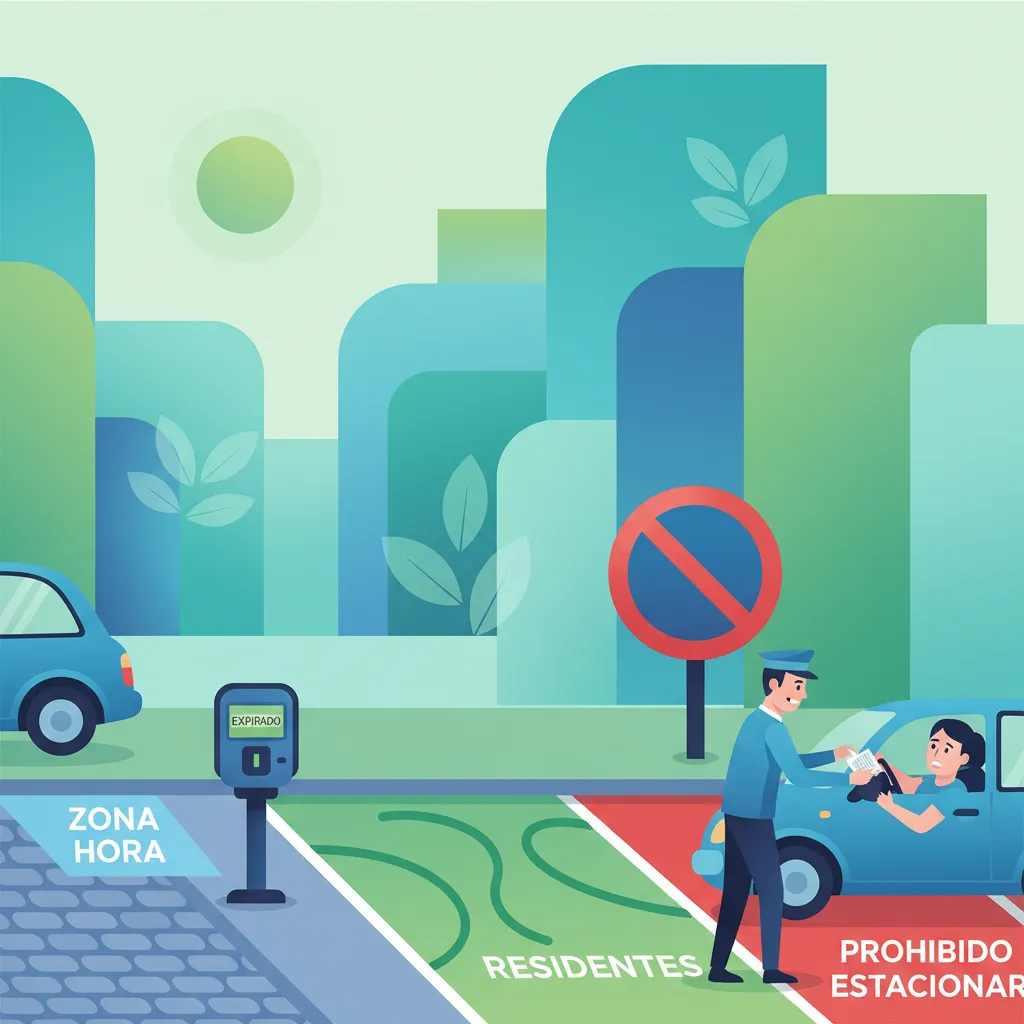
This lesson outlines the legal framework surrounding parking regulations in Spain, including the identification of regulated zones (e.g., ORA/SER), no-parking areas, and disabled parking spaces. It explains DGT signage interpretation and how improper parking can affect traffic flow and result in penalties. Learners will understand the regulatory environment to comply with parking laws and avoid fines.
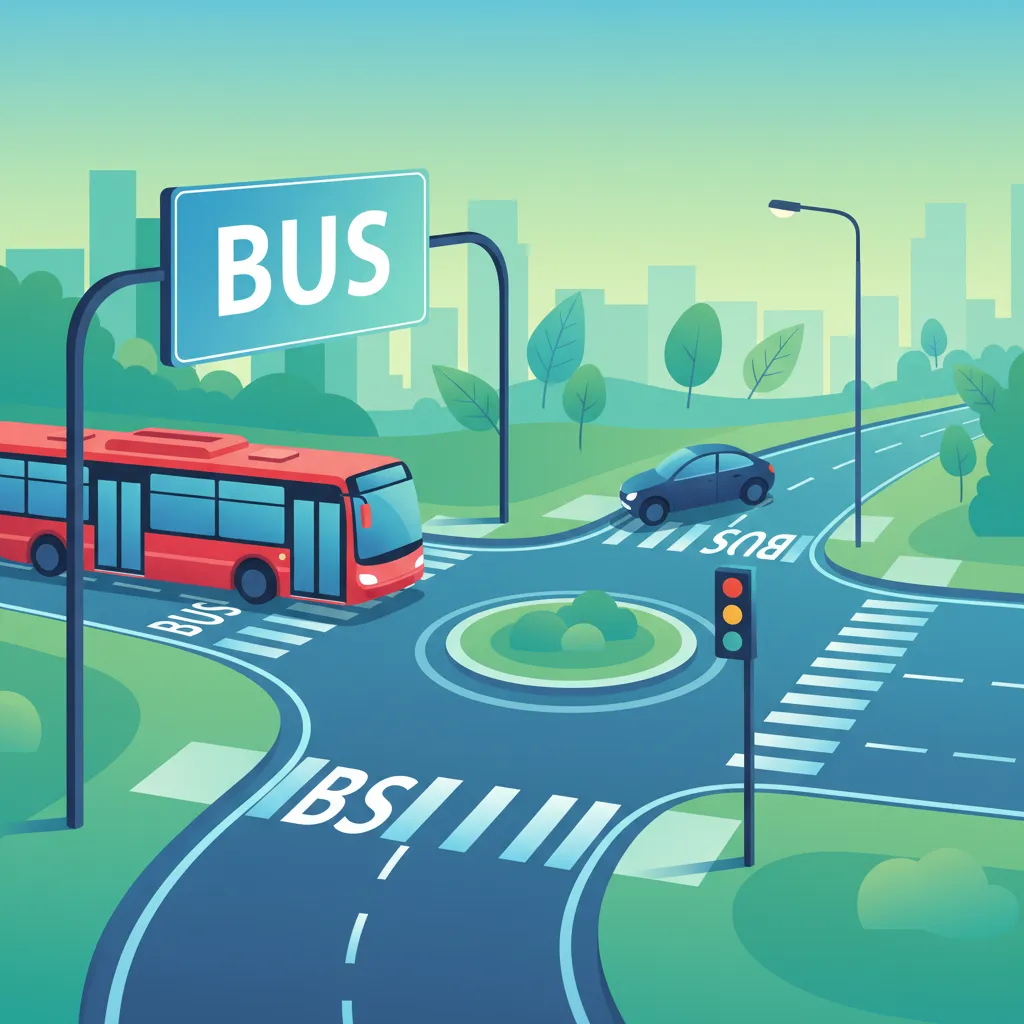
This lesson explores the regulations for dedicated bus lanes in urban environments, detailing the correct interpretation of associated lane markings and traffic signage. Learners will understand the specified times of operation, rules for sharing lanes with other vehicles, and the legal consequences of unauthorized entry. The module also provides clear guidelines for entering and exiting bus lanes at designated points to maintain traffic flow.
This lesson focuses on the comprehensive understanding of traffic light signals and their timing sequences. It defines the meanings of steady red, amber, and green lights, as well as flashing amber and arrow signals. The content also covers pedestrian and cyclist phases, describing the actions drivers must take during each signal change to maintain safety and compliance.

This lesson provides a detailed breakdown of the D and D1 license categories, defining the vehicle dimensions and passenger capacities for each. It explains the DGT's eligibility requirements, including minimum age, medical certification, and mandatory psychological assessments for professional drivers. Learners will understand the complete procedural path to obtaining a professional bus or coach license in Spain.
This lesson provides a broad overview of the key traffic regulations in Spain that directly impact professional truck drivers. It details the rules of priority at intersections, the interpretation of different road markings, and the principles of correct lane discipline. Furthermore, it explains the specific speed limits applicable to heavy vehicles and the legal protocols for safe overtaking and signaling.
This lesson introduces the regulatory signs that impose obligations or prohibitions on road users, with a focus on those pertinent to mopeds. It covers common signs such as speed limits, 'no entry', and mandatory turn directions, explaining how their shape and color indicate their function. Learners will be able to identify and correctly interpret these signs to navigate urban road networks legally and safely, avoiding potential fines.

This lesson explains the fundamental DGT regulations that govern public transport services, including requirements for operational permits and route authorizations. It covers the mandatory schedules for vehicle inspections, standards for emissions, and the legal importance of adhering to timetables and service quality. Learners will also understand the nature of regulatory audits and compliance checks that operators must undergo.
This lesson explains each phase of a Spanish traffic light, detailing the specific action required for red, amber, and green signals. It clarifies the meaning of a flashing amber light, which indicates yielding to other traffic or pedestrians, and the red-amber combination. Understanding these signals is fundamental for safely navigating controlled intersections and ensuring compliance with traffic flow rules established by the DGT.
Find clear answers to common questions learners have about Points System and Infractions. Learn how the lesson is structured, which driving theory objectives it supports, and how it fits into the overall learning path of units and curriculum progression in Spain. These explanations help you understand key concepts, lesson flow, and exam focused study goals.
New drivers in Spain typically start with a full balance of 12 points. After two years of accident-free driving, they gain an additional 2 points, reaching a maximum of 15 points. This initial balance is designed to encourage careful driving from the outset.
Common reasons for losing points include speeding, using a mobile phone while driving, not wearing a seatbelt, running red lights, driving under the influence of alcohol or drugs, and failing to yield to pedestrians or other vehicles. The severity of the infraction determines the number of points deducted.
Points can be recovered in two main ways. If you lose some points but not all, you can attend a safe driving course offered by authorized driving schools to recover up to 6 points, provided you haven't completed one in the last two years. If you lose all your points, you must pass a rehabilitation course and then a specific DGT exam to have your license reinstated with an initial balance of 8 points.
If you commit an infraction or a combination of infractions that leads to the loss of all your initial 12 points, your driving license will be revoked. You will be prohibited from driving any vehicle requiring a license for a specific period, and to drive again, you must complete a rehabilitation course and pass a DGT-issued theoretical exam.
Yes, the points system applies to all categories of driving licenses issued in Spain, including categories B and BE. The principles of point accumulation, deduction, and recovery are consistent across different license types.
Use our powerful search functionality to pinpoint specific Spanish DGT driving theory practice sets. Filter by road sign categories, traffic law topics, or question difficulty to build custom study sessions and reinforce your knowledge precisely where it matters for your official exam.