
Logo
Breakdown Safety

Spanish V-16 Beacon & Breakdown Safety Rules for Your DGT Driving Exam

Understand the latest Spanish traffic regulations regarding vehicle breakdowns and immobilization. This set focuses on the mandatory V-16 connected beacon, reflective vest requirements, and safe passenger protocols. Prepare effectively for the official DGT driving theory exam by learning how to protect yourself and others during roadside emergencies, ensuring you know what to do in line with Spanish law.
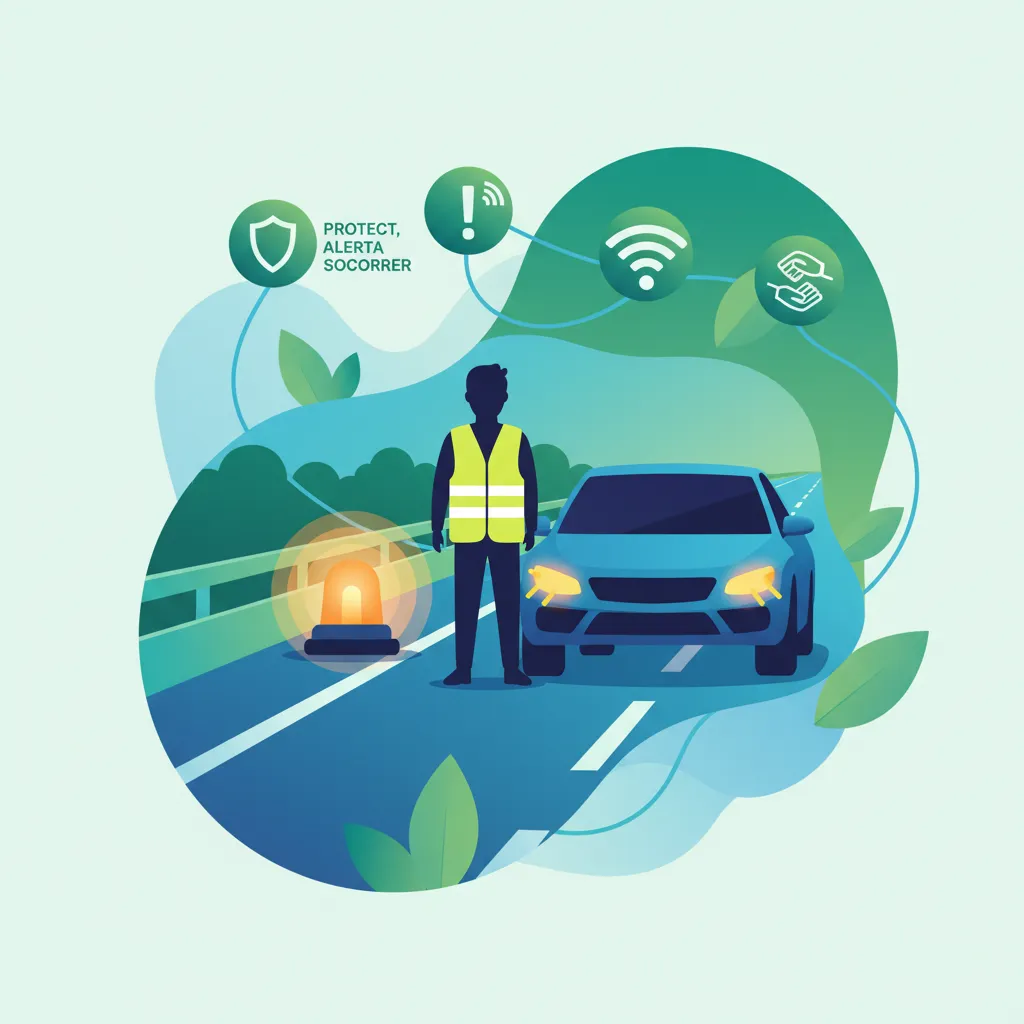
V-16 beaconbreakdown safetyreflective vestemergencyDGT rulesroad safetyPAS protocol
Spanish V-16 Beacon & Breakdown Safety Rules for Your DGT Driving Exam

Essential Revision: V-16 Beacon and Breakdown Safety in Spain

Prepare for the Spanish driving theory exam by mastering DGT regulations on vehicle breakdowns. This practice set covers essential procedures like using the V-16 beacon, reflective vests, and the PAS protocol, ensuring you gain critical road safety knowledge for unexpected emergencies on Spanish roads.

Prepare for unexpected vehicle breakdowns by understanding crucial safety measures. This set focuses on using the new V-16 connected beacon, proper reflective vest usage, and the 'Protect, Alert, Socorrer' (PAS) protocol, all vital for your Spanish driving theory exam.

Example Questions in V-16 & Breakdown Safety

Preview sample questions from the V-16 & Breakdown Safety practice set to see how they help you prepare for the driving theory exam in Spain.

Passengers Highway SafetyPAS Protocol Alert StepV-16 Mandatory DateV-16 Replaces WhatV-16 Beacon ConnectivityWhen to Wear VestReflective Vest StoragePAS Protocol Protect StepV-16 Personal DataV-16 Beacon PlacementPAS Protocol Socorrer StepReflective Vest Day UseTriangles After 2026V-16 Over Triangles ReasonHazard Lights Importance

Why Learners Search for V-16 & Breakdown Safety When Preparing for the Theory Exam

Learners choose V-16 & Breakdown Safety to improve accuracy and understanding of key exam themes in Spain. It offers realistic driving theory questions and targeted revision for effective preparation.

V-16 beacon rules Spain DGT examSpanish breakdown safety protocol questionsmandatory reflective vest Spain driving theoryemergency triangles vs V-16 beacon Spainhow to use V-16 beacon for breakdownPAS protocol for vehicle immobilization Spain

Questions Learners Have About V-16 & Breakdown Safety

Find answers to the most common queries learners have when practising V-16 & Breakdown Safety, including how questions match the official theory exam in Spain, how scoring works, and how this practice improves exam readiness.

What is the V-16 connected beacon and when does it become mandatory in Spain?

The V-16 connected beacon is a flashing light signal device placed on the roof of a vehicle to indicate its immobilization. It becomes mandatory for Spanish-registered vehicles from January 1, 2026, replacing emergency triangles.

Where should the V-16 beacon be placed when my vehicle is immobilized?

The V-16 connected beacon should be placed on the highest possible part of the vehicle, typically the roof, to ensure maximum visibility without requiring the driver to exit the vehicle into traffic.

When is it mandatory to use a reflective vest in Spain?

It is mandatory to wear a reflective vest if you exit your vehicle on an interurban road due to an emergency or breakdown. The vest must be stored in a place accessible from the driver's seat.

Are emergency triangles still valid for signaling a breakdown in Spain?

For Spanish-registered vehicles, emergency triangles will no longer be valid for signaling a breakdown from January 1, 2026. The V-16 connected beacon will be the only valid device from that date.

What is the 'PAS' protocol in the context of a breakdown?

The 'PAS' protocol stands for 'Protect, Alert, Socorrer' (Protect, Alert, Help). During a breakdown, 'Protect' involves securing the scene, 'Alert' means signaling the situation (e.g., with the V-16 beacon), and 'Socorrer' refers to assisting any injured persons, if applicable, though for a breakdown without injury, it means ensuring passenger safety.

Skills You Will Build for the Driving Theory Exam

By completing V-16 & Breakdown Safety, you will gain stronger rule knowledge, faster recognition of signs and situations, better decision making in traffic scenarios, and increased accuracy on exam style questions used in Spain. These outcomes directly support higher scoring exam performance.

Understand the mandatory use and placement of the V-16 connected beacon from January 1, 2026.
Recognize when and how to correctly use the reflective vest on Spanish interurban roads.
Apply the 'Protect, Alert, Socorrer' (PAS) protocol during vehicle immobilization.
Identify the correct safety measures for passengers during a roadside breakdown in Spain.
Differentiate between the old emergency triangles and the new V-16 beacon requirements for Spanish-registered vehicles.

Reinforce Spanish Breakdown Safety and V-16 Beacon Rules

Engaging with related practice questions helps consolidate your understanding of breakdown safety and V-16 beacon usage. This comprehensive topic revision is essential for mastering official DGT traffic rules and excelling in your Spanish driving theory test.
The V-16 Connected Beacon: New Mandatory Rules for Spanish Roads

V-16 Beacon 2026

Prepare for the 2026 Deadline: Understand Spain's Essential New Emergency Signal
V-16Emergency signalsRoad safety
12 questionsView details
Spanish PAS Protocol: Securing the Scene and Notification

PAS Protocol & 112 Calls

Master the crucial first steps after a traffic accident according to Spanish DGT rules.
Accident protocolPAS protocolEmergency calls
20 questionsView details
Scene Safety: The 'Proteger' Phase of the PAS Protocol in Spain

PAS: Scene Protection

Your first priority in an accident: Protect yourself and the scene according to DGT rules.
AccidentsEmergencySafety
15 questionsView details
Signaling Immobilized Vehicles at Night for the Spanish DGT Exam

Night Breakdown Signaling

Master Spanish Rules for Vehicle Breakdown Signaling at Night

signalingimmobilized vehiclenight driving
16 questionsView details
Emergency Vehicles and the V-1 Signal in Spain

Emergency Vehicles & V-1 Signal

Master Spanish Rules for Emergency Vehicle Priority: Your Exam Success Depends on It!
emergency vehiclespriorityV-1 signal
15 questionsView details
Winter Driving Protocols and the V-27 Signal in Spain

Winter Driving & V-27

Master Spanish Winter Driving Rules and Stay Safe on Snowy Roads.

Winter DrivingSnow ChainsWinter Tires
12 questionsView details

Questions in V-16 & Breakdown Safety

Exam focused questionss

0

Difficulty Level

How This Driving Theory Practice Helps You Pass Faster

V-16 & Breakdown Safety offers quick, focused exam style practice to boost your Spanish knowledge for the driving theory exam in Spain.

Avoid common mistakes related to breakdown safety on the DGT exam.
Gain confidence in knowing the correct procedures for roadside emergencies in Spain.
Understand the legal requirements for V-16 beacons and reflective vests.
Improve your ability to react safely and protect passengers during a breakdown.
Stay updated on the latest Spanish traffic laws for emergency signaling.

Who Should Practise V-16 & Breakdown Safety?

V-16 & Breakdown Safety helps learners in Spain with clear explanations and targeted Spanish practice to improve essential driving theory topics.

This practice set is ideal for new learners and anyone preparing for the Spanish driving theory exam. It addresses common confusion around emergency equipment and protocols, especially the upcoming changes with the V-16 beacon. It ensures you are fully prepared to handle vehicle immobilization situations safely and according to DGT regulations.

Start Practice

Ready to Start Practicing? Choose Your Theory Category

Dive deeper into your Spanish DGT driving theory preparation by selecting a specific practice category. Whether you need to review road signs, master traffic priority rules, or understand vehicle safety, pick a topic to begin targeted exercises and reinforce your knowledge for the official exam.

Explore Practice Categories

CTA Decorative Squares

Practice Spanish driving theory questions

Spanish road signsSpanish article topicsSearch Spanish road signsSpanish driving theory homeSpanish road sign categoriesSpanish driving theory topicsSpanish Moped Theory AM courseSearch Spanish theory articlesSpanish driving theory coursesSpanish driving theory articlesSpanish driving theory practiceSpanish driving licence proceduresSpanish Driving Theory D & D1 courseSpanish Driving Theory B & BE courseLane Signs Spanish road sign categoryOther Signs Spanish road sign categorySpanish Truck Driving Theory C/C1 courseService Signs Spanish road sign categoryPriority Signs Spanish road sign categoryLocation Signs Spanish road sign categoryMandatory Signs Spanish road sign categoryDirection Signs Spanish road sign categorySpanish Motorcycle Theory (A, A1, A2) courseRestriction Signs Spanish road sign categoryAdditional Panels Spanish road sign categoryRoute Number Signs Spanish road sign categoryConfirmation Signs Spanish road sign categoryPre-signaling Signs Spanish road sign categoryGeneral Danger Signs Spanish road sign categoryDe-restriction Signs Spanish road sign categoryEntry Prohibition Signs Spanish road sign categoryGeneral Indication Signs Spanish road sign categoryConstruction Warning Signs Spanish road sign categoryConstruction Indication Signs Spanish road sign categoryConstruction Speed Limit Signs Spanish road sign categoryConstruction De-restriction Signs Spanish road sign categoryConstruction Reflective Marking Signs Spanish road sign categoryOther Prohibition or Restriction Signs Spanish road sign categorySigns for Specific Use in Built-up Areas Spanish road sign categoryConstruction Regulation and Priority Signs Spanish road sign category