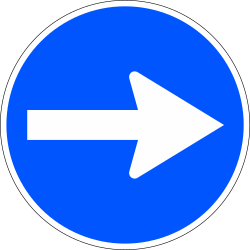
The R-400d is a mandatory traffic sign in Spain instructing you that turning right is compulsory at this specific location. Unlike warning or prohibition signs, this sign dictates a required action to ensure traffic flow and safety, particularly at complex junctions or where specific lane usage is needed. You must follow the direction indicated by the sign and any accompanying arrows or lane markings to avoid potential conflicts with other road users or infrastructure.
Master the R-400d sign to correctly interpret mandatory right turns, a crucial step for your Spanish theory test revision. Understanding the precise meaning of this traffic sign ensures you follow correct road rules and avoid potential hazards.
The sign for turn right tells road users what they are required to do rather than what they must avoid. Spanish mandatory signs are used where the road design, lane arrangement, or traffic management demands a specific direction, route, or traffic class. Ignoring the instruction can put you into conflict with opposing traffic, protected users, or reserved infrastructure. Always follow the symbol itself first, then use arrows, lane markings, and panels to understand the exact path or maneuver that is compulsory.
This mandatory sign requires road users to follow turn right. It tells you which maneuver, direction, route, or lane use is compulsory at that point.
Get clear, practical answers to the most common questions about the R-400d - Turn right road sign. Learn how the sign works, what rules it represents, and how it affects real driving situations. This FAQ strengthens your understanding and supports accurate decision making for the Spanish driving theory exam in Spain.
The R-400d sign is a mandatory instruction indicating that you must turn right at the point where the sign is displayed. It's not a suggestion; it's a requirement. You will see this sign when a specific manoeuvre or route is compulsory for safety or traffic management reasons.
When you encounter the R-400d sign, you are legally obligated to turn right. You must position your vehicle correctly in advance and complete the right turn. Pay close attention to any directional arrows or lane markings that accompany the sign, as they will specify exactly which lane to use and the precise path of the turn.
No, you absolutely cannot. The R-400d sign is a mandatory sign, meaning it dictates a required action. Going straight or turning left when instructed to turn right would be a violation of traffic rules and could lead to dangerous situations or collisions with oncoming traffic or other road users.
A common trap in theory exams is confusing mandatory signs like the R-400d with advisory signs or signs that offer a choice. Learners might incorrectly assume they can choose a different direction. Always remember that mandatory signs require strict obedience to the indicated manoeuvre, direction, or lane use.
Ignoring the R-400d sign means you are not following a mandatory instruction, which is a traffic violation. In real driving, this could place you in conflict with opposing traffic, pedestrians, or cyclists, leading to a dangerous situation. In a theory exam, failing to correctly identify and react to such mandatory signs will result in a failed question or section.
A clear reference image of the R-400d - Turn right road sign used in Spain.
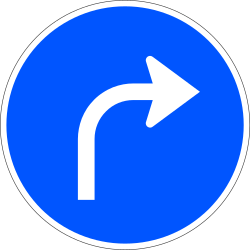
The R-400d - Turn right road sign may also be known by these alternative names or terms.
The R-400d - Turn right road sign is part of the Mandatory Signs category, which groups together signs with similar rules and functions.
Mastering Spanish road signs involves distinguishing between similar symbols. Reviewing related mandatory signs side-by-side helps prevent confusion and aids accurate identification for your theory test revision.
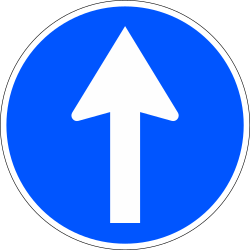
Mandatory 'Go Straight' Sign (R-400c): Know Your Compulsory Direction
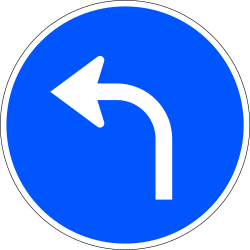
Mandatory Turn Left: Know What This Sign Demands on Spanish Roads
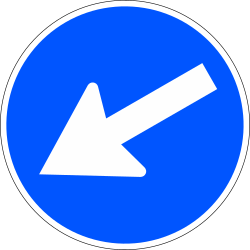
The R-401b 'Keep Left' Sign: Your Compulsory Direction in Spain
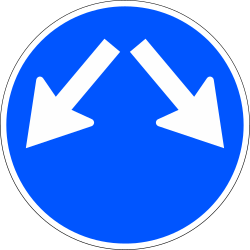
Mandatory R-401c Sign: You Must Pass On This Side
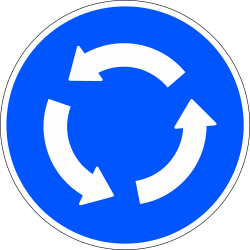
Understand the R-402: Mandatory Roundabout Maneuver Sign
Connect visual signage with the specific Spanish traffic laws and priority rules required to pass your theory test. Explore detailed articles and practice sets that explain how these regulatory markers influence daily driving on local roads.
Learners will discover the legal hierarchy of road surfaces and why the standard priority-to-the-right rule does not apply when transitioning from a dirt path to a paved street. This guide clarifies the responsibilities of both the driver on the main road and the driver entering from an unpaved area to ensure safe traffic flow. Mastering these nuances is essential for passing the DGT theory exam and maintaining hazard perception skills in rural and semi-rural Spanish environments.
Master Road Arrows to Avoid Confusion and Drive Confidently
Master Tunnel Lighting: Drive Safely and Avoid Fines in Spanish Tunnels
Traffic lights in Spain go well beyond the standard red, yellow, and green circular signals. This article covers the specific legal requirements for lane-control lights, cycle signals, and public transport indicators, providing the necessary clarity for your theory exam preparation and real-world driving. You will learn the exact behavior required for flashing yellow lights and how to interpret specialized directional arrows to ensure you navigate intersections safely and in full compliance with the General Traffic Regulations.
The sign for road for trucks and vans tells road users what they are required to do rather than what they must avoid. Spanish mandatory signs are used where the road design, lane arrangement, or traffic management demands a specific direction, route, or traffic class. Ignoring the instruction can put you into conflict with opposing traffic, protected users, or reserved infrastructure. Always follow the symbol itself first, then use arrows, lane markings, and panels to understand the exact path or maneuver that is compulsory.
The sign for road for mopeds (and vehicles for people with reduced mobility) tells road users what they are required to do rather than what they must avoid. Spanish mandatory signs are used where the road design, lane arrangement, or traffic management demands a specific direction, route, or traffic class. Ignoring the instruction can put you into conflict with opposing traffic, protected users, or reserved infrastructure. Always follow the symbol itself first, then use arrows, lane markings, and panels to understand the exact path or maneuver that is compulsory.
You've explored the complete list of Spanish road signs. Now, deepen your understanding by reviewing specific sign groups or testing your knowledge with practice questions. Fully prepare for your DGT driving theory exam and confidently navigate Spanish roads.
Browse All Spanish Road Signs