
This lesson details the critical safety steps required when a large passenger vehicle breaks down on public roads. As part of your professional training, you will learn how to protect your passengers, secure your bus, and manage the incident safely in accordance with Swiss traffic regulations.
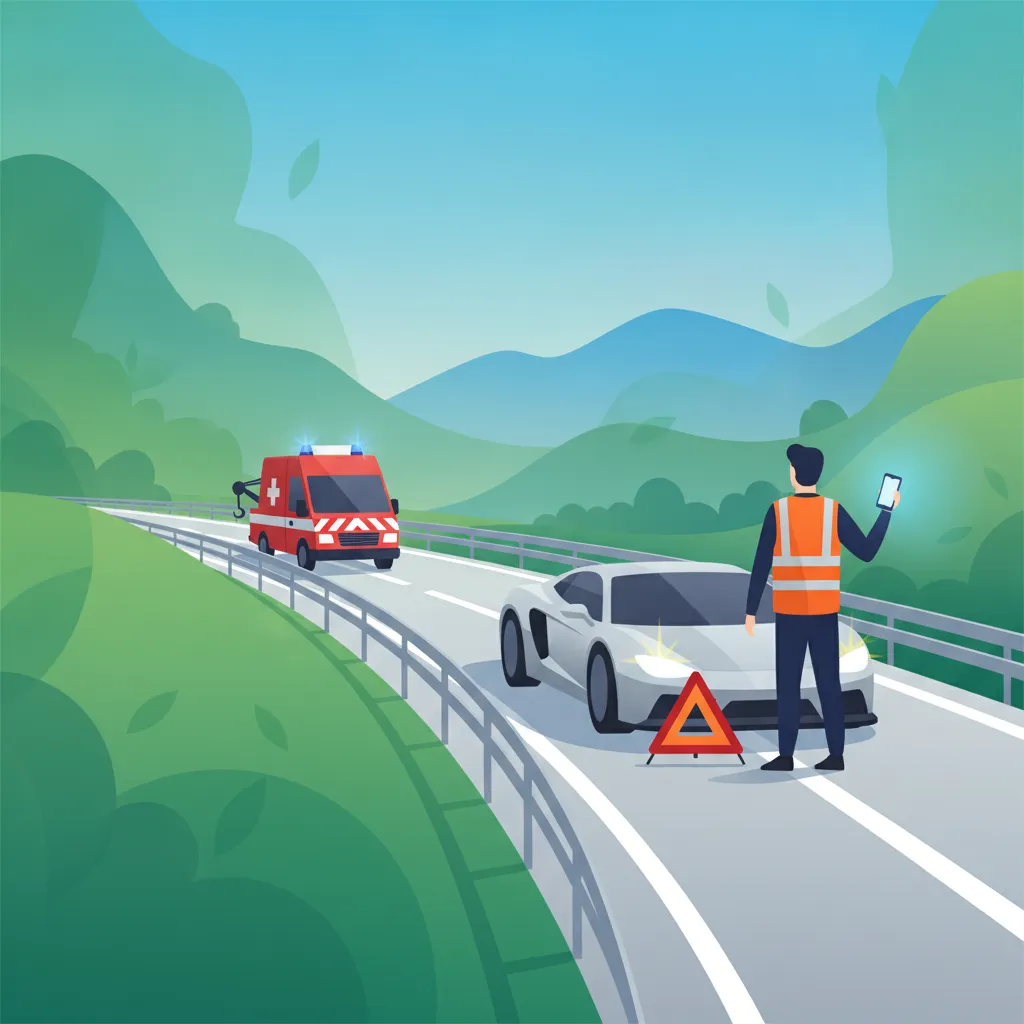
Lesson content overview
A vehicle breakdown on a public road, especially when operating a bus or coach (Category D vehicle) with passengers, is a serious incident that demands immediate, correct, and decisive action. Such an event can quickly escalate into a dangerous situation, posing significant risks not only to the driver and passengers but also to other road users and emergency personnel. For professional drivers of large passenger vehicles, adherence to established breakdown procedures is not merely a recommendation; it is a fundamental aspect of their legal duty of care and professional responsibility under Swiss law.
This lesson provides a comprehensive, sequential guide to managing a vehicle breakdown safely and efficiently. It covers the essential steps from the moment a problem is detected to the successful resolution of the incident, with particular emphasis on safety, communication, and compliance with Swiss traffic regulations. Understanding these procedures is crucial for minimizing the likelihood of secondary accidents, protecting vulnerable occupants, and ensuring the driver fulfills all legal obligations.
Effective management of a vehicle breakdown is built upon several core principles designed to ensure maximum safety and compliance. Adhering to these foundational concepts will guide your actions during a stressful event.
When a vehicle breakdown occurs, a systematic approach is essential. The following steps outline the correct protocol for bus and coach drivers in Switzerland.
The very first action is to safely bring your vehicle to a halt and position it in the safest possible location. This is critical to prevent immediate danger and create a buffer from ongoing traffic.
Detect the problem: As soon as you realize a breakdown is occurring or imminent, begin looking for a safe place to stop.
Signal your intention: Use your indicators to signal your intention to move to the side of the road or onto the hard shoulder.
Decelerate smoothly: Reduce your speed gradually and safely. Avoid sudden braking, especially with passengers on board.
Move to the safest location:
On Motorways (Autobahnen / Autoroutes): Always try to reach the hard shoulder (Pannenstreifen / bande d’arrêt d’urgence). Pull over as far to the right as possible, ensuring the vehicle is completely off the main carriageway. If the hard shoulder is too narrow or obstructed, consider a service area or exit ramp if safely accessible.
On Rural or Urban Roads: Seek a wide verge, a designated parking bay, a lay-by, or an area that provides maximum clearance from traffic lanes. Avoid stopping on bends, hills, or immediately after a blind summit where visibility is poor.
Secure the vehicle: Once stopped, apply the parking brake firmly. If the terrain is sloped, consider turning the wheels towards the curb or verge. Switch off the engine.
Stopping in the travel lane or exiting onto a pavement without adequate clearance from moving traffic are common mistakes that must be avoided. Your goal is to remove the vehicle as much as practicable from the direct flow of traffic while remaining on the public road.
Immediately after stopping your vehicle in a safe location, you must activate your hazard warning lights.
Flashing lights on all corners of a vehicle that indicate it is stationary and may pose a hazard to other traffic.
These lights serve as a crucial visual alert to other road users, indicating that your vehicle is stopped and potentially causing an obstruction or danger. They must be activated without delay. In extremely low-visibility conditions, such as dense fog or heavy snowfall, an auxiliary flashing torch or other reflective devices can supplement the vehicle's standard hazard lights, but they do not replace them. Always ensure your vehicle's rear lights are fully functional when hazard lights are activated.
If you need to leave your vehicle on a public road, wearing a high-visibility reflective vest is mandatory under Swiss law.
A garment made of fluorescent material with reflective strips, designed to make the wearer highly visible to others, especially in low light or adverse weather conditions.
This vest significantly increases your visibility to oncoming traffic, especially at night, in poor weather, or on high-speed roads like motorways. You must don the reflective vest before stepping out of the vehicle. If passengers must also exit the vehicle, it is advisable for them to wear reflective vests if available, particularly in high-risk environments. Assuming reflective vests are optional or only necessary on motorways are dangerous misunderstandings; they are crucial whenever you exit your vehicle on a public road where traffic is present.
The warning triangle is an indispensable safety device designed to provide an early visual cue to approaching drivers, giving them ample time to react to your stationary vehicle.
A portable, reflective triangular sign that drivers must place on the road at a specified distance behind a stopped vehicle that is causing a hazard.
The placement distance is legally mandated and varies depending on the type of road:
When placing the triangle, walk facing oncoming traffic for your safety. Position it upright on the road surface so it is clearly visible. Forgetting to retrieve the triangle after the incident is a common mistake; always remember to collect it once assistance arrives and the situation is resolved.
As a Category D driver, your primary duty is the safety and well-being of your passengers. Clear and calm communication is paramount during a breakdown.
Maintain Control: The driver must maintain control over passenger movement while addressing the breakdown.
Neglecting to inform passengers or allowing them to disembark without assessing road safety are critical errors that can lead to serious accidents involving pedestrians.
Once your vehicle is safely stopped and warning devices are deployed, the next step is to contact the appropriate authorities.
It is a legal obligation to report any stopped vehicle that creates a danger on the road. Assuming that calling roadside assistance alone suffices, particularly on a busy motorway, is a common and potentially dangerous misunderstanding. Authorities need to manage traffic flow and ensure overall public safety.
Securing the scene involves taking all possible measures to prevent other road users from colliding with your stationary vehicle. This builds upon the deployment of hazard lights and the warning triangle.
Relying exclusively on hazard lights without placing a warning triangle, especially on high-speed roads, is insufficient and can be extremely dangerous. The goal is to maximize the visibility of your breakdown to approaching traffic from as far away as possible.
Passenger evacuation should only be considered if the vehicle cannot be moved promptly, if there is an immediate danger (e.g., fire risk), or if instructed by emergency services. This process must be controlled and safe.
Never allow passengers to exit onto active traffic lanes without clear safety measures.
Assess the situation: Evaluate the road conditions, traffic speed, and availability of a safe area for passengers to disembark (e.g., a wide hard shoulder, a pedestrian walkway, or a designated lay-by).
Communicate clearly: Announce the evacuation over the PA system, providing specific instructions on which doors to use and where to proceed.
Supervise disembarkation: Open doors only when it is safe to do so. Supervise passengers as they exit, ensuring they move away from the vehicle and active traffic lanes to a designated safe zone.
Assist vulnerable passengers: Provide assistance to passengers with reduced mobility, the elderly, or children. Portable ramps may be needed for wheelchair users. Emergency services (fire services or ambulance) can often provide specialized assistance for such cases.
Maintain group cohesion: Instruct passengers to stay together in the safe area and await further instructions or the arrival of alternative transport.
The driver's role is critical in preventing passengers from entering dangerous areas, such as active traffic lanes, and ensuring an orderly and safe movement away from the breakdown scene.
Swiss road traffic law (Strassenverkehrsgesetz, SVG / Loi sur la circulation routière, LCR and its ordinances) outlines specific mandatory actions for drivers experiencing a breakdown on a public road. Compliance with these regulations is not only a matter of safety but also a legal requirement.
Breakdown procedures need to be adapted based on the specific conditions of the incident. Different environments and circumstances will require variations in how you apply the core principles.
Understanding common mistakes made during breakdowns is crucial for ensuring safety and compliance. Being aware of these pitfalls allows you to respond correctly and avoid exacerbating an already challenging situation.
Every step in the breakdown procedure is rooted in fundamental principles of safety, human perception, and legal responsibility. Understanding the "why" behind each action reinforces its importance.
Handling a vehicle breakdown on a public road demands a disciplined and methodical approach, especially for professional Category D drivers. By following these essential steps, you can ensure the safety of your passengers, yourself, and other road users, while complying with all relevant Swiss regulations.
Safely Stop and Secure the Vehicle: Immediately decelerate and maneuver your bus or coach to the safest possible location, ideally the hard shoulder on a motorway or a wide verge on other roads. Apply the parking brake and switch off the engine.
Activate Hazard Warning Lights: Turn on your vehicle's hazard warning lights the moment you stop to alert all approaching traffic to your stationary vehicle.
Don Reflective Vest: Before exiting the vehicle for any reason, put on your high-visibility reflective vest.
Place Warning Triangle: Position the warning triangle at the legally mandated distance: at least 30 metres behind the vehicle on motorways, and at least 15 metres on other public roads.
Prioritize Passenger Safety and Communication: Inform passengers calmly via the PA system, instructing them to remain seated with doors closed until further notice. Provide regular updates.
Contact Emergency Services: Call the police (117) or motorway patrol immediately if your breakdown creates an obstruction or danger. Provide precise location details (e.g., kilometer marker on a motorway) and details about your vehicle and passengers. Subsequently, contact your roadside assistance provider.
Secure the Scene and Manage Traffic: Ensure all warning devices are deployed correctly. If available and safe, use additional cones to enhance visibility and guide traffic.
Controlled Passenger Evacuation (If Necessary): If passengers must disembark, ensure it is done in a controlled manner, onto a safe area (hard shoulder, sidewalk, lay-by), away from active traffic, and with assistance for those with reduced mobility. This should only happen when absolutely safe or if instructed by emergency services.
Remain with the Vehicle: Stay with your vehicle and passengers, supervising the situation, until assistance arrives or passengers are safely evacuated and accounted for.
Document the Incident: Note the time, location, nature of the breakdown, and all actions taken for subsequent reports or insurance claims.
By diligently following these procedures, you not only ensure maximum safety during an unexpected event but also uphold your professional responsibilities as a Category D driver.
This lesson provides comprehensive breakdown procedures for professional Swiss Category D drivers, emphasizing a systematic eight-step protocol from safe vehicle positioning through controlled passenger evacuation. Key legal requirements include activating hazard lights immediately, placing the warning triangle at least 30 metres on motorways and 15 metres on other roads, and wearing a reflective vest before exiting. The driver must maintain passenger safety through clear PA communication and keep doors closed until a safe disembarkation zone is secured. Swiss traffic law under Strassenverkehrsgesetz obligates drivers to report hazardous breakdowns to police, and failure to follow these procedures constitutes a breach of professional duty of care.
A short set of high-value points that capture the most important learning from this lesson.
Always activate hazard lights immediately upon stopping, before any other action, to alert approaching traffic to your stationary vehicle.
Warning triangle placement is legally mandated: minimum 30 metres on motorways and 15 metres on all other public roads.
Don your reflective vest BEFORE exiting the vehicle on any public road, regardless of daylight conditions.
Passenger safety is the driver's direct responsibility: keep doors closed, use PA system, and maintain control over disembarkation decisions.
Contact police (117) immediately if your breakdown creates an obstruction or danger on public roads; roadside assistance alone is insufficient.
Explore all units and lessons included in this driving theory course.
On motorways, pull onto the hard shoulder (Pannenstreifen) as far right as possible; on other roads, seek a wide verge, lay-by, or parking bay away from bends and hills.
Never allow passengers to exit onto active traffic lanes; evacuation must be to a safe zone such as a hard shoulder, sidewalk, or designated lay-by.
Always walk facing oncoming traffic when placing the warning triangle, and retrieve it once assistance arrives.
Provide precise location details when calling authorities: road name, kilometer marker on motorways, nearest exit, vehicle type, and passenger count.
Swiss law under Strassenverkehrsgesetz (SVG) imposes a duty of care that extends to all road users, not just passengers.
Placing the warning triangle too close to the vehicle on a motorway, reducing reaction time for drivers approaching at high speed.
Exiting the vehicle without wearing a reflective vest, especially in low-visibility conditions, making the driver a hazard.
Allowing passengers to disembark without first assessing road safety and supervising the exit onto active traffic lanes.
Neglecting to call police when the breakdown blocks traffic, preventing authorities from managing flow and securing the scene.
Relying only on hazard lights without placing a warning triangle, which provides insufficient detection distance for approaching drivers.
Lesson content overview
A short set of high-value points that capture the most important learning from this lesson.
Always activate hazard lights immediately upon stopping, before any other action, to alert approaching traffic to your stationary vehicle.
Warning triangle placement is legally mandated: minimum 30 metres on motorways and 15 metres on all other public roads.
Don your reflective vest BEFORE exiting the vehicle on any public road, regardless of daylight conditions.
Passenger safety is the driver's direct responsibility: keep doors closed, use PA system, and maintain control over disembarkation decisions.
Contact police (117) immediately if your breakdown creates an obstruction or danger on public roads; roadside assistance alone is insufficient.
Explore all units and lessons included in this driving theory course.
On motorways, pull onto the hard shoulder (Pannenstreifen) as far right as possible; on other roads, seek a wide verge, lay-by, or parking bay away from bends and hills.
Never allow passengers to exit onto active traffic lanes; evacuation must be to a safe zone such as a hard shoulder, sidewalk, or designated lay-by.
Always walk facing oncoming traffic when placing the warning triangle, and retrieve it once assistance arrives.
Provide precise location details when calling authorities: road name, kilometer marker on motorways, nearest exit, vehicle type, and passenger count.
Swiss law under Strassenverkehrsgesetz (SVG) imposes a duty of care that extends to all road users, not just passengers.
Placing the warning triangle too close to the vehicle on a motorway, reducing reaction time for drivers approaching at high speed.
Exiting the vehicle without wearing a reflective vest, especially in low-visibility conditions, making the driver a hazard.
Allowing passengers to disembark without first assessing road safety and supervising the exit onto active traffic lanes.
Neglecting to call police when the breakdown blocks traffic, preventing authorities from managing flow and securing the scene.
Relying only on hazard lights without placing a warning triangle, which provides insufficient detection distance for approaching drivers.
Explore search topics learners often look for when studying Procedures for a Vehicle Breakdown on a Public Road. These topics reflect common questions about road rules, driving situations, safety guidance, and lesson level theory preparation for learners in Switzerland.
Browse additional driving theory lessons that cover connected traffic rules, road signs, and common driving situations related to this topic. Improve your understanding of how different rules interact across everyday traffic scenarios.
Understand the specific legal requirements for professional drivers in Switzerland regarding vehicle breakdowns, including mandatory use of warning triangles, reflective vests, and timely reporting to authorities to ensure road safety.

The driver is legally responsible for the roadworthiness of their vehicle at the start of and during every journey. This lesson outlines the formal process for reporting any identified defects to the transport manager or maintenance staff. It stresses the critical rule that a vehicle with a known safety-critical defect must not be driven until it has been professionally repaired and declared safe.
After stopping for an emergency, making the scene safe is the top priority. This lesson details the procedure: activate hazard warning lights, put on high-visibility clothing before exiting the cab, and place the warning triangle at the correct distance behind the vehicle (at least 100m on motorways). This warns approaching traffic and creates a safer environment for the driver and emergency responders.
This lesson outlines the mandatory documentation required during any professional transport journey in Switzerland. Drivers must be able to present the vehicle registration document ('Fahrzeugausweis'), their valid driving license, and the OACP qualification card upon request. It also touches upon transport-specific documents like consignment notes, which are crucial for legal compliance during roadside inspections by authorities.
This lesson covers essential first aid skills and the procedures for reporting accidents in Switzerland. It details the use of emergency numbers 112 and 144, the correct placement of warning triangles, and the use of high-visibility vests. The content outlines the steps for securing an accident scene, providing assistance, and coordinating with emergency services.

This lesson provides clear, actionable steps for managing a motorcycle breakdown safely. It covers moving the vehicle to a safe location, making yourself visible to other traffic with hazard lights and reflective gear, and contacting breakdown services. Following a proper protocol minimizes risk in a vulnerable situation.
This lesson details the specific documents that must be present in the vehicle and on the driver's person during service. It covers the driving license, OACP card, vehicle registration, and tachograph records. You will learn the importance of ensuring all paperwork is current and correct to ensure legal compliance at all times.
This lesson provides a practical guide for handling a vehicle breakdown. It covers the immediate steps to take, such as moving the vehicle off the road if possible and making it visible to other traffic using hazard lights. The content also explains how to contact breakdown services and what information to provide to them.
A tyre blowout or engine failure can be a frightening experience. This lesson provides a clear action plan: maintain a firm grip on the steering wheel, avoid harsh braking, signal, and move the vehicle to a safe location like the hard shoulder if possible. It then covers the essential safety steps of activating hazard lights, placing the warning triangle, and waiting in a safe place away from the vehicle.
This lesson provides a structured guide for managing the scene of a road traffic accident. It covers the internationally recognized priorities: assess for danger, make the scene safe, send for help by calling emergency services (112), and provide first aid to the injured if trained to do so. It also details the legal requirement to stop and exchange information after being involved in a collision.
This lesson clarifies the legal requirements for reporting traffic incidents in Switzerland. It provides guidance on how to interact with police and emergency personnel, providing clear and accurate information. Understanding these procedures helps ensure the incident is documented correctly for legal and insurance purposes.
Explore critical response actions for coach breakdowns on Swiss roads, focusing on advanced passenger safety, controlled evacuation, and effective coordination with emergency services and roadside assistance for Category D drivers.
In the event of a fire or other serious danger, a driver must be able to lead an evacuation. This lesson covers the decision-making process, how to use all available emergency exits, and the importance of clear, authoritative communication to guide passengers. The goal is to move everyone to a safe location away from the vehicle and any traffic.
This lesson outlines the steps a driver should take when a passenger becomes ill or requires medical attention. It covers safely stopping the vehicle, making an emergency call to the correct number (144/112), and providing basic assistance until professional help arrives. The focus is on a calm, systematic response to a stressful situation.

Effective communication is vital during an emergency. This lesson teaches you what critical information to provide when calling emergency services, including precise location and the nature of the incident. It also covers techniques for communicating with passengers to provide reassurance and instruction, helping to maintain calm and order.
After stopping for an emergency, making the scene safe is the top priority. This lesson details the procedure: activate hazard warning lights, put on high-visibility clothing before exiting the cab, and place the warning triangle at the correct distance behind the vehicle (at least 100m on motorways). This warns approaching traffic and creates a safer environment for the driver and emergency responders.
This lesson covers the immediate actions to take following a collision. The priorities are to prevent further incidents by securing the scene, to assess the situation for injuries, and to alert the emergency services. You will learn the correct procedures for making the area safe for yourself, your passengers, and other road users.
This lesson focuses on the legally required safety equipment that must be on board every passenger vehicle. You will learn how to locate and check the fire extinguisher, first aid kit, and emergency hammers. It also covers the inspection of emergency exits to ensure they are unobstructed and functional.

Reversing is the most dangerous manoeuvre a large vehicle can perform and should be avoided whenever possible. This lesson details a safe system of work for when reversing is unavoidable. It covers the importance of a 360-degree check before starting, the use of a banksman, and how to interpret standard hand signals.
This lesson provides clear, actionable steps for managing a motorcycle breakdown safely. It covers moving the vehicle to a safe location, making yourself visible to other traffic with hazard lights and reflective gear, and contacting breakdown services. Following a proper protocol minimizes risk in a vulnerable situation.
This lesson provides a practical guide for handling a vehicle breakdown. It covers the immediate steps to take, such as moving the vehicle off the road if possible and making it visible to other traffic using hazard lights. The content also explains how to contact breakdown services and what information to provide to them.
Find clear answers to common questions learners have about Procedures for a Vehicle Breakdown on a Public Road. Learn how the lesson is structured, which driving theory objectives it supports, and how it fits into the overall learning path of units and curriculum progression in Switzerland. These explanations help you understand key concepts, lesson flow, and exam focused study goals.
On motorways, it must be placed at least 100 meters behind the vehicle. On other roads, it is typically placed 50 meters behind, but you should adjust based on visibility and road layout to ensure it is visible to oncoming traffic well in advance.
Generally, if the bus is in a safe location away from traffic, passengers should remain on board. However, if the vehicle is in a high-risk area, such as a lane or a hard shoulder on a busy motorway, an immediate and safe evacuation to a protected area behind the barrier is required.
While not always legally mandated for every passenger to carry one, it is a professional best practice to ensure your own visibility with a high-visibility vest whenever you exit the vehicle. For passengers, focus on moving them to a secure location rather than gear distribution.
The exam often uses multi-choice scenarios showing a vehicle stopped in a dangerous position. You must select the correct sequence of actions: activating hazard lights, ensuring passenger safety, using the warning triangle, and calling for professional recovery.
Pinpoint specific Swiss traffic rules, road signs, or driving situations you need to master. Use the practice search to start a focused revision session now and build confidence for your official driving theory exam.