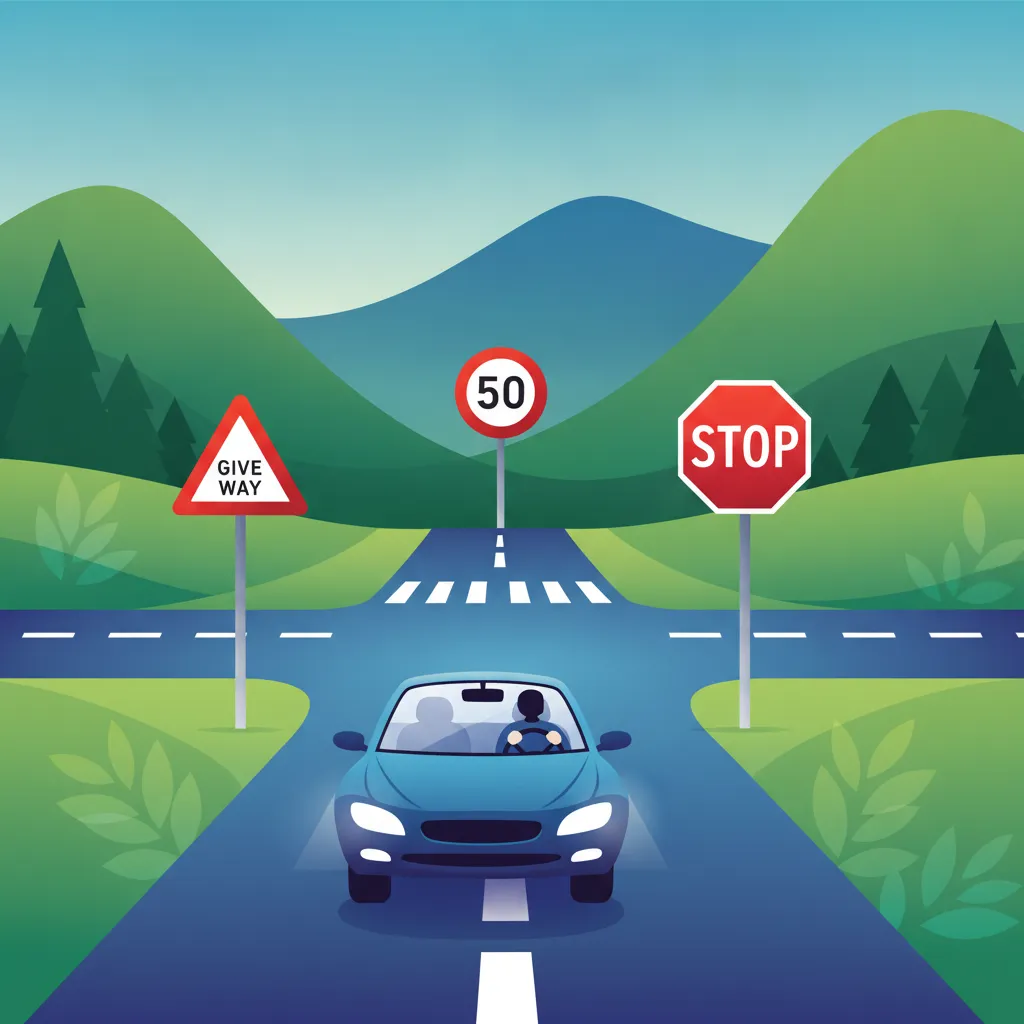
This lesson guides you through the complex system of regulatory traffic signs in Switzerland, which are essential for every Category B driver. You will learn to correctly identify and obey various mandates and prohibitions, ensuring you are prepared for both the official theoretical exam and safe everyday driving.
Lesson content overview
Regulatory traffic signs form the backbone of safe and orderly traffic flow on Swiss roads. These crucial signs issue direct instructions, either mandating specific actions or prohibiting others, thereby ensuring compliance and predictability for all road users. For anyone preparing for the Swiss Category B theoretical exam, a deep understanding of these signs is not just beneficial, but absolutely essential. This lesson delves into the shapes, colours, meanings, and legal implications of regulatory signs, equipping you with the knowledge to navigate the Swiss traffic system confidently and safely.
Regulatory signs are not mere suggestions; they are legally binding directives that drivers must obey without exception. Their primary purpose is to enforce specific behaviours, manage traffic flow, prevent conflicts, and protect vulnerable road users. By clearly defining what is permitted and what is forbidden, these signs contribute significantly to road safety and efficiency. Ignoring them can lead to dangerous situations, traffic disruptions, and severe legal consequences, including fines and potential license penalties. Understanding these signs is a fundamental component of the Comprehensive Swiss Driving Theory Course.
The design of regulatory signs is standardized to allow for rapid recognition and comprehension, even at speed or in challenging conditions. In Switzerland, as in much of Europe, the shape and colour of a sign immediately communicate its general category and authority.
Signs that prohibit an action are typically circular with a red border. The symbol within the circle, often with a diagonal line through it, clearly indicates the forbidden action. The red colour signifies immediate restriction and demands compliance.
This type of sign, for instance, marks a road where vehicular entry is forbidden. Drivers encountering such a sign must immediately understand that they cannot proceed in that direction.
Signs that mandate a specific action are usually circular with a blue background and white symbols. These signs instruct drivers on what they must do, such as turning in a specific direction or using a particular lane.
This sign indicates that drivers must continue straight ahead, prohibiting turns in other directions.
This clear visual distinction—red circles for "do not" and blue circles for "do"—is a fundamental principle of Swiss traffic signage and significantly reduces ambiguity on the road.
Prohibitive signs are critical for preventing dangerous maneuvers, restricting access to certain areas, or regulating specific vehicle types. They represent a clear "no" to the action depicted.
These signs address actions that are broadly disallowed for most or all vehicle types in a given area.
Some prohibitive signs target particular categories of vehicles, regulating their access to specific roads or zones. This is crucial for maintaining road integrity, reducing congestion, or protecting sensitive environments.
Drivers must always check their vehicle type and dimensions against such signs to ensure compliance. Misinterpreting these signs can lead to fines and potential hazards.
Always be aware of your vehicle's type, size, and weight, especially when encountering vehicle-specific prohibition signs. Ignorance is not an excuse for non-compliance.
Speed limit signs are a fundamental type of regulatory sign, directly impacting road safety and traffic efficiency. They define the legal speed range for a given road segment, adapted to its design, environment, and potential hazards.
These are among the most common regulatory signs, dictating the highest speed at which vehicles are legally permitted to travel. They are circular with a red border and a black number indicating the limit in kilometres per hour (km/h).
Less common but equally important are minimum speed limit signs. These are blue circular signs with a white number, indicating the lowest speed at which drivers must travel. They are typically found on motorways (Autobahnen) or other high-speed routes to prevent excessively slow vehicles from impeding traffic flow and creating hazards.
Remember that speed limits are maximums for good conditions, but minimums when posted, with safety as the ultimate decider. Always drive at a speed appropriate for the circumstances, even if it's below the posted maximum.
Entry restriction signs play a vital role in traffic management by limiting who can access certain roads or areas, under what conditions. These signs prevent specific types of vehicles from entering unsuitable zones, thus protecting vulnerable road users, preserving sensitive environments, or ensuring smooth traffic flow.
These signs restrict all or broad categories of motor vehicles from entering a road segment.
This specific sign, often displayed at the beginning of pedestrian zones or private roads, indicates that no motor vehicles are permitted to proceed. This is distinct from the "No Entry" sign (2.01) which applies only to the direction of travel.
These restrictions target specific classes of vehicles, allowing other traffic to pass. Examples include:
Many entry restrictions are not absolute but apply only during specific times or days. These are always communicated via supplementary signs (Zusatztafeln) placed below the main regulatory sign.
If a supplementary sign states "7h-19h," the truck restriction applies only between 7 AM and 7 PM. Outside these hours, trucks may be permitted. It is crucial to carefully read and interpret these supplementary plates, as they modify the primary sign's meaning.
In this scenario, a driver could theoretically enter with a motor vehicle outside of Monday to Friday, 8 AM to 6 PM. However, caution is advised, and local regulations should always be observed.
Mandatory direction signs are blue circular signs with white arrows or symbols that dictate the only permissible path for traffic. They are essential for managing traffic at intersections, roundabouts, and on multi-lane roads, preventing confusion and potential collisions.
These signs leave no room for alternative choices; drivers must follow the direction indicated by the arrow.
Beyond simple turns, mandatory signs can also dictate lane usage, particularly on multi-lane highways or urban arteries.
Ignoring mandatory direction signs can cause immediate danger, as other road users will expect traffic to follow the designated flow. Such violations are serious and can lead to immediate accident risk and legal penalties.
The legal weight of regulatory signs in Switzerland is absolute. Non-compliance is not merely a suggestion; it constitutes a traffic offense with clear and often severe consequences.
Violating regulatory signs can result in a range of penalties under Swiss traffic law, varying depending on the severity of the offense and the specific regulation broken.
Understanding these consequences underlines the importance of not only knowing what the signs mean but also developing a consistent habit of compliance and vigilance.
The application of regulatory signs isn't always straightforward. Various conditions can influence how drivers must interpret and respond to these directives.
While a speed limit sign indicates the maximum permissible speed under ideal conditions, drivers have an overarching responsibility to adjust their speed to prevailing circumstances.
Regulatory signs set the legal maximum or minimum, but safety always dictates the actual appropriate speed or action.
Some regulatory signs specifically target certain vehicle types or impose restrictions based on weight or dimensions.
In areas with high pedestrian or cyclist traffic, regulatory signs prioritize their safety.
As mentioned earlier, many regulatory signs, especially those concerning entry restrictions or parking, are accompanied by supplementary plates indicating specific hours or days of applicability. Ignoring these time-based conditions is a common violation.
In this scenario, parking on Sunday evening would be permitted, as the restriction only applies on weekdays during specified hours. Always read supplementary signs carefully.
Applying the knowledge of regulatory signs in real-world driving situations is where theory meets practice.
Setting: You are driving through a Swiss town, and you encounter a 50 km/h speed limit sign. Later, you enter a residential area marked with a 30 km/h zone sign. Correct Behavior: You smoothly reduce your speed to 50 km/h upon seeing the first sign and then further reduce to 30 km/h as you enter the residential zone. You maintain awareness for pedestrians and children, even if traffic is light. Incorrect Behavior: You continue at a higher speed, believing the limit is a mere suggestion or that lower traffic justifies faster driving. This increases accident risk, particularly for vulnerable road users, and will likely result in a fine if caught by speed cameras or police.
Setting: You are on an acceleration lane joining a motorway, where a minimum speed limit sign of 80 km/h is posted. Correct Behavior: You accelerate quickly and smoothly, matching your speed to at least 80 km/h (or the speed of traffic if higher) before merging safely onto the motorway. Incorrect Behavior: You merge too slowly (e.g., 60 km/h), creating a dangerous speed differential with fast-moving motorway traffic, forcing other drivers to brake or swerve, which is a significant hazard and a violation.
Setting: You approach an intersection with two lanes. An overhead blue circular sign in your lane shows a straight arrow and a right-turn arrow, meaning you can go straight or turn right. The left lane has a blue circular sign with a left-turn arrow only. Correct Behavior: If you intend to turn left, you ensure you are in the left lane. If you intend to go straight or turn right, you use your current lane. You follow the arrow corresponding to your chosen direction. Incorrect Behavior: You realize you need to turn left while in the straight/right-turn lane and attempt a last-minute lane change or ignore the sign by turning left from the wrong lane, risking a collision with vehicles in the correct lane.
Setting: You are driving a delivery van, approaching a shopping street marked with a red circular sign showing a black truck icon with a diagonal line (No Entry for Trucks), supplemented by a sign indicating "Lieferverkehr 06:00-10:00 Uhr" (Delivery traffic 06:00-10:00). It's 11:30 AM. Correct Behavior: You recognize it's outside the permitted delivery hours and find an alternative route or a designated delivery zone nearby. Incorrect Behavior: You enter the street, assuming the sign doesn't apply to "delivery" trucks, or you ignore the time restriction, resulting in a fine and potentially causing congestion or damage in a pedestrian-priority zone.
The strict enforcement and clear design of regulatory signs are not arbitrary. They are carefully conceived elements of the Swiss road safety strategy.
Mastering the interpretation and immediate application of regulatory signs is a cornerstone of responsible driving in Switzerland. It builds the foundation for navigating complex traffic situations, making informed decisions, and ultimately, contributing to safer roads for everyone.
Swiss regulatory signs are legally binding directives that use standardized shapes and colors: red circles with diagonal lines signal prohibitions, while blue circles with white symbols indicate mandatory actions. Speed limit signs show maximum permissible speeds under good conditions, but drivers must always adjust downward for weather, visibility, or traffic hazards; minimum speed signs (less common) set a floor on motorways. Entry restrictions and mandatory directions are often modified by supplementary plates specifying times, vehicle types, or conditions. Violations carry fines, license penalties, and possible criminal charges. This lesson equips Category B learners with the sign recognition skills and contextual understanding needed for both the Swiss theory exam and safe real-world driving.
A short set of high-value points that capture the most important learning from this lesson.
Red circular signs with red borders indicate prohibitions (do not), while blue circular signs with white symbols indicate mandatory actions (do).
Speed limit signs set maximum speeds for ideal conditions; you must reduce speed for weather, traffic, or visibility, even below the posted limit if unsafe.
Supplementary signs (Zusatztafeln) placed below primary signs modify their meaning with time restrictions, vehicle types, or specific conditions.
Mandatory direction signs leave no alternative choices; you must follow the indicated direction, and failing to position correctly before an intersection is dangerous and illegal.
Regulatory signs in Switzerland carry full legal authority; non-compliance can result in fines, license penalties, and criminal charges if injury results.
Explore all units and lessons included in this driving theory course.
No Entry (2.01) prohibits entry in the indicated direction only; No Motor Vehicles (2.02) prohibits all motor vehicles in both directions.
No Stopping (2.27) forbids stopping for any reason; No Parking allows brief stops for loading or passengers.
Minimum speed limits (blue with white number) appear on motorways; you may only go below them if conditions genuinely make it unsafe to maintain the speed.
Conditional restrictions, such as truck bans applying only 7h–19h, require careful reading of supplementary plates every time you encounter the sign.
Police instructions override all signs; temporary roadwork signs override permanent signs; road markings reinforce but do not override regulatory signs.
Confusing a prohibitive red-circle sign with a mandatory blue-circle sign, leading to wrong responses in exam questions and dangerous driving actions.
Ignoring supplementary time or vehicle-specific plates, such as entering a truck-restricted zone outside permitted hours or failing to notice a height restriction.
Assuming that driving at exactly the posted speed limit is always safe and legal, without adjusting for reduced adhesion, fog, snow, or heavy traffic.
Attempting to change lanes or turn at the last moment when already in the wrong lane for a mandatory direction sign, causing conflict with other road users.
Not checking vehicle type, weight, or dimensions against prohibition signs, leading to fines or hazardous situations in restricted areas.
Lesson content overview
A short set of high-value points that capture the most important learning from this lesson.
Red circular signs with red borders indicate prohibitions (do not), while blue circular signs with white symbols indicate mandatory actions (do).
Speed limit signs set maximum speeds for ideal conditions; you must reduce speed for weather, traffic, or visibility, even below the posted limit if unsafe.
Supplementary signs (Zusatztafeln) placed below primary signs modify their meaning with time restrictions, vehicle types, or specific conditions.
Mandatory direction signs leave no alternative choices; you must follow the indicated direction, and failing to position correctly before an intersection is dangerous and illegal.
Regulatory signs in Switzerland carry full legal authority; non-compliance can result in fines, license penalties, and criminal charges if injury results.
Explore all units and lessons included in this driving theory course.
No Entry (2.01) prohibits entry in the indicated direction only; No Motor Vehicles (2.02) prohibits all motor vehicles in both directions.
No Stopping (2.27) forbids stopping for any reason; No Parking allows brief stops for loading or passengers.
Minimum speed limits (blue with white number) appear on motorways; you may only go below them if conditions genuinely make it unsafe to maintain the speed.
Conditional restrictions, such as truck bans applying only 7h–19h, require careful reading of supplementary plates every time you encounter the sign.
Police instructions override all signs; temporary roadwork signs override permanent signs; road markings reinforce but do not override regulatory signs.
Confusing a prohibitive red-circle sign with a mandatory blue-circle sign, leading to wrong responses in exam questions and dangerous driving actions.
Ignoring supplementary time or vehicle-specific plates, such as entering a truck-restricted zone outside permitted hours or failing to notice a height restriction.
Assuming that driving at exactly the posted speed limit is always safe and legal, without adjusting for reduced adhesion, fog, snow, or heavy traffic.
Attempting to change lanes or turn at the last moment when already in the wrong lane for a mandatory direction sign, causing conflict with other road users.
Not checking vehicle type, weight, or dimensions against prohibition signs, leading to fines or hazardous situations in restricted areas.
Explore search topics learners often look for when studying Regulatory Signs and Their Implications. These topics reflect common questions about road rules, driving situations, safety guidance, and lesson level theory preparation for learners in Switzerland.
Browse additional driving theory lessons that cover connected traffic rules, road signs, and common driving situations related to this topic. Improve your understanding of how different rules interact across everyday traffic scenarios.
Go beyond basic regulatory signs. Explore complex scenarios, supplementary signs, and vehicle-specific restrictions in Swiss traffic law. Essential for mastering traffic rules and ensuring safe driving.
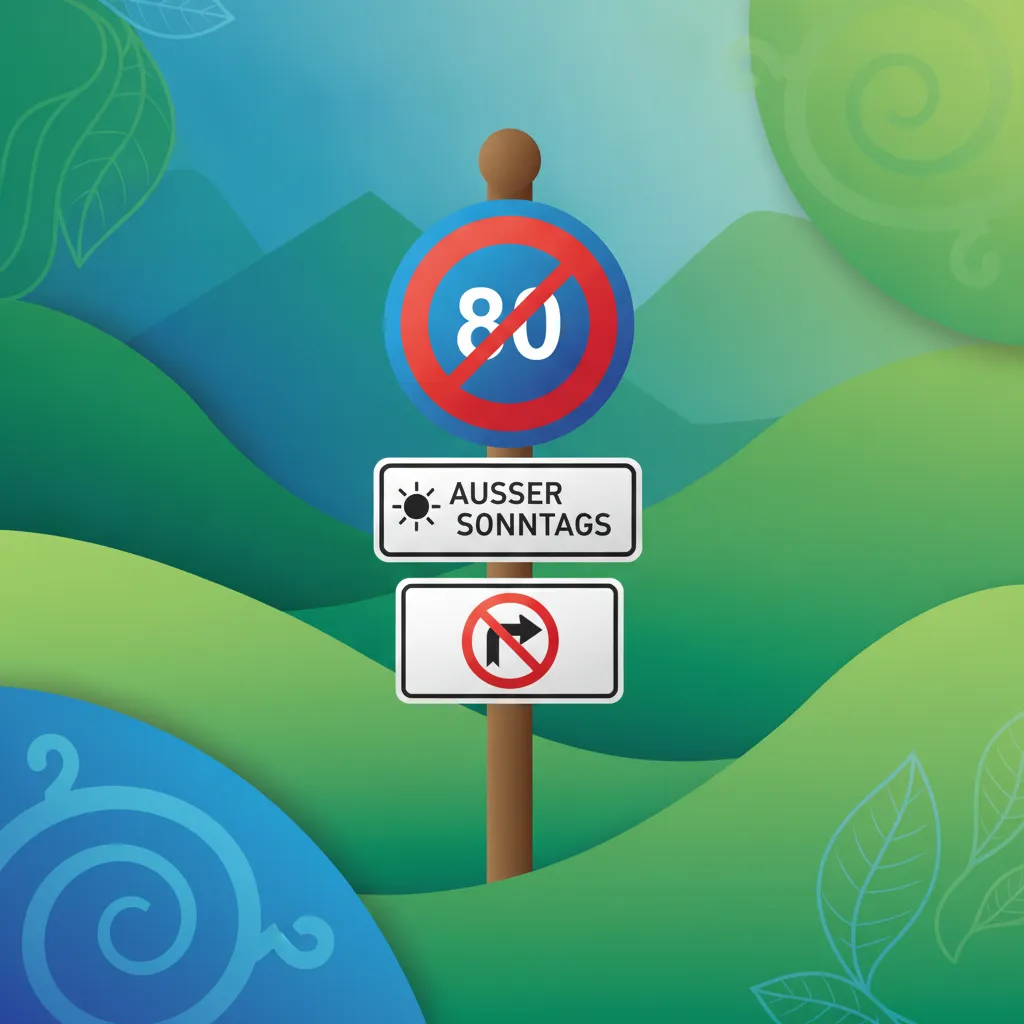
This lesson delves into supplementary signs that modify or clarify the meaning of primary traffic signs. You will learn to interpret signs indicating time restrictions, vehicle-specific limitations, and lane-specific instructions. The content also highlights how these signs interact with main regulatory signs to convey precise, context-sensitive traffic rules.
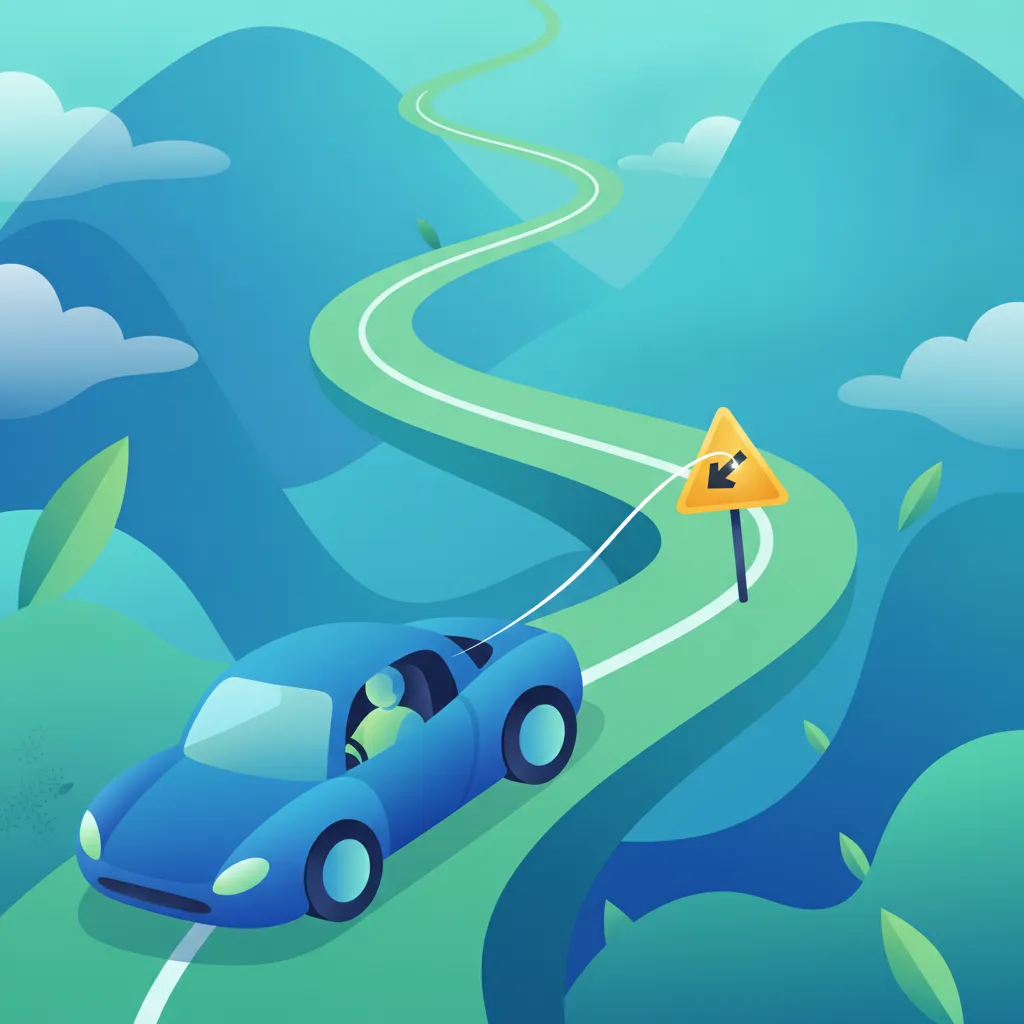
This lesson focuses on warning signs that alert drivers to potential hazards ahead, such as curves, steep descents, and roadwork zones. You will understand how these signs prompt anticipatory driving behavior, allowing for adjustments in speed and position. The content also discusses the typical placement of warning signs to help you react safely to changing conditions.
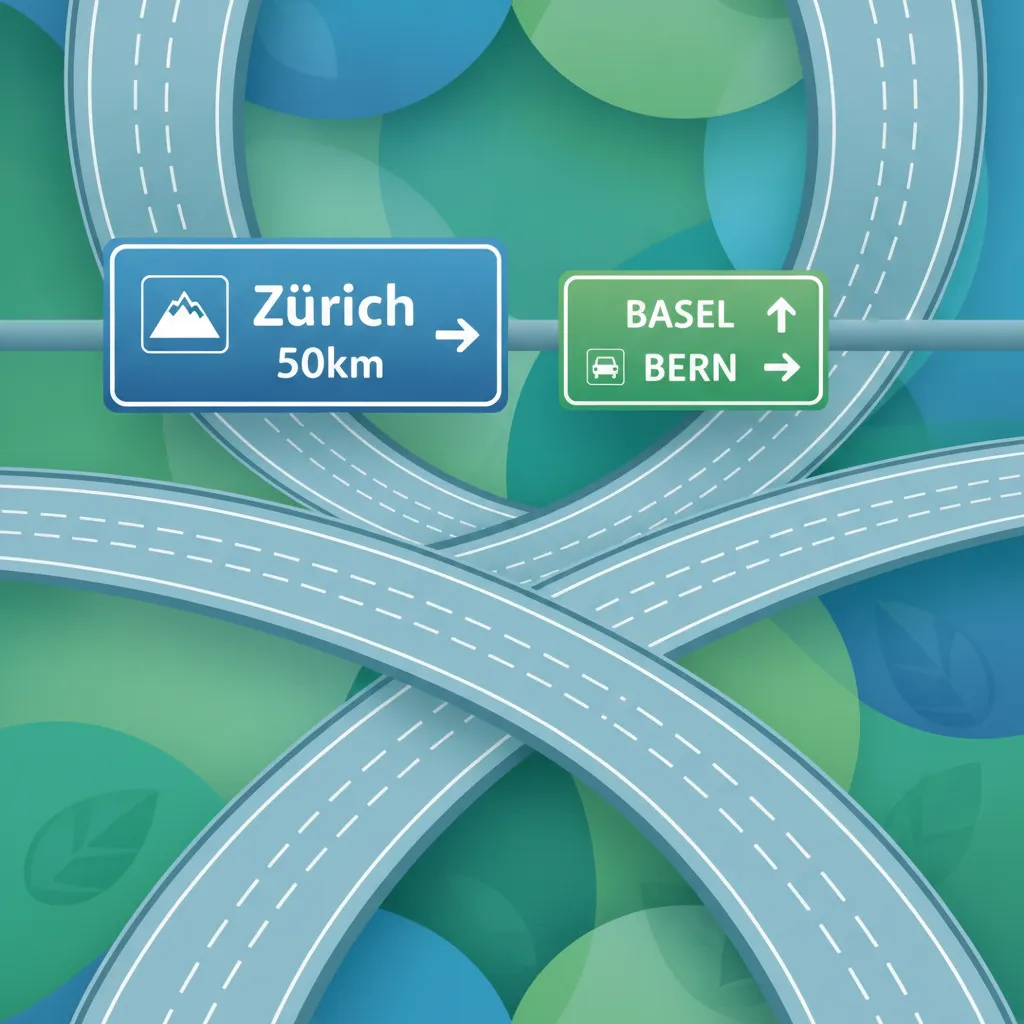
This lesson examines informational signs that provide route guidance, destination distances, and tourist information. It explains how direction signs, distance markers, and service area signs assist drivers in planning routes and making informed decisions. Understanding the logic of informational signage ensures efficient and safe navigation through the Swiss road network.
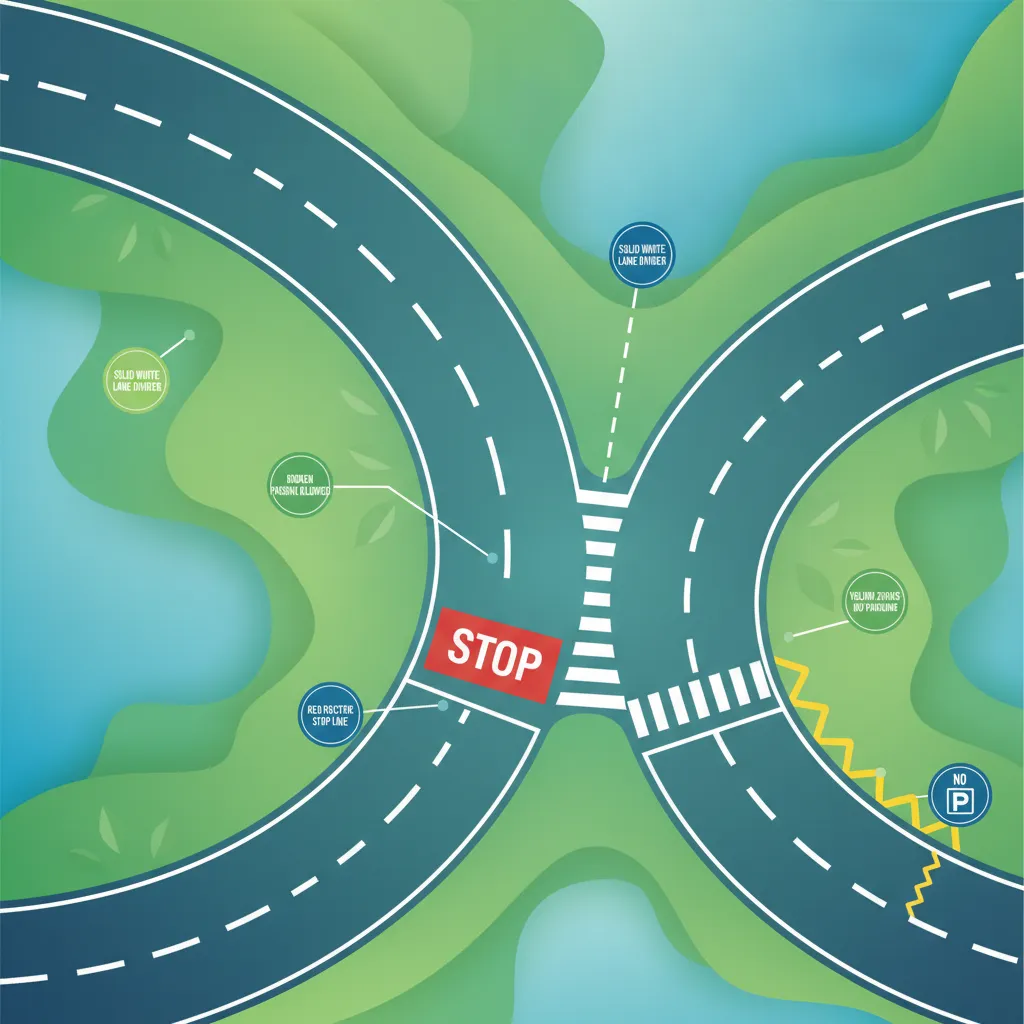
This lesson covers the various road surface markings that dictate lane usage, turning movements, and pedestrian zones. It explains the significance of solid versus broken lines, directional arrows, and specific markings for bike lanes. Understanding these markings is crucial for maintaining lane discipline and ensuring safe interactions in complex traffic environments.
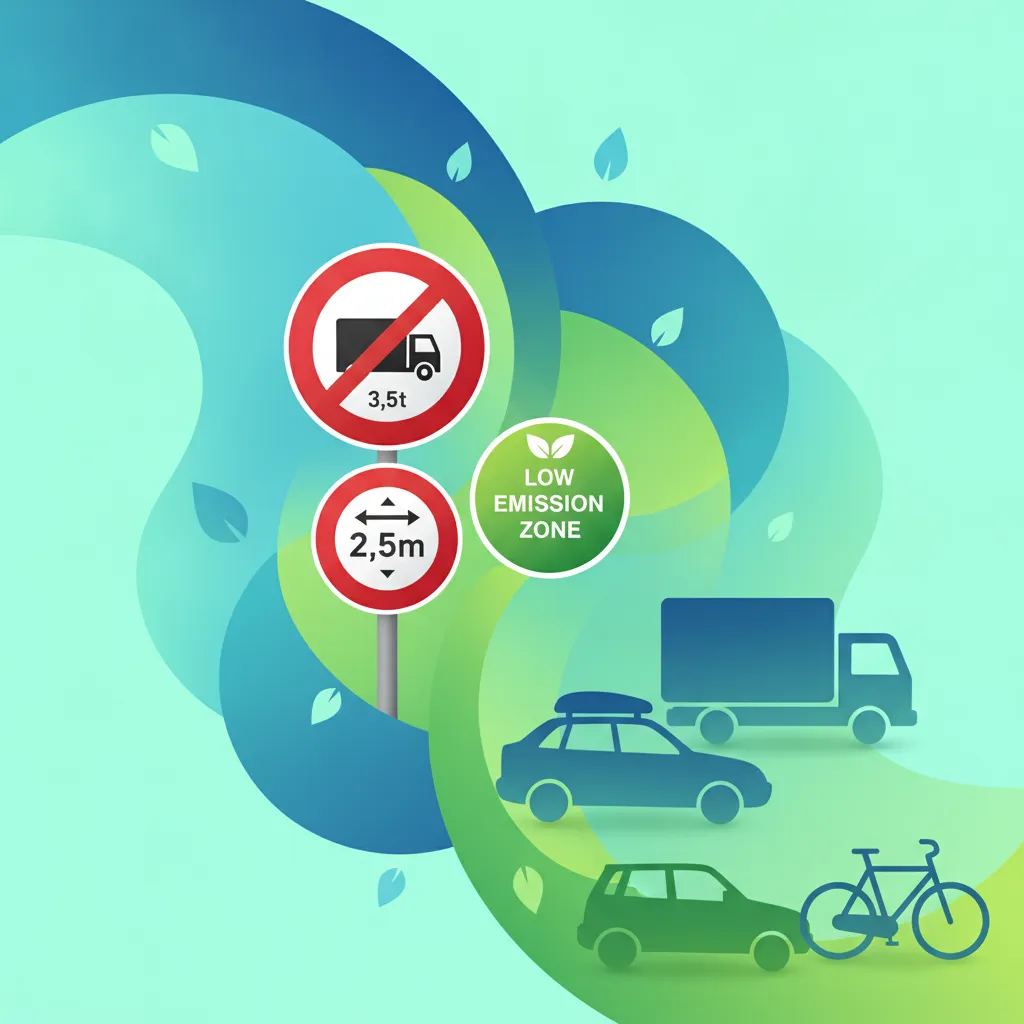
Many urban areas have restrictions to manage traffic and protect infrastructure. This lesson teaches drivers to identify and interpret traffic signs that prohibit access based on gross vehicle weight, axle load, height, or width. It also covers the growing prevalence of environmental or low-emission zones, which may restrict entry for older, more polluting vehicles.

This lesson introduces the fundamental traffic signs that directly impact small vehicle riders. It covers the classification of signs into regulatory, warning, and mandatory categories, explaining how their shape and color indicate their function. Learners will be able to recognize and correctly interpret speed limits, priority signs, and other key information vital for safe navigation.
This lesson focuses on the variety of painted markings on Swiss roads and their legal significance. Learners will understand the difference between solid and broken lines, the rules for stop lines, and their obligations at a zebra crossing (Fußgängerstreifen). Correct interpretation of these markings is essential for proper lane positioning and safe interaction with all road users.
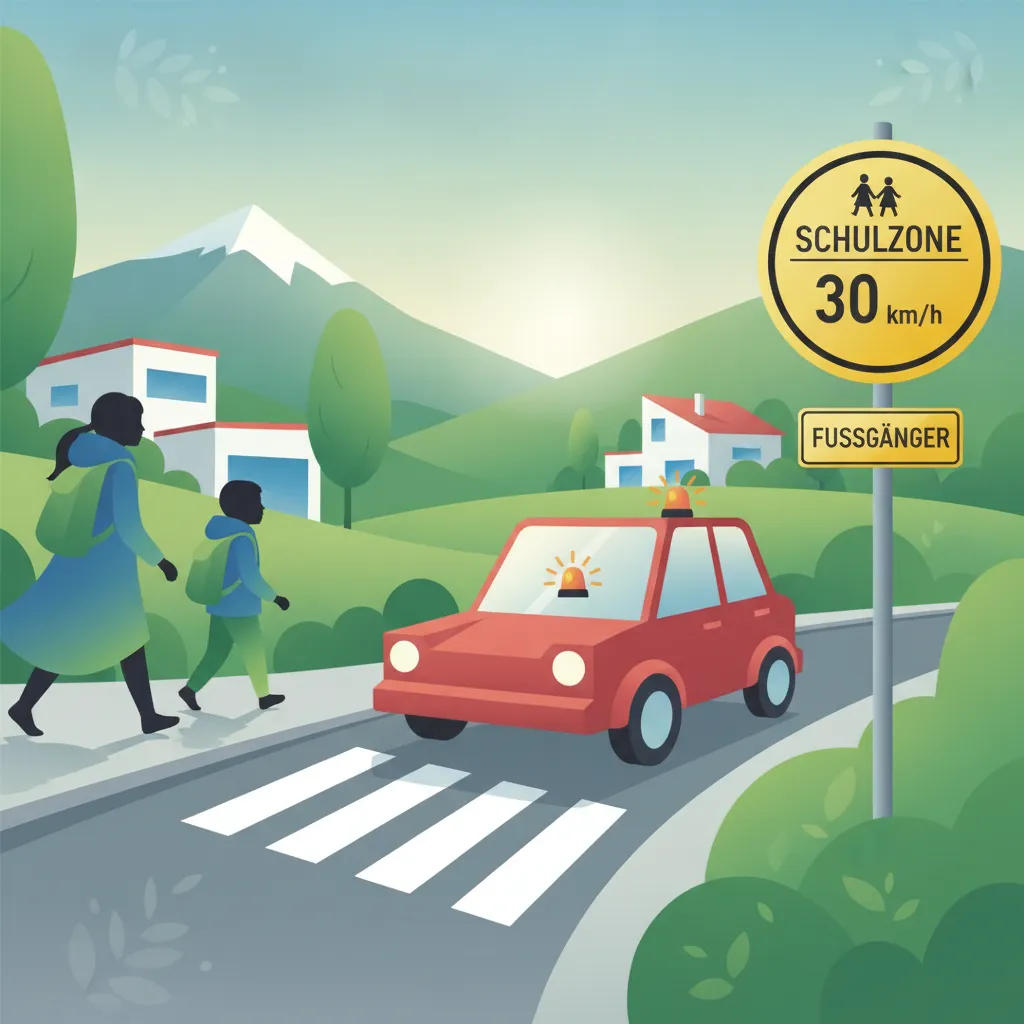
This lesson focuses on school zones, where special speed limits and cautionary measures are required. You will learn to recognize school zone signs, understand reduced speed limits, and be aware of designated child crossing zones. The content also emphasizes the need for heightened vigilance when school buses stop for students to ensure child safety.
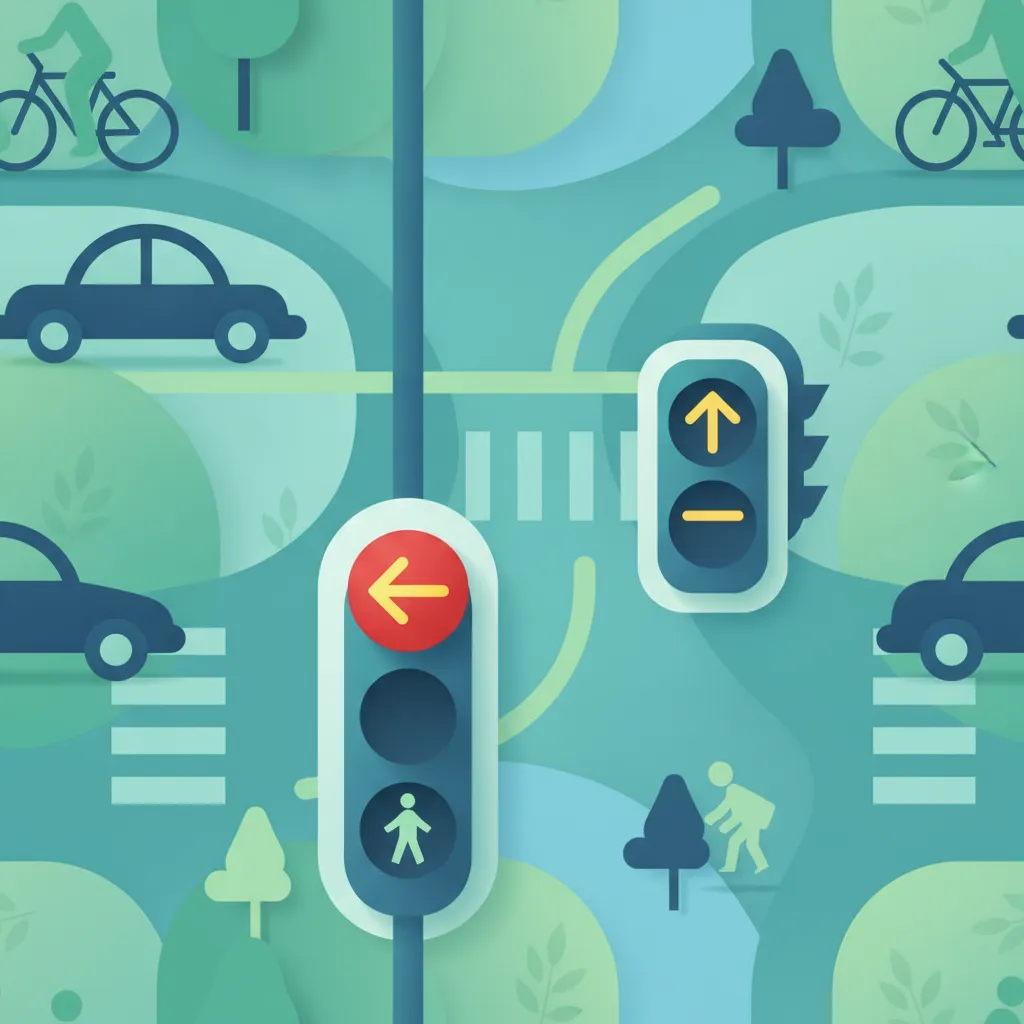
This lesson details the operation of traffic light systems in Switzerland. It explains the sequence and meaning of red, amber, and green lights, including flashing amber signals. The content also covers specific signals for pedestrians and the priority rules associated with tram signals to ensure safe interaction at controlled intersections.
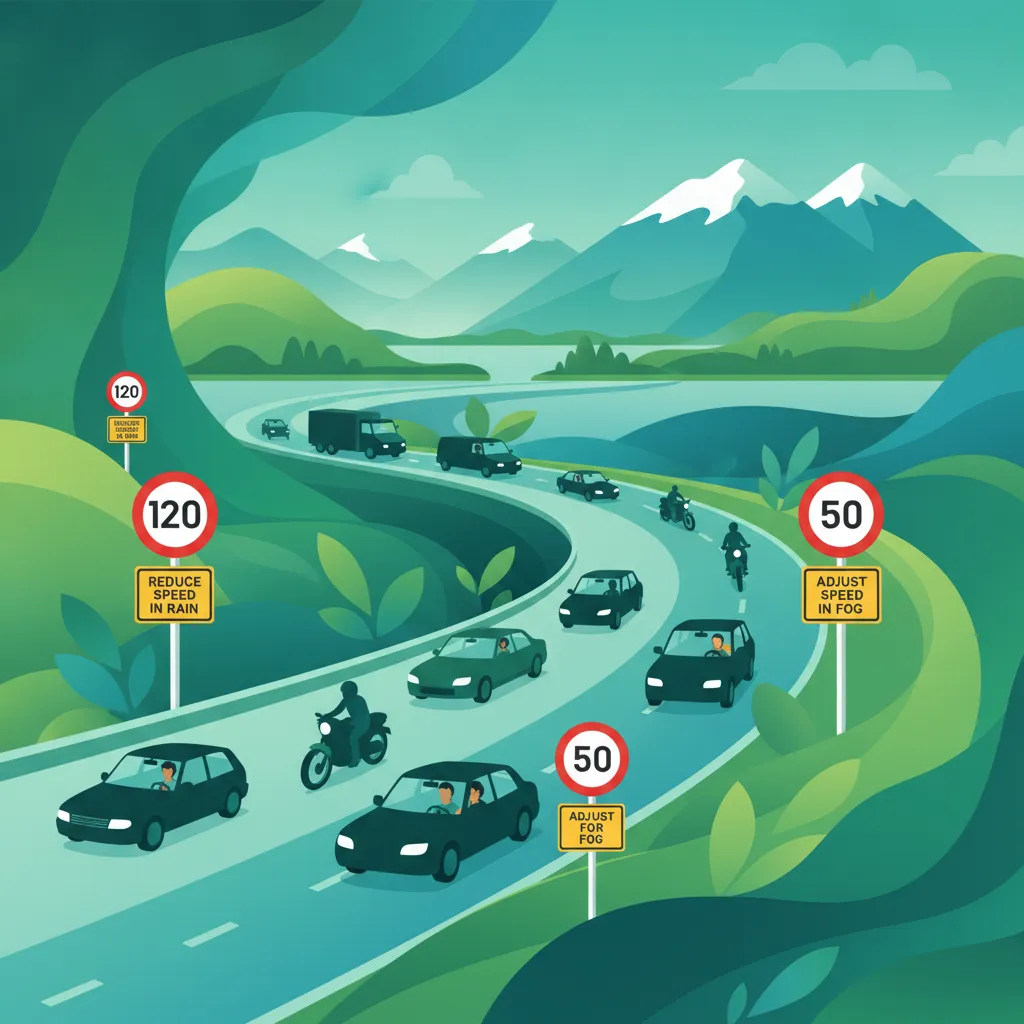
This lesson details the different speed limits applicable in urban, rural, and motorway environments across Switzerland. It explains speed limit signs, temporary restrictions, and how to adapt speed safely based on visibility and road conditions. Understanding these principles helps you comply with legal limits while ensuring an appropriate speed for the circumstances.
Learn the hierarchy of traffic control in Switzerland, including how regulatory signs interact with traffic lights, police signals, and temporary instructions. Essential for safe decision-making in complex traffic situations.
This lesson details the operation of traffic light systems in Switzerland. It explains the sequence and meaning of red, amber, and green lights, including flashing amber signals. The content also covers specific signals for pedestrians and the priority rules associated with tram signals to ensure safe interaction at controlled intersections.
This lesson explores how traffic lights dictate priority at intersections, superseding general priority rules. It explains the meanings of red, amber, and green signals and the required actions for each. Emphasis is placed on understanding green light right-of-way and the cautionary role of the amber phase for navigating signal-controlled junctions safely.
This lesson delves into supplementary signs that modify or clarify the meaning of primary traffic signs. You will learn to interpret signs indicating time restrictions, vehicle-specific limitations, and lane-specific instructions. The content also highlights how these signs interact with main regulatory signs to convey precise, context-sensitive traffic rules.
Many Swiss cities use systems that give buses priority at traffic lights to improve punctuality. This lesson explains how these systems detect an approaching bus and alter the signal phasing. You will learn to recognize and correctly respond to the special white light signals that grant this priority.
This lesson focuses on warning signs that alert drivers to potential hazards ahead, such as curves, steep descents, and roadwork zones. You will understand how these signs prompt anticipatory driving behavior, allowing for adjustments in speed and position. The content also discusses the typical placement of warning signs to help you react safely to changing conditions.
This lesson covers the various road surface markings that dictate lane usage, turning movements, and pedestrian zones. It explains the significance of solid versus broken lines, directional arrows, and specific markings for bike lanes. Understanding these markings is crucial for maintaining lane discipline and ensuring safe interactions in complex traffic environments.
This lesson examines informational signs that provide route guidance, destination distances, and tourist information. It explains how direction signs, distance markers, and service area signs assist drivers in planning routes and making informed decisions. Understanding the logic of informational signage ensures efficient and safe navigation through the Swiss road network.
Many urban areas have restrictions to manage traffic and protect infrastructure. This lesson teaches drivers to identify and interpret traffic signs that prohibit access based on gross vehicle weight, axle load, height, or width. It also covers the growing prevalence of environmental or low-emission zones, which may restrict entry for older, more polluting vehicles.
This lesson examines railway crossings, focusing on the signals, barriers, and safety procedures required for safe passage. It explains the different types of level crossings, the meaning of flashing lights and audible warnings, and the required driver actions. You will learn to interpret warning signs and integrate these safety measures into your driving behavior.
This lesson examines special traffic situations such as railway level crossings and shared zones where different road users coexist. It explains the specific safety procedures required at railway crossings and how to behave in shared zones with mixed traffic. The content also addresses the need to yield to oncoming trains and follow special signage in these unique zones.
Find clear answers to common questions learners have about Regulatory Signs and Their Implications. Learn how the lesson is structured, which driving theory objectives it supports, and how it fits into the overall learning path of units and curriculum progression in Switzerland. These explanations help you understand key concepts, lesson flow, and exam focused study goals.
Regulatory signs in Switzerland are typically circular with a red border for prohibitions or a blue background for mandatory actions. Recognizing these distinct shapes and color codes is essential for correctly identifying the sign's legal instruction.
Not necessarily. Many regulatory signs are accompanied by supplementary plates that specify time frames, vehicle types, or weather conditions. Always scan for these small signs below the main regulatory sign to see if the rule applies to your specific situation.
A 'no entry' sign is a red circle with a white horizontal bar, prohibiting entry entirely. A 'no thoroughfare' sign, often a white circle with a red border, means the road is closed to all vehicles, but exceptions for local residents or specific access rights might be noted below.
Yes. If you encounter a blue circular sign with a white arrow indicating a mandatory direction, you are legally required to follow that path. Failing to comply with these signs is a common mistake that leads to points deduction in the Swiss theory exam.
Pinpoint specific Swiss traffic rules, road signs, or driving situations you need to master. Use the practice search to start a focused revision session now and build confidence for your official driving theory exam.