
This lesson guides you through the specialized rules for navigating railway level crossings and shared zones in Switzerland. Mastering these environments is crucial for your Category B exam and real-world safety, as they involve unique interaction requirements with trains, cyclists, and pedestrians. You will learn to identify the specific signals and right-of-way hierarchies needed to drive safely in these distinct road settings.
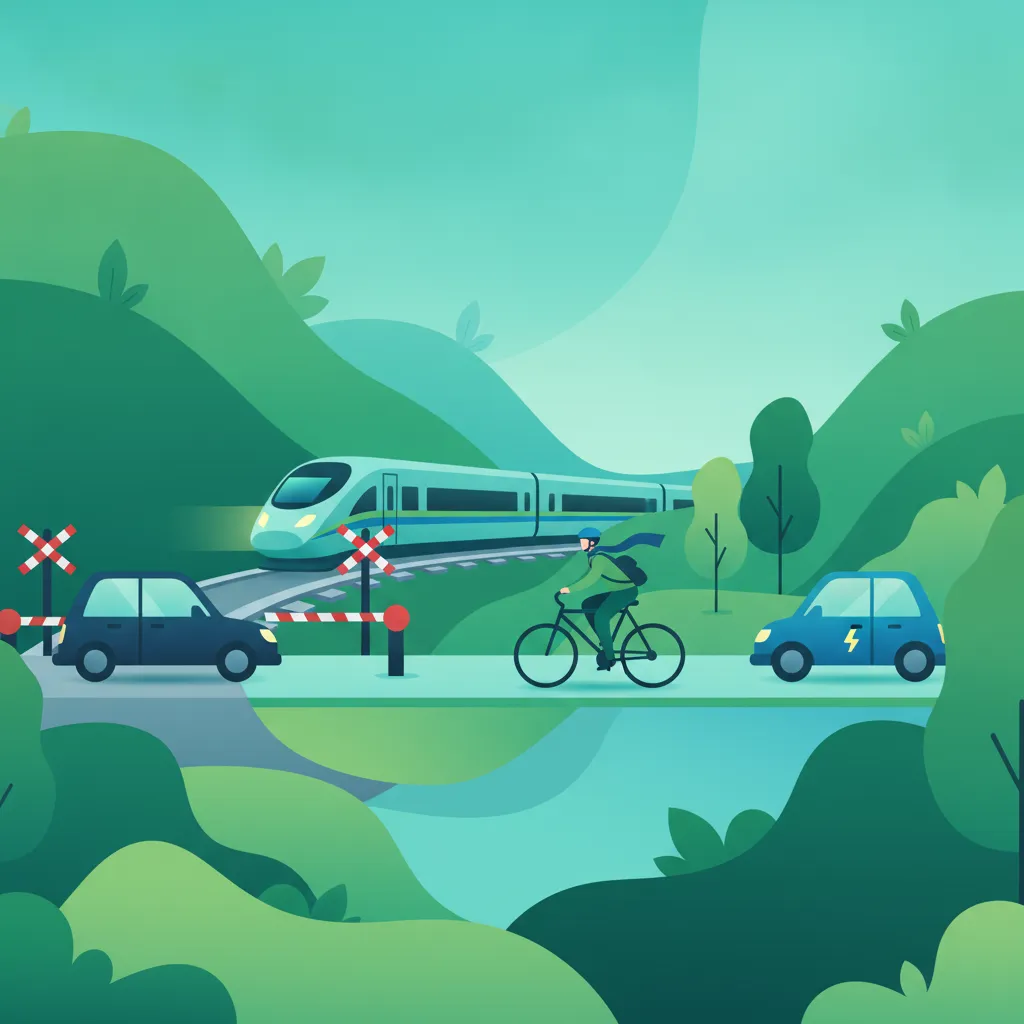
Lesson content overview
Welcome to this comprehensive lesson, an essential part of your Swiss Category B Driving Theory Course. As a responsible driver, you will encounter diverse and often complex traffic environments. Among the most critical are railway level crossings and various types of shared zones. These situations demand specialized knowledge, heightened awareness, and strict adherence to specific rules to ensure the safety of all road users. Understanding how to navigate these unique areas is not just about avoiding penalties; it is about preventing potentially catastrophic incidents and fostering safe coexistence on Switzerland's roads.
This lesson will delve into the intricacies of these special traffic situations. We will explore the different types of railway crossings, the specific signals and barriers you must obey, and the absolute priority of trains. Furthermore, we will examine shared zones, where pedestrians, cyclists, and trams often intermingle with motorized traffic, requiring reduced speeds, mutual respect, and clear understanding of priority rules. By mastering the concepts presented here, you will gain the foundational knowledge to navigate these challenging scenarios confidently and safely.
Railway level crossings are points where a railway line and a road intersect at the same level. These intersections are inherently high-risk environments because trains, due to their immense mass and speed, cannot stop quickly or deviate from their tracks. For this reason, road traffic must always yield to trains, and strict safety procedures are paramount to prevent collisions. Ignoring these rules can lead to severe consequences, including fatal accidents.
Not all railway crossings are the same. They are classified based on the warning and protection systems in place, each demanding a specific level of vigilance from drivers. Recognizing the type of crossing you are approaching is the first step towards safe navigation.
Active Crossings: Equipped with flashing red lights and often warning bells, active crossings provide an audible and visual alert when a train is approaching. Upon activation of these signals, drivers must stop immediately before the stop line or barrier. These systems are designed to give ample warning, but a driver's prompt and correct reaction is crucial.
Barrier Crossings: These are the most common and safest type of railway crossing on busier roads. They feature physical barriers (either full or half-barriers) that lower to block vehicle passage when a train is nearing.
Navigating a railway crossing safely requires strict adherence to specific rules. These rules are non-negotiable and designed to protect lives.
Observe and Anticipate: As you approach a railway crossing, always be scanning for warning signs (triangular warning signs, stop lines) and active signals (flashing lights, lowering barriers, audible bells). Reduce your speed well in advance.
Stop When Required: You must stop your vehicle at the stop line whenever:
Ensure you stop far enough back from the tracks to avoid being hit by a passing train, typically before the white stop line.
Wait for Complete Clearance: Do not proceed until all warning signals have ceased, the barriers have fully risen, and you have visually confirmed that no train is approaching or present on any track. A barrier rising does not always mean it is safe to proceed immediately, especially if multiple tracks are present or another train is following.
No Overtaking: Overtaking other vehicles at a railway crossing or immediately before it is strictly prohibited. This prevents obstructing other drivers' views and causing blockages.
Clear the Tracks: Ensure you have enough space on the other side of the crossing to completely clear the tracks before driving onto them. Never stop on the tracks.
Absolute Priority of Trains: Trains always have absolute right-of-way over road traffic. They cannot swerve or stop quickly. Your safety depends entirely on yielding to them. Never attempt to "beat" a train, even if you think you have enough time.
Swiss roads use specific signage and signals to warn drivers of railway crossings and instruct them on necessary actions.
While the standard warning signs (e.g., a fence or locomotive symbol within a red-bordered triangle) alert you to the presence of a crossing, the active signals dictate your immediate action.
Drivers must always stop behind the designated stop line (often a thick white line painted across the road). If no stop line is present, stop at a distance that allows a clear view of the tracks without entering the danger zone.
Effective hazard perception is vital at railway crossings. It involves continuously scanning your environment, listening for warnings, and anticipating potential dangers.
Horn Use in Poor Visibility: In Switzerland, it is recommended to use your horn to alert other road users and potentially the train driver if visibility is severely reduced (e.g., dense fog or heavy snowfall) when approaching a passive railway crossing. This is a best practice to enhance safety.
Shared traffic zones are specifically designed road sections where different categories of road users—motorized vehicles, pedestrians, cyclists, and often trams—coexist in the same space without strict physical segregation. These zones aim to promote urban vitality, reduce vehicle dominance, and enhance safety for vulnerable road users. However, they demand a significant shift in driver mindset, emphasizing mutual respect, heightened awareness, and reduced speeds.
Shared zones represent a departure from traditional road design, where separate lanes or paths are allocated to different user types. Instead, they integrate various modes of transport, encouraging lower speeds and more direct interaction between users.
The primary purpose of shared zones is to:
In shared zones, the conventional hierarchy of right-of-way often shifts to favor vulnerable road users. This is a fundamental principle that every driver must understand.
Begegnungszone / Zone de rencontre at 20 km/h) to give drivers more time to react to unpredictable movements of pedestrians and cyclists.Trams are an integral part of public transport in many Swiss cities. When tram tracks are integrated into shared zones, specific rules apply to ensure their smooth operation and the safety of all.
The reduced speed limits in shared zones are not merely suggestions; they are legally binding and critically important for safety.
Begegnungszone, strict adherence to the posted speed limit is mandatory. Driving slower than the limit is often advisable, especially when visibility is poor or many vulnerable users are present.Understanding the rules is one thing, but applying them consistently in dynamic traffic situations is another. Many accidents in special traffic zones stem from common misunderstandings or risky behaviors. Recognizing these pitfalls is key to safe driving.
External conditions and vehicle specifics can significantly impact safety in special traffic situations. Adapting your driving behavior to these variations is a mark of a skilled and responsible driver.
| Condition | Variation | Reasoning |
|---|---|---|
| Nighttime | Rely more on illuminated signs, reflective markings, and vehicle headlights. Use dipped beam when stopped at crossings to avoid dazzling. | Reduced natural light significantly impairs visibility; enhanced signals and vehicle lighting become crucial for detecting hazards and other users. |
| Fog or Heavy Rain | Significantly reduce speed at railway crossings and in shared zones. Increase reliance on auditory signals (train horns, bells) and use hazard lights. Maintain greater stopping distances. | Visibility is severely limited, making it difficult to spot trains, pedestrians, or other vehicles in time. Reduced speed provides more reaction time, and auditory cues become more important. Wet tracks also increase braking distance. |
| Heavy Traffic | Ensure sufficient space to clear railway tracks completely before entering. Maintain larger following distances in shared zones to avoid sudden stops. | Increased vehicle density raises the risk of getting stuck on tracks or causing bottlenecks in shared zones. Early stopping and maintaining ample space prevent dangerous blockages. |
| Vehicle with Trailer | Requires additional space to stop safely behind the stop line at railway crossings. Increased length demands extra caution when maneuvering in shared zones. No overtaking allowed at crossings. | The added length and weight of a trailer increase braking distances and reduce maneuverability, making precise positioning and early stopping even more critical. Prevents the trailer from being hit by a train or blocking a shared space. |
| Tram Approaching in Shared Zone | Motorists must yield to the tram even if traffic lights are green for them, if tram priority is indicated by signage or signals. | Tram's right-of-way often supersedes standard road signals due to its fixed path and inability to stop quickly. Drivers must prioritize tram safety. |
| Pedestrians with Disabilities | Show extra caution and patience, especially in shared zones. Be prepared to yield even before a marked crossing, as they may move slower or have impaired perception. | Vulnerable pedestrians, particularly those with disabilities, may require more time and space to navigate. Proactive yielding enhances their safety and accessibility. |
| Train Horn Not Audible | In situations where a train horn might not be heard (e.g., loud music in vehicle, hearing impairment, environmental noise), visual signals (flashing lights, barriers) become the primary and most critical cue. Maintain hyper-vigilance. | Reliance on auditory warnings can be compromised. Therefore, increased attention to visual warnings and scanning the tracks becomes paramount for detecting approaching trains. |
| Barrier Malfunction | If a barrier at a railway crossing is malfunctioning (e.g., stuck up, repeatedly lowering/raising), treat the crossing as an uncontrolled or passive crossing. Use heightened vigilance: stop, look, listen, and proceed only when absolutely certain the tracks are clear. Report the malfunction. | An inactive or malfunctioning barrier removes a key safety mechanism. Drivers must revert to the safest possible procedure, assuming the worst-case scenario to prevent accidents. |
Mastering the complexities of railway crossings and shared zones is fundamental to safe driving in Switzerland. These environments demand a proactive, patient, and highly observant approach from all road users.
Begegnungszone) and active signals (flashing lights, barriers, tram signals). These are your primary guides.This lesson covers two critical special traffic environments in Switzerland. At railway level crossings, drivers must understand the hierarchy of passive, active, and barriered crossings, always yielding absolute priority to trains and stopping behind the stop line when signals are active. The lesson details specific procedures including the prohibition of overtaking at crossings and the need to ensure complete clearance before proceeding. In shared zones, the key principle is that pedestrians and cyclists have priority over vehicles, with speed limits of 30 km/h in Zone 30 and 20 km/h in Begegnungszone. Drivers must also respect tram priority rules, never blocking tracks or overtaking boarding trams without safety islands. These environments demand heightened observation using both visual and auditory cues, reduced speeds, and a defensive cooperative mindset to ensure safety for all road users.
A short set of high-value points that capture the most important learning from this lesson.
Trains have absolute priority at railway crossings and cannot stop or swerve, making it critical to always yield and never attempt to beat an approaching train.
Railway crossings are classified as passive (signs only), active (flashing lights and bells), or barriered (physical gates), each requiring different levels of driver vigilance.
In shared zones such as Begegnungszone (max 20 km/h) and Zone 30 (max 30 km/h), pedestrians and cyclists have priority over motor vehicles.
Trams have fixed routes and limited braking capability, requiring drivers to yield unless specific signage indicates otherwise.
Hazard perception at railways requires both visual scanning of tracks in both directions and auditory monitoring for train horns and warning bells.
Explore all units and lessons included in this driving theory course.
Always stop behind the stop line when flashing red lights, bells, or barriers are active, or when a train is visible or audible.
Never overtake another vehicle at a railway crossing or enter a crossing if you cannot clear it completely on the other side.
A barrier beginning to rise does not mean it is safe to proceed—wait until all signals have ceased and visually confirm no train on any track.
In Begegnungszone, pedestrians have absolute priority and your speed must not exceed walking pace (20 km/h).
At unguarded/passive crossings with no active signals, you must stop, look, and listen before proceeding across all tracks.
Driving immediately when a barrier begins to lift, not waiting for full clearance or checking for a second train on adjacent tracks.
Attempting to accelerate and cross when signals are activating, believing you can beat the train—trains cannot stop quickly and the consequences are fatal.
Overtaking a vehicle that has stopped at a railway crossing, which blocks your view of the tracks and creates a dangerous blockage.
Assuming vehicle priority in shared zones; pedestrians and cyclists have priority and drivers must yield proactively.
Blocking tram tracks or overtaking a stationary tram boarding passengers when no safety island exists, which endangers disembarking passengers.
Lesson content overview
A short set of high-value points that capture the most important learning from this lesson.
Trains have absolute priority at railway crossings and cannot stop or swerve, making it critical to always yield and never attempt to beat an approaching train.
Railway crossings are classified as passive (signs only), active (flashing lights and bells), or barriered (physical gates), each requiring different levels of driver vigilance.
In shared zones such as Begegnungszone (max 20 km/h) and Zone 30 (max 30 km/h), pedestrians and cyclists have priority over motor vehicles.
Trams have fixed routes and limited braking capability, requiring drivers to yield unless specific signage indicates otherwise.
Hazard perception at railways requires both visual scanning of tracks in both directions and auditory monitoring for train horns and warning bells.
Explore all units and lessons included in this driving theory course.
Always stop behind the stop line when flashing red lights, bells, or barriers are active, or when a train is visible or audible.
Never overtake another vehicle at a railway crossing or enter a crossing if you cannot clear it completely on the other side.
A barrier beginning to rise does not mean it is safe to proceed—wait until all signals have ceased and visually confirm no train on any track.
In Begegnungszone, pedestrians have absolute priority and your speed must not exceed walking pace (20 km/h).
At unguarded/passive crossings with no active signals, you must stop, look, and listen before proceeding across all tracks.
Driving immediately when a barrier begins to lift, not waiting for full clearance or checking for a second train on adjacent tracks.
Attempting to accelerate and cross when signals are activating, believing you can beat the train—trains cannot stop quickly and the consequences are fatal.
Overtaking a vehicle that has stopped at a railway crossing, which blocks your view of the tracks and creates a dangerous blockage.
Assuming vehicle priority in shared zones; pedestrians and cyclists have priority and drivers must yield proactively.
Blocking tram tracks or overtaking a stationary tram boarding passengers when no safety island exists, which endangers disembarking passengers.
Explore search topics learners often look for when studying Special Traffic Situations: Railway Crossings and Shared Zones. These topics reflect common questions about road rules, driving situations, safety guidance, and lesson level theory preparation for learners in Switzerland.
Browse additional driving theory lessons that cover connected traffic rules, road signs, and common driving situations related to this topic. Improve your understanding of how different rules interact across everyday traffic scenarios.
Deepen your understanding of Swiss shared zones, focusing on complex interactions with trams, pedestrians, and cyclists. Master the nuanced priority rules and defensive driving techniques essential for safe coexistence in these mixed-traffic environments.
Sharing road space with trams presents unique challenges, including different priority rules and physical hazards like tracks. This lesson covers the Swiss regulations regarding tram priority at junctions and stops. It also provides practical advice on crossing tram tracks safely and maintaining awareness of tram movements.
This lesson focuses on the rules governing interactions with public transport vehicles like buses and trams. It explains the priority given to these vehicles at stops and the use of dedicated lanes. Additionally, the content covers tram track crossing procedures and correct vehicle positioning near public transport stops to ensure safety.
This lesson addresses the unique challenges posed by tram tracks, especially for two-wheeled vehicles. It explains the importance of crossing tracks at as close to a right angle as possible to avoid tyres getting caught, particularly in wet conditions. The lesson also covers the priority rules that often favor trams and how to interpret tram-specific signals.
This lesson focuses on safe interaction with large vehicles. It highlights the significant blind spots (or 'no-zones') around trucks and buses and teaches riders how to position themselves to remain visible. The content also provides guidance on overtaking large vehicles safely and anticipating their wide turning radius at intersections.
This lesson explores the priority given to public transport vehicles, especially trams and buses, in Swiss traffic. It explains how to recognize dedicated public transport lanes and the requirement to yield to trams at intersections. The content also covers procedures when a bus is stopping for passengers and how to ensure safe interactions.
This lesson provides guidance on safely navigating roundabouts and tram lanes, common features in Swiss cities. It covers the rules for yielding, lane positioning within the roundabout, and signaling intentions upon exiting. Special attention is given to the hazards of crossing slippery tram tracks and sharing the road with public transport.
This lesson explores pedestrian right-of-way at various crossings, including zebra crossings and pedestrian islands. It emphasizes the need for drivers to reduce speed, anticipate pedestrian movement, and stop safely when required. The content also covers special regulations that apply in school zones, such as reduced speed limits and heightened vigilance.
This lesson details the operation of traffic light systems in Switzerland. It explains the sequence and meaning of red, amber, and green lights, including flashing amber signals. The content also covers specific signals for pedestrians and the priority rules associated with tram signals to ensure safe interaction at controlled intersections.
Pedestrians, cyclists, motorcyclists, and e-scooter riders are extremely vulnerable in any interaction with a heavy vehicle. This lesson instills a defensive mindset, teaching drivers to be hyper-aware of VRUs, especially near junctions, crossings, and cycle lanes. It focuses on anticipation and giving VRUs extra space, as they can be unpredictable and are often hidden in blind spots.
This lesson explores the complexities of riding in busy urban areas with a mix of traffic types. It covers strategies for safely navigating alongside buses, trams, cyclists, and pedestrians. Key topics include respecting designated lanes, anticipating the movements of vulnerable road users, and maintaining heightened situational awareness.
Learn about frequent mistakes drivers make at railway crossings in Switzerland. This lesson focuses on critical safety insights and essential procedures to prevent accidents, ensuring you can navigate these high-risk areas correctly.
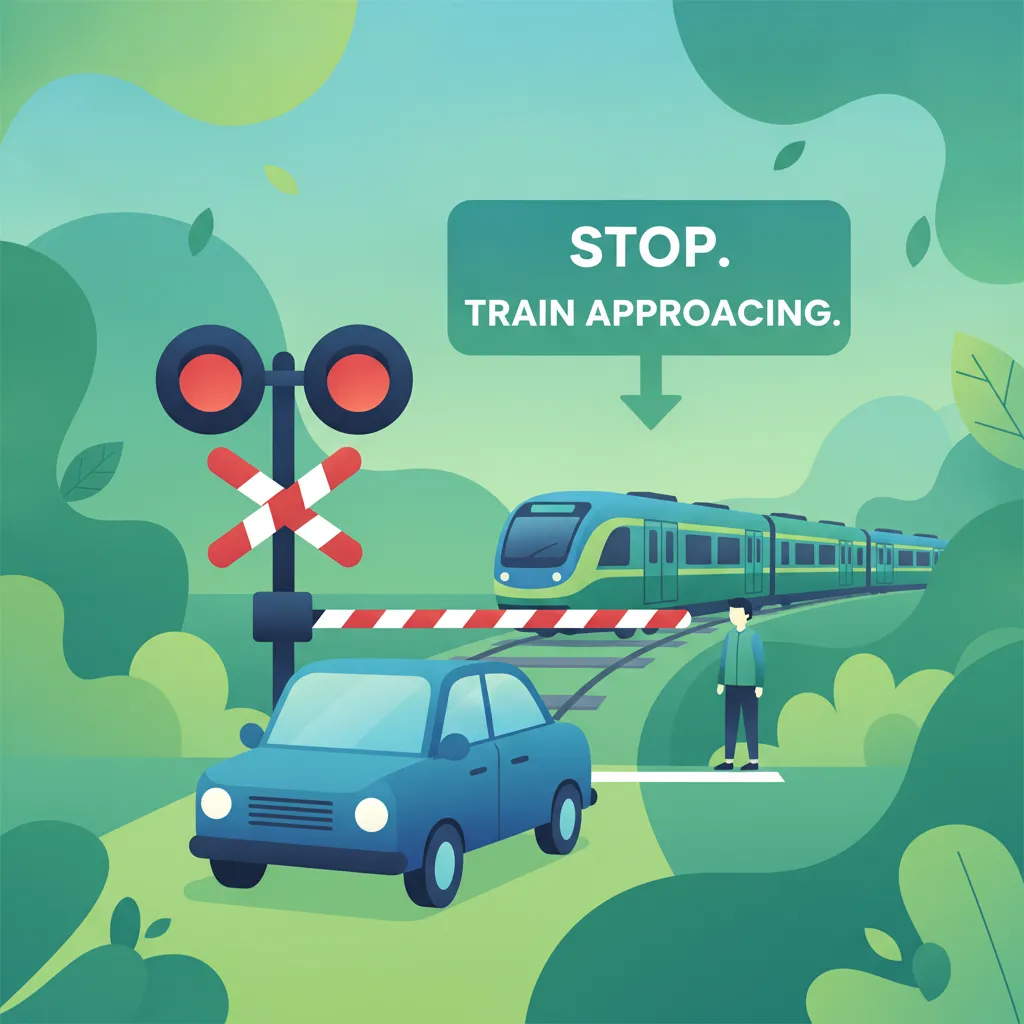
This lesson examines railway crossings, focusing on the signals, barriers, and safety procedures required for safe passage. It explains the different types of level crossings, the meaning of flashing lights and audible warnings, and the required driver actions. You will learn to interpret warning signs and integrate these safety measures into your driving behavior.
This lesson explores pedestrian right-of-way at various crossings, including zebra crossings and pedestrian islands. It emphasizes the need for drivers to reduce speed, anticipate pedestrian movement, and stop safely when required. The content also covers special regulations that apply in school zones, such as reduced speed limits and heightened vigilance.
This lesson focuses on the variety of painted markings on Swiss roads and their legal significance. Learners will understand the difference between solid and broken lines, the rules for stop lines, and their obligations at a zebra crossing (Fußgängerstreifen). Correct interpretation of these markings is essential for proper lane positioning and safe interaction with all road users.
This lesson addresses the unique challenges posed by tram tracks, especially for two-wheeled vehicles. It explains the importance of crossing tracks at as close to a right angle as possible to avoid tyres getting caught, particularly in wet conditions. The lesson also covers the priority rules that often favor trams and how to interpret tram-specific signals.
This lesson explains the fundamental rules of priority that govern traffic flow at Swiss intersections. It details the concept of 'Rechtsvortritt' at unmarked junctions and how priority signs alter this default rule. The specific procedures for entering, navigating, and exiting roundabouts are also covered to ensure predictable and safe maneuvers.
Departing from a bus stop is a high-risk manoeuvre. This lesson details the critical sequence of actions: checking all passengers are clear of the doors, performing a comprehensive mirror and blind spot check, signalling, and waiting for a safe gap in traffic. This systematic approach is essential for preventing collisions with overtaking vehicles, cyclists, or pedestrians.
This lesson details the operation of traffic light systems in Switzerland. It explains the sequence and meaning of red, amber, and green lights, including flashing amber signals. The content also covers specific signals for pedestrians and the priority rules associated with tram signals to ensure safe interaction at controlled intersections.
This lesson provides guidance on safely navigating roundabouts and tram lanes, common features in Swiss cities. It covers the rules for yielding, lane positioning within the roundabout, and signaling intentions upon exiting. Special attention is given to the hazards of crossing slippery tram tracks and sharing the road with public transport.
This lesson focuses on identifying and managing specific road surface hazards that can compromise traction. It provides techniques for safely crossing slippery tram rails and painted markings, navigating uneven cobblestones, and maintaining control on loose gravel. The core skill is learning to scan the road ahead and adjust riding style proactively.
Tunnels are enclosed environments with unique risks. This lesson covers the mandatory pre-entry checks, such as removing sunglasses and turning on dipped headlights. It explains the importance of maintaining a greater following distance and outlines the critical emergency procedures in case of a breakdown or fire inside a tunnel.
Find clear answers to common questions learners have about Special Traffic Situations: Railway Crossings and Shared Zones. Learn how the lesson is structured, which driving theory objectives it supports, and how it fits into the overall learning path of units and curriculum progression in Switzerland. These explanations help you understand key concepts, lesson flow, and exam focused study goals.
In a shared zone (Begegnungszone), pedestrians have priority over all other road users. They may use the entire width of the road, but must not unnecessarily obstruct traffic. Drivers must yield to pedestrians at all times.
Yes, you must stop immediately. It is strictly prohibited to enter or cross a level crossing once the warning lights have activated or the barriers have begun to descend, as these are clear indicators that a train is approaching.
The maximum permitted speed in a shared zone is 20 km/h. This limit is designed to ensure safety for pedestrians and cyclists sharing the same space as motor vehicles.
Yes, in a shared zone, parking is only permitted in designated parking spaces marked by lines or signs. Parking outside of these marked areas is prohibited unless otherwise specified.
Pinpoint specific Swiss traffic rules, road signs, or driving situations you need to master. Use the practice search to start a focused revision session now and build confidence for your official driving theory exam.