
This lesson covers the critical safety protocols required when approaching and crossing railway lines in Switzerland. You will learn to identify the various signs and signals associated with level crossings and understand the legal requirements for stopping and safe passage. Mastering these rules is essential for both your theory exam and real-world safety on Swiss roads.
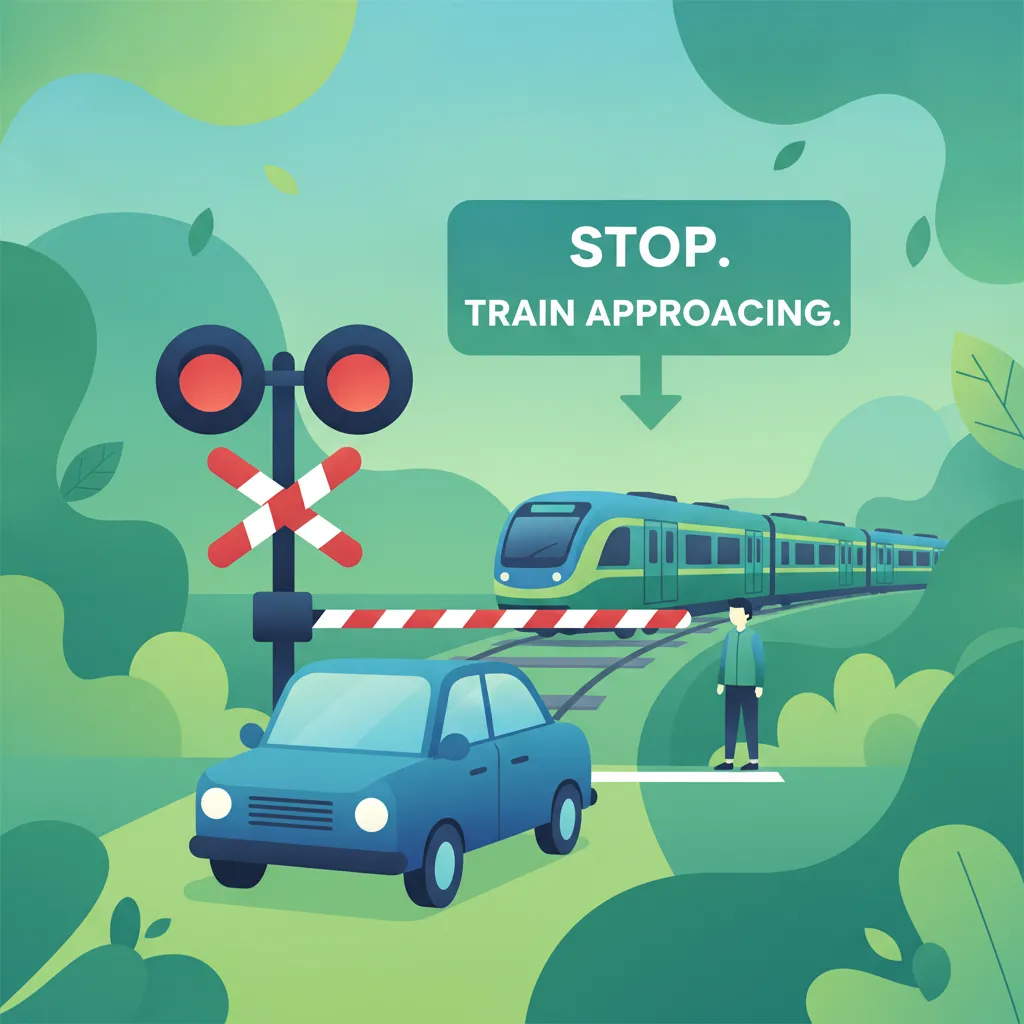
Lesson content overview
Railway crossings, also known as level crossings, are critical points where road traffic intersects with railway tracks at the same level. These intersections pose unique risks due to the inherent differences in speed, braking capability, and operational characteristics between road vehicles and trains. For every driver seeking a Swiss Category B license, a thorough understanding of railway crossing safety protocols, warning devices, and legal obligations is paramount. This lesson delves into the various types of level crossings, the meaning of their signals and barriers, and the mandatory actions drivers must take to ensure safe passage and prevent collisions.
The interaction between road and rail traffic at level crossings represents a significant potential for severe accidents. Unlike road vehicles, trains operate on fixed tracks, have extremely long braking distances, and cannot deviate from their path. Consequently, trains always have absolute priority at level crossings. Drivers must recognize that any misjudgment or violation of rules can lead to catastrophic consequences for themselves, their passengers, and train occupants. Mastering this topic is not merely a matter of legal compliance but a fundamental aspect of defensive driving and ensuring overall road safety within Switzerland. This knowledge builds upon foundational lessons concerning general traffic signs, right-of-way rules, and safe stopping distances.
Safe navigation of railway crossings is built upon several non-negotiable principles designed to mitigate risks and protect all road users.
Railway level crossings in Switzerland are categorized by the presence and type of warning devices installed, which dictates the level of protection and driver responsibility. Understanding these distinctions is crucial for appropriate driver response.
Passive crossings are the simplest type, relying solely on static signage to warn drivers of the presence of railway tracks. They lack active warning devices such as flashing lights, audible alarms, or mechanical barriers. The primary sign for a passive crossing is the "Railway Crossing without barrier" warning sign.
Drivers approaching a passive crossing must exercise maximum caution. It is their sole responsibility to look both ways, listen for approaching trains, and only proceed when absolutely certain the tracks are clear. Speed must be reduced significantly to allow for a full stop if a train is detected.
Active light crossings are equipped with flashing white lights (Lichtzeichen) and often an accompanying audible alarm. These devices activate automatically when a train is within a specified distance, providing a dynamic warning to road users. The typical warning sign for such a crossing indicates a railway crossing with active warning devices.
When the flashing lights activate, drivers must stop immediately behind the designated stop line, regardless of whether a train is visible. Proceeding is only permissible once the lights have ceased flashing and it is safe to do so. The audible alarm serves as an additional warning, particularly useful in conditions of poor visibility or high ambient noise.
Half-barrier crossings combine flashing lights and audible alarms with mechanical half-barriers. These barriers cover only one side of the road, typically the entry side, allowing vehicles to exit the crossing if they become trapped on the tracks. The warning sign used is similar to active light crossings, indicating a crossing with active devices.
When the flashing lights activate, and the half-barriers begin to lower, drivers must stop behind the stop line. It is strictly prohibited to attempt to drive around the lowering or lowered half-barriers. Proceed only after the barriers are fully raised and the flashing lights have stopped. Despite the half-barrier allowing an exit, attempting to navigate around them when a train is approaching is extremely dangerous and illegal.
Full-barrier crossings offer the highest level of protection. They feature flashing lights, audible alarms, and mechanical full barriers that block both directions of traffic, completely preventing vehicular entry onto the tracks when a train is imminent. The same warning sign as for half-barrier crossings is typically used.
At a full-barrier crossing, drivers must stop behind the stop line as soon as the warning signals activate and the barriers begin to lower. It is absolutely forbidden to proceed until the barriers are fully raised and the flashing lights have ceased. These crossings provide the strongest physical enforcement of the "no entry" rule during train passage.
Active railway crossings are equipped with a suite of sophisticated warning devices designed to ensure drivers receive timely and clear alerts of an approaching train. Understanding each component is vital for safe navigation.
Flashing white lights, often arranged in a triangular cluster, are the primary visual warning at active level crossings. These lights typically activate when a train is within a predetermined distance, providing a clear and unmistakable signal to road users. Their purpose is to give drivers sufficient time to react and stop safely before the crossing.
Drivers must immediately reduce speed and prepare to stop the moment these lights begin to flash. The legal obligation is to bring the vehicle to a complete halt at least five metres before the nearest rail or the designated stop line when the lights are active. This rule applies regardless of whether a train is yet visible.
Never attempt to cross or proceed when the flashing lights are active, even if you do not see or hear a train. The system is designed to activate well in advance of a train's arrival.
In conjunction with flashing lights, most active level crossings are fitted with audible alarms, typically bells or horns. These alarms serve as an essential supplementary warning, particularly in situations where visual cues might be compromised. This includes conditions of heavy fog, intense rain, bright sunlight, or situations where a driver's attention might be momentarily diverted.
The audible alarm usually begins to sound shortly after the flashing lights activate, providing an additional layer of sensory input to alert drivers. This redundancy ensures that even if one warning system is less effective, the other can still provide the crucial alert. Drivers must treat the sound of an alarm with the same urgency as flashing lights and immediately prepare to stop.
Mechanical barriers are physical obstacles that prevent road traffic from entering the tracks during a train's approach. Their presence significantly enhances safety by providing a tangible block.
Mechanical arms that lower to block only one side of the road, typically the lane approaching the tracks. They allow vehicles that might already be on the tracks to exit.
Mechanical arms that lower across the entire width of the road, blocking traffic in both directions completely. These provide the highest level of physical protection.
Barriers typically begin to lower after the flashing lights and audible alarms have been active for a short period, allowing drivers to stop safely. Once a barrier begins to move downwards, it is an absolute command to stop. Drivers must never attempt to drive around or through a lowering or lowered barrier. Proceeding is only safe and legal after the barriers are fully raised and all other warning signals have ceased.
In addition to the immediate warning devices, railway crossings are often preceded by static signs and specific road markings. These serve to prepare drivers well in advance.
The "Railway Crossing with barrier" (F2) and "Railway Crossing without barrier" (F1) signs alert drivers to the presence of a crossing ahead. Supplementary signs like "Vorbehaltlich Eisenbahnsignale" (Subject to railway signals) may indicate that drivers should primarily heed the active signals. Speed limit signs are also frequently posted on the approach to crossings to ensure drivers can stop safely.
Road markings, particularly the stop line (a continuous red line painted across the lane), visually reinforce the exact point where vehicles must stop when warning devices are active. Drivers must ensure their vehicle's front bumper remains behind this line. In some cases, yellow yield triangles might indicate a yield line. These markings are legally binding and designed to prevent vehicles from encroaching onto the dangerous track area.
Approaching and navigating a railway crossing requires a precise sequence of actions from drivers to ensure safety and compliance with Swiss traffic law.
Anticipate and Reduce Speed: As soon as a railway crossing warning sign is sighted, reduce your speed significantly. Be prepared for sudden activation of warning devices. Adjust your speed according to visibility, road conditions, and vehicle type.
Observe All Warnings: Actively scan for flashing lights, listen for audible alarms, and watch for any movement of barriers. Your observation should be continuous and thorough.
Stop Immediately and Safely: If flashing lights activate, an audible alarm sounds, or barriers begin to lower, come to a complete stop. Position your vehicle safely behind the designated stop line or, if no line is present, at least 5 metres before the nearest rail. Ensure there is enough space behind your vehicle for others to stop safely.
Maintain Stopped Position: Remain stationary until all warning devices cease. This means flashing lights are off, audible alarms are silent, and any barriers are fully raised. Do not proceed even if you think the train has passed, as a second train might be approaching on multiple tracks.
Proceed Only When Clear: Once all warnings have stopped, and the crossing is clear of any trains, proceed across the tracks without hesitation. If your view is obstructed at a passive crossing, stop, look, and listen carefully before advancing.
Failing to stop when required at an active railway crossing is considered a serious traffic violation under Swiss law (Strassenverkehrsordnung, SVG) and carries significant penalties, including fines and potential license suspension. It is critical to always prioritize safety over saving a few seconds.
When stopping at a crossing, always ensure you leave enough space for vehicles behind you to stop safely. Avoid stopping in a way that blocks traffic or creates further hazards.
The rules governing behaviour at railway crossings in Switzerland are enshrined in federal law, primarily the Road Traffic Act (Strassenverkehrsgesetz, SVG) and its implementing ordinance, the Road Traffic Ordinance (Verkehrsregelverordnung, VRV, often referenced by its German abbreviation SVV). These regulations provide a clear and enforceable framework for driver conduct.
These legal provisions mandate strict compliance from all road users. They underscore that the responsibility for avoiding collisions at level crossings rests squarely with the road user. The law does not differentiate between intentional and accidental non-compliance; any failure to adhere to the warnings and rules constitutes a violation. Understanding these articles is essential for any driver in Switzerland, as ignorance of the law is not an excuse.
Despite clear rules and warnings, certain driver behaviours and situations frequently lead to dangerous incidents or violations at railway crossings. Awareness of these common pitfalls can help drivers avoid them.
Safe driving at railway crossings requires flexibility and adaptation to various environmental and vehicle-specific conditions.
Understanding the precise definitions of terms related to railway crossings is fundamental for mastering this lesson and for safe driving.
Applying theoretical knowledge to real-world scenarios is crucial for developing safe driving habits. Here are several practical examples of navigating railway crossings.
You are driving on a quiet country road and see the "Railway Crossing without barrier" (F1) sign. There are no flashing lights, alarms, or barriers. Correct Behavior: You immediately reduce your speed, actively look left and right down the tracks for any approaching trains, and listen for train horns or other sounds. Only after confirming that the tracks are entirely clear and no train is approaching from either direction, do you proceed cautiously across the tracks. You maintain a speed that allows you to stop instantly if an unexpected train appears. Incorrect Behavior: You maintain your current speed, assuming the crossing is always clear because there are no active warnings. You look only briefly or not at all before crossing, risking a collision with an unsignaled train.
You are approaching an urban railway crossing equipped with flashing white lights and half-barriers. As you get closer, the lights begin to flash, and the audible alarm sounds, followed by the half-barriers starting to descend. Correct Behavior: You immediately begin to brake, stopping your vehicle completely behind the red stop line. You remain stopped, observing the barriers as they lower fully. You wait patiently until the barriers are completely raised and the flashing lights and audible alarm have ceased before you proceed safely across the tracks. Incorrect Behavior: You see the lights flash and hear the alarm but attempt to accelerate to "beat" the lowering half-barrier, believing you have enough time. This is extremely dangerous and could lead to your vehicle being trapped on the tracks or colliding with the barrier.
You are driving a heavy truck and approaching a full-barrier crossing during heavy fog, severely limiting visibility. The flashing lights are active, the audible alarm is sounding loudly, and the full barriers are fully lowered. Correct Behavior: Recognizing the increased stopping distance required for your heavy vehicle, you began decelerating well in advance of the crossing. Upon hearing the alarm and seeing the faint flashing lights, you applied brakes smoothly and came to a complete stop well behind the stop line. You wait for the barriers to fully raise and all signals to cease, relying heavily on the audible cues due to the limited visibility. Incorrect Behavior: You rely primarily on visual cues, which are obscured by the fog. You approach too quickly, struggling to stop the heavy vehicle in time and potentially overrunning the stop line or hitting the lowered barrier. You might also become impatient due to the delay and attempt to find a way around the barrier, risking a severe accident.
The strict rules and comprehensive warning systems at railway crossings are not arbitrary; they are deeply rooted in physics, human psychology, and accident prevention research.
Navigating railway crossings safely is a non-negotiable skill for every driver in Switzerland. From understanding the nuances of passive versus active crossings to recognizing and reacting correctly to flashing lights, audible alarms, and mechanical barriers, every detail contributes to preventing potentially fatal accidents. The legal framework, particularly the SVG and SVV, underscores the gravity of driver obligations, reinforcing that trains always have priority. By integrating these safety measures into your driving behaviour, anticipating risks, and consistently adhering to all warning signals and rules, you ensure not only your safety but also that of your passengers and other road users. This knowledge is a cornerstone of responsible and defensive driving within the Swiss road network.
Swiss railway crossings are categorised as passive (static signs only) or active (flashing lights, audible alarms, and/or barriers), with active crossings requiring drivers to stop immediately when warnings activate regardless of train visibility. The Strassenverkehrsgesetz (SVG) mandates that trains always have priority and establishes legal obligations for stopping, with significant penalties for violations. Safe navigation requires anticipating crossings, reducing speed on approach, observing all warning signals, and proceeding only when all devices have ceased and the crossing is completely clear.
A short set of high-value points that capture the most important learning from this lesson.
Trains always have absolute priority at level crossings due to their inability to stop or swerve quickly
Active warning devices (flashing lights, audible alarms, barriers) activate well before a train arrives — stop immediately when they activate
At passive crossings, drivers must personally verify tracks are clear by looking both ways and listening before proceeding
A minimum stopping distance of 5 metres before the nearest rail is legally required when signals are active
Never attempt to cross when lights are flashing, alarms are sounding, or barriers are lowering, regardless of whether a train is visible
Explore all units and lessons included in this driving theory course.
Active crossings: stop behind the stop line when lights flash — proceed only when lights cease, alarms stop, and barriers are fully raised
Passive crossings (F1 sign): slow down, look left and right, listen — proceed only when tracks are confirmed clear
Half-barriers block only one direction; they allow vehicles already on tracks to exit but do not permit driving around them
At multi-track crossings, wait after one train passes — a second train may be approaching on an adjacent track
SVG Article 62 establishes mandatory stopping obligations; SVG Article 70 sets penalties for violations including fines and license withdrawal
Attempting to 'beat' a closing barrier by accelerating through an active crossing, often due to misjudging train speed or arrival time
Relying solely on visual cues and failing to respond to audible alarms, which can be obscured in urban noise or favourable conditions
Stopping too close to or beyond the stop line, reducing the safety buffer between the vehicle and the tracks
Proceeding immediately after one train passes a multi-track crossing without checking for a second approaching train
Assuming signals are malfunctioning when they remain active for longer than expected and proceeding illegally
Lesson content overview
A short set of high-value points that capture the most important learning from this lesson.
Trains always have absolute priority at level crossings due to their inability to stop or swerve quickly
Active warning devices (flashing lights, audible alarms, barriers) activate well before a train arrives — stop immediately when they activate
At passive crossings, drivers must personally verify tracks are clear by looking both ways and listening before proceeding
A minimum stopping distance of 5 metres before the nearest rail is legally required when signals are active
Never attempt to cross when lights are flashing, alarms are sounding, or barriers are lowering, regardless of whether a train is visible
Explore all units and lessons included in this driving theory course.
Active crossings: stop behind the stop line when lights flash — proceed only when lights cease, alarms stop, and barriers are fully raised
Passive crossings (F1 sign): slow down, look left and right, listen — proceed only when tracks are confirmed clear
Half-barriers block only one direction; they allow vehicles already on tracks to exit but do not permit driving around them
At multi-track crossings, wait after one train passes — a second train may be approaching on an adjacent track
SVG Article 62 establishes mandatory stopping obligations; SVG Article 70 sets penalties for violations including fines and license withdrawal
Attempting to 'beat' a closing barrier by accelerating through an active crossing, often due to misjudging train speed or arrival time
Relying solely on visual cues and failing to respond to audible alarms, which can be obscured in urban noise or favourable conditions
Stopping too close to or beyond the stop line, reducing the safety buffer between the vehicle and the tracks
Proceeding immediately after one train passes a multi-track crossing without checking for a second approaching train
Assuming signals are malfunctioning when they remain active for longer than expected and proceeding illegally
Explore search topics learners often look for when studying Railway Crossings and Level Crossing Safety. These topics reflect common questions about road rules, driving situations, safety guidance, and lesson level theory preparation for learners in Switzerland.
Browse additional driving theory lessons that cover connected traffic rules, road signs, and common driving situations related to this topic. Improve your understanding of how different rules interact across everyday traffic scenarios.
Explore common errors and high-risk scenarios at Swiss railway crossings. Understand how to adapt driving for different conditions like fog or heavy vehicles, and learn the reasoning behind strict level crossing safety rules.
This lesson examines special traffic situations such as railway level crossings and shared zones where different road users coexist. It explains the specific safety procedures required at railway crossings and how to behave in shared zones with mixed traffic. The content also addresses the need to yield to oncoming trains and follow special signage in these unique zones.

This lesson explores pedestrian right-of-way at various crossings, including zebra crossings and pedestrian islands. It emphasizes the need for drivers to reduce speed, anticipate pedestrian movement, and stop safely when required. The content also covers special regulations that apply in school zones, such as reduced speed limits and heightened vigilance.
Pedestrians, cyclists, motorcyclists, and e-scooter riders are extremely vulnerable in any interaction with a heavy vehicle. This lesson instills a defensive mindset, teaching drivers to be hyper-aware of VRUs, especially near junctions, crossings, and cycle lanes. It focuses on anticipation and giving VRUs extra space, as they can be unpredictable and are often hidden in blind spots.

This lesson trains drivers to look beyond other vehicles and actively search for pedestrians, cyclists, and motorcyclists, especially those who may be distracted or unaware. It covers common behavioral patterns of different VRU groups. The goal is to see potential hazards developing early and create time and space to react safely.

This lesson focuses on general driving safety in areas with a high concentration of children. It stresses the importance of significantly reducing speed, being prepared for unexpected events, and scanning for children between parked cars. The driver must exhibit maximum vigilance in these high-risk environments at all times.
Sharing road space with trams presents unique challenges, including different priority rules and physical hazards like tracks. This lesson covers the Swiss regulations regarding tram priority at junctions and stops. It also provides practical advice on crossing tram tracks safely and maintaining awareness of tram movements.

Standing passengers are particularly vulnerable to sudden vehicle movements. This lesson covers the driver's responsibility to adapt their driving style when people are standing. It emphasizes even smoother control, heightened awareness, and clear communication to minimize the risk of falls and injuries.
This lesson focuses on the variety of painted markings on Swiss roads and their legal significance. Learners will understand the difference between solid and broken lines, the rules for stop lines, and their obligations at a zebra crossing (Fußgängerstreifen). Correct interpretation of these markings is essential for proper lane positioning and safe interaction with all road users.
This lesson addresses the unique challenges posed by tram tracks, especially for two-wheeled vehicles. It explains the importance of crossing tracks at as close to a right angle as possible to avoid tyres getting caught, particularly in wet conditions. The lesson also covers the priority rules that often favor trams and how to interpret tram-specific signals.

Departing from a bus stop is a high-risk manoeuvre. This lesson details the critical sequence of actions: checking all passengers are clear of the doors, performing a comprehensive mirror and blind spot check, signalling, and waiting for a safe gap in traffic. This systematic approach is essential for preventing collisions with overtaking vehicles, cyclists, or pedestrians.
Understand the legal framework governing Swiss railway crossings, including the Swiss Road Traffic Act (SVG) and Ordinance (SVV). Learn the precise mandatory actions and driver obligations for safe passage at all types of level crossings.
This lesson examines special traffic situations such as railway level crossings and shared zones where different road users coexist. It explains the specific safety procedures required at railway crossings and how to behave in shared zones with mixed traffic. The content also addresses the need to yield to oncoming trains and follow special signage in these unique zones.
This lesson details the operation of traffic light systems in Switzerland. It explains the sequence and meaning of red, amber, and green lights, including flashing amber signals. The content also covers specific signals for pedestrians and the priority rules associated with tram signals to ensure safe interaction at controlled intersections.
This lesson explores the category of regulatory signs, which dictate permissible and prohibited actions for drivers. It covers speed limit signs, entry restrictions, and mandatory direction signs, explaining their legal significance. Emphasis is placed on recognizing the shapes and colours that distinguish these critical signs within the Swiss traffic system.
This lesson explores pedestrian right-of-way at various crossings, including zebra crossings and pedestrian islands. It emphasizes the need for drivers to reduce speed, anticipate pedestrian movement, and stop safely when required. The content also covers special regulations that apply in school zones, such as reduced speed limits and heightened vigilance.
This lesson emphasizes the broad responsibilities of holding a driver's licence in Switzerland, including adherence to traffic laws and maintaining vehicle roadworthiness. It covers legal obligations related to insurance, registration, and reporting accidents, as well as the consequences of violations. The content reinforces the duty of care drivers owe to all other road users.

This lesson focuses on the rules governing when and how to stop a vehicle safely. You will learn to calculate the required stopping distance, considering reaction time and braking distance. The content also covers how to adjust stopping behavior for different road conditions and safe stopping techniques on inclines to ensure the vehicle remains under control.
This lesson focuses on the variety of painted markings on Swiss roads and their legal significance. Learners will understand the difference between solid and broken lines, the rules for stop lines, and their obligations at a zebra crossing (Fußgängerstreifen). Correct interpretation of these markings is essential for proper lane positioning and safe interaction with all road users.
Transporting children carries the highest level of responsibility. This lesson covers the specific legal requirements for school buses in Switzerland, including the use of special signs and warning lights. It details the safe procedures for stopping, boarding, and alighting, and the driver's role in supervising children.

This lesson introduces the core behaviour rules governing safe communication, focusing on the use of signals, mirrors, and eye contact. It emphasizes the importance of timely indicator usage and the correct procedure for checking mirrors and blind spots. The content also covers non-verbal communication cues that help convey intent and foster predictable traffic flow.
Motorway driving requires constant concentration due to high speeds. This lesson emphasizes the importance of staying in the right-hand lane unless overtaking and the specific restrictions on lorry overtaking in Switzerland. It reinforces the need for a following distance of at least four seconds to compensate for the vehicle's long stopping distance and provides guidance on safely merging and exiting.
Find clear answers to common questions learners have about Railway Crossings and Level Crossing Safety. Learn how the lesson is structured, which driving theory objectives it supports, and how it fits into the overall learning path of units and curriculum progression in Switzerland. These explanations help you understand key concepts, lesson flow, and exam focused study goals.
You must stop immediately before the stop line or the gate. It is strictly forbidden to cross if the lights are flashing, the barriers are moving, or if an acoustic warning is sounding, as a train is approaching.
Unguarded crossings will be marked with a specific cross-shaped sign (St. Andrew's Cross) and often lack barriers or flashing lights. You must exercise extreme caution and look both ways before proceeding.
No, overtaking is strictly prohibited at railway crossings unless they are controlled by traffic lights or a police officer, although it is generally safest to avoid overtaking in the vicinity of any crossing entirely.
You should attempt to move the vehicle off the tracks immediately. If it is impossible, all occupants must exit the vehicle and move to a safe distance, then alert emergency services immediately.
Pinpoint specific Swiss traffic rules, road signs, or driving situations you need to master. Use the practice search to start a focused revision session now and build confidence for your official driving theory exam.