
This lesson provides an essential guide to interpreting informational road signs across the Swiss network. As part of our comprehensive Category B course, you will learn how to read direction signs, distance markers, and service area indicators to navigate effectively. Mastering these signs is vital for both your upcoming theoretical exam and for safe, stress-free driving on Swiss roads.
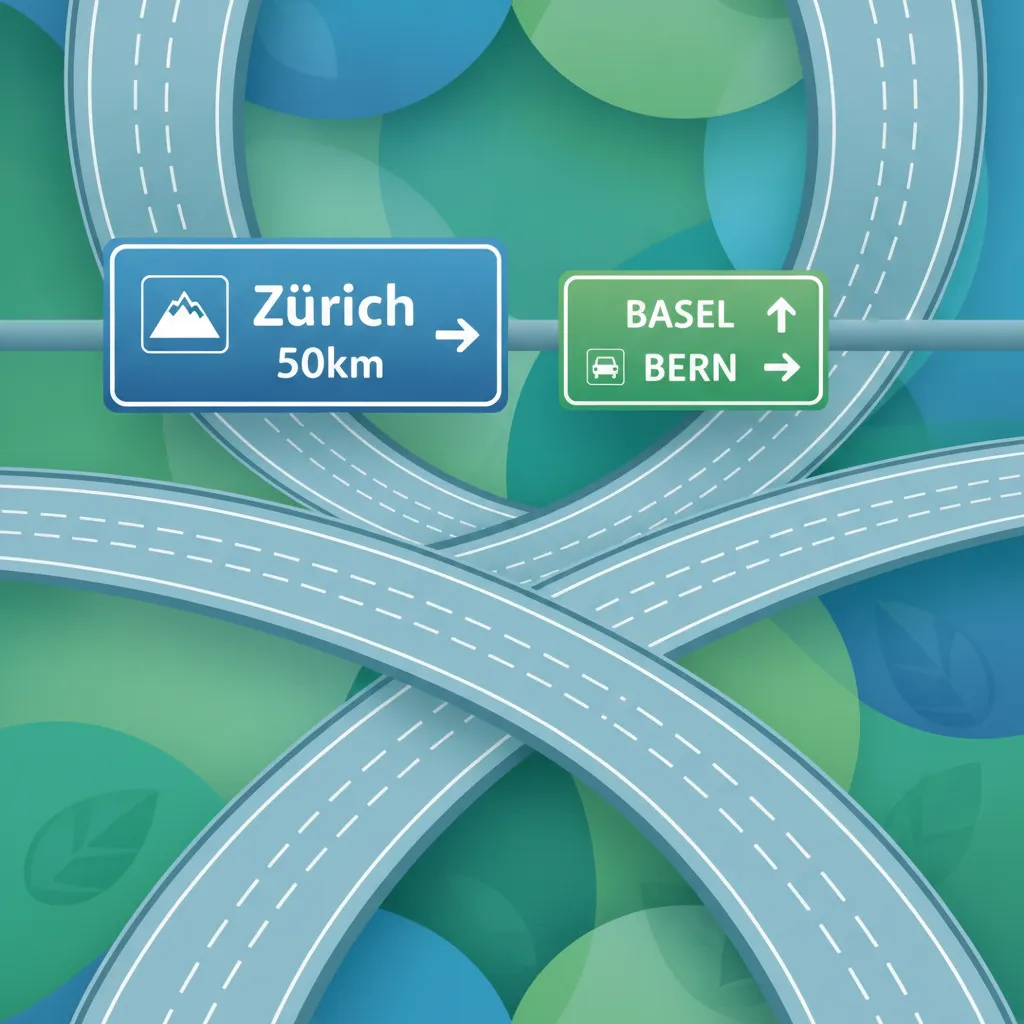
Lesson content overview
Navigating the diverse Swiss road network, from bustling cities to serene mountain passes, requires a thorough understanding of its unique signage system. This lesson delves into informational signs, which are crucial for route guidance, destination awareness, and identifying essential services. Unlike regulatory or warning signs, informational signs provide non-binding advice, aiding drivers in planning their journeys, making informed decisions, and ensuring efficient and safe navigation through unfamiliar or complex areas.
Understanding these signs is a cornerstone of safe driving in Switzerland, allowing you to anticipate upcoming junctions, plan necessary stops, and maintain situational awareness. This knowledge not only reduces stress but also significantly contributes to smoother traffic flow and accident prevention, forming an essential part of your preparation for the Swiss Category B theoretical exam.
Swiss informational signs operate on a set of core principles designed to provide clear, consistent, and actionable guidance to all road users. These principles ensure that drivers can quickly interpret the information presented, regardless of their language proficiency or familiarity with a specific route.
A fundamental aspect of informational signs is their non-regulatory nature. This means they do not impose legal obligations or prohibitions. Instead, they offer advice, suggestions, or factual information to assist drivers. For instance, a sign indicating a tourist attraction doesn't mandate a detour; it simply informs you of its presence. This distinction allows drivers the discretion to make choices based on their personal situation, such as their fuel level, time constraints, or travel plans. However, it is crucial to remember that while the information is advisory, ignoring critical guidance, such as an upcoming exit for your intended route, can lead to unsafe maneuvers or navigational errors.
Informational signs are vital for directional guidance, clearly pointing the way to various destinations, including cities, motorways, and specific points of interest. They use arrows, destination names, and often distance information to confirm you are on the correct path or to help you choose the right lane for an upcoming turn or exit. Proper interpretation of these signs ensures route continuity, preventing drivers from getting lost or making abrupt, last-minute lane changes that can disrupt traffic flow and increase collision risk.
The principle of distance indication is critical for effective journey planning. Signs often display distances in kilometres to various points, such as the next major city, motorway exit, or service area. This information allows drivers to anticipate their arrival times, manage fuel consumption, and schedule breaks efficiently. Accurate distance markers help drivers make timely decisions, avoiding situations like running out of fuel or missing a critical exit.
Service area identification signs are designed to inform drivers about upcoming facilities crucial for comfort, safety, and vehicle maintenance. These signs indicate the availability of petrol stations, rest areas, restaurants, and other amenities like toilets or parking. By providing advance notice, these signs enable drivers to plan their stops strategically, combatting fatigue, ensuring their vehicle is well-maintained, and preventing unscheduled pull-overs that might obstruct traffic.
Tourist information signs highlight cultural, historical, or natural attractions, scenic routes, and points of interest. They encourage safe exploration by guiding drivers to attractions without requiring sudden or dangerous diversions. These signs typically use a distinct brown background, helping drivers quickly identify them as advisory for leisure and sightseeing.
The use of standardized symbolism is a cornerstone of the Swiss signage system. Uniform symbols, colours, and shapes are employed across the entire country, ensuring instant recognition and comprehension regardless of a driver's language proficiency. This consistency significantly reduces the potential for misinterpretation, which is particularly beneficial for international visitors and in areas with diverse linguistic populations. Blue signs typically indicate route guidance, green signs denote services, and brown signs mark tourist attractions.
The Swiss road network employs several distinct categories of informational signs, each serving a specific purpose to aid drivers in their navigation and decision-making processes.
Directional signposts are perhaps the most common type of informational sign, providing direct guidance towards specific destinations. These signs often feature destination names, sometimes accompanied by distance information, and a clear arrow indicating the direction. They are strategically placed on main roads and, crucially, well in advance of junctions to give drivers ample time to react and position their vehicles correctly.
These signs are categorized into:
It is a common misunderstanding to assume that the nearest exit is always the best option for a specific destination. Drivers must pay close attention to the destination name and accompanying distance markers to ensure they are taking the correct route. On motorways, these signs are positioned at least 150 metres before an interchange, while on primary roads, they appear at least 100 metres before a junction. This advance placement is critical for allowing drivers to make safe and timely lane changes.
Distance markers, often referred to as milestones, are essential for gauging travel progress and planning. These signs indicate the distance in kilometres to a specific destination and are usually placed at regular intervals along motorways, expressways, and major routes.
Subcategories of distance markers include:
These markers are typically found on the left side of the carriageway, facing oncoming traffic, ensuring they are clearly visible. A common mistake is to interpret the distance as a precise measure of remaining travel time without considering variable factors like speed limits, traffic congestion, or road conditions. While distance is fixed, travel time is not, and drivers should constantly adjust their expectations.
Service area signs are crucial informational signs that alert drivers to upcoming facilities along the road network. These facilities include essential services such as petrol stations, rest areas, restaurants, and other amenities like toilets or parking. They are particularly important on highways and major routes, enabling drivers to plan necessary stops before their fuel runs low or fatigue sets in.
Types of service area signs include:
Service signs must clearly display the distance to the facility (e.g., “3 km”) and use standardized pictograms for quick recognition. A common misunderstanding is to assume that all rest areas offer all indicated services. Drivers should be aware that some rest areas might only provide basic facilities like parking and toilets, even if the sign includes a restaurant pictogram (it might refer to a restaurant further down the road, not directly at the rest stop). It is advisable to verify services upon arrival or consult a map if specific amenities are critical.
Tourist information signs are designed to highlight cultural, historical, or natural attractions, scenic routes, and other points of interest. These signs are advisory in nature and aim to guide visitors to attractions without disrupting main traffic flows or causing abrupt diversions.
Subcategories might include:
These signs are typically brown with white lettering or symbols. They are often placed near tourist destinations or along designated scenic routes. A key misunderstanding is interpreting these signs as mandatory routes; they are purely for information and drivers should plan any detours safely, adhering to all other traffic rules and lane discipline. Tourist signs should ideally be placed at least 100 metres before the point of interest and not within 5 metres of a junction to avoid causing distraction or confusion.
Route guidance signs are a sophisticated form of informational signage that often combines direction arrows, distance markers, and sometimes service information onto a single, comprehensive sign. These signs are particularly prevalent near motorway interchanges and major junctions where drivers need to make critical lane choices well in advance. Their purpose is to concisely guide drivers through complex road layouts, allowing them to anticipate lane changes and exit decisions.
These signs can be found as:
These signs are crucial for maintaining smooth traffic flow and preventing dangerous last-minute maneuvers. They must be placed at standardized distances before the decision point: typically 500–800 metres before a motorway exit and 200–300 metres before a primary road junction. A common error is overlooking the specific lane guidance on these signs, which can lead to drivers ending up in the wrong lane for their intended destination, especially at multi-lane exits.
The placement, design, and visibility of informational signs in Switzerland are strictly regulated by national laws, including the Swiss Road Traffic Act and the Ordinance on Signage (VSS-Norm 2-25, "Signalisationsnorm"). These regulations ensure uniformity, clarity, and safety across the entire road network.
| Regulation | Statement | Applicability | Legal Status | Rationale |
|---|---|---|---|---|
| Placement of Directional Signs | Directional signs must be placed at least 150 metres before a motorway interchange and 100 metres before a primary road junction. | Motorways, primary roads, major arterial routes | Mandatory | Provides drivers with sufficient reaction time to choose the correct lane or exit safely, reducing sudden maneuvers. |
| Visibility of Service Area Signs | Service area signs must be visible from both directions and positioned so the displayed distance is accurate. | All roads offering services | Mandatory | Prevents driver confusion and allows for accurate planning of stops for fuel, rest, or amenities. |
| Combination Sign Format | When directional and distance information are combined on a single sign, the distance must be displayed in kilometres and placed beneath the destination name. | Motorways, expressways, main routes | Mandatory | Ensures uniformity, readability, and immediate comprehension for all drivers, including international visitors. |
| Colour and Symbol Standardisation | Information signs must use prescribed colours (blue for route guidance, green for services, brown for tourist attractions) and symbols as per the Swiss Sign Standard (V2-25). | Nationwide | Mandatory | Consistency improves quick recognition and reduces misinterpretation, enhancing safety and efficiency. |
| Timing of Service Area Alerts | Service area signs must appear at least 5 kilometres before the service area for long-distance travel and at least 2 kilometres for short-distance journeys. | Motorways, long-distance routes | Mandatory | Allows adequate planning for fuel and rest, particularly important for heavy vehicles and preventing fatigue-related incidents. |
| Tourist Information Sign Placement | Tourist information signs should be placed at the roadside, at least 100 metres before the location of interest, and not within 5 metres of a junction. | Roads leading to tourist sites | Recommended (for safety) | Prevents driver distraction and confusion near complex traffic maneuvers or intersections. |
Always remember that distances displayed on signs are generally measured from the sign's location to the start of the indicated facility or exit.
Misinterpreting or ignoring informational signs can lead to unsafe driving situations, unnecessary detours, and increased stress. Awareness of common pitfalls can help drivers navigate the Swiss roads more effectively and safely.
The effectiveness of informational signs can be significantly influenced by various environmental and situational factors. Drivers must adjust their behaviour and reliance on these signs based on prevailing conditions.
While informational signs primarily guide vehicles, their context can involve vulnerable road users. For example, if a service area is located near a school zone, drivers must maintain reduced speeds and be extra vigilant for pedestrians. In tourist areas with high pedestrian traffic, route guidance signs must be obeyed without making sudden stops or turns near crossings, always prioritizing pedestrian safety.
Informational signs are not just navigational aids; they are integral components of the Swiss road safety system. Their design, placement, and content contribute significantly to reducing accidents and enhancing the overall driving experience.
Understanding and correctly interpreting informational signs is a fundamental skill for any driver in Switzerland, particularly for those preparing for the Category B theoretical exam. These non-regulatory signs are essential tools for navigating the diverse Swiss road network efficiently and safely.
By internalizing these principles and practices, you will not only pass your theoretical exam but also become a more confident, safe, and efficient driver on Swiss roads.
Explore all units and lessons included in this driving theory course.
Lesson content overview
Explore all units and lessons included in this driving theory course.
Explore search topics learners often look for when studying Information Signs and Route Guidance. These topics reflect common questions about road rules, driving situations, safety guidance, and lesson level theory preparation for learners in Switzerland.
Browse additional driving theory lessons that cover connected traffic rules, road signs, and common driving situations related to this topic. Improve your understanding of how different rules interact across everyday traffic scenarios.
Learn to interpret green service area signs for petrol stations and rest stops, and brown tourist signs for attractions. Understand how these signs aid in planning safe journeys and discovering Switzerland.

This lesson focuses on warning signs that alert drivers to potential hazards ahead, such as curves, steep descents, and roadwork zones. You will understand how these signs prompt anticipatory driving behavior, allowing for adjustments in speed and position. The content also discusses the typical placement of warning signs to help you react safely to changing conditions.
This lesson delves into supplementary signs that modify or clarify the meaning of primary traffic signs. You will learn to interpret signs indicating time restrictions, vehicle-specific limitations, and lane-specific instructions. The content also highlights how these signs interact with main regulatory signs to convey precise, context-sensitive traffic rules.

This lesson focuses on general driving safety in areas with a high concentration of children. It stresses the importance of significantly reducing speed, being prepared for unexpected events, and scanning for children between parked cars. The driver must exhibit maximum vigilance in these high-risk environments at all times.
This lesson explores the category of regulatory signs, which dictate permissible and prohibited actions for drivers. It covers speed limit signs, entry restrictions, and mandatory direction signs, explaining their legal significance. Emphasis is placed on recognizing the shapes and colours that distinguish these critical signs within the Swiss traffic system.

Urban driving requires heightened awareness and careful planning. This lesson covers the challenges of narrow streets, heavy traffic, and the need to identify designated loading and unloading zones. It emphasizes the importance of planning routes in advance to account for time-based access restrictions and to avoid unsuitable roads.
This lesson covers the various road surface markings that dictate lane usage, turning movements, and pedestrian zones. It explains the significance of solid versus broken lines, directional arrows, and specific markings for bike lanes. Understanding these markings is crucial for maintaining lane discipline and ensuring safe interactions in complex traffic environments.

Motorway driving involves high speeds and requires constant concentration. This lesson covers correct lane discipline, safe procedures for joining and leaving the motorway, and techniques for overtaking other large vehicles. Maintaining appropriate speed and a safe following distance is emphasized throughout.

Motorway driving requires constant concentration due to high speeds. This lesson emphasizes the importance of staying in the right-hand lane unless overtaking and the specific restrictions on lorry overtaking in Switzerland. It reinforces the need for a following distance of at least four seconds to compensate for the vehicle's long stopping distance and provides guidance on safely merging and exiting.

This lesson introduces the fundamental traffic signs that directly impact small vehicle riders. It covers the classification of signs into regulatory, warning, and mandatory categories, explaining how their shape and color indicate their function. Learners will be able to recognize and correctly interpret speed limits, priority signs, and other key information vital for safe navigation.

This lesson focuses on driving on mountain roads, addressing steep gradients, hairpin bends, and altitude-related challenges. You will learn proper techniques for climbing ascents and using engine braking on descents. The content also covers the use of snow chains, recognizing avalanche risks, and interpreting mountain road signs for safe alpine navigation.
Understand how blue directional and route guidance signs help navigate complex intersections, motorways, and multi-lane junctions in Switzerland. Learn to anticipate lane changes and plan your route effectively.
The size of a bus requires careful planning when negotiating complex intersections. This lesson teaches the importance of early lane selection, clear signalling, and comprehensive observation. It provides specific techniques for managing the vehicle's swept path through multi-lane roundabouts and other challenging urban junctions.
This lesson provides a detailed guide to navigating roundabouts, focusing on yielding to circulating traffic and correct lane usage. You will learn the priority principle that vehicles already in the roundabout have precedence over entering traffic. The content also covers multi-lane roundabout navigation and proper exit strategies for smooth, safe traversal.

This lesson explores the correct procedures for turning at intersections and navigating roundabouts, focusing on lane selection and signaling. It covers the right-of-way rules for right and left turns and the importance of positioning the vehicle correctly before the turn. In roundabouts, the content emphasizes yielding to circulating traffic and selecting the correct exit lane.
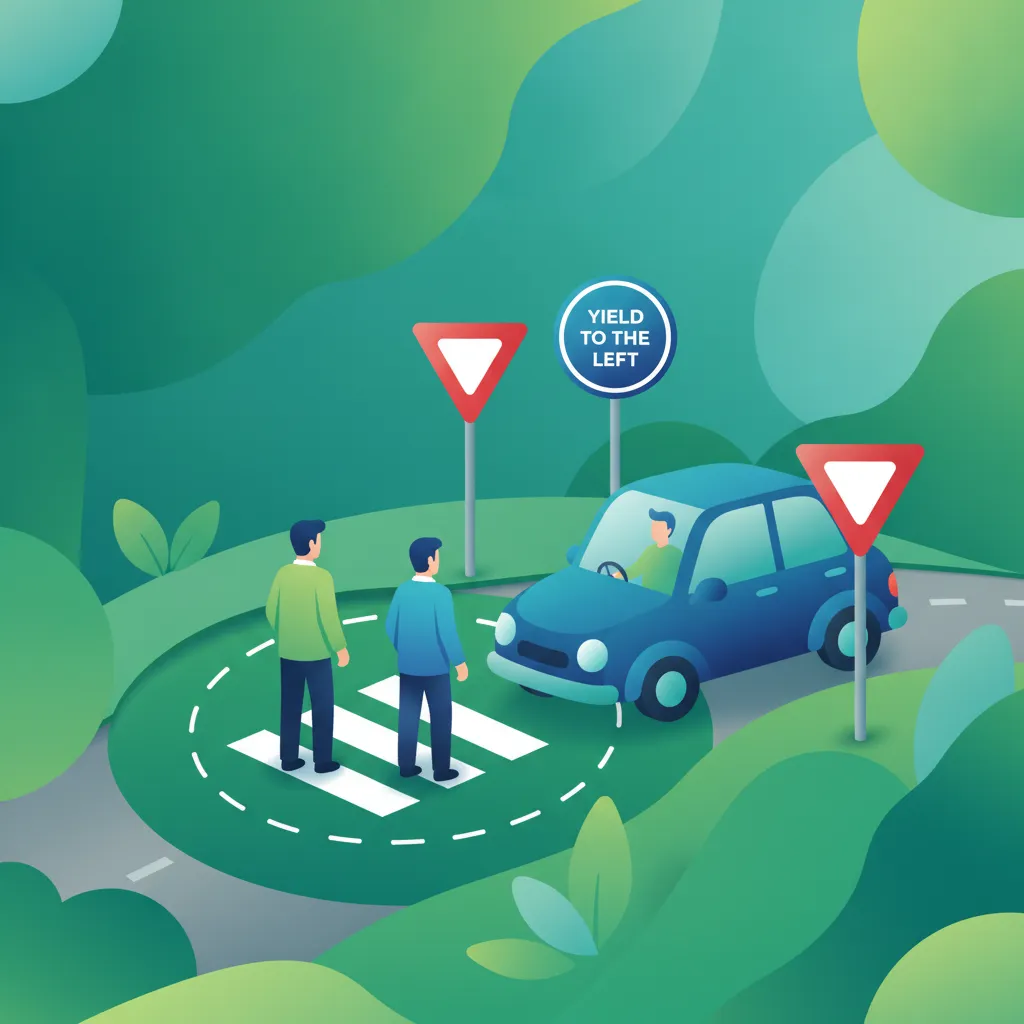
This lesson focuses specifically on the rules and techniques for navigating roundabouts. It clarifies that traffic already in the roundabout has priority and explains how to choose the correct lane on approach based on your intended exit. Proper signaling procedure for entering and, most importantly, exiting the roundabout is also detailed.

This lesson provides guidance on safely navigating roundabouts and tram lanes, common features in Swiss cities. It covers the rules for yielding, lane positioning within the roundabout, and signaling intentions upon exiting. Special attention is given to the hazards of crossing slippery tram tracks and sharing the road with public transport.

This lesson provides a step-by-step guide to navigating intersections. It reinforces the priority rules, such as 'Rechtsvortritt', and the meaning of yield and stop signs. The content emphasizes the importance of a thorough visual scan on approach and correct positioning to ensure visibility and a safe passage.
This lesson delves into supplementary signs that modify or clarify the meaning of primary traffic signs. You will learn to interpret signs indicating time restrictions, vehicle-specific limitations, and lane-specific instructions. The content also highlights how these signs interact with main regulatory signs to convey precise, context-sensitive traffic rules.
This lesson provides guidance on safely negotiating intersections and roundabouts on a motorcycle. It details the correct procedures for approach, lane selection, and yielding according to Swiss traffic regulations. Emphasis is placed on heightened awareness of other vehicles, cyclists, and pedestrians in these complex traffic environments.
This lesson focuses on warning signs that alert drivers to potential hazards ahead, such as curves, steep descents, and roadwork zones. You will understand how these signs prompt anticipatory driving behavior, allowing for adjustments in speed and position. The content also discusses the typical placement of warning signs to help you react safely to changing conditions.
This lesson explores the category of regulatory signs, which dictate permissible and prohibited actions for drivers. It covers speed limit signs, entry restrictions, and mandatory direction signs, explaining their legal significance. Emphasis is placed on recognizing the shapes and colours that distinguish these critical signs within the Swiss traffic system.
Find clear answers to common questions learners have about Information Signs and Route Guidance. Learn how the lesson is structured, which driving theory objectives it supports, and how it fits into the overall learning path of units and curriculum progression in Switzerland. These explanations help you understand key concepts, lesson flow, and exam focused study goals.
Regulatory signs are typically circular or have specific shapes that impose rules, whereas information signs are generally rectangular or square and provide guidance without imposing a strict command.
No, Swiss signs use colour coding to distinguish road types. For example, motorway signs are green, main road signs are blue, and local road signs are typically white or yellow.
While the exam focuses primarily on safety and rules, you may encounter questions about signs indicating service areas, hospitals, or transit points as they relate to safe driving decisions and route planning.
Being able to read these signs quickly prevents last-minute lane changes or dangerous maneuvers, which are common causes of driving errors during both the theory and practical parts of your licence acquisition.
Pinpoint specific Swiss traffic rules, road signs, or driving situations you need to master. Use the practice search to start a focused revision session now and build confidence for your official driving theory exam.