
Understanding how to correctly navigate roundabouts, known locally as glorietas, is a fundamental requirement for the Spanish driving theory test. This guide breaks down the legal obligations for priority, proper lane positioning, and signaling to help you avoid common exam traps and real-world accidents. Whether you are driving in urban or rural settings, these principles ensure you remain compliant with the Reglamento General de Circulación.
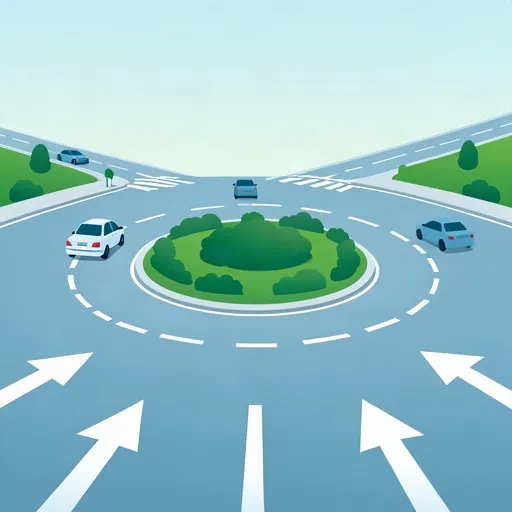
Article content overview
Navigating roundabouts, known in Spain as glorietas, is one of the most critical skills a driver must master for the DGT theory exam and for safe daily driving. While these intersections are designed to improve traffic flow, they remain the site of a significant number of accidents every year. According to statistics compiled by Automovilistas Europeos Asociados (AEA) using DGT data, between 2020 and 2024, thousands of incidents occurred at roundabouts, leading to hundreds of fatalities and tens of thousands of injuries. Understanding the specific legal framework governing these junctions is not only vital for passing your test but essential for reducing your personal risk on the road.
The most fundamental concept to grasp is the priority rule. In Spain, contrary to the general rule where vehicles approaching from the right have priority in unmarked intersections, the glorieta has a specific regulation. Vehicles already circulating inside the roundabout always have priority over those attempting to enter.
Vehicles already inside the roundabout must be granted priority of passage by any driver waiting to enter the intersection. Never force your entry if it compels a vehicle inside to brake or change speed, as this is a common reason for automatic failure in a practical driving test.
To successfully navigate a roundabout, you should view the maneuver as a three-stage process: entering, circulating, and exiting. Each stage requires specific attention to lane discipline, signaling, and speed management.
One of the most dangerous and common mistakes is attempting to exit a roundabout from an interior lane. In the DGT theory exam, you must remember that you should always position your vehicle in the rightmost lane before exiting. If you realize you are in an interior lane and cannot safely move to the outside, you must continue circling the roundabout until you can safely change lanes or try again.
Proper lane management is a frequent topic in the DGT theory exam. When a roundabout has multiple lanes, the rule is to use the interior lanes for circulation and the exterior lane for exiting. Signaling is a legal requirement that serves to communicate your intentions to other drivers and must be performed correctly to avoid confusion.
When you approach a roundabout, you must decide your exit path early. If you intend to take the first or second exit, staying in the right lane (the outer lane) is generally the safest and most standard practice. If you are taking a later exit, you may use inner lanes, but you must move to the outer lane well before your exit point.
The DGT includes questions about roundabouts to test your ability to synthesize several rules at once: priority, signaling, lane positioning, and observation. Many students fail because they do not understand that the law treats these intersections as distinct from standard road crossings. Recent data showing an 84% increase in rural roundabout accidents highlights that these maneuvers are not just theory exam concepts—they are real-world safety criticals.
Always remember that in the context of the Spanish theory exam, legal compliance and safety are synonymous. Never prioritize speed over the correct execution of a maneuver. If you are ever unsure of your position or if traffic density is too high to exit safely, it is far better to perform another full lap of the roundabout than to cut across lanes and risk a collision. Maintaining a calm, predictable, and rule-abiding driving style is the best way to ensure your success on the test and your safety on the road.
Spanish roundabouts (glorietas) require drivers to follow a specific legal framework where vehicles already circulating inside always have priority over those entering. The maneuver consists of three distinct stages—entry, circulation, and exit—each demanding proper lane discipline, signaling, and speed management. Lane positioning is critical: use the outer lane (carril exterior) for exiting and the inner lanes (carril interior) for circulating when taking later exits. Common exam and safety failures stem from misapplying standard intersection priority rules, exiting from incorrect lanes, and inadequate signaling. Mastering these principles is essential for both passing the DGT theory exam and ensuring real-world driving safety.
A short set of high-value points that capture the most important ideas from this article.
Vehicles already circulating inside a roundabout always have priority over those waiting to enter, regardless of the standard right-hand priority rule at unmarked intersections.
Roundabout navigation follows a three-stage process: entry, circulation, and exit, each requiring specific attention to speed, lane position, and signaling.
Always exit a roundabout from the outermost lane (carril exterior) to avoid crossing the paths of other vehicles.
Signal your intention to leave well in advance and move to the outer lane before your exit point.
If you are in the wrong lane to exit safely, continue circling rather than cutting across lanes to avoid a collision.
In Spain, roundabouts (glorietas) invert the normal right-of-way rule: traffic inside has priority over traffic entering.
The three stages are: entry (observe left, reduce speed, find a gap), circulation (maintain lane, stay aware), and exit (signal early, use outer lane).
Use inner lanes (carril interior) only for circulating through multiple exits; always move to the outer lane before exiting.
Ceda el paso (yield) signs are mandatory at all roundabout entries in Spain.
If you cannot safely exit from your current lane, complete another lap rather than force a dangerous lane change.
Assuming the standard right-hand priority rule applies inside a roundabout, when vehicles already inside always have priority.
Attempting to exit from an interior lane instead of moving to the outermost lane first.
Failing to signal when exiting, which prevents other drivers from anticipating your maneuver.
Entering the roundabout without sufficient gap, forcing vehicles inside to brake.
Getting stuck in the wrong lane and making a dangerous last-minute lane change to exit.
Article content overview
A short set of high-value points that capture the most important ideas from this article.
Vehicles already circulating inside a roundabout always have priority over those waiting to enter, regardless of the standard right-hand priority rule at unmarked intersections.
Roundabout navigation follows a three-stage process: entry, circulation, and exit, each requiring specific attention to speed, lane position, and signaling.
Always exit a roundabout from the outermost lane (carril exterior) to avoid crossing the paths of other vehicles.
Signal your intention to leave well in advance and move to the outer lane before your exit point.
If you are in the wrong lane to exit safely, continue circling rather than cutting across lanes to avoid a collision.
In Spain, roundabouts (glorietas) invert the normal right-of-way rule: traffic inside has priority over traffic entering.
The three stages are: entry (observe left, reduce speed, find a gap), circulation (maintain lane, stay aware), and exit (signal early, use outer lane).
Use inner lanes (carril interior) only for circulating through multiple exits; always move to the outer lane before exiting.
Ceda el paso (yield) signs are mandatory at all roundabout entries in Spain.
If you cannot safely exit from your current lane, complete another lap rather than force a dangerous lane change.
Assuming the standard right-hand priority rule applies inside a roundabout, when vehicles already inside always have priority.
Attempting to exit from an interior lane instead of moving to the outermost lane first.
Failing to signal when exiting, which prevents other drivers from anticipating your maneuver.
Entering the roundabout without sufficient gap, forcing vehicles inside to brake.
Getting stuck in the wrong lane and making a dangerous last-minute lane change to exit.
Explore related topics, search based questions, and concepts that learners often look up when studying Spanish Roundabout Rules. These themes reflect real search intent and help you understand how this topic connects to wider driving theory knowledge in Spain.
Find clear and practical answers to common questions learners often have about Spanish Roundabout Rules. This section helps explain difficult points, remove confusion, and reinforce the key driving theory concepts that matter for learners in Spain.
Vehicles already circulating inside the roundabout have priority over those attempting to enter. You must always yield to traffic already in the junction.
Generally, you should use the outermost lane to exit a roundabout. You should move to the outer lane well in advance of your exit while signaling your intention.
If you miss your exit or cannot change lanes safely due to traffic, do not force the maneuver. Continue around the roundabout for another circuit and try again when it is safe to do so.
Yes, you must signal your exit to inform other drivers of your intentions, following the same signaling rules as you would for any other road turn.
Now that you have found specific articles, continue to deepen your understanding by exploring related DGT regulations or other driving theory topics. Strengthen your knowledge of road signs, traffic scenarios, and essential Spanish driving procedures to prepare for your official driving license exam.