
Candidates preparing for the Spanish driving licence exam must clearly distinguish between the regulatory frameworks for Personal Mobility Vehicles (VMPs) and mopeds (ciclomotores). This article provides a comprehensive overview of speed limits, prohibited road types like motorways, and mandatory traffic behaviour as defined by the DGT. Mastering these distinctions is critical for accuracy in your theory test and essential for maintaining safety on public roads.
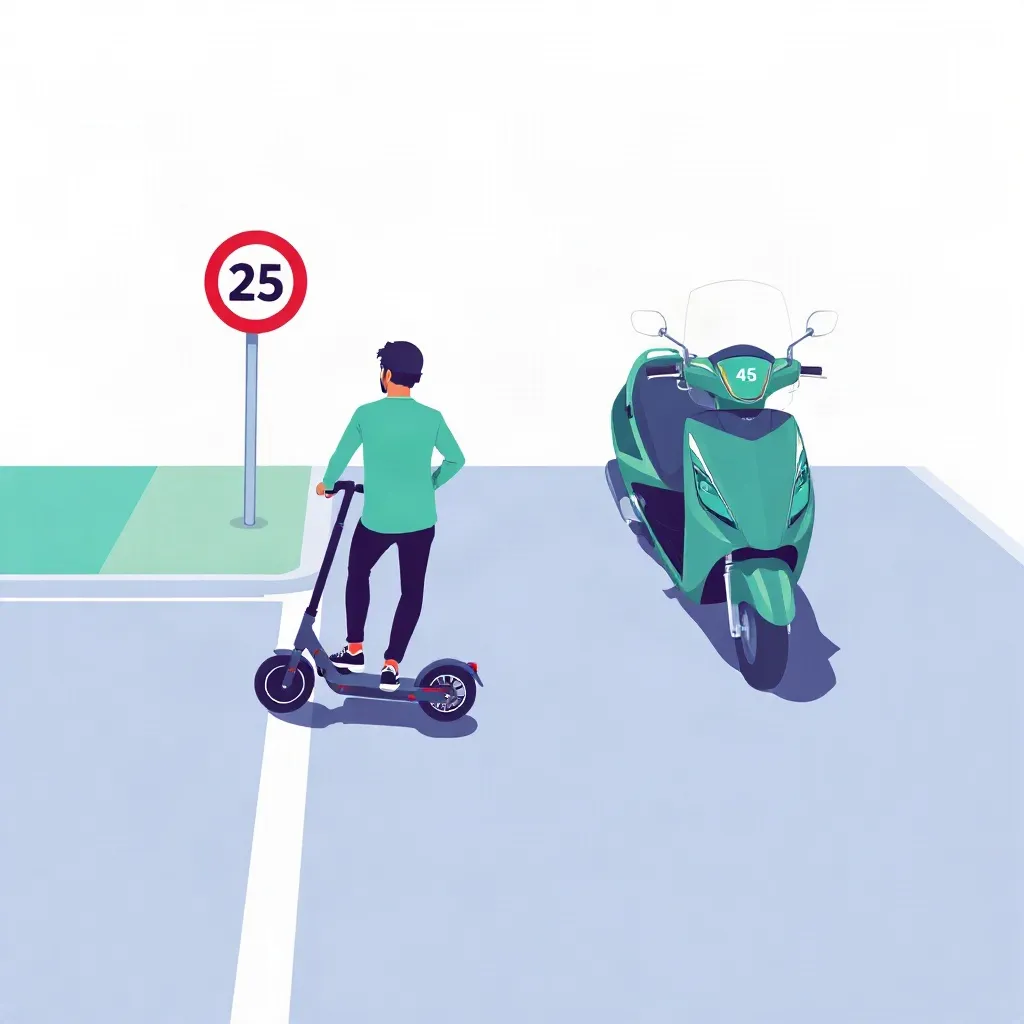
Article content overview
The landscape of urban mobility in Spain has undergone significant changes in recent years, particularly with the integration of Personal Mobility Vehicles (VMPs) alongside traditional mopeds. For candidates preparing for the DGT theory exam, distinguishing between these vehicle categories is not just a matter of terminology; it is a critical requirement for understanding road safety and avoiding common legal pitfalls. Whether you are navigating busy city streets or suburban roads, knowing the precise speed limits and prohibited zones for each vehicle type is essential for both your exam success and daily compliance with the Ley de Seguridad Vial.
A Personal Mobility Vehicle, or VMP, is defined by the DGT as a vehicle with one or more wheels, equipped with a single seat, and propelled exclusively by electric motors. To be classified as a VMP, the vehicle must be capable of reaching a maximum speed by design of between 6 and 25 km/h. It is important to note that this category explicitly excludes vehicles intended for persons with reduced mobility.
A VMP must have an electric motor, a maximum design speed between 6 and 25 km/h, and a single seating position. Any vehicle capable of exceeding 25 km/h is not classified as a VMP and may be subject to different, more stringent registration and licensing requirements.
One of the most frequent errors in the theory exam involves confusion regarding where these vehicles can circulate. By law, VMPs are strictly prohibited from using motorways (autopistas), dual carriageways (autovías), interurban roads, tunnels, and pedestrian zones. In urban areas, you must adhere to local municipal ordinances, which dictate specific paths or lanes. If no local ordinance exists, you are permitted to circulate on the urban road surface, but never on sidewalks.
Unlike VMPs, which are considered a relatively new category, mopeds (ciclomotores) have long been a fixture of the Spanish road network. A moped is defined as a two-wheeled vehicle with a combustion engine not exceeding 50 cubic centimeters, or a maximum design speed not exceeding 45 km/h. Four-wheeled vehicles under 350 kilograms can also fall into this category.
Attempting to "tune" or modify the engine or exhaust of a moped to increase its top speed is strictly illegal in Spain. Such modifications not only pose a severe safety risk to the rider and others but also result in significant fines and legal consequences. The DGT considers this a grave infraction.
Because of their design limitations, both VMPs and mopeds are subject to specific restrictions regarding the types of roads they can access. Neither vehicle type is permitted on motorways or dual carriageways. On conventional roads, they are generally required to use the shoulder (arcén) if it is safe and practicable to do so, ensuring they do not obstruct the flow of faster traffic while maintaining a high level of vigilance.
To succeed in your DGT theory test, you must memorize the generic speed limits that apply to these vehicles. While a motorcycle or a car may be permitted to reach much higher speeds, the law imposes strict caps on micro-mobility and low-powered vehicles to account for their reduced stability and fragility in the event of an impact.
| Vehicle Type | Maximum Speed Limit |
|---|---|
| Personal Mobility Vehicle (VMP) | 25 km/h |
| Moped (Ciclomotor) | 45 km/h |
| Motorcycle (Motocicleta) | Varies by road type (up to 120 km/h) |
A common exam trap is asking candidates to identify the speed limit of a motorcycle versus a moped. Remember: a moped is capped at 45 km/h, whereas a motorcycle is a standard motor vehicle subject to the generic limits of the road. Confusing these two will lead to an incorrect answer.
Violating these regulations is categorized by the DGT as either a grave (serious) or very grave infraction, depending on the circumstances. For instance, speeding with a moped is not treated lightly. Exceeding the limits leads to tiered fines. Furthermore, both VMP and moped riders are held to the same strict alcohol and drug limits as car drivers. Driving under the influence of prohibited substances while on a scooter or moped is an offence that carries heavy financial penalties and potential administrative sanctions.
Always maintain full awareness of your surroundings. Because these vehicles are smaller and less visible than cars, your responsibility as a rider is to prioritize safety, use proper signaling, and always respect the specific road markings and signage that govern your route.
Verify your route to ensure it does not include prohibited motorway sections.
Check the municipal ordinance for the specific town to confirm where VMPs are permitted.
Always use the shoulder (arcén) when circulating on conventional roads unless it is unsafe.
Ensure your vehicle is certified and not modified beyond its design specifications.
Maintain a speed that allows you to remain in full control, adapting to traffic and visibility conditions.
This article distinguishes two key low-speed vehicle categories for the DGT theory exam: Personal Mobility Vehicles (VMPs), which are electric-only and limited to 25 km/h, and mopeds (ciclomotores), which can have combustion engines up to 50cc and are capped at 45 km/h. Both categories are banned from motorways and dual carriageways, must use the road shoulder on conventional roads, and are subject to the same alcohol limits as car drivers. Modifying these vehicles beyond their certified specifications is a serious traffic offence. Learners should memorize the speed thresholds, understand where each vehicle type may circulate, and always verify local municipal ordinances for VMP rules.
A short set of high-value points that capture the most important ideas from this article.
VMPs (Personal Mobility Vehicles) are electric-only vehicles with a maximum design speed between 6 and 25 km/h and a single seating position.
Mopeds (ciclomotores) are limited to a maximum speed of 45 km/h and can have a combustion engine up to 50 cubic centimeters.
Both VMPs and mopeds are strictly prohibited from motorways (autopistas) and dual carriageways (autovías).
VMPs cannot use sidewalks unless a specific municipal ordinance explicitly permits it.
Modifying a moped or VMP beyond its certified design specifications is a serious infraction under Spanish traffic law.
VMP speed range is 6–25 km/h; anything capable of exceeding 25 km/h is classified differently.
A moped is capped at 45 km/h and may be two-wheeled or four-wheeled under 350 kg.
On conventional interurban roads, both vehicle types must use the arcén (shoulder) when available and safe.
Alcohol and drug limits for VMP and moped riders are identical to car driver limits.
Local municipal ordinances can add extra restrictions or permissions for VMPs in urban areas.
Confusing a moped (45 km/h) with a motorcycle, which is subject to the standard road speed limits applicable to motor vehicles.
Assuming VMPs can legally ride on sidewalks without checking if a local municipal ordinance permits it.
Forgetting that VMPs must be exclusively electric; a petrol-powered scooter exceeding 25 km/h does not qualify as a VMP.
Neglecting to verify route restrictions before riding, leading to unintentional motorway or autovía use.
Believing that tuning or modifying a moped's exhaust or engine to increase speed is a minor infraction; it is classified as a grave or muy grave violation.
Article content overview
A short set of high-value points that capture the most important ideas from this article.
VMPs (Personal Mobility Vehicles) are electric-only vehicles with a maximum design speed between 6 and 25 km/h and a single seating position.
Mopeds (ciclomotores) are limited to a maximum speed of 45 km/h and can have a combustion engine up to 50 cubic centimeters.
Both VMPs and mopeds are strictly prohibited from motorways (autopistas) and dual carriageways (autovías).
VMPs cannot use sidewalks unless a specific municipal ordinance explicitly permits it.
Modifying a moped or VMP beyond its certified design specifications is a serious infraction under Spanish traffic law.
VMP speed range is 6–25 km/h; anything capable of exceeding 25 km/h is classified differently.
A moped is capped at 45 km/h and may be two-wheeled or four-wheeled under 350 kg.
On conventional interurban roads, both vehicle types must use the arcén (shoulder) when available and safe.
Alcohol and drug limits for VMP and moped riders are identical to car driver limits.
Local municipal ordinances can add extra restrictions or permissions for VMPs in urban areas.
Confusing a moped (45 km/h) with a motorcycle, which is subject to the standard road speed limits applicable to motor vehicles.
Assuming VMPs can legally ride on sidewalks without checking if a local municipal ordinance permits it.
Forgetting that VMPs must be exclusively electric; a petrol-powered scooter exceeding 25 km/h does not qualify as a VMP.
Neglecting to verify route restrictions before riding, leading to unintentional motorway or autovía use.
Believing that tuning or modifying a moped's exhaust or engine to increase speed is a minor infraction; it is classified as a grave or muy grave violation.
Explore related topics, search based questions, and concepts that learners often look up when studying VMP and Moped Speed Limits. These themes reflect real search intent and help you understand how this topic connects to wider driving theory knowledge in Spain.
Find clear and practical answers to common questions learners often have about VMP and Moped Speed Limits. This section helps explain difficult points, remove confusion, and reinforce the key driving theory concepts that matter for learners in Spain.
The maximum speed limit for VMPs, such as electric scooters, is 25 km/h. Exceeding this speed through technical modification is illegal and subject to fines.
No, both VMPs and mopeds are strictly prohibited from circulating on motorways (autopistas and autovías) because they cannot reach the minimum speeds required for these roads.
The generic maximum speed limit for a moped (ciclomotor) is 45 km/h, regardless of the road type, provided they are permitted to circulate there.
Yes, modifying a VMP to exceed 25 km/h is illegal. Such actions are considered serious infractions, and the vehicle may be impounded or the owner heavily fined.
Now that you have found specific articles, continue to deepen your understanding by exploring related DGT regulations or other driving theory topics. Strengthen your knowledge of road signs, traffic scenarios, and essential Spanish driving procedures to prepare for your official driving license exam.