
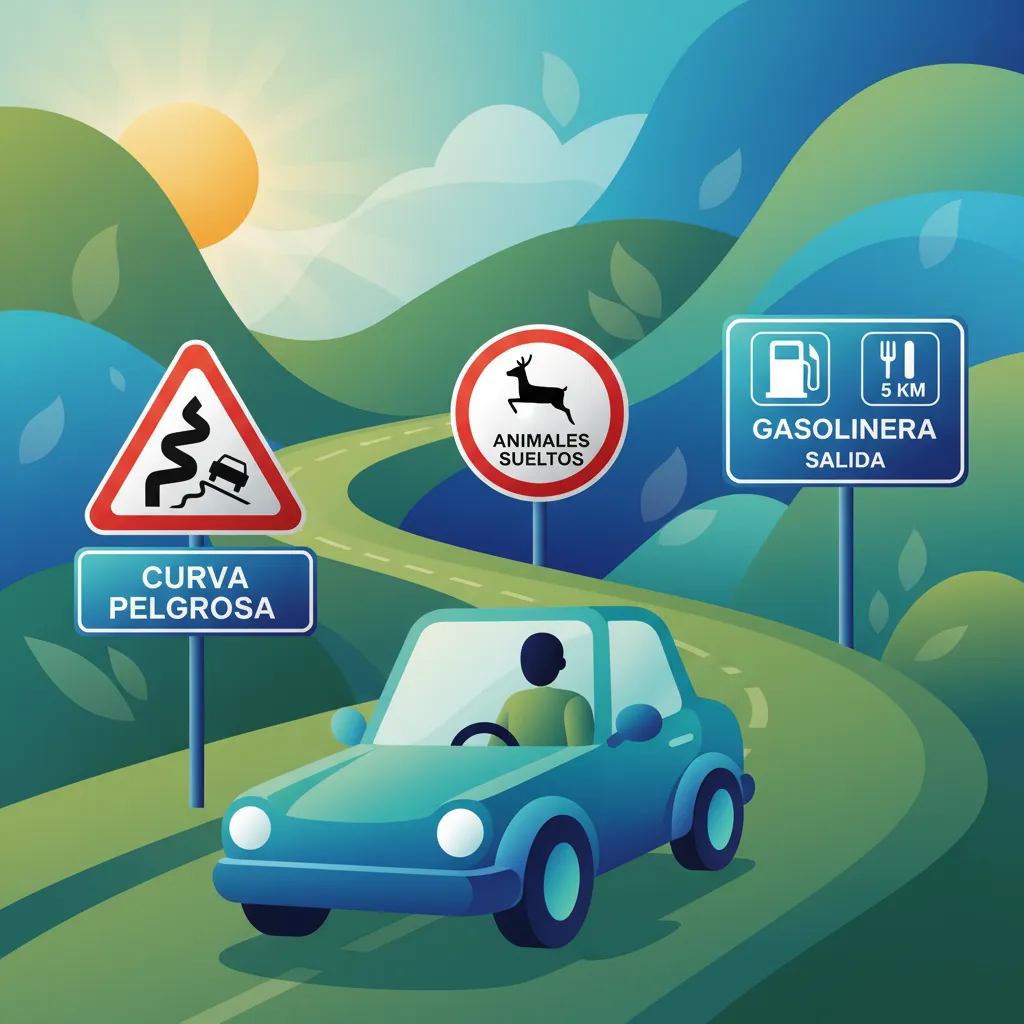
This lesson focuses on warning and informational road signs, crucial for anticipating hazards and navigating safely in Spanish urban areas. Understanding these signs is vital for your AM category theory exam and for making informed decisions on the road.
Lesson content overview
Road signs are a universal language for drivers, conveying critical information about the road ahead, potential hazards, and essential instructions. For moped riders operating under the Category AM license in Spain, a thorough understanding of these signs is not just a recommendation but a legal and safety imperative. This lesson delves into warning signs (often triangular) and informational signs (typically rectangular), explaining their distinct purposes and how to interpret them correctly to ensure safe and compliant riding on Spanish roads.
Recognizing and correctly interpreting road signs is fundamental to safe driving for all road users, including moped riders. These visual cues provide advance notice of upcoming conditions, allowing riders to anticipate hazards, plan their maneuvers, and adjust their speed and positioning proactively. Ignoring or misinterpreting signs can lead to dangerous situations, traffic violations, and potential accidents. For Category AM vehicles, which are more vulnerable in traffic due to their size and limited speed, early awareness provided by signs is even more critical for defensive riding and self-protection.
Road signs in Spain, like in most European countries, adhere to a standardized system designed for clarity and immediate comprehension. This system is built upon several core principles that ensure consistency and effectiveness, helping every rider, including those on mopeds, navigate the road network safely.
One of the foundational principles of road signage is the use of standardized shapes and colours to instantly categorize a sign's general meaning. Triangular signs with a red border and white background, for instance, are immediately recognized as warning signs, alerting to an upcoming hazard. Similarly, rectangular signs typically provide information or guidance. This rapid visual identification allows drivers to quickly grasp the sign's intent, reducing the time needed to process the information and react appropriately, which is vital for safe moped operation.
Warning signs are designed to communicate potential risks before they become visually apparent. This predictive hazard communication is crucial for moped riders, as it provides a valuable buffer to prepare for changes in road conditions, traffic flow, or environmental factors. By signaling dangers like sharp curves, slippery surfaces, or pedestrian crossings well in advance, these signs enable riders to pre-emptively reduce speed, adjust their lane position, or prepare for braking, significantly enhancing safety and preventing accidents.
Beyond warnings, rectangular informational signs serve to guide riders, provide directions, indicate distances, or offer supplementary data. This informational guidance supports effective route planning, helps in making timely decisions about lane changes, and assists in complying with various road rules. For moped riders, who often navigate urban environments, these signs are invaluable for understanding the road network, locating services, and ensuring they follow the correct path to their destination.
All road signs in Spain, as stipulated by the Reglamento General de Circulación (RGC), carry legal authority and are binding on all road users, including those operating Category AM vehicles. Disregarding a sign constitutes a traffic violation, which can lead to fines, demerit points on a driving license, or even more severe legal consequences in the event of an accident. The legal hierarchy of signs ensures uniform behaviour and maintains order and safety within the traffic flow.
While most road signs apply universally, certain signs or regulations have specific implications for mopeds due to their distinct characteristics (maximum speed of 45 km/h, smaller engine displacement, different road positioning rules). Moped riders must be particularly attentive to signs indicating speed limits, lane restrictions, or access prohibitions that may apply exclusively to Category AM vehicles. Recognizing when a sign applies specifically to mopeds ensures compliance and prevents dangerous situations arising from misapplication of general rules.
Triangular warning signs are perhaps the most critical category of signs for hazard anticipation. Their distinctive shape and colour scheme are designed for immediate recognition, allowing riders to prepare for potential dangers ahead.
Warning signs in Spain are easily identifiable by their equilateral triangular shape, with a red border, a white background, and a black or white symbol in the centre. The triangle always points upwards. These signs do not command an action but rather alert the rider to an upcoming hazard that requires heightened attention and often an adjustment in speed or riding technique. Moped riders must understand that these warnings are just as crucial for them as for larger vehicles.
Warning signs cover a broad spectrum of potential dangers, categorized to make their interpretation clear and consistent.
These signs alert riders to changes in the road's alignment or elevation that could pose a risk if approached at an inappropriate speed.
Upon seeing a sign for a sharp curve, a moped rider must reduce speed well in advance, ensuring they can safely navigate the turn without losing control. Similarly, signs indicating steep ascents or descents warn riders to prepare for changes in engine strain or braking requirements.
These warnings relate to the physical state of the road surface or structure.
A "Slippery Road" sign (P-26), for example, demands extra caution, particularly for mopeds with smaller tires and lighter weight, which have less contact patch with the road. Riders should reduce speed, avoid sudden braking or acceleration, and maintain a greater following distance. Other signs might indicate a narrowing road, loose gravel, or speed bumps, all requiring a responsive adjustment in riding.
Signs indicating the presence of vulnerable road users are particularly important in urban areas where mopeds frequently operate.
These signs (P-20, P-22a) prompt riders to be extra vigilant, reduce speed, and be prepared to stop or yield. The presence of these signs means pedestrians or cyclists are likely to be crossing the road, even if not immediately visible.
Less common but equally important are signs warning of animal crossings, often found in rural or semi-rural areas.
Other general warning signs, such as those indicating "Roadworks" or "Other Dangers," require a broad assessment of the situation and a cautious approach.
The practical meaning of a warning sign is a directive to anticipate and adapt. For a moped rider, this often translates into reducing speed, covering the brakes, adjusting lane position, and scanning for the specific hazard indicated. Common misunderstandings include assuming the sign applies only to cars, or not reducing speed sufficiently, particularly for hazards like steep descents or winding roads. Remember, a moped's dynamics differ from cars; what might be a minor inconvenience for a car could be a significant hazard for a moped.
Always reduce your speed before reaching the hazard indicated by a warning sign, not as you enter it. This pre-emptive action is critical for maintaining control, especially on a moped.
While warning signs alert to dangers, rectangular informational signs provide guidance, directions, and supplementary data, helping riders plan their routes and make informed decisions.
Informational signs in Spain are typically rectangular (either vertical or horizontal) and come in various background colours, though often with a white background and black symbols or text for general information, or blue/green backgrounds with white text for directions on major roads. Unlike regulatory or warning signs, they primarily inform rather than command, though the information they provide often aids in adhering to other regulations.
Informational signs serve a wide range of purposes, categorized to streamline navigation and rider assistance.
These are crucial for navigation, indicating upcoming turns, destinations, and often the number of the road.
For moped riders, understanding these signs is essential for making timely lane changes and avoiding missed turns, especially in complex urban intersections or when transitioning to roads where mopeds might be restricted.
Signs providing distances help riders gauge their journey and prepare for exits or junctions.
These signs allow for adequate time to signal, check mirrors, and safely position the moped for an exit or a turn. Ignoring them can lead to sudden, unsafe maneuvers.
Some informational signs provide context or clarification to regulatory signs. For example, a sign might indicate the "End of Speed Limit" previously imposed, or mark the beginning or end of a specific zone. While informational, these signs help riders comply with the true boundaries of regulations.
Signs indicating services like parking areas, fuel stations, hospitals, or rest stops are designed for convenience and planning long journeys. Although mopeds have smaller fuel tanks, knowing the location of a fuel station can prevent running out of petrol.
Informational signs offer actionable data. For a moped rider, this means using destination signs to plan lane choices in advance, employing distance signs to prepare for timely exits, and utilizing service signs to locate necessary facilities. A common misunderstanding is to ignore temporary informational signs (e.g., for detours), or to mistake advisory directional signs for mandatory turns, leading to unnecessary route changes. Always confirm with other navigation cues if unsure.
While informational signs are not typically legally binding in themselves, the actions you take based on the information (e.g., a lane change for an exit) must still comply with all applicable traffic laws and safe driving practices.
Beyond general warning and informational signs, certain signage elements specifically impact moped riders. Understanding these is vital for legal and safe operation of Category AM vehicles.
While mopeds have a general maximum speed limit, specific signs might reduce this further, especially in residential zones, school areas, or shared spaces. These signs often feature the speed limit number (e.g., 30 km/h) accompanied by a moped or scooter icon, clearly indicating their specific applicability.
Moped riders must adhere strictly to these posted limits, even if their vehicle is technically capable of higher speeds or if the general speed limit for cars is higher. Ignoring these tailored limits can result in fines and increased risk to vulnerable road users.
Many regulatory signs (circular signs, often with red borders for prohibitions or blue backgrounds for mandatory actions) dictate actions or restrictions that directly apply to mopeds.
Prohibitory signs, such as "No Entry for Mopeds" (R-106), are critical. Entering a prohibited area not only risks a fine but also endangers the rider and others, as these restrictions are often in place for safety (e.g., pedestrian zones, motorways). Mandatory signs, like "Turn Left Only" (R-301 series with an arrow), must be obeyed to maintain predictable traffic flow and prevent collisions.
Temporary signs are used to indicate short-term changes due to roadworks, accidents, or special events. In Spain, these signs typically have a yellow background with black symbols or text. They carry the same legal weight as permanent signs while they are in effect.
Moped riders must treat temporary signs with equal importance, adapting their speed and route as directed. Ignoring a temporary speed reduction or lane shift in a construction zone can be extremely dangerous. Once the temporary condition is over, permanent signs resume their authority.
The Reglamento General de Circulación (RGC) is the primary legal framework governing all aspects of traffic in Spain, including the interpretation and obedience of road signs. Understanding these articles is fundamental for every moped rider.
This article unequivocally states that all drivers, without exception, must obey all road signs. This applies across the entire Spanish road network and to all vehicle categories, including AM vehicles. Failure to comply directly contributes to traffic chaos and significantly increases accident risk.
Disobeying any road sign is a violation of the RGC and can result in legal penalties, regardless of whether it leads to an immediate incident.
Article 64.2 of the RGC stipulates that speed limits indicated by signs must be observed. In the absence of specific signage, the default speed limit for mopeds is 45 km/h in urban areas. Mopeds are generally prohibited from roads designed for faster traffic, such as motorways (autovías and autopistas), and may face restrictions on other rural roads depending on their characteristics. It is crucial for moped riders to understand that 45 km/h is their absolute maximum legal speed, and they must adhere to any lower posted limits.
This article makes it clear that prohibitory signs, which forbid certain actions or access, must be obeyed. Violating a prohibitory sign, such as entering a "No Entry for Mopeds" zone, constitutes a traffic offense. These signs are often implemented to protect vulnerable users, manage specific traffic flows, or prevent vehicles from entering unsuitable areas.
Mandatory signs, which indicate compulsory actions (e.g., "Turn Left Only"), are legally binding under Article 73. Failure to comply with these signs disrupts predictable traffic flow and significantly raises the risk of collisions. Moped riders must follow mandatory directions to ensure their safety and the safety of others.
Article 57 establishes that temporary signs, typically identified by their yellow background, have the same legal authority as permanent signs while they are in effect. This is critical for construction zones or areas with temporary road changes. Moped riders must respond to these signs with the same diligence as permanent ones, adjusting their speed and route accordingly to navigate temporary hazards safely.
While informational signs provide valuable guidance, Article 81 clarifies that they are generally advisory and not enforceable unless coupled with a specific mandatory or prohibitory sign. For example, a sign indicating the distance to an exit is informational. However, if that exit requires a specific lane change, the rules governing safe lane changes (which may be mandatory) still apply. Riders should use informational signs for planning but understand they do not, on their own, impose a legal command.
Even with a good understanding of road signs, certain situations can lead to common errors or present difficult scenarios for moped riders.
The interpretation and application of road signs are not static; they must be adapted based on prevailing conditions and specific contexts.
In adverse weather conditions like rain, fog, or strong winds, warning signs such as Slippery Road (P-26) demand an even greater reduction in speed due to reduced tyre friction and limited visibility. At night, reflective signs are essential, and moped riders must ensure their headlamps provide adequate illumination to spot signs early. Reduced visibility necessitates more caution and earlier reaction to all signs.
The type of road influences how signs are presented and interpreted. On urban streets, warning and informational signs appear more frequently due to the higher density of hazards, intersections, pedestrians, and varied speed limits. On rural roads, signs might be spaced further apart, but the hazards (e.g., Wild Animals P-33, sharp, unbanked curves) can be more severe. Moped riders must adjust their scanning and reaction times accordingly.
A heavily loaded moped will have longer stopping distances and potentially altered handling characteristics. Adherence to warning signs, particularly those indicating sharp curves or steep descents, becomes even more critical, requiring earlier speed reduction and more cautious maneuvering. Understanding your moped's specific capabilities under different loads is crucial for safe riding.
The design and legal enforcement of road signs are rooted in fundamental principles of human perception, vehicle dynamics, and public safety.
Understanding these key terms is crucial for any Category AM rider preparing for the Spanish driving exam and for safe riding:
Let's consider some real-world scenarios to solidify the understanding of warning and informational signs.
Setting: You are riding your moped on a winding rural road in dry weather.
Sign: You see a triangular warning sign with a red border and a black arrow curving sharply to the left (P-1b).
Correct Behavior: You immediately ease off the throttle, gently apply the brakes to reduce your speed before entering the curve, and position your moped appropriately for the turn, maintaining a smooth line.
Incorrect Behavior: You maintain your current speed, only braking sharply as you enter the curve, risking loss of traction and control.
Explanation: The warning sign gives you time to prepare. Reducing speed proactively ensures you manage centrifugal forces effectively, keeping your moped stable and safe through the bend.
Setting: You are entering a quiet residential area in a Spanish town. Sign: You see a rectangular speed limit sign showing "30" with a small moped icon below it. Correct Behavior: You immediately slow your moped to ensure your speed does not exceed 30 km/h, even if your moped can go faster or if the general urban limit is 45 km/h. Incorrect Behavior: You continue riding at 45 km/h, assuming the sign is for cars or that your general moped limit applies. Explanation: This category-specific sign overrides the default speed limit for mopeds. These lower limits are often in place to protect children and residents, and to reduce noise pollution. Failure to comply can result in a fine.
Setting: You are on a multi-lane urban avenue, planning to take an upcoming exit. Sign: You see a rectangular blue informational sign indicating "Salida 500 m" (Exit 500 m). Correct Behavior: You check your mirrors, signal your intention, and safely move into the correct lane for the exit well in advance of the 500-meter mark, ensuring a smooth transition. Incorrect Behavior: You ignore the sign, stay in the wrong lane until the last moment, and then attempt a sudden, abrupt lane change to make the exit. Explanation: The distance sign provides crucial planning time. Early and deliberate action based on this information prevents dangerous last-minute maneuvers that can lead to collisions.
Setting: You are approaching a section of road where construction is underway. Sign: You see a yellow background sign indicating "Obras - Reducir Velocidad a 30 km/h" (Roadworks - Reduce Speed to 30 km/h) and a temporary lane shift. Correct Behavior: You immediately reduce your speed to 30 km/h, stay alert for workers and equipment, and follow the temporary markings for the lane shift, exercising extra caution. Incorrect Behavior: You continue at your normal speed, ignoring the yellow sign, and cut across the construction zone, endangering workers and yourself. Explanation: Temporary signs, especially those for roadworks, have the same legal authority as permanent ones. They are put in place to ensure safety in dynamic and potentially hazardous environments.
Mastering warning and informational signs is a cornerstone of safe and legal moped riding in Spain. It involves a systematic approach to observation, interpretation, and adaptation.
By diligently practicing these principles, moped riders can significantly enhance their safety, ensure legal compliance, and contribute to a smoother, more predictable traffic flow for everyone on Spanish roads.
This lesson covers the two main categories of non-regulatory road signs for moped riders in Spain: triangular warning signs (red border, white background) that alert to hazards like sharp curves, slippery surfaces, and pedestrian crossings, and rectangular informational signs (various colors) that provide navigation guidance and distances. Warning signs require immediate preemptive action such as speed reduction, while informational signs support route planning. Temporary yellow signs hold equal legal weight to permanent signs. All road signs are legally binding under the RGC, and moped riders must adhere to category-specific speed limits that may be lower than the default 45 km/h urban limit.
A short set of high-value points that capture the most important learning from this lesson.
Triangular warning signs with red borders and white backgrounds alert riders to upcoming hazards and require preemptive speed reduction
Rectangular informational signs provide guidance, directions, and distances to help with route planning
Temporary road signs (yellow background) carry the same legal authority as permanent signs while in effect
Moped-specific speed limit signs override the default 45 km/h limit and must be obeyed strictly
All road signs in Spain are legally binding under the RGC, and violations carry penalties
Explore all units and lessons included in this driving theory course.
Sharp curve signs (P-1a/P-1b) demand significant speed reduction BEFORE entering the curve, not as you enter it
Slippery road signs (P-26) require extra caution as mopeds have smaller contact patches and are more vulnerable
A 'No Entry for Mopeds' sign (R-106) prohibits access entirely; entering risks fines, demerit points, and danger
Informational signs are advisory only unless combined with a mandatory or prohibitory sign
Temporary yellow signs for roadworks must be treated with the same diligence as permanent signs
Maintaining speed through sharp curve or slippery road warnings instead of reducing speed proactively
Ignoring moped-specific speed limit signs (e.g., 30 km/h zones) and riding at the default 45 km/h limit
Confusing temporary detour signs with permanent route changes or ignoring temporary speed reductions in construction zones
Failing to follow mandatory turn signs, potentially causing near-collisions or obstructing traffic flow
Mistaking informational distance signs for regulatory commands, leading to unnecessary braking or inappropriate actions
Lesson content overview
A short set of high-value points that capture the most important learning from this lesson.
Triangular warning signs with red borders and white backgrounds alert riders to upcoming hazards and require preemptive speed reduction
Rectangular informational signs provide guidance, directions, and distances to help with route planning
Temporary road signs (yellow background) carry the same legal authority as permanent signs while in effect
Moped-specific speed limit signs override the default 45 km/h limit and must be obeyed strictly
All road signs in Spain are legally binding under the RGC, and violations carry penalties
Explore all units and lessons included in this driving theory course.
Sharp curve signs (P-1a/P-1b) demand significant speed reduction BEFORE entering the curve, not as you enter it
Slippery road signs (P-26) require extra caution as mopeds have smaller contact patches and are more vulnerable
A 'No Entry for Mopeds' sign (R-106) prohibits access entirely; entering risks fines, demerit points, and danger
Informational signs are advisory only unless combined with a mandatory or prohibitory sign
Temporary yellow signs for roadworks must be treated with the same diligence as permanent signs
Maintaining speed through sharp curve or slippery road warnings instead of reducing speed proactively
Ignoring moped-specific speed limit signs (e.g., 30 km/h zones) and riding at the default 45 km/h limit
Confusing temporary detour signs with permanent route changes or ignoring temporary speed reductions in construction zones
Failing to follow mandatory turn signs, potentially causing near-collisions or obstructing traffic flow
Mistaking informational distance signs for regulatory commands, leading to unnecessary braking or inappropriate actions
Explore search topics learners often look for when studying Warning and Informational Signs. These topics reflect common questions about road rules, driving situations, safety guidance, and lesson level theory preparation for learners in Spain.
Browse additional driving theory lessons that cover connected traffic rules, road signs, and common driving situations related to this topic. Improve your understanding of how different rules interact across everyday traffic scenarios.
Understand the vital role of triangular warning signs and rectangular informational signs in Spanish traffic law. Learn to interpret symbols and colours to anticipate hazards and navigate safely on the road. Essential theory for your AM category license.

This lesson introduces the regulatory signs that impose obligations or prohibitions on road users, with a focus on those pertinent to mopeds. It covers common signs such as speed limits, 'no entry', and mandatory turn directions, explaining how their shape and color indicate their function. Learners will be able to identify and correctly interpret these signs to navigate urban road networks legally and safely, avoiding potential fines.

This lesson clarifies the technical classification of mopeds under Spanish law, differentiating them from motorcycles based on engine displacement not exceeding 50cc and specific power limits. It explains how these specifications impact vehicle categorization, registration, and permissible road speed. The content also covers how electric mopeds fit within the same legal framework and the implications for their use on public roads.

This lesson outlines the compulsory equipment and documentation required for an AM-class vehicle. It emphasizes the legal mandate for an approved helmet, a valid insurance policy, and a vehicle registration plate. Learners will also understand the requirements for the roadworthiness certificate (ITV) and other essential documents needed to prove compliance with DGT safety and legal standards during a traffic stop.
This lesson outlines the mandatory lighting and visibility equipment as per DGT regulations. It covers the correct use of headlights (low and high beams), taillights, and turn signals, ensuring the moped is visible to others, especially at night or in poor weather. The importance of wearing high-visibility or reflective clothing is also emphasized as a critical measure to enhance personal safety by making the rider more conspicuous.
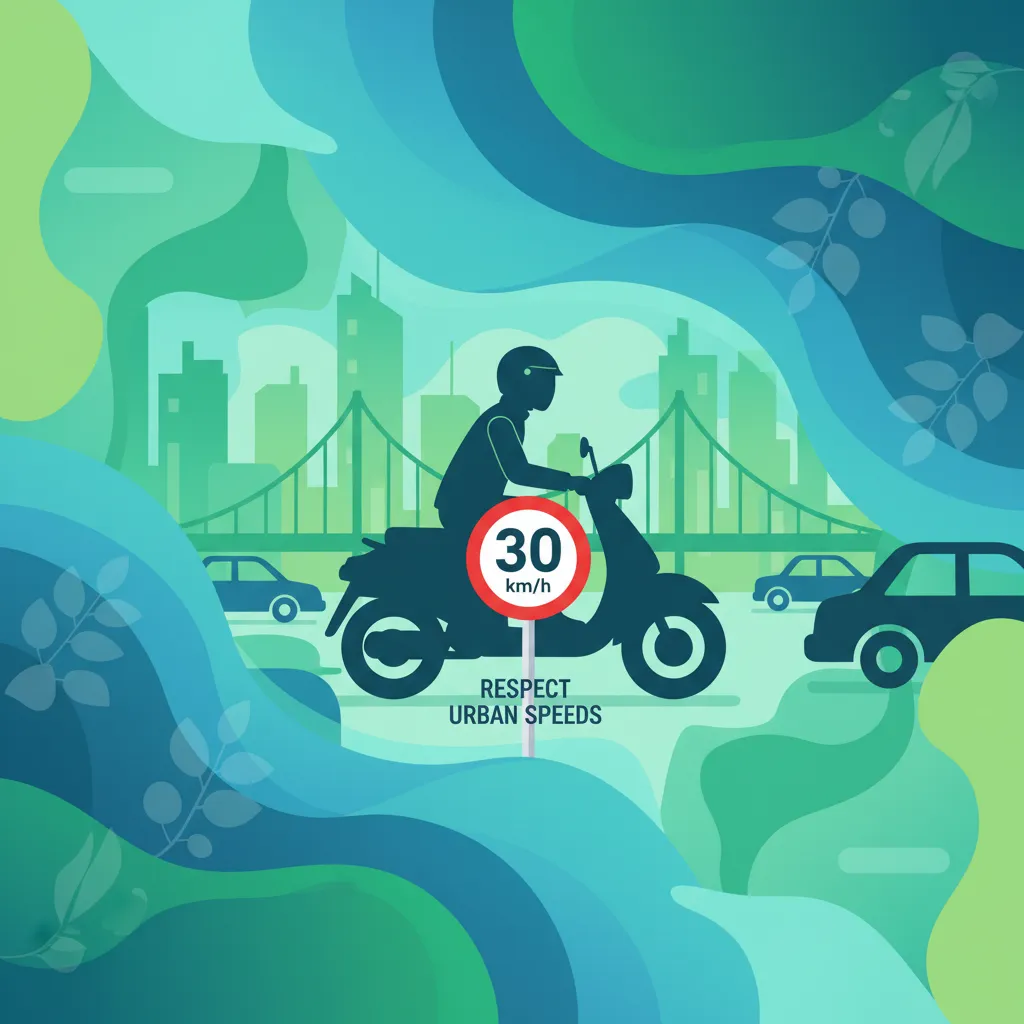
This lesson details the specific speed limits applicable to mopeds within Spanish urban areas, such as the 30 km/h limit on single-lane roads and the 50 km/h limit on roads with two or more lanes per direction. It teaches learners to identify speed zone signage and understand the legal rationale behind these restrictions. Adhering to these DGT-mandated limits is crucial for safety and avoiding penalties.

This lesson focuses on the optimal position for a moped within a traffic lane to maximize visibility and safety. It discusses the importance of maintaining a safety buffer from other vehicles and hazards, particularly the risk posed by the doors of parked cars. The content explains how to use lane positioning strategically to discourage unsafe overtaking and to be clearly seen by drivers in front and behind, especially when approaching intersections.

This lesson introduces the visual language of road markings, focusing on the distinction between solid and broken lines and what they permit regarding lane changes and overtaking. It explains the meaning of directional arrows painted on the road surface, which guide drivers into the correct lane for their intended maneuver. Understanding these markings is crucial for maintaining proper lane discipline and navigating complex intersections and multi-lane roads.

This lesson provides a detailed guide to safely starting a moped, from the ignition sequence to the coordinated use of the throttle and brakes. It explains the importance of a pre-ride checklist to verify lights and controls are functional. The content also covers techniques for achieving smooth acceleration from a standstill and performing controlled stops, which is crucial for managing stop-and-go urban traffic conditions.

This lesson teaches riders the critical importance of maintaining a safe following distance to allow for adequate reaction and braking time. It explains practical methods for judging this distance, such as the 'two-second rule,' and how this gap must be increased in adverse weather or poor visibility. Understanding this principle is fundamental to preventing rear-end collisions, one of the most common types of traffic accidents.

This lesson details the environmental regulations affecting mopeds, including limits on exhaust emissions and noise levels. It explains the concept of low-emission zones (ZBE/LEZ) in major Spanish cities and the requirement for an environmental sticker to gain access. Learners will also be introduced to eco-driving principles, such as smooth acceleration and avoiding unnecessary idling, to minimize fuel consumption and pollution.
Explore how warning and informational signs are applied in real-world Spanish driving scenarios for mopeds. Understand specific interpretations for urban roads, rural routes, and various weather conditions, focusing on safe application.
This lesson introduces the regulatory signs that impose obligations or prohibitions on road users, with a focus on those pertinent to mopeds. It covers common signs such as speed limits, 'no entry', and mandatory turn directions, explaining how their shape and color indicate their function. Learners will be able to identify and correctly interpret these signs to navigate urban road networks legally and safely, avoiding potential fines.
This lesson introduces the visual language of road markings, focusing on the distinction between solid and broken lines and what they permit regarding lane changes and overtaking. It explains the meaning of directional arrows painted on the road surface, which guide drivers into the correct lane for their intended maneuver. Understanding these markings is crucial for maintaining proper lane discipline and navigating complex intersections and multi-lane roads.
This lesson details the specific speed limits applicable to mopeds within Spanish urban areas, such as the 30 km/h limit on single-lane roads and the 50 km/h limit on roads with two or more lanes per direction. It teaches learners to identify speed zone signage and understand the legal rationale behind these restrictions. Adhering to these DGT-mandated limits is crucial for safety and avoiding penalties.
This lesson clarifies the technical classification of mopeds under Spanish law, differentiating them from motorcycles based on engine displacement not exceeding 50cc and specific power limits. It explains how these specifications impact vehicle categorization, registration, and permissible road speed. The content also covers how electric mopeds fit within the same legal framework and the implications for their use on public roads.

This lesson explains each phase of a Spanish traffic light, detailing the specific action required for red, amber, and green signals. It clarifies the meaning of a flashing amber light, which indicates yielding to other traffic or pedestrians, and the red-amber combination. Understanding these signals is fundamental for safely navigating controlled intersections and ensuring compliance with traffic flow rules established by the DGT.
This lesson focuses on the optimal position for a moped within a traffic lane to maximize visibility and safety. It discusses the importance of maintaining a safety buffer from other vehicles and hazards, particularly the risk posed by the doors of parked cars. The content explains how to use lane positioning strategically to discourage unsafe overtaking and to be clearly seen by drivers in front and behind, especially when approaching intersections.
This lesson outlines the mandatory lighting and visibility equipment as per DGT regulations. It covers the correct use of headlights (low and high beams), taillights, and turn signals, ensuring the moped is visible to others, especially at night or in poor weather. The importance of wearing high-visibility or reflective clothing is also emphasized as a critical measure to enhance personal safety by making the rider more conspicuous.
This lesson focuses on the specific signage systems used in rural and highway environments in Spain. It explains how to interpret directional signs, exit numbering, distance markers, and signs for services like fuel and rest areas. Understanding these signs is crucial for effective navigation and safe driving at high speeds.

This lesson focuses on the absolute priority of pedestrians at marked crosswalks, often known as zebra crossings. It explains that riders must always be prepared to stop and yield the right-of-way to any pedestrian waiting to cross or already crossing. The content also covers signaled pedestrian crossings and general awareness in urban areas where pedestrians may cross unexpectedly, reinforcing safety and legal compliance.

This lesson clarifies the primary rule for roundabouts: all vehicles entering must yield to traffic already on the circular roadway. It explains how to approach a roundabout, select the appropriate lane based on the intended exit, and merge safely into the flow of traffic. Proper signaling before exiting is also covered, ensuring other drivers can anticipate the rider's movements for a smooth and safe negotiation of the junction.
Find clear answers to common questions learners have about Warning and Informational Signs. Learn how the lesson is structured, which driving theory objectives it supports, and how it fits into the overall learning path of units and curriculum progression in Spain. These explanations help you understand key concepts, lesson flow, and exam focused study goals.
In Spain, triangular warning signs alert you to potential hazards ahead, like sharp curves or pedestrian crossings, requiring you to be cautious. Rectangular informational signs, on the other hand, provide guidance, such as directions, distances, or road numbers, helping you navigate your route effectively. Both are essential for safe moped riding and passing your theory exam.
Yes, AM category riders should pay close attention to warning signs indicating slippery surfaces (like 'road may be slippery'), sharp curves, pedestrian crossings, or areas with increased bicycle traffic. These signs are crucial for anticipating and avoiding common urban hazards.
Informational signs help you plan your journey by showing distances to towns, indicating specific lanes for different destinations, or identifying low-emission zones. For moped riders, this means you can better position yourself and anticipate upcoming traffic situations based on the guidance provided.
Absolutely. The Spanish DGT theory exam for the AM category includes multiple-choice questions specifically designed to test your understanding of various road signs, including warning and informational types. Mastering these is key to a successful exam outcome.
Always err on the side of caution and assume the warning sign is relevant. Road conditions can change rapidly, and the sign is there to alert you to a potential, perhaps hidden, danger. If you're unsure, reduce speed and proceed with extreme care.
Use our powerful search functionality to pinpoint specific Spanish DGT driving theory practice sets. Filter by road sign categories, traffic law topics, or question difficulty to build custom study sessions and reinforce your knowledge precisely where it matters for your official exam.